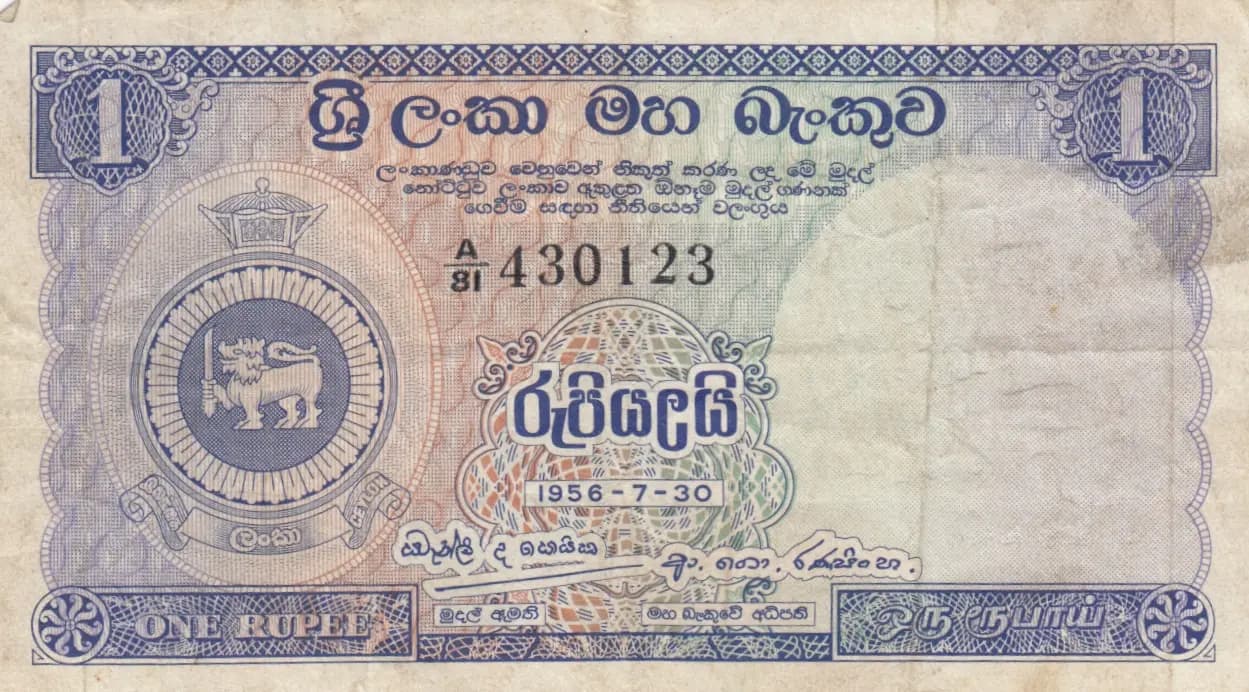
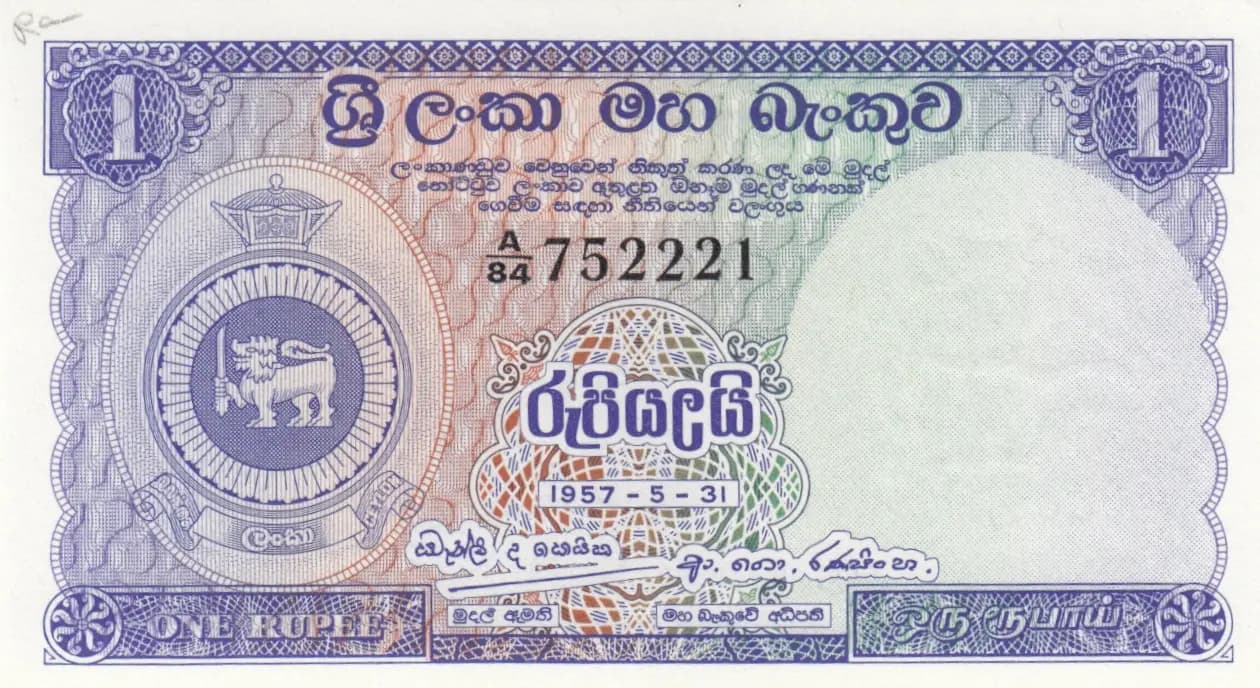
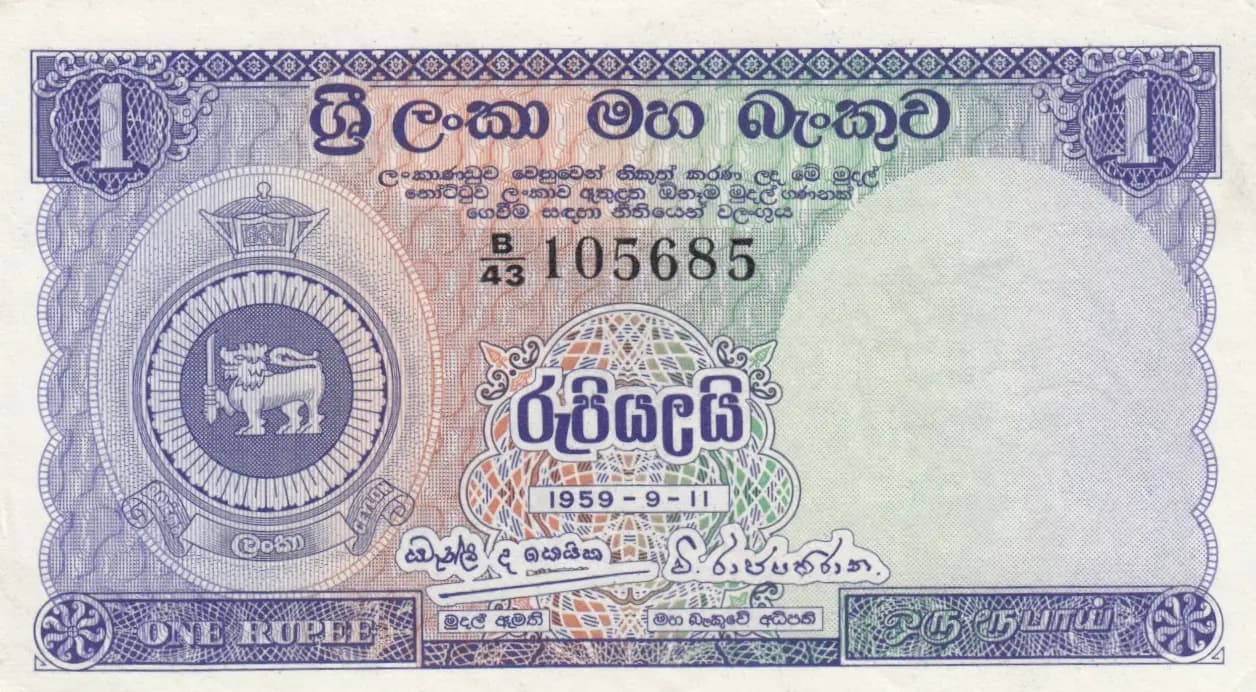
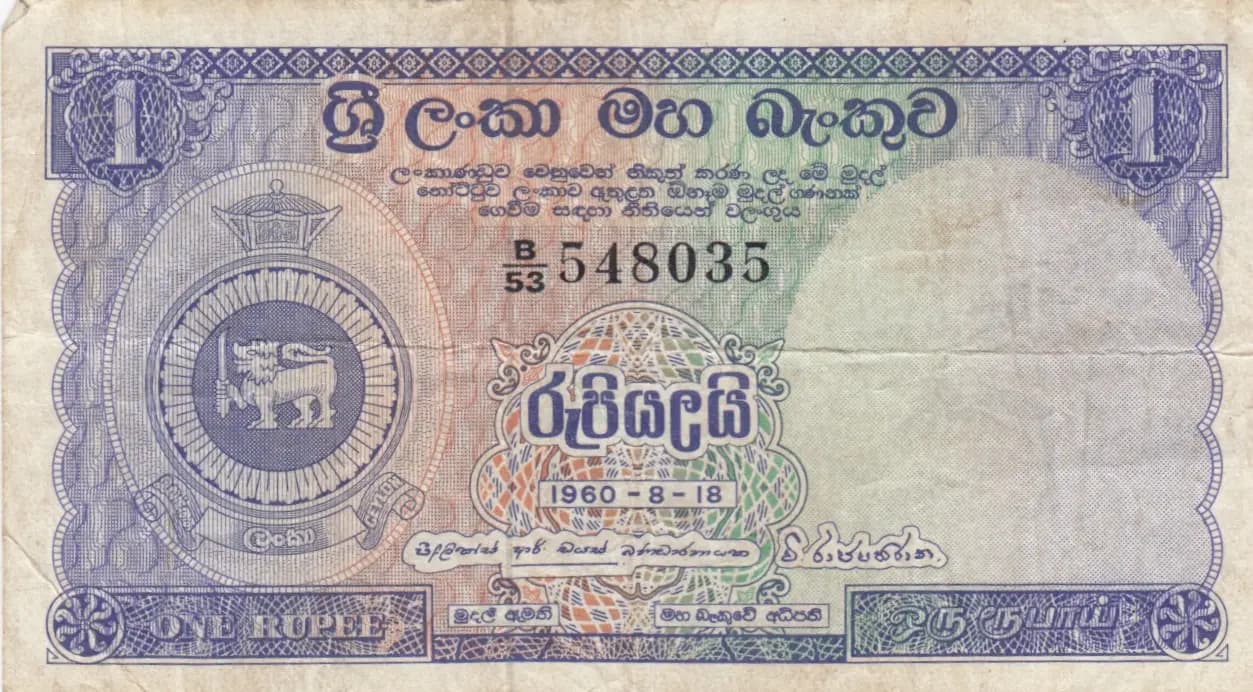
1 rupee 1958
About This Note
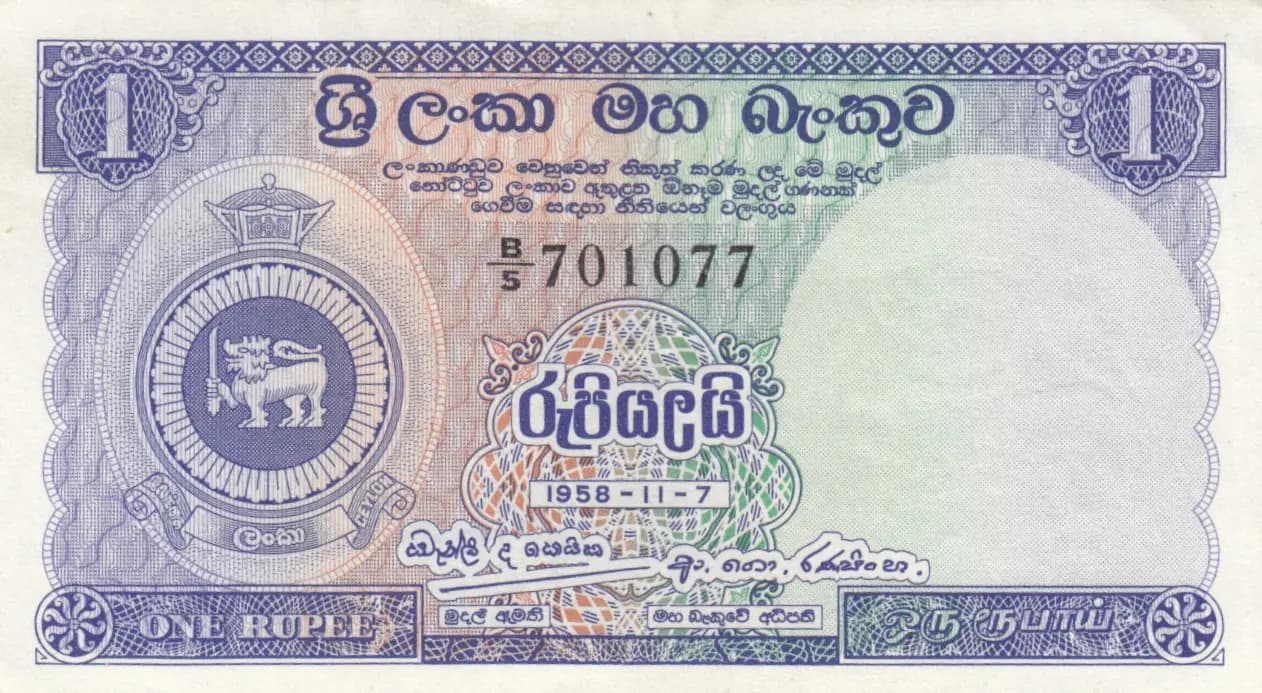
This is a well-preserved example of Sri Lanka's 1 rupee note from 1958, issued by the Central Bank of Ceylon and printed by the prestigious Bradbury Wilkinson security printer. The note displays excellent condition with crisp printing, vibrant purple-blue coloring on the obverse featuring the Sri Lankan lion emblem, and an architectural reverse depicting a significant Buddhist temple structure. The serial number B/5 7010077 and the specific date of November 7, 1958 are clearly visible, making this an identifiable specimen from the early post-independence period of Ceylon.
Common. This is a standard circulation note from a long series (Pick 56, with variants spanning 1956-1963) issued by the Central Bank of Ceylon in significant quantities. The EF condition grade and survival of this note is not unusual, as 1 rupee notes from this period were produced in large numbers and many examples have been preserved. No specific print run limitations, recalls, or special circumstances suggest rarity. This note would typically be readily available to collectors at modest prices.
This note was issued during the formative years of independent Ceylon (Sri Lanka), just eight years after independence in 1948, when the Central Bank was establishing its currency identity. The choice to feature the national lion emblem on the obverse and what appears to be a Buddhist temple (likely the Temple of the Tooth at Kandy, a major pilgrimage site) on the reverse reflects the cultural and religious significance of Buddhism in Ceylon's national identity during this period. The use of Sinhala script alongside English demonstrates the nation's assertion of its local language following independence from British rule.
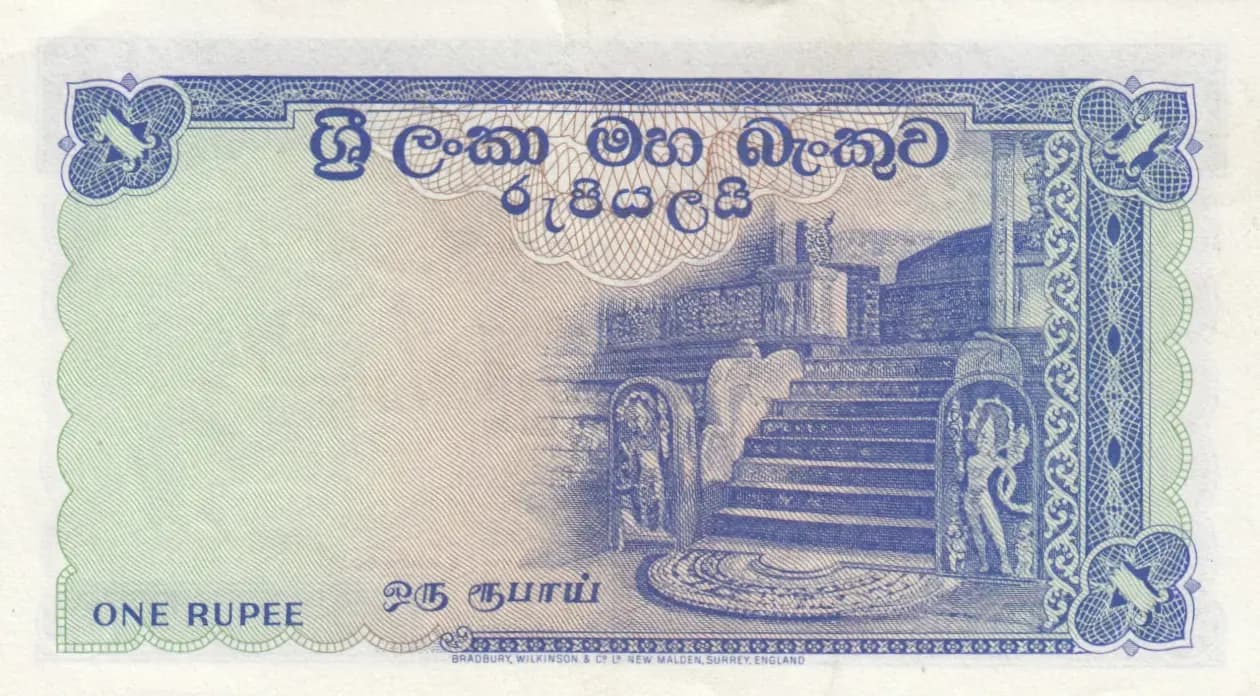
The obverse features the Lion of Sri Lanka (Sinhalese Lion), the national emblem of Ceylon, enclosed within a circular ornamental frame positioned center-left. This lion emblem is one of the most important national symbols and appears prominently on the flag and state seal. The reverse depicts an ornate multi-tiered building with stepped architectural design and columned portico, which represents a significant Buddhist temple, likely the Temple of the Tooth at Kandy (Dalada Maligawa), one of Buddhism's most sacred sites in Ceylon. Both sides are framed by intricate guilloche border patterns and decorative corner ornaments typical of high-security banknote design. The color scheme of purple-blue, green, cream, and subtle pink-orange gradients creates visual interest while maintaining the dignified appearance appropriate for the lowest denomination of the currency.
Front side: 'ශ්රී ලංකා මධ්ය බැංකුව' (Sinhala) = 'Central Bank of Sri Lanka'; 'ශ්රී ලංකා' (Sinhala) = 'Sri Lanka'; 'ONE RUPEE' (English); Serial number 'B/5 7010077'; Date '1958-11-7' (November 7, 1958). Reverse side: 'ශ්රී ලංකා මධ්ය බැංකුව' (Sinhala) = 'Central Bank of Sri Lanka'; 'බුද්ධගය' (Sinhala) = 'Buddhagaya' or reference to a Buddhist temple site; 'ONE RUPEE' (English); 'BRADBURY, WILKINSON & CO LTD NEW MALDEN, SURREY ENGLAND' = Printer attribution.
Intaglio engraving (line engraving and steel plate printing), as evidenced by the fine detailed line work visible in the guilloche patterns, the precise architectural details on the reverse, and the sharp, crisp impression characteristic of security printing. The note was produced by Bradbury Wilkinson & Co Ltd of New Malden, Surrey, England, one of the world's foremost security printers of the era, known for their expertise in high-security banknote production using traditional intaglio methods.
This specimen is Pick 56b, representing a specific variant within the 1956-1963 1 rupee series. The serial number prefix 'B/5' and the specific date of November 7, 1958 help identify this as a particular printing batch. Varieties within this Pick number are typically distinguished by serial number prefixes, watermark variations, and signature varieties. Without additional reference materials on specific signature varieties and printing run allocations for this issue, further precise variety identification would require comparison with other documented specimens of the same series.