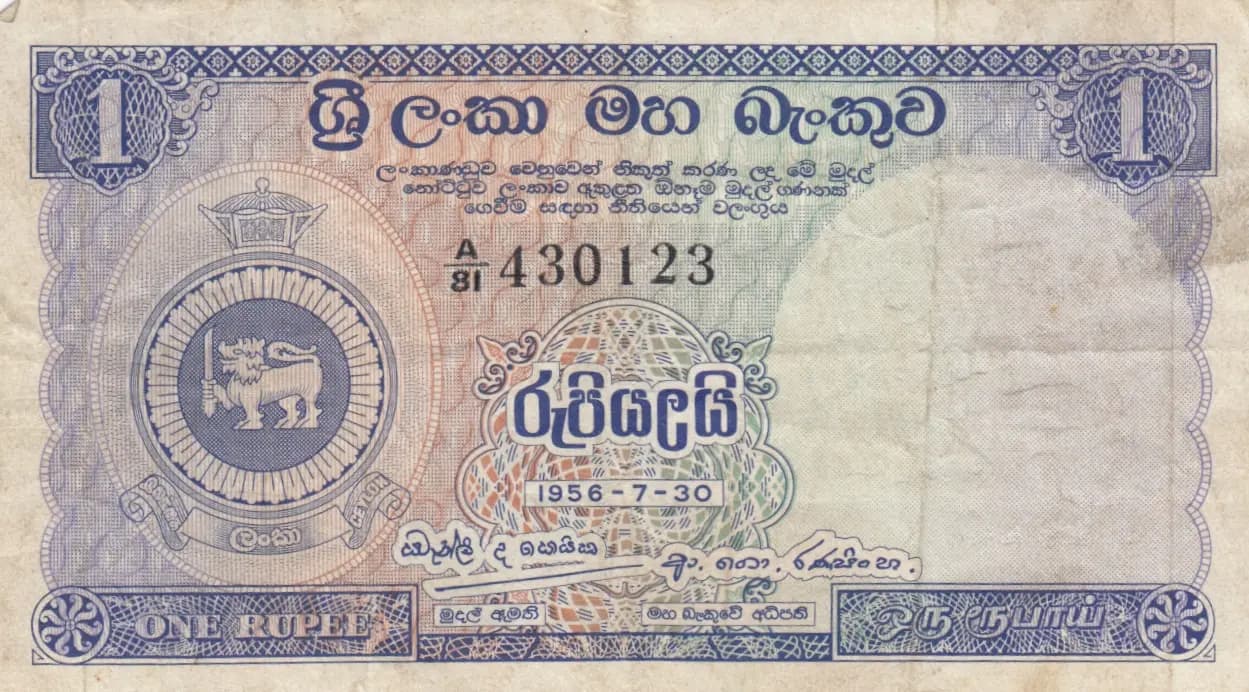
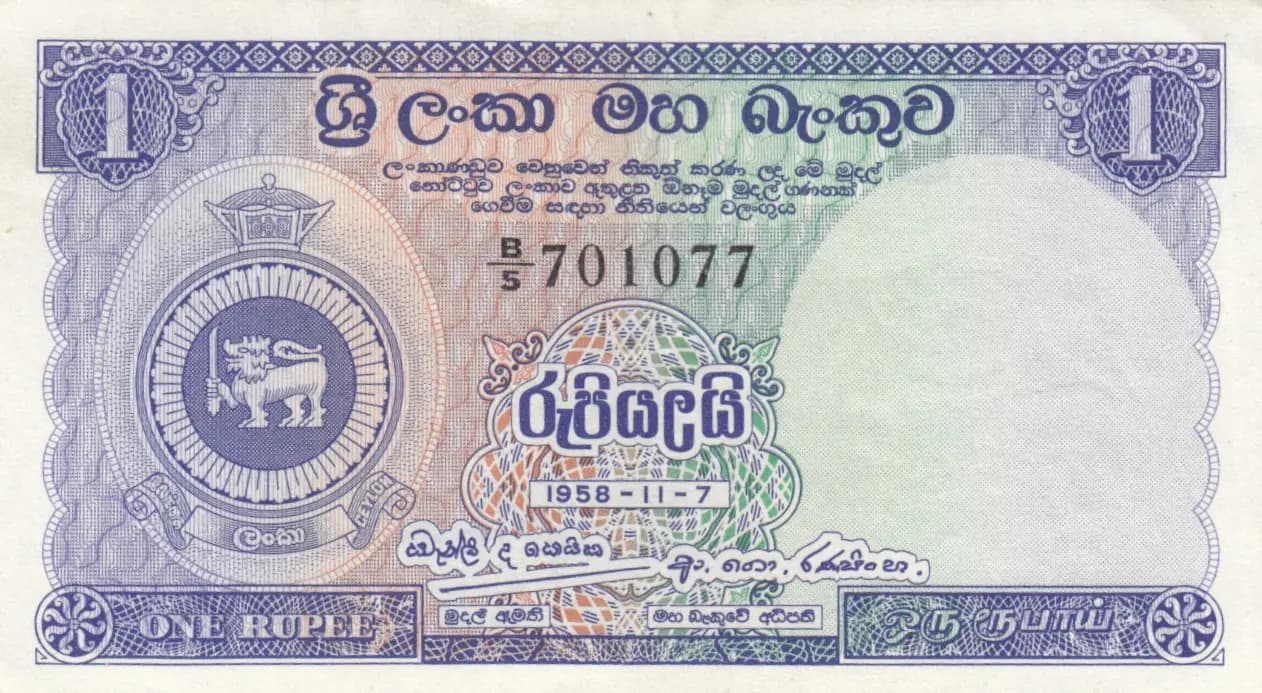
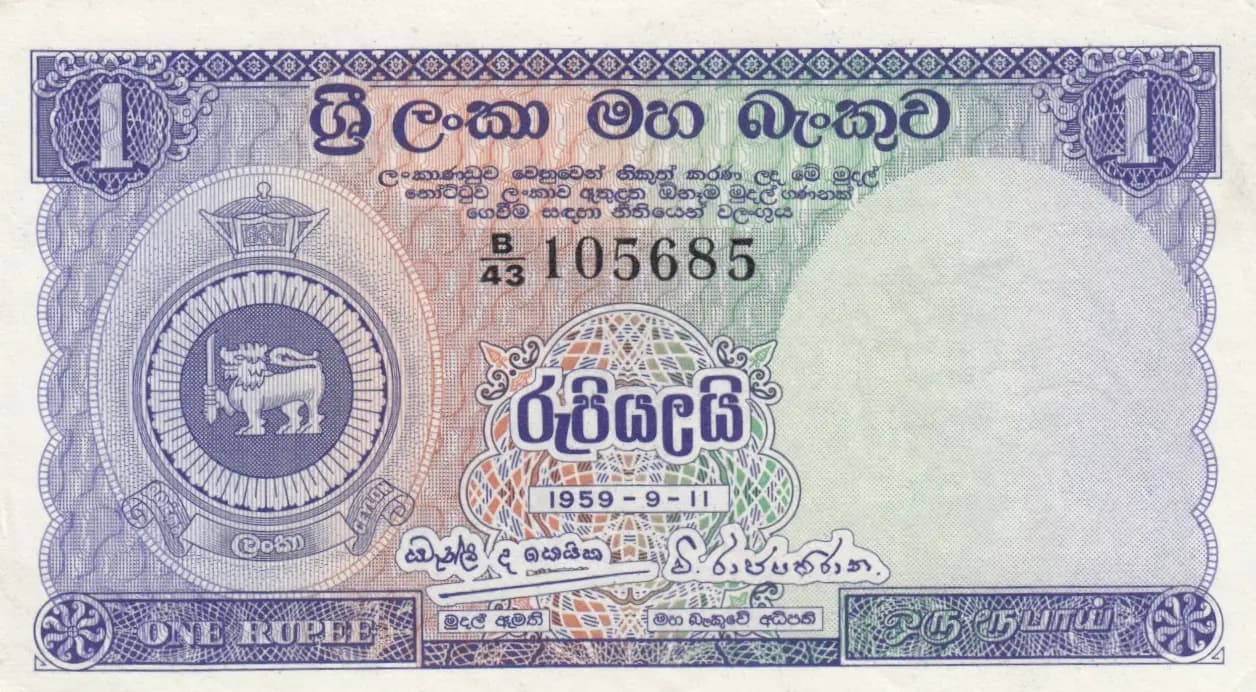
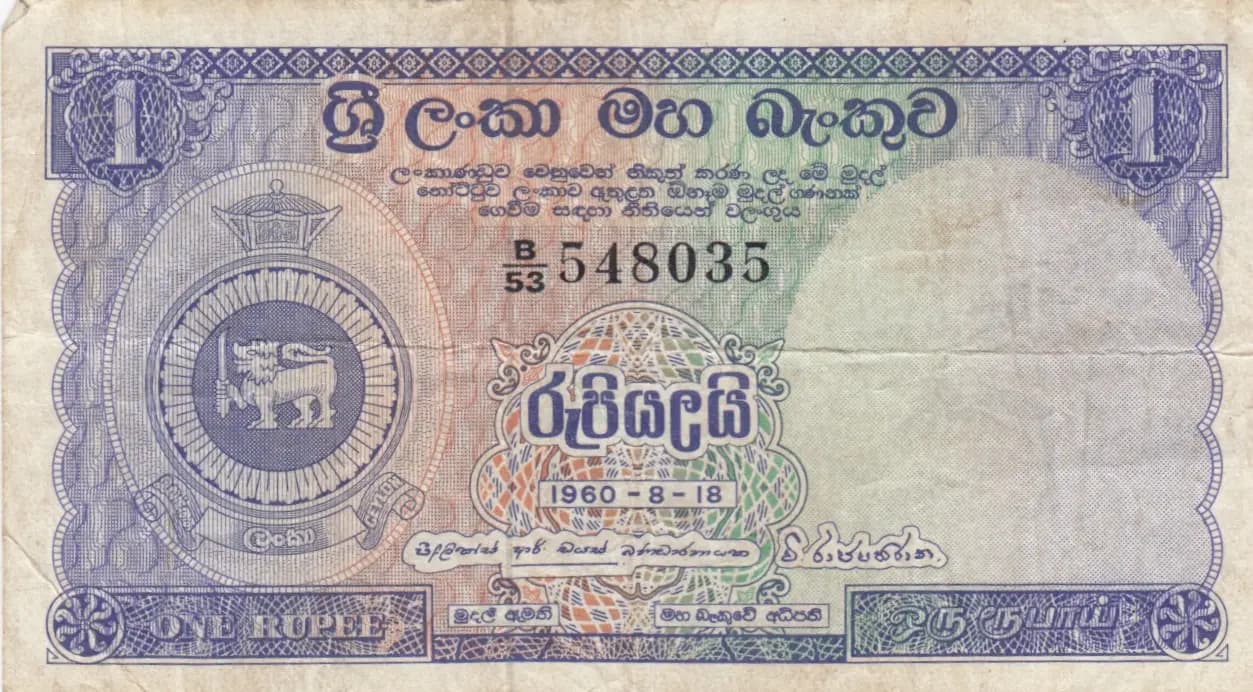
1 rupee 1957
About This Note
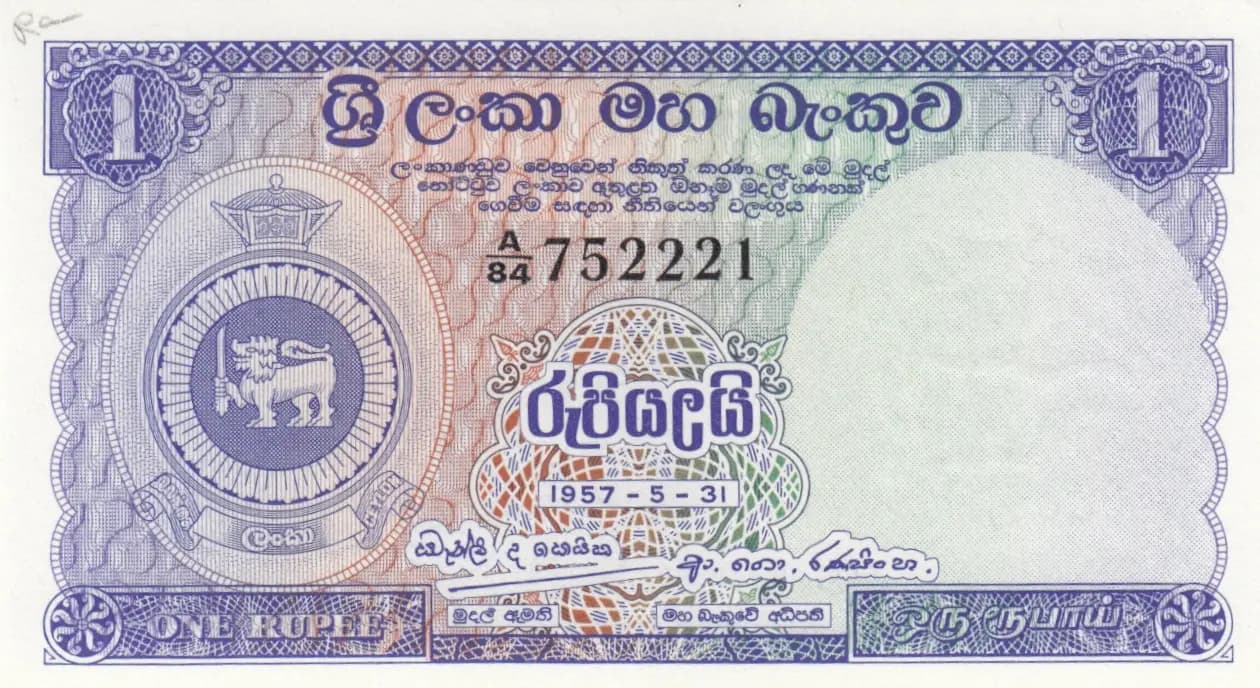
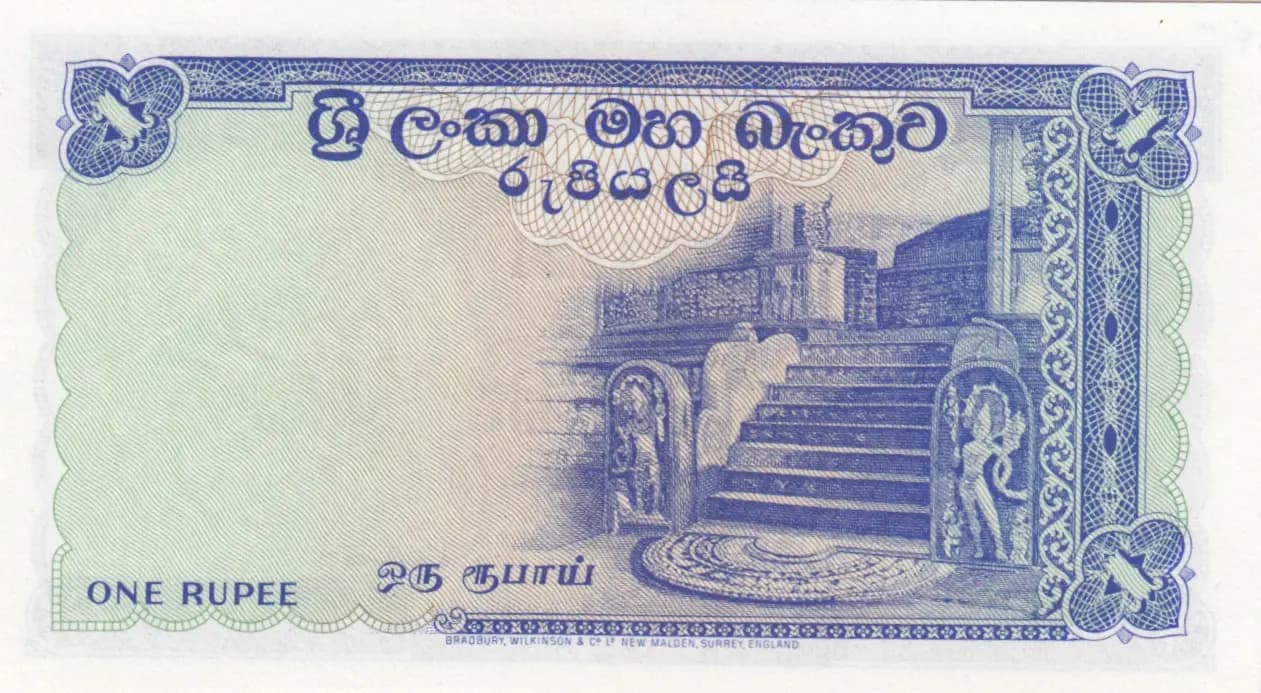
This is a 1957 Central Bank of Ceylon 1 Rupee note (Pick P-56b) in uncirculated condition, featuring the national lion emblem on the obverse and an ornate temple stairway on the reverse. The note displays exceptional engraving quality with multicolored decorative borders in purple, orange, green, and blue, characteristic of Bradbury Wilkinson's premium intaglio work from this period. Despite its age, the note shows minimal wear and retains sharp detail throughout, making it a desirable example of early post-independence Sri Lankan currency.
Common. The 1 Rupee denomination from this 1956-1963 series was produced in substantial quantities to serve daily circulation needs in Ceylon. While individual notes from this era show age-related wear, uncirculated examples are not exceptionally difficult to locate in the international banknote market. The Pick P-56b variety lacks the scarcity factors (limited print run, recall, short issuing period) that would elevate rarity. Most notes from this series and denomination trade in the lower price ranges typical of common 1950s-era circulating currency.
This note was issued during Ceylon's early years as an independent nation (1948-1972), specifically in 1957 when the Central Bank of Ceylon maintained tight control over currency design and security. The lion emblem on the obverse represents Sri Lanka's national heraldry and sovereignty, while the temple stairway depicted on the reverse reflects the island's rich Buddhist and architectural heritage. The trilingual inscriptions in Sinhala, English, and Tamil reflect Ceylon's multicultural composition during this formative post-colonial period.
The obverse features the Lion of Sri Lanka (the national coat of arms symbol) rendered in a large circular emblem facing left, representing sovereignty and national identity. The lion is surrounded by ornate decorative borders featuring intricate geometric and floral patterns in purple, orange, green, and beige. A secondary circular seal or badge with decorative geometric patterns appears to the right of the lion emblem. The reverse depicts an ornate temple stairway—likely representing a significant Sri Lankan Buddhist architectural monument—rendered in blue with elaborate stone railings and carved decorative elements. The architectural structure is framed by elaborate scrollwork and floral border patterns in blue and green. Both sides feature distinctive scalloped edge designs, a hallmark of this series. The color palette and ornate engraving reflect high-quality intaglio printing standards of the 1950s.
FRONT SIDE: 'ශ්රී ලංකා මහ බැංකුව' (Sinhala: Central Bank of Sri Lanka); 'ONE RUPEE' (English); 'ටිකට්' (Sinhala: Note/Ticket); '1957 - 5 - 31' (Date: May 31, 1957); 'A 84 752221' (Serial Number). BACK SIDE: 'ශ්රී ලංකා මහ බැංකුව' (Sinhala: Central Bank of Sri Lanka); 'එකට ටිකට්' (Sinhala: One Rupee Note); 'ONE RUPEE' (English); 'ஒரு ரூபாய்' (Tamil: One Rupee); 'BARUCCI, WILKINSON & CO LTD NEW MALDEN, SURREY, ENGLAND' (Printer attribution).
Intaglio engraving by Bradbury Wilkinson & Co Ltd (listed as 'BARUCCI, WILKINSON & CO LTD' on the note), a renowned British banknote security printer located in New Malden, Surrey. The fine line work visible throughout the borders, the intricate detail in the architectural elements, and the complex geometric patterns are characteristic of premium intaglio printing. The multicolor printing was achieved through multiple passes of the intaglio plates, creating the layered color effects visible in the purple, blue, orange, and green tones. Security features include fine engraved line work, intricate border patterns, and high-quality watermarking areas visible on the obverse.
This specific note is dated May 31, 1957, with serial number A 84 752221. The 'A' prefix indicates an early emission from the series. Pick P-56b is the standard variety designation for 1 Rupee notes from the 1956-1963 period. Known varieties in this series include different signature combinations and date variations across the 1956-1963 issuance window. The presence of Sinhala, English, and Tamil text is consistent with all notes from this era, reflecting the trilingual policy of the Central Bank of Ceylon. No overprints or special markings are evident on this example.