500 pesetas 1931
Market Prices
29 salesAbout This Note
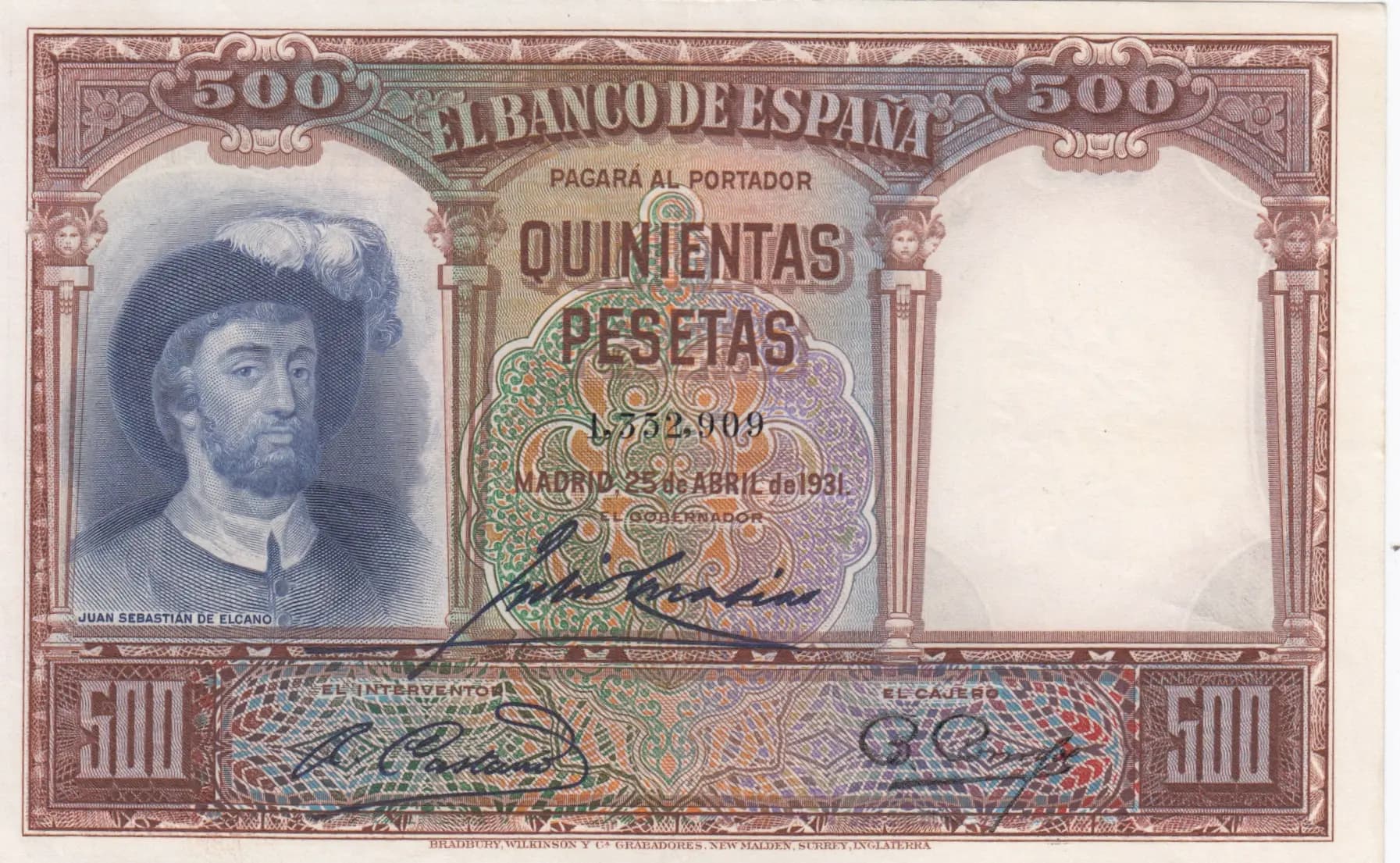
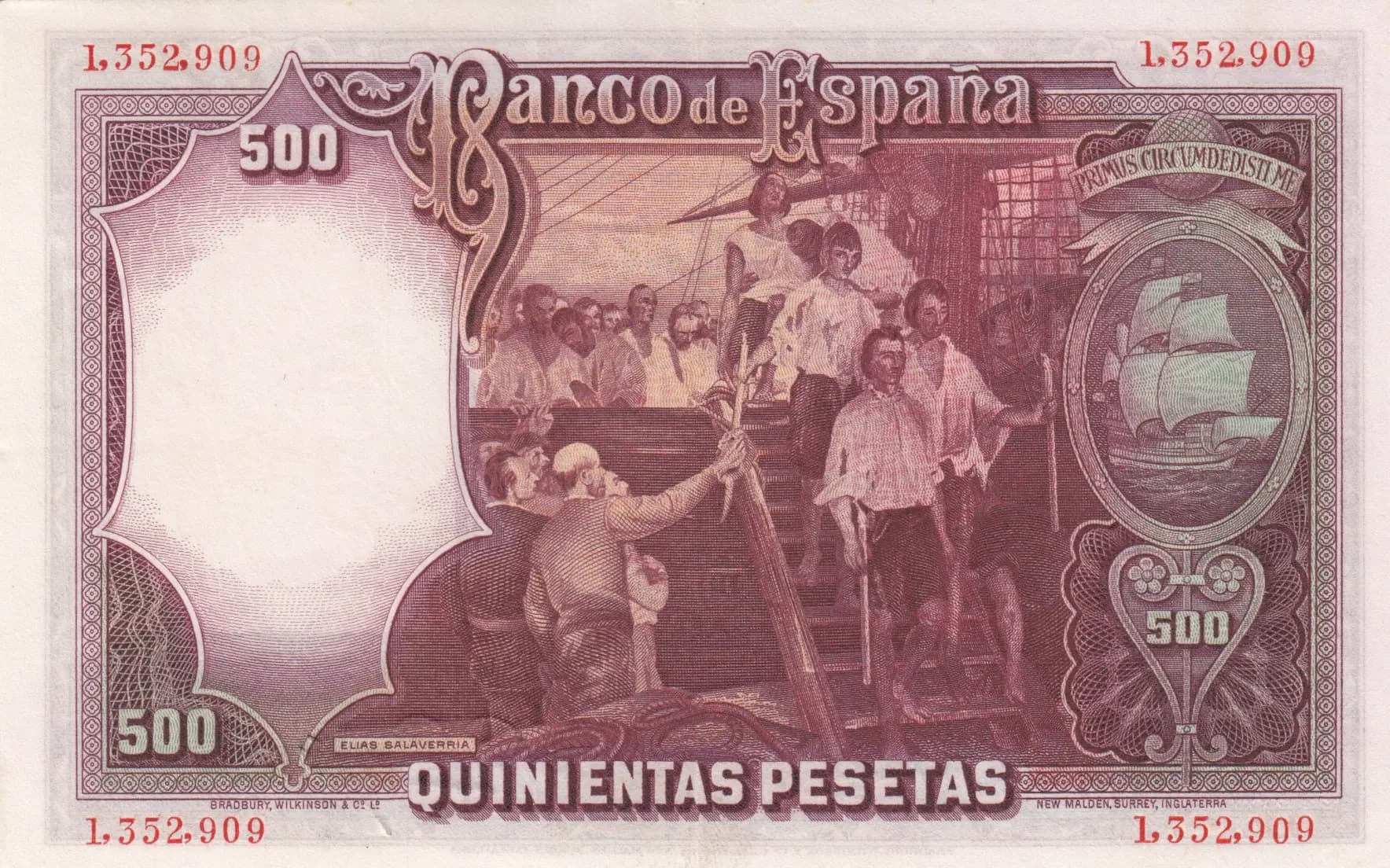
This Spain 500 Pesetas banknote from 1931 presents an exceptional example of early Republican-era Spanish currency design, featuring an ornate classical aesthetic with fine engraving throughout. The obverse showcases a distinguished portrait of Juan Sebastián de Elcano rendered in blue ink, complemented by elaborate architectural columns and baroque-style flourishes, while the reverse depicts Elias Salaverría's maritime scene of the disembarkation from Elcano's ship Victoria. In EF condition, the note displays characteristic circulation wear with visible creasing and handling marks, yet the intricate guilloché patterns and fine line engraving remain well-defined, making it a solid mid-grade example of this transitional Spanish historical issue.
Common. This is a regular issue banknote from 1931 with no indication of limited print runs or premature recall. The eBay price history provided demonstrates consistent market activity across multiple sales in various grades (ranging from F to UNC), with EF-graded examples routinely selling in the $14-45 range as of the early-to-mid 2010s, indicating a readily available note without scarcity premiums. The fact that 2016 catalog values listed this denomination at $60 for VF and $175 for UNC further confirms its status as a common, regularly-encountered note in the philatelic market.
Issued on April 24, 1931, just days after the proclamation of the Second Spanish Republic, this banknote commemorates Juan Sebastián de Elcano, the 16th-century Basque navigator who completed Magellan's circumnavigation expedition aboard the Victoria. The reverse's depiction of the disembarkation scene references Spain's Age of Exploration heritage, serving as nationalist imagery during a period of significant political transition in Spain. This note represents the early monetary output of the Republican government, printed by the prestigious British security printer Bradbury Wilkinson & Company, reflecting the technical standards of the era.
The front features a left-facing profile portrait of Juan Sebastián de Elcano, a bearded historical figure rendered in blue ink, positioned at the left of the note and occupying a prominent place in the composition. The design incorporates classical architectural elements including decorative columns flanking the portrait, ornamental scrollwork, cherub or angel head designs in the upper corners, and a heraldic shield or coat of arms centrally positioned. The reverse presents a detailed engraved maritime scene by artist Elias Salaverría depicting multiple figures on the deck of a ship, with a separate oval-framed medallion on the right side containing a fully-rigged sailing vessel (the Victoria). Decorative elements include geometric border patterns, heart-shaped floral motifs, and classical framing consistent with early 20th-century security printing aesthetics. The color scheme combines brown, red/maroon, blue, green, and cream tones across both sides.
FRONT SIDE: 'EL BANCO DE ESPAÑA' (The Bank of Spain), 'PAGARA AL PORTADOR' (Will pay to bearer), 'QUINIENTAS PESETAS' (Five hundred pesetas), 'JUAN SEBASTIAN DE ELCANO' (Juan Sebastian de Elcano - portrait identification), 'L.352.909' (Serial number), 'MADRID, 24 ABRIL 1931' (Madrid, April 24, 1931), 'EL INTERVENTOR' (The Auditor/Inspector), 'EL CAJERO' (The Cashier), 'BRADBURY, WILKINSON Y CÍA GRABADORES, NEW MALDEN, SURREY, INGLATERRA' (Bradbury, Wilkinson and Co. Engravers, New Malden, Surrey, England). BACK SIDE: 'Banco de España' (Bank of Spain), 'QUINIENTAS PESETAS' (Five hundred pesetas), 'L.352.909' (Serial number), 'ELIAS SALAVERRIA' (Artist/Engraver attribution), 'BRADBURY, WILKINSON Y CIA SURREY, INGLATERRA' (Bradbury, Wilkinson and Co., Surrey, England).
Intaglio engraving (line engraving) executed by Bradbury, Wilkinson & Company of New Malden, Surrey, England. The note exhibits fine line engraving throughout with complex decorative background patterns, ornamental guilloché patterns characteristic of security printing, and multiple color printing technique. The precision of the engraving details, particularly in the maritime scene and architectural elements, reflects the high standards of British security printing during the early 20th century.
Specific variety designation: P-84 (Pick catalog). The PMG population report indicates this is the base Pick number for the 500 Pesetas Madrid issue with a documented serial number prefix 'L' visible on the examined specimen (L.352.909). Known variant P-84Aa exists as a 1000 Pesetas denomination, but the present note is confirmed as the 500 Pesetas standard issue. The date of April 24, 1931 (MADRID, 24 ABRIL 1931) shown on the front represents the early Republican issue date, distinguishing it from any subsequent issues. Handwritten signatures are present in blue/dark ink across the center, typical of banker signatures of the era. No overprints or special markings indicate this as a standard circulation issue.