100 pesetas 1906
Market Prices
8 salesAbout This Note
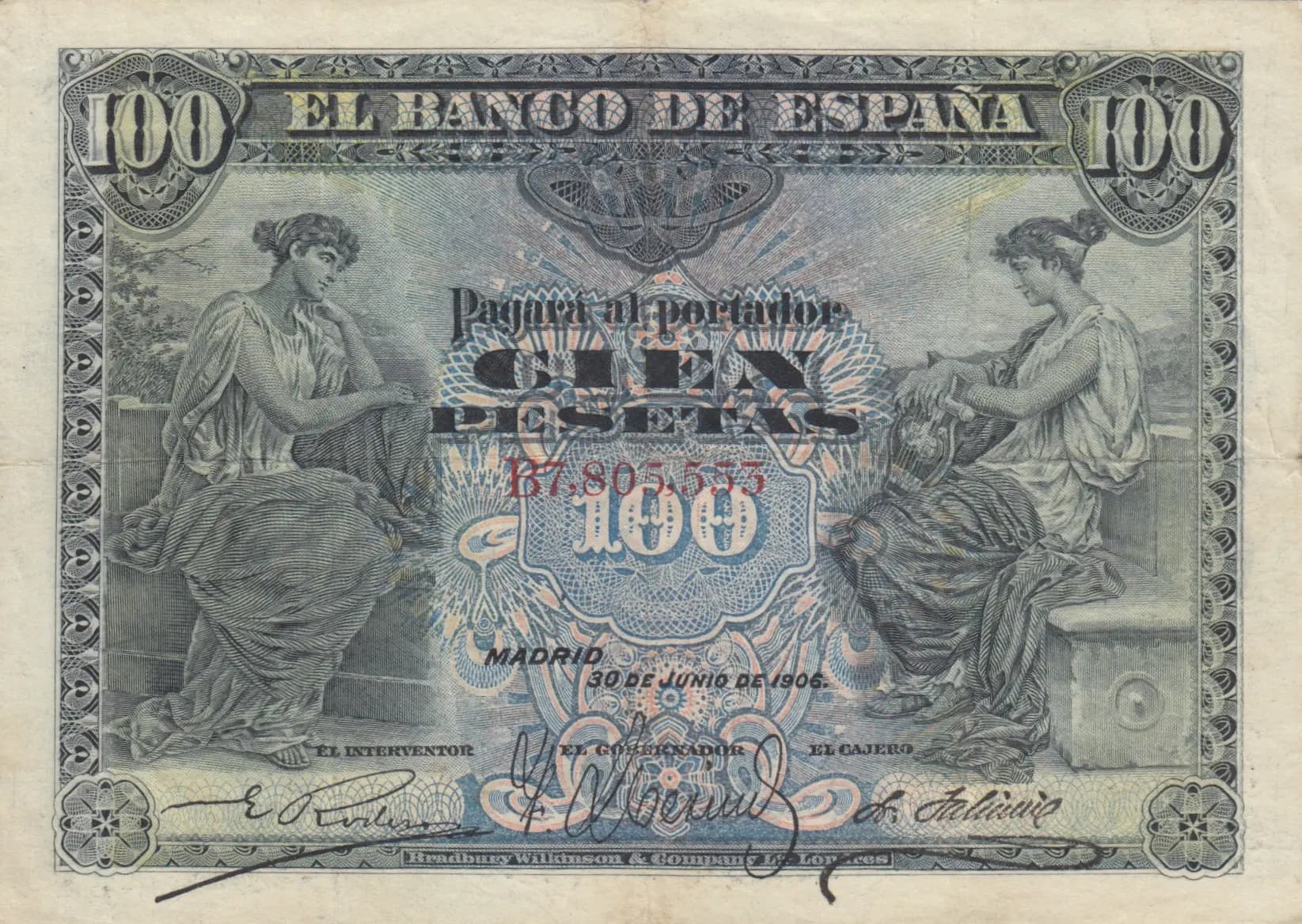
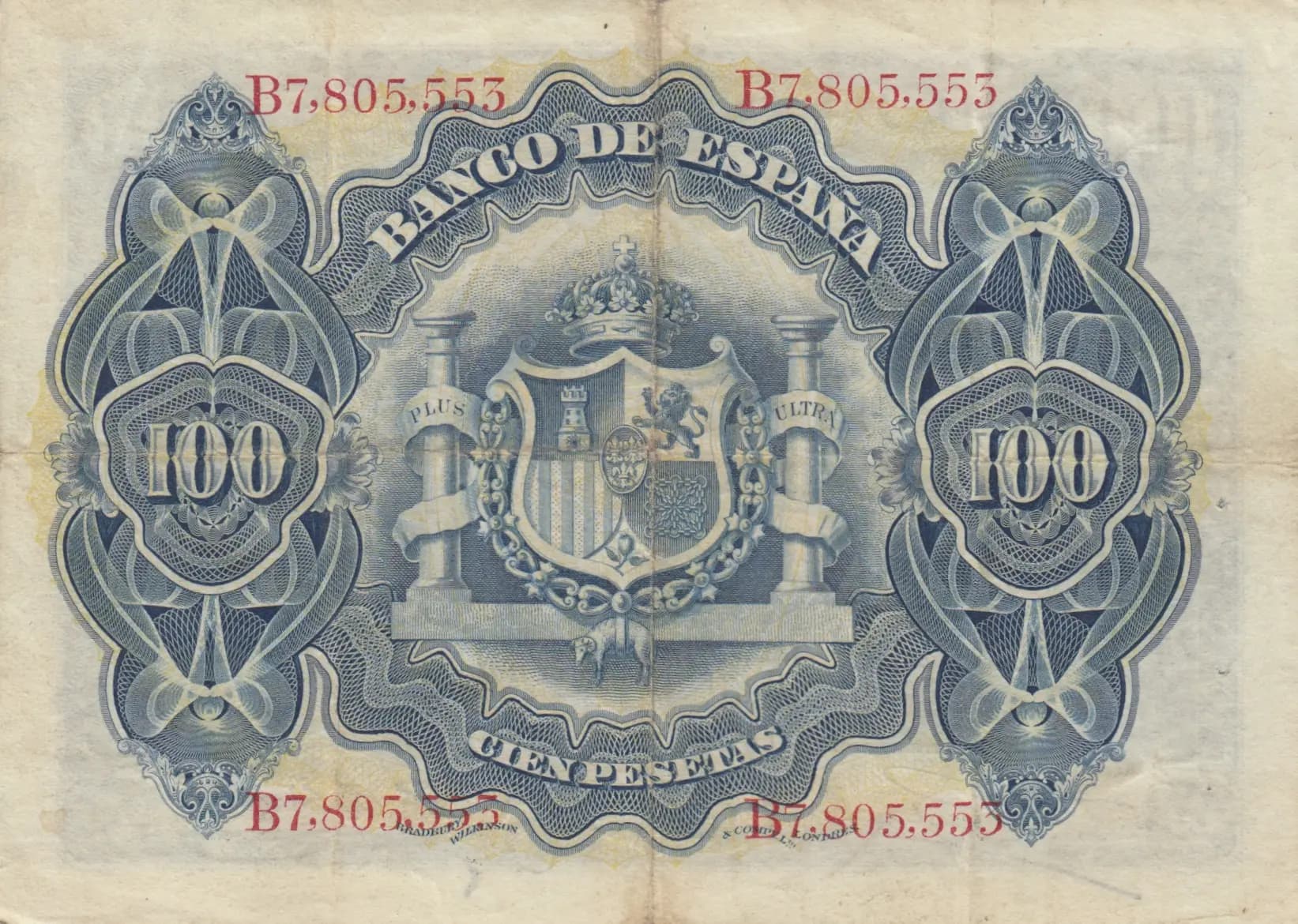
This 100 pesetas note from 1906 features exquisite classical allegorical design work by Bradbury Wilkinson with two seated female figures flanking an ornamental central cartouche on the obverse, and a prominent Spanish coat of arms on the reverse. The note exhibits moderate wear consistent with historical circulation, showing creasing, yellowing, and foxing typical of early 20th-century Spanish currency in VF condition. The fine line engraving and complex decorative patterns reflect the high security standards of Banco de España's early issues.
Common. This is a regular issue from 1906 with no evidence of limited print runs or unusual scarcity factors. eBay market data confirms common-grade pricing, with VF examples selling in the $28-$33.50 range from 2010-2022. The 2016 catalogue valuation of $30 (G), $90 (F), and $225 (EF) aligns with typical market behavior for common early Spanish peseta notes. No collecting premium or rarity factor applies to this standard Banco de España issue.
This banknote was issued during Spain's early modern banking period, reflecting the country's monetary modernization in the early 1900s. The Spanish coat of arms with its crowned shield and supporters, prominently displayed on the reverse, symbolizes national sovereignty and the authority of Banco de España. The classical allegorical female figures and the Latin motto 'PLUS ULTRA' ('Further Beyond') on the reverse harken to Spain's historical imperial identity and aspirations, common themes in Spanish numismatic design of this era.
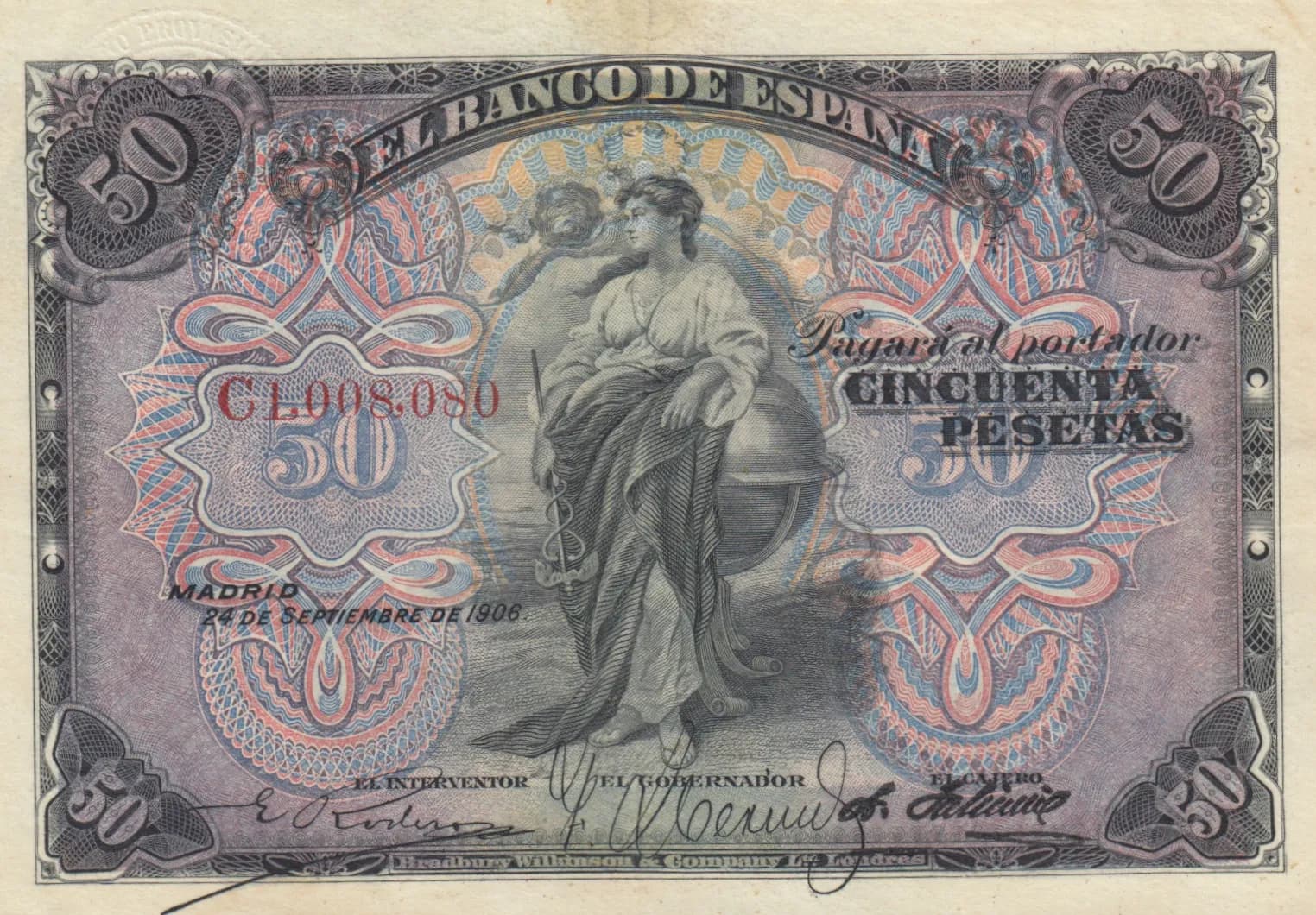
The obverse features two classical allegorical female figures in draped robes seated symmetrically on either side of an ornamental central shield cartouche bearing the denomination. These figures represent prosperity and commerce, common allegorical elements in late 19th and early 20th-century banknote design. The central ornamental design contains radiating patterns and is framed by an intricate scrollwork border with floral ornamentation in all four corners. The reverse displays the Spanish national coat of arms—a crowned shield with heraldic divisions representing the historic kingdoms of Spain—positioned centrally and flanked by symmetrical botanical/floral ornamental motifs. Corner ornaments contain shield cartouches with the denomination in all four corners. The entire composition emphasizes formal heraldic authority and classical artistic principles.
Front side: 'EL BANCO DE ESPAÑA' (The Bank of Spain), '100' (denomination), 'Pagará al portador' (Will pay to bearer), 'cien pesetas' (one hundred pesetas), 'MADRID' (Madrid), '30 DE JUNIO DE 1906' (30 June 1906), 'EL INTERVENTOR' (The Supervisor), 'EL GOBERNADOR' (The Governor), 'EL CAJERO' (The Cashier), 'Bradbury Wilkinson & Company Engravers' (printer attribution). Back side: 'BANCO DE ESPAÑA' (Bank of Spain), '100' (denomination, appears four times in corners), 'CIEN PESETAS' (One Hundred Pesetas), 'PLUS ULTRA' (Further Beyond/Further Still), Serial number: 'B7.805.553' (appears three times).
Intaglio engraving (line engraving) throughout, executed by Bradbury Wilkinson & Company of London, one of the world's premier security printers. The fine line work, complex scrollwork patterns, and detailed heraldic rendering are characteristic of high-security intaglio printing. The use of fine engraved lines and ornamental patterns served as anti-counterfeiting measures. Serial numbers were printed in red using a separate printing pass.
Pick 59a is the standard variety of this 1906 issue dated 30 June 1906. The observed serial number B7.805.553 is consistent with the standard production run. No overprints or unusual varieties are apparent in the visual analysis. The note exhibits typical signature varieties associated with the governor, supervisor, and cashier positions of Banco de España in 1906, but these represent standard administrative variations rather than distinct collecting varieties.