100 pesetas 1903
Market Prices
About This Note
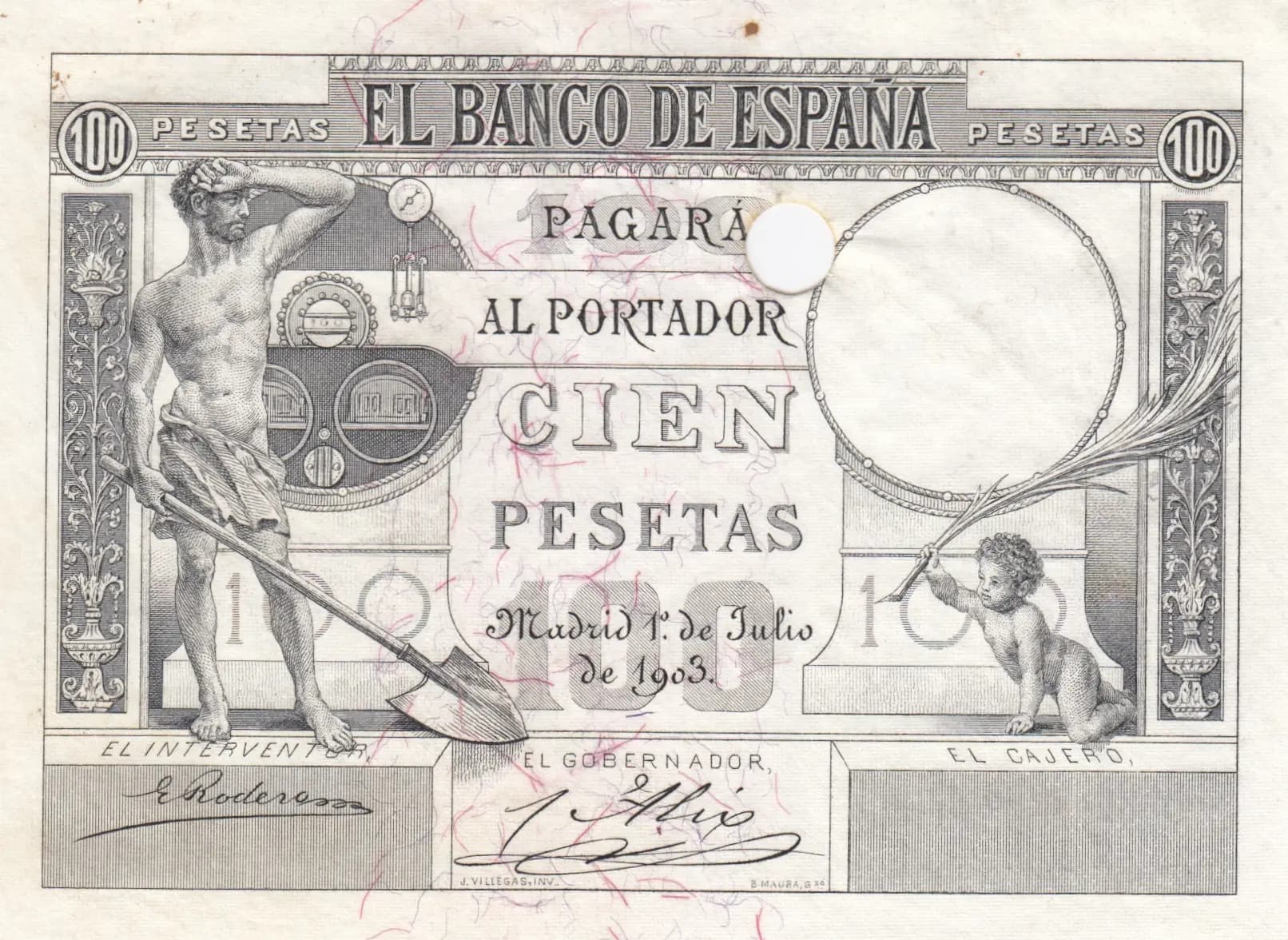
This is a 100 Pesetas banknote issued by Banco de España on July 1, 1903 (Pick P-53), graded in AU condition. The note features a classical engraved design with a prominent Neptune-like male figure holding a trident on the left side and a cherub in the lower right corner, with ornamental borders and heraldic shields. The specimen shows archival handling marks including pink/red handwritten annotations, a center punch hole, and age-related foxing consistent with museum or bank archival storage rather than circulation wear.
Common. The eBay market data shows AU examples selling in the $15.93 USD range with multiple listings at low price points ($3.99-$22.00 USD for AU/XF grades), indicating healthy supply and weak collector demand. The 2016 catalogue value of $3000 for EF grade appears inflated relative to current market realizations. This is a standard issue from a major national bank with presumably substantial print runs. The presence of archival handling marks and punch holes suggests this particular specimen may have been part of a bank archive or collection that was subsequently dispersed.
This 1903 issue represents Spain's early 20th-century banknote production during a period of relative stability under the Restoration Monarchy. The classical allegorical imagery—Neptune with trident symbolizing maritime commerce and the cherub representing prosperity—reflects the design aesthetic favored by Spanish authorities to project economic strength and tradition. The 'Al Portador' (bearer) designation indicates this was a bearer instrument typical of the pre-modern banking era, before personalized accounts became standard.
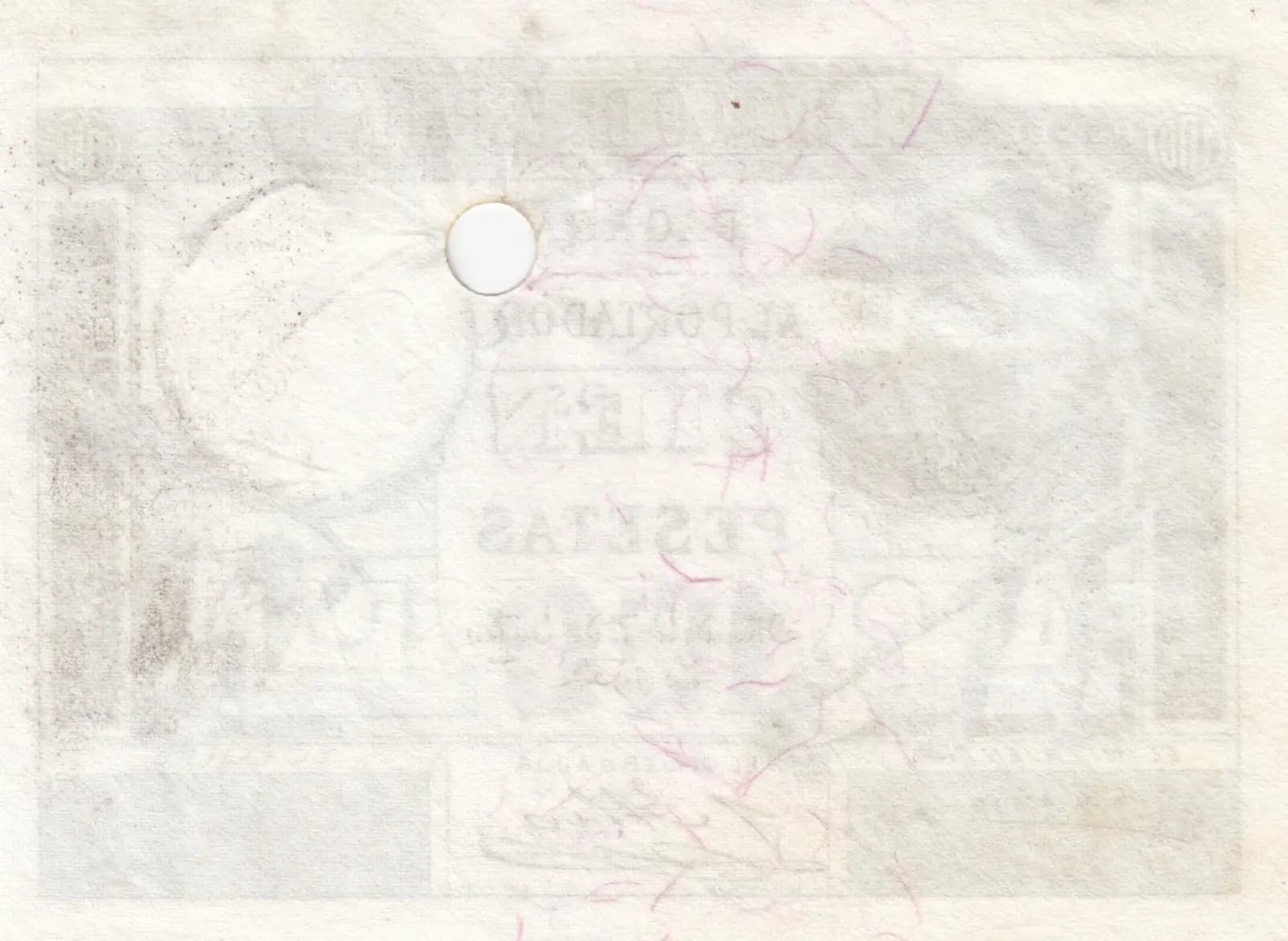
The obverse features a neoclassical allegorical composition centered on Neptune, the Roman god of the sea, depicted as a muscular bearded male figure in classical style holding a trident—symbolizing Spain's maritime heritage and commercial prosperity. A cherub or putti figure appears in the lower right corner, representing divine blessing or fortune. The note is framed by ornamental borders on both left and right sides containing fine floral scrollwork and heraldic shields (likely the Spanish coat of arms or regional emblems). A large empty circular medallion in the upper right portion appears designed to accommodate a portrait, security feature, or watermark. The reverse side appears blank or contains only faint design elements. The overall composition reflects the neoclassical aesthetic popular in Spanish fin-de-siècle financial design, emphasizing allegorical virtue and economic progress.
FRONT SIDE: 'El Banco de España' (The Bank of Spain); 'Pagará al Portador' (Will pay to the bearer); '100 Pesetas' / 'Cien Pesetas' (One Hundred Pesetas); 'Madrid 1º de Julio de 1903' (Madrid, July 1st, 1903); 'El Interventor' (The Auditor/Inspector); 'El Gobernador' (The Governor); 'El Cajero' (The Cashier); Signatures: 'E. Rodríguez', 'J. Millo'; Designer mark: 'J. VILLEGAS-INV.' (J. Villegas - Inventor/Designer); Engraver mark: 'E. MAURA G.A.C.' (E. Maura - Engraver). BACK SIDE: No legible inscriptions observed; reverse appears largely blank or contains only extremely faint design elements.
Fine line steel engraving throughout, consistent with late 19th/early 20th century security printing standards. The detailed ornamental borders, intricate geometric and floral designs, and the precision of the figurative elements (Neptune and cherub) indicate work by skilled engravers. The signature of 'E. Maura G.A.C.' (likely a master engraver mark) and designer credit to 'J. Villegas' suggest this was produced by a specialized security printing house, potentially the Spanish Royal Mint (Casa de la Moneda) or a contracted security printer. The black and white printing with no visible color suggests monochrome engraved production, which was standard for this period and denomination.
The specific variety can be identified by the date (July 1, 1903) and the signatures present: 'E. Rodríguez' (Cajero/Cashier), 'J. Millo' (Gobernador/Governor), and presumably 'El Interventor' (Inspector) signature. The designer and engraver marks 'J. VILLEGAS-INV.' and 'E. MAURA G.A.C.' are integral to this design. The archival punch hole in the upper center and pink/red handwritten markings suggest this specimen comes from a bank institutional archive or numismatic collection that employed such processing methods. Without access to serial number information (not clearly visible in the images), a more precise variety designation cannot be made, though Spanish notes from this period typically have identifiable serial ranges by date.