100 pesetas 1925
Market Prices
96 salesAbout This Note
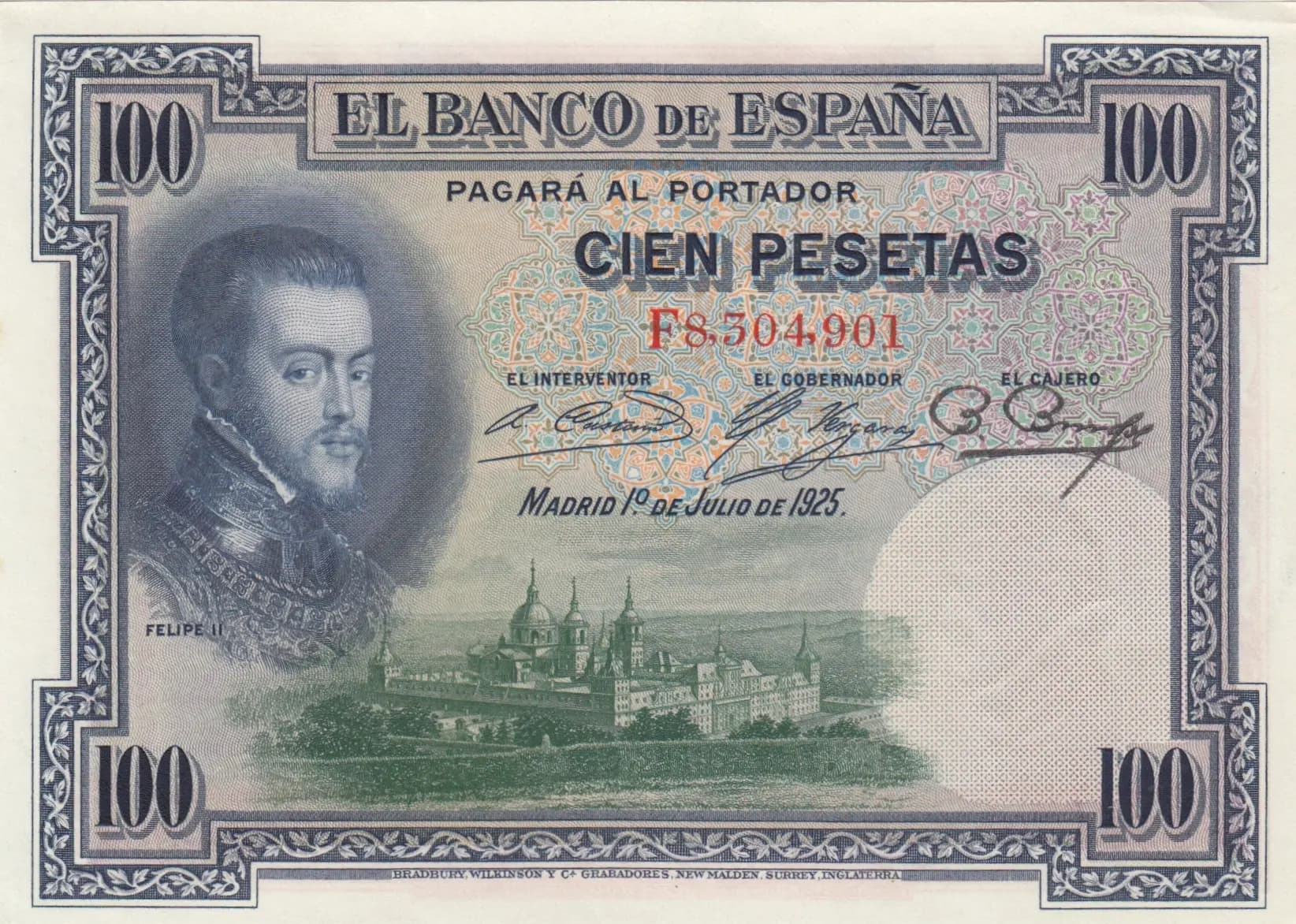
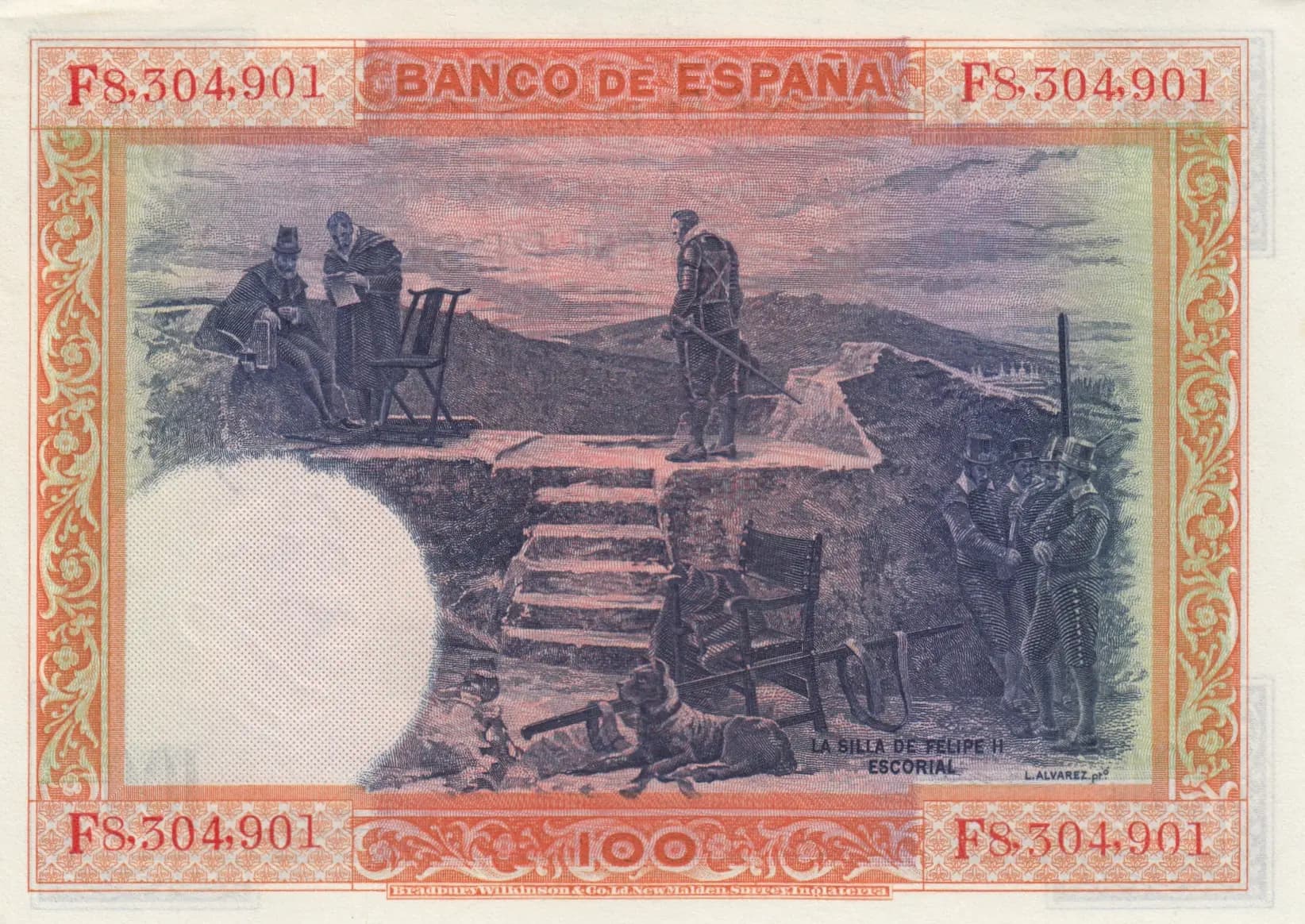
This is an exceptional example of the Spain 100 Pesetas 1925 (Pick P-69c), displaying AU condition with crisp, vibrant colors and no visible wear. The note features a striking dual-portrait design with King Felipe II on the obverse and a historical military scene on the reverse, both rendered with fine engraved detail by the prestigious British security printer Bradbury Wilkinson. The sharp impression, excellent color preservation, and lack of circulation marks make this a desirable specimen for collectors of Spanish peseta currency.
Common. The extensive eBay auction data provided demonstrates consistent and frequent sales, with examples regularly selling in the $1–$60 range depending on condition and certification. PMG-graded specimens in grades 58–66 command $16–$63, while uncertified examples in VF–AU condition typically realize $2–$20. Print runs for this 1925 issue were substantial, and survival rates are high. The AU grade specimen catalogued here is desirable but not rare; the market shows abundant supply at all grade levels.
Issued on July 1, 1925, during the reign of Alfonso XIII and the Spanish Monarchy, this banknote commemorates Felipe II (Philip II), the 16th-century Spanish king who built the El Escorial monastery-fortress near Madrid. The reverse depicts a historical scene from the Escorial, representing Spain's imperial past and cultural heritage. The ornate engraved design reflects the security printing standards of the 1920s and the Bank of Spain's commitment to high-quality currency production during a period of economic consolidation.
The obverse features a left-facing profile portrait of King Felipe II (Philip II, 1527-1598) wearing 16th-century Spanish noble armor with an ornate collar, rendered with exceptional engraved detail and cross-hatching. To the right is a panoramic view of the El Escorial monastery-fortress complex on a hillside, identifiable by its distinctive domes and multiple spires. The reverse depicts 'La Silla de Felipe II' (The Chair of Philip II), a historical scene set at the Escorial showing three figures in period clothing—two seated in discussion and one standing—overlooking a fortified military position with soldiers, flags, and defensive structures visible below. The composition conveys Felipe II's command during a military retreat or strategic moment. Both sides are framed by ornate decorative borders featuring intricate floral and geometric patterns in the style typical of early 20th-century Bank of Spain currency. The color palette combines dark blue/navy with orange, tan, beige, and cream tones.
FRONT: 'BANCO DE ESPAÑA' (Bank of Spain); 'PAGARÁ AL PORTADOR' (Will Pay to the Bearer); 'CIEN PESETAS' (One Hundred Pesetas); 'MADRID 1º DE JULIO DE 1925' (Madrid, July 1st, 1925); 'FELIPE II' (Philip II); 'EL INTERVENTOR' (The Comptroller); 'EL GOBERNADOR' (The Governor); 'EL CAJERO' (The Cashier); 'BRADBURY WILKINSON Y Cía GRABADORES. NEW MALDEN. SURREY. INGLATERRA' (Bradbury Wilkinson and Co. Engravers. New Malden, Surrey, England); Serial number 'F8.504,901'. BACK: 'BANCO DE ESPAÑA' (Bank of Spain); 'LA SILLA DE FELIPE II' (The Chair of Philip II); 'ESCORIAL' (Escorial); 'L. ALVAREZ' (Artist/Engraver signature); 'BRADBURY WILKINSON & CO. LTD. NEW MALDEN. SURREY. ENGLAND' (Bradbury Wilkinson & Co. Ltd. New Malden, Surrey, England); Serial number repeated in all four corners.
Intaglio engraving (line engraving), the premium security printing method of the era. Executed by Bradbury Wilkinson & Co. Ltd., a renowned British security printer located in New Malden, Surrey. The fine cross-hatching, portrait detail, and complex ornamental border designs are characteristic of intaglio work. The multi-color printing was achieved through successive passes of differently inked plates, a labor-intensive technique that provided excellent counterfeiting protection. Artist L. Alvarez signed the reverse design.
Serial number prefix 'F' and serial range F8,504,901 indicates this is from the main production run. The date 'MADRID 1º DE JULIO DE 1925' and printer identification 'BRADBURY WILKINSON Y Cía' on the obverse confirm the standard 1925 first issue type. No overprints or special markings are visible. This represents the regular issue of Pick P-69c; no known varieties with significant rarity are documented for this denomination and date. The specimen follows the standard design with three official signatures (El Gobernador, El Interventor, El Cajero) as required for circulation.