50 pesetas 1902
Market Prices
About This Note
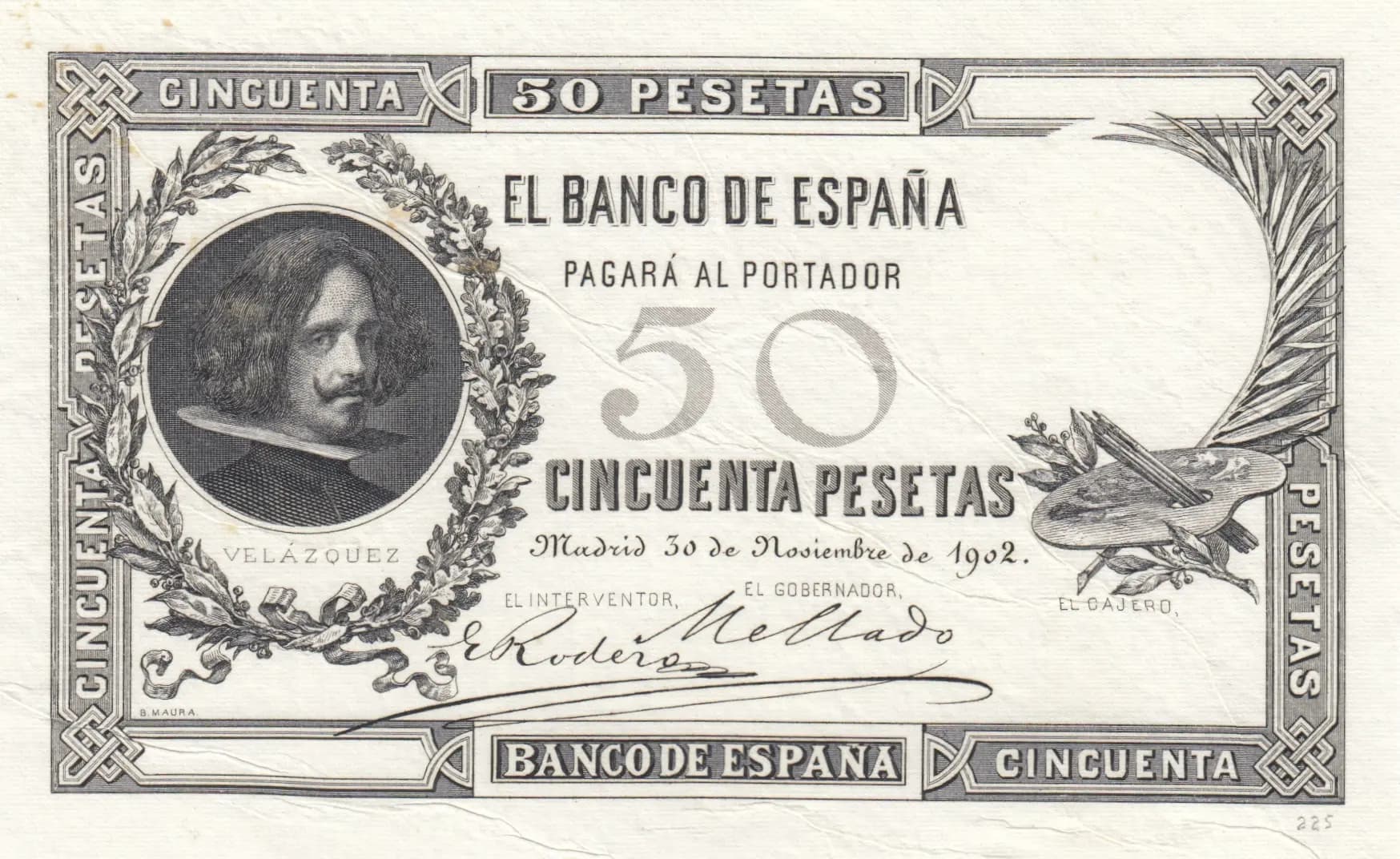
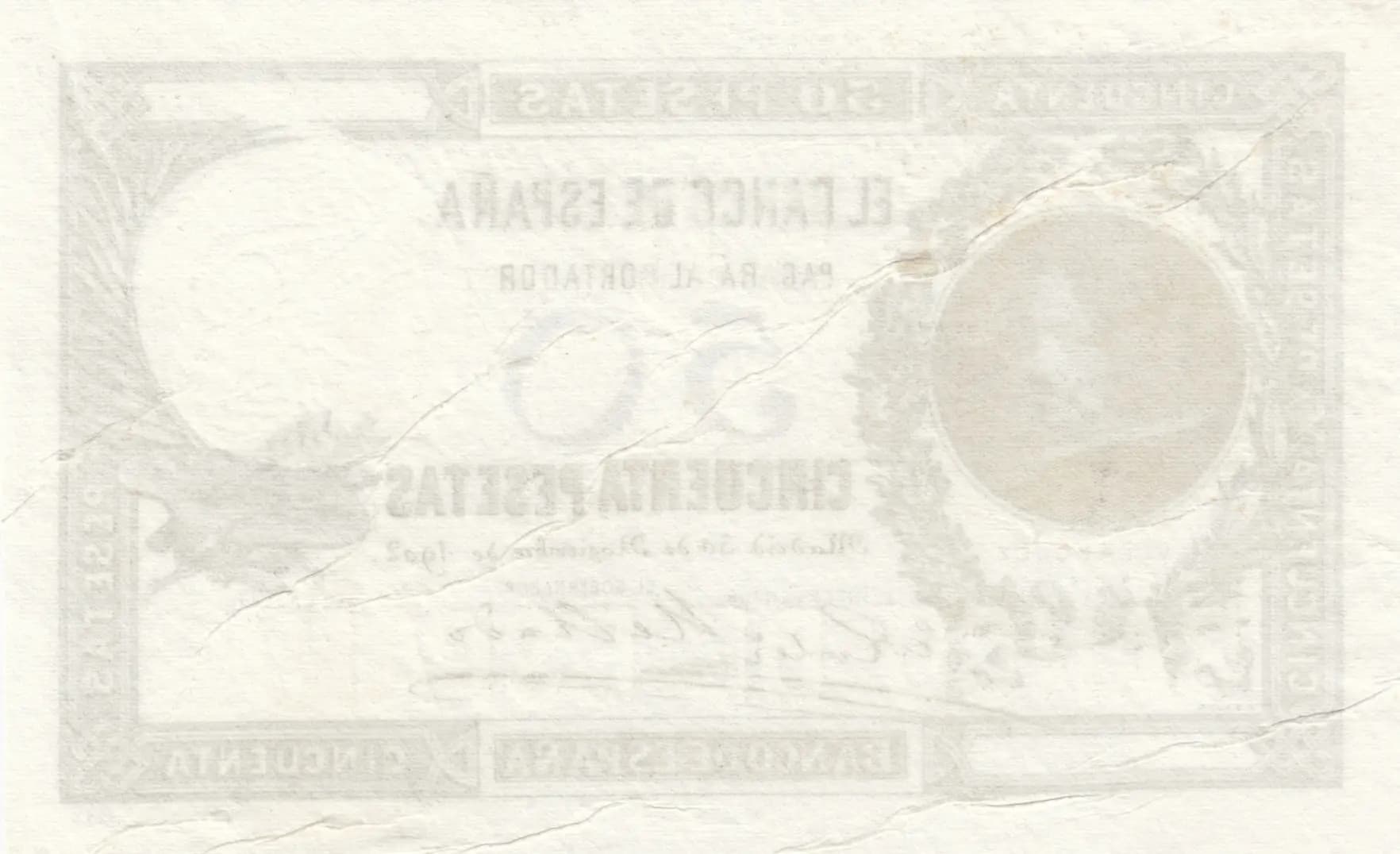
This is a Spanish 50 Pesetas banknote from 1902, issued by the Banco de España and graded AU. The obverse features a finely engraved portrait of Diego Velázquez facing left within an ornate laurel wreath, rendered in classical engraving style with Celtic knot corner designs. The reverse is heavily faded and largely illegible due to age-related deterioration and foxing, though faint architectural elements suggest the allegorical 'Apollo in the Forge of Vulcan' composition. Despite the AU grade, the note shows a prominent horizontal center crease and overall yellowing consistent with 120+ years of aging.
Common. Market data from realbanknotes.com shows consistent eBay sales in the $50–$115 range for VF examples, with catalog values of $450 for F grade and $1,000 for EF grade (2016 pricing). The wide availability of listed examples and moderate pricing indicate this was a regularly circulated note with a substantial print run. The AU grade specimen observed here commands higher value than VF examples, but the note itself is not rare or scarce — it remains accessible to collectors of Spanish peseta currency.
This note was issued during the reign of King Alfonso XIII and reflects Spain's financial modernization in the early 20th century. The choice to honor Diego Velázquez, one of Spain's greatest artists from the 17th century, demonstrates the Banco de España's practice of celebrating Spanish cultural heritage on its currency. The allegorical imagery on the reverse, derived from Velázquez's famous painting 'Apollo in the Forge of Vulcan' (1630), connects artistic tradition to economic authority during a period of relative stability before the tumultuous events of the Spanish Civil War.
The obverse depicts Diego Velázquez (1599–1660), the renowned Spanish Baroque painter and court artist to Philip IV, positioned in a left-facing classical portrait style within a decorative laurel wreath symbolizing honor and achievement. The portrait is executed in fine black-line engraving against a cream paper ground. Ornamental Celtic knot patterns occupy all four corners, while elaborate botanical and plant-motif borders frame the left and right margins. The top and bottom feature geometric ornamental bands typical of Banco de España design standards. The denomination '50 PESETAS' and 'CINCUENTA' appear multiple times for redundancy and verification. The note is signed by three officials (El Interventor, El Gobernador, El Cajero) as required by Spanish central banking protocols, with specific names visible including B. Maura, Mellado, and Rodríguez. The reverse, now largely illegible due to deterioration, was originally designed to reproduce Velázquez's 'Apollo in the Forge of Vulcan' (1630), a mythological scene from his collection.
FRONT SIDE: 'CINCUENTA' (Fifty), '50 PESETAS' (50 Pesetas), 'EL BANCO DE ESPAÑA' (The Bank of Spain), 'PAGARÁ AL PORTADOR' (Will pay the bearer), 'CINCUENTA PESETAS' (Fifty Pesetas), 'VELÁZQUEZ' (Velázquez — identifying the portrayed figure), 'Madrid 30 de Noviembre de 1902' (Madrid, 30th November 1902), 'EL INTERVENTOR' (The Comptroller), 'EL GOBERNADOR' (The Governor), 'EL CAJERO' (The Cashier), 'BANCO DE ESPAÑA' (Bank of Spain), signature line 'B. MAURA' (B. Maura), 'Mellado' (Mellado), 'Rodríguez' (Rodríguez). REVERSE SIDE: Specific inscriptions illegible due to heavy fading and deterioration, though the design references 'Apollo in the Forge of Vulcan.'
Steel engraving (intaglio) printing, the standard security printing method for Spanish banknotes of this era. The fine line work, portrait detail, and ornamental borders are characteristic of hand-engraved steel plates, which was the most secure banknote printing technology of the period. The Banco de España employed Spain's leading security printers for this series. The multicolor or single-color intaglio process produced the sharp definition visible on the obverse, though the reverse's deterioration has obscured its original printing characteristics.
This note is cataloged as Pick P-52 (Madrid issue). The PMG population report indicates two variants exist: P-52 (Madrid) and P-52s. The specific signatures visible on this example (B. Maura, Mellado, Rodríguez) correspond to officials serving in 1902. The date 'Madrid 30 de Noviembre de 1902' confirms the issue date of 30 November 1902. No serial number is clearly visible in the provided images due to the obverse's layout and image resolution, though serial numbers would help distinguish specific printings. The variant designation 'P-52s' likely denotes a signature or location variant, though definitive attribution requires examination of both the obverse and reverse serial number positioning.