500 pesetas 1971
Market Prices
61 salesAbout This Note
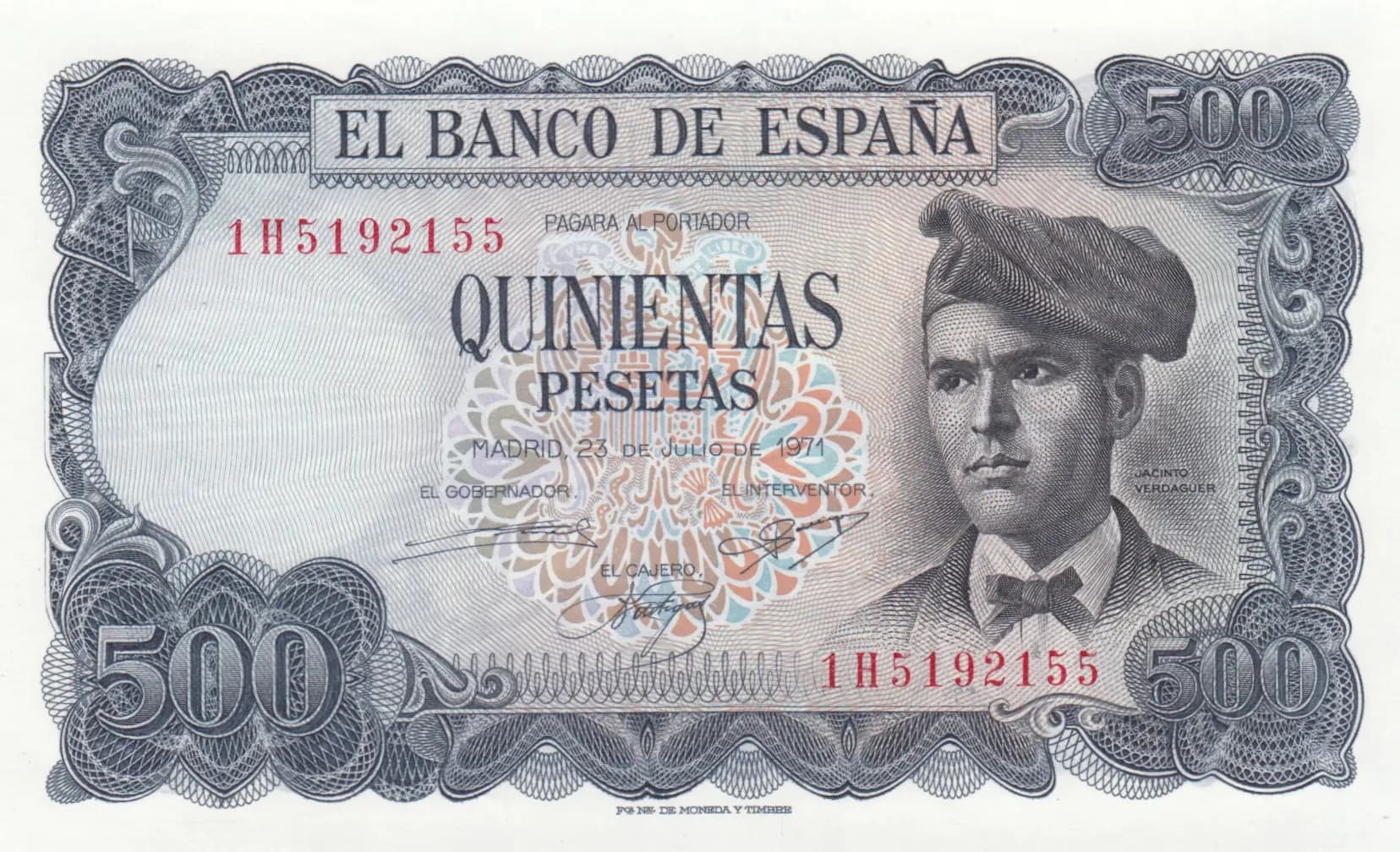
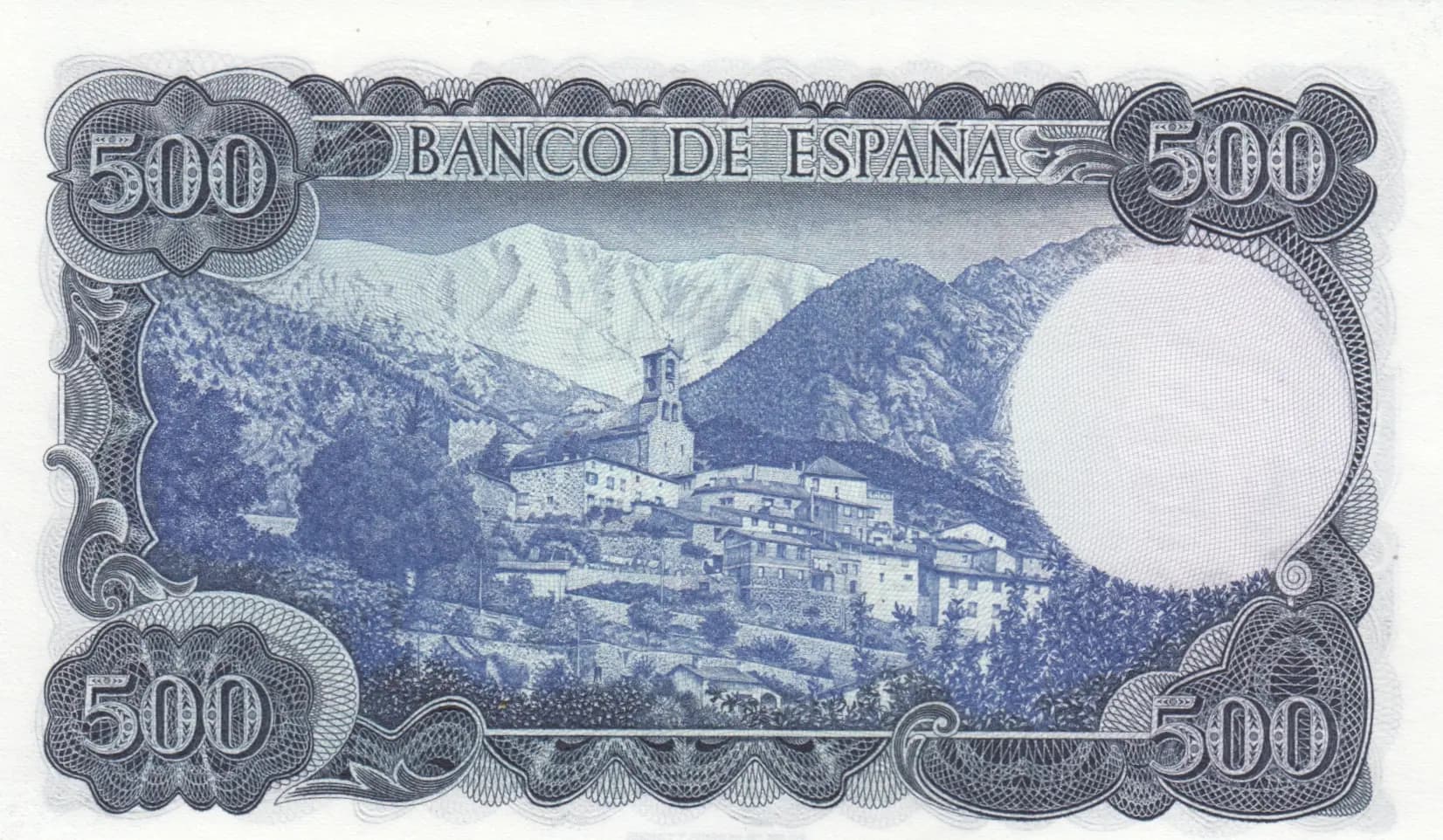
This is a well-preserved 500 Pesetas banknote from Spain's 1971 regular issue, graded UNC (Uncirculated). The front features a formal portrait of Jacinto Verdaguer, a notable Catalan figure, rendered in blue-gray tones with intricate ornamental borders and a heraldic emblem. The reverse presents an engraved landscape of Mount Canigó with the village of Vinyoles d'Oris, demonstrating exceptional clarity and detail characteristic of high-quality currency production from this period.
Common. This is a regular issue from Spain's established currency series with high circulation figures typical of a 500-peseta denomination. eBay market data confirms this assessment, with UNC examples consistently selling in the $12-$50 range over nearly a decade of sales history, and vast majority of transactions under $60. The abundance of graded examples (PMG Population Report documents multiple grades) and steady low-to-moderate pricing indicate widespread availability in the collector market.
Issued on July 23, 1971, during Spain's transition period under Franco's regime, this banknote celebrates Catalan cultural heritage through its depiction of Jacinto Verdaguer and the Pyrenean landscape. The choice to honor Verdaguer and feature Mount Canigó reflects the Banco de España's effort to represent Spain's diverse regional identities through its currency design during an era of economic modernization.
The obverse features Jacinto Verdaguer (1845-1902), a revered Catalan poet and intellectual, portrayed in formal three-quarter view wearing a bow tie, positioned on the right side of the note. The design incorporates an ornate heraldic emblem in the center with red and beige coloring, typical of Spanish currency security design from this era. The reverse depicts an Alpine landscape dominated by Mount Canigó with the village of Vinyoles d'Oris nestled in the valley below, complete with a visible church or bell tower serving as a focal point. Both sides employ intricate ornamental frames with spiral and fan-like corner designs characteristic of mid-20th-century Spanish banknote aesthetics.
Front: 'EL BANCO DE ESPAÑA' (The Bank of Spain), '500' / 'QUINIENTAS PESETAS' (Five Hundred Pesetas), 'PAGARÁ AL PORTADOR' (Pay to Bearer), 'MADRID, 23 DE JULIO DE 1971' (Madrid, July 23, 1971), 'EL GOBERNADOR' (The Governor), 'EL INTERVENTOR' (The Comptroller), 'EL CAJERO' (The Cashier), serial number '1H5192155', and 'VERDAGUER' (identifying the portrayed figure). Back: 'BANCO DE ESPAÑA' (Bank of Spain) and '500' repeated in corner denominations.
Intaglio (line engraving) printing, executed by the Fábrica Nacional de Moneda y Timbre (National Mint and Stamp Factory) in Madrid. The fine mesh-like background patterns, detailed landscape engraving, and sharp portrait execution are hallmarks of this traditional security printing method. The precision of the ornamental borders and the depth of tone variations indicate professional-quality intaglio production.
Pick catalog P-153a (Madrid variant). The note displays a single 'H' prefix in the serial number '1H5192155', consistent with the standard Madrid printing. No significant overprints or signature variants are apparent in the visual analysis. The uniform design and printing characteristics suggest this is the primary variety for the 1971 issue date.