50 pesetas 1931
Market Prices
23 salesAbout This Note
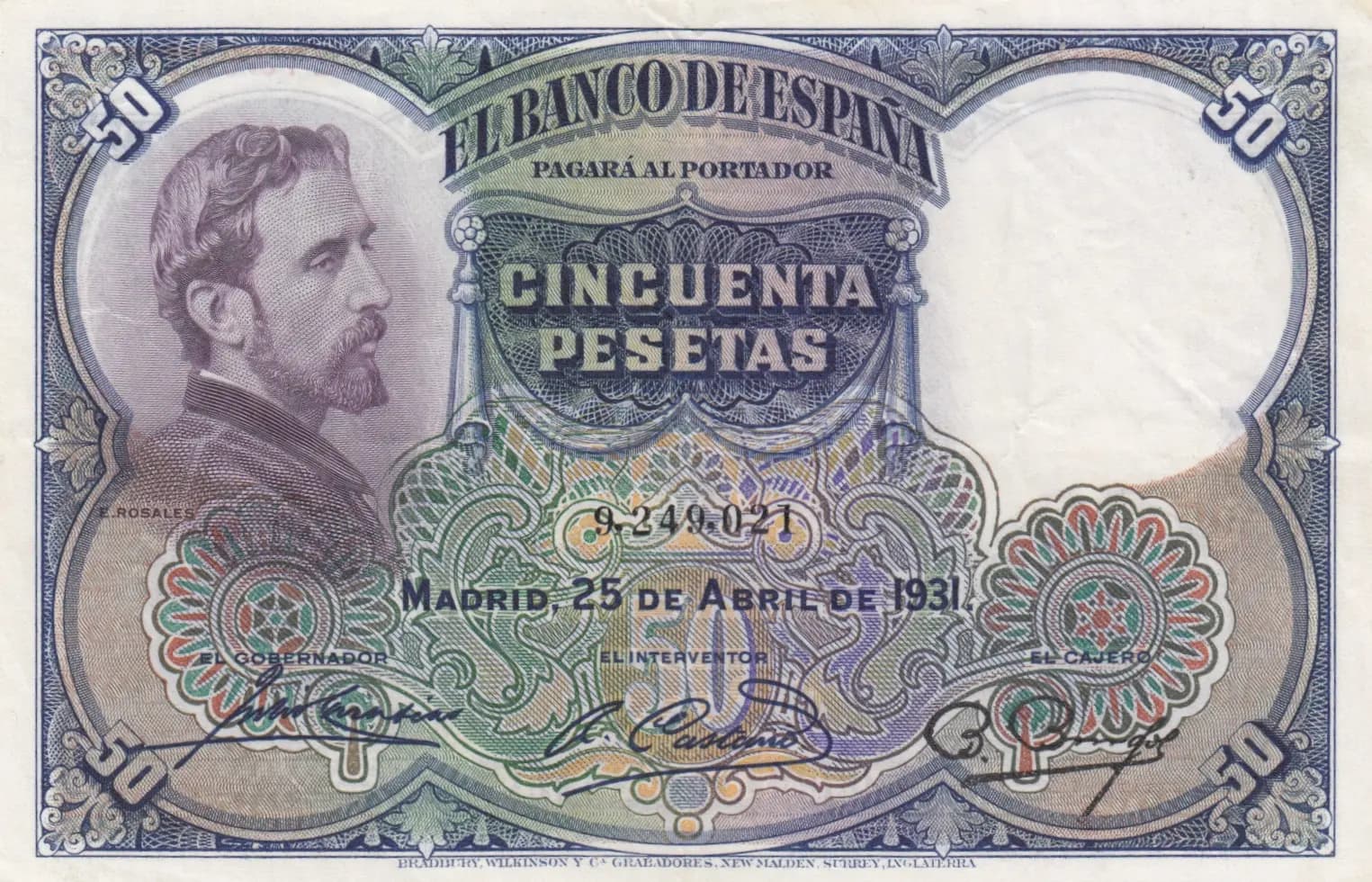
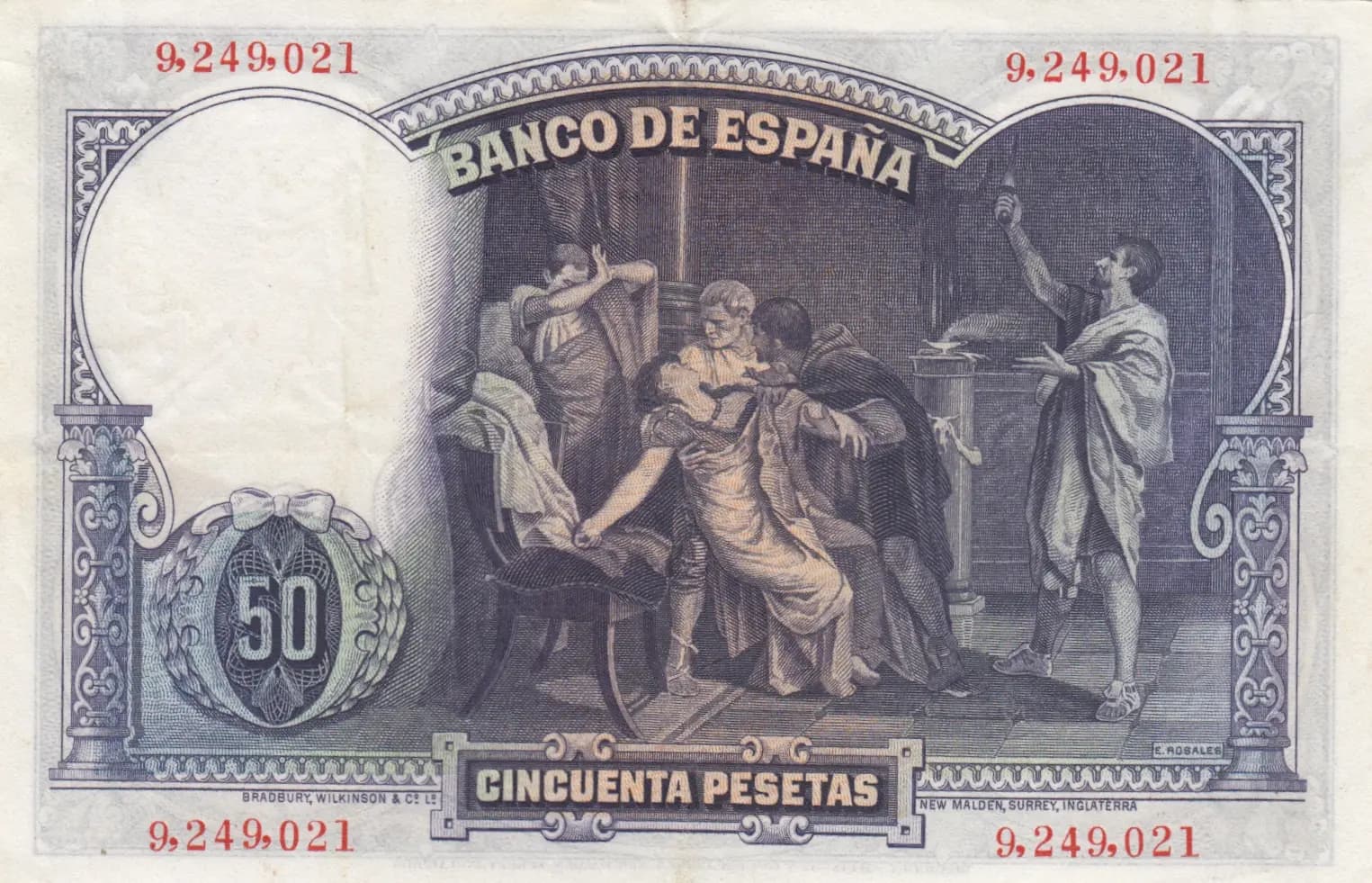
This 50 pesetas banknote from 1931 represents a significant transitional piece issued during Spain's Second Republic period, featuring a distinguished bearded portrait on the obverse and a classical allegorical scene on the reverse. The note displays extensive circulation wear with visible foxing, creasing, and age-related discoloration consistent with its VF grade, yet the fine line engraving remains legible throughout. The design elements and official signatures (Gobernador, Interventor, Cajero) reflect the institutional authority of the Banco de España during this turbulent historical period.
Common. This is a regular-issue banknote from the Banco de España with no indication of a limited print run, recalled status, or short production period. eBay historical sales data shows consistent circulation of VF-graded examples selling in the $2-$22 range over the past decade, with most transactions between $4-$7, indicating substantial availability in the market. The 2016 catalogue value of $30 for VF condition further supports common status, as scarce notes typically command significantly higher premiums.
Issued on April 25, 1931, just days after Spain's transition from monarchy to the Second Spanish Republic, this banknote embodies the early institutional continuity of the new regime through the established Banco de España. The classical artistic reference—featuring Eugenio Rosales' composition—demonstrates the Republic's connection to Spain's cultural heritage and artistic traditions. The formal inscriptions 'PAGARÁ AL PORTADOR' (will pay to the bearer) and official governance signatures reflect the constitutional monetary authority framework established during this revolutionary period.
The obverse features a distinguished bearded male portrait in profile facing right, rendered in purple and mauve tones, identified as Eugenio Rosales—the Spanish painter and engraver whose signature appears on both sides. The portrait is surrounded by ornate decorative floral and geometric patterns in blue, green, and purple, with corner medallions providing additional security detail. The reverse displays 'The Death of Lucretia,' one of Rosales' most famous classical paintings, depicted as a dramatic multi-figure allegorical scene with approximately 5-6 robed classical figures in a complex composition, rendered in black and white fine-line engraving. A circular wreath containing '50' appears in the lower left, with the denomination repeated in the main text. Both sides feature the name of the printer (Bradbury, Wilkinson & Co Ltd) prominently displayed, reflecting the high-security standards of British banknote production.
FRONT SIDE: 'EL BANCO DE ESPAÑA' (The Bank of Spain) / 'CINCUENTA PESETAS' (Fifty pesetas) / 'PAGARÁ AL PORTADOR' (Will pay to the bearer) / 'MADRID, 25 DE ABRIL DE 1931' (Madrid, April 25, 1931) / 'ROSALES' (Designer/Engraver attribution) / 'GOBERNADOR' (Governor) / 'INTERVENTOR' (Auditor/Inspector) / 'CAJERO' (Cashier) / 'HARRISON WILKINSON Y CÍA GRABADORES, NEWMALDEN, SURREY, INGLATERRA' (Harrison Wilkinson & Co. Engravers, Newmalden, Surrey, England). BACK SIDE: 'BANCO DE ESPAÑA' (Bank of Spain) / 'CINCUENTA PESETAS' (Fifty pesetas) / 'C. ROSALES' (Eugenio Rosales, artist) / 'BRADBURY, WILKINSON & CO LTD' (Printer) / 'NEW MALDEN, SURREY, INGLATERRA' (New Malden, Surrey, England) / Serial number '9,249,021' (appears in red on all four corners).
This note was produced using steel-plate line engraving, a security-focused intaglio method executed by the renowned British security printer Bradbury, Wilkinson & Co Ltd of New Malden, Surrey. The fine line engraving technique, evident in the detailed portrait work, complex decorative patterns, and intricate classical scene composition, served as the primary anti-counterfeiting measure of the era. The printer attribution appears on both obverse and reverse, indicating the high-quality production standards applied to this official government currency.
The observed specimen features the standard 1931 design with no overprints or printing variations noted. Serial number 9,249,021 is present in standard red printing on all four corners. The signatures of the Gobernador, Interventor, and Cajero represent the standard authorization structure for 1931 Bank of Spain issues. No known major varieties (such as different signature combinations, color variants, or overprints) are evident in this example.