50 pesetas 1928
Market Prices
50 salesAbout This Note
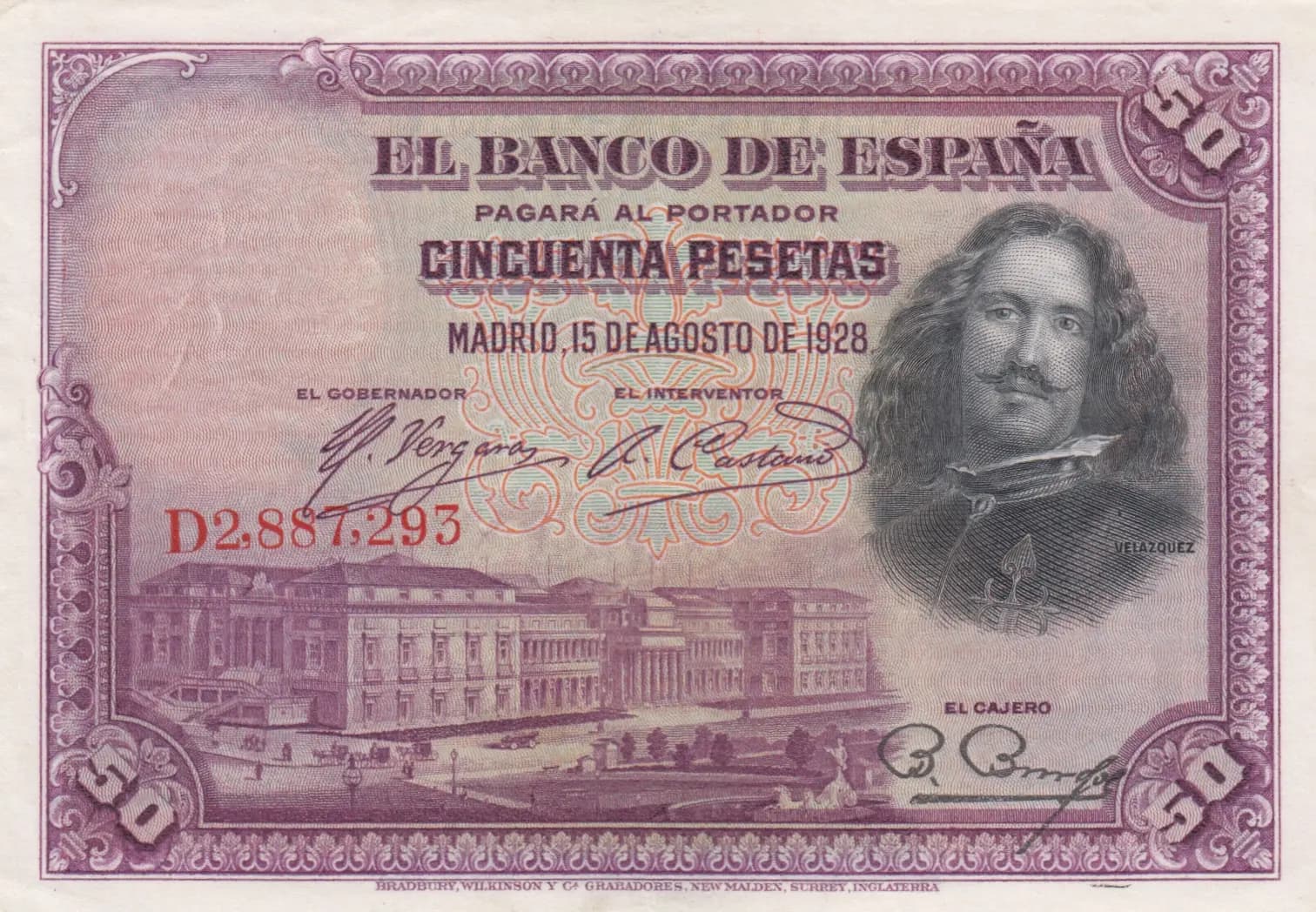
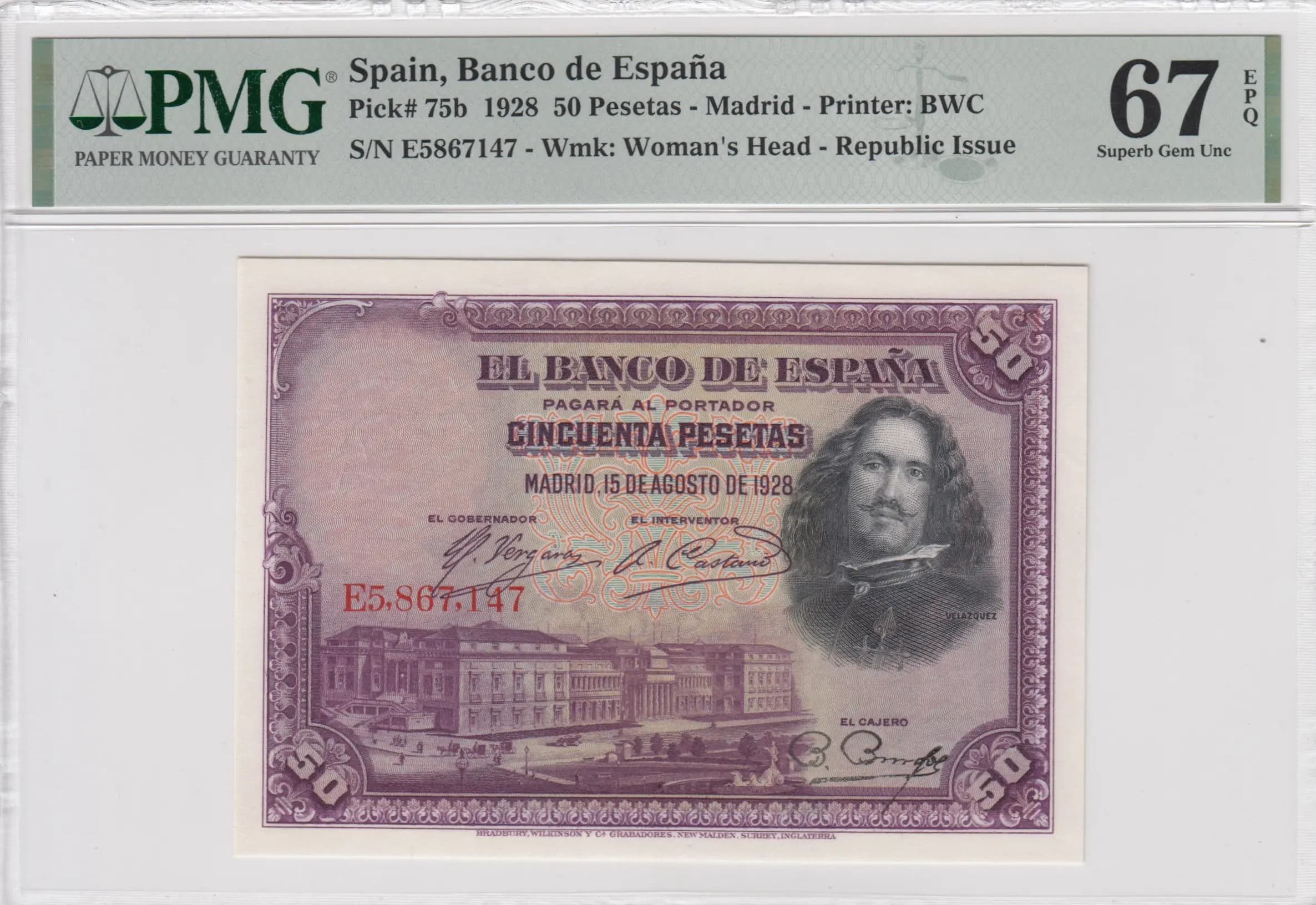
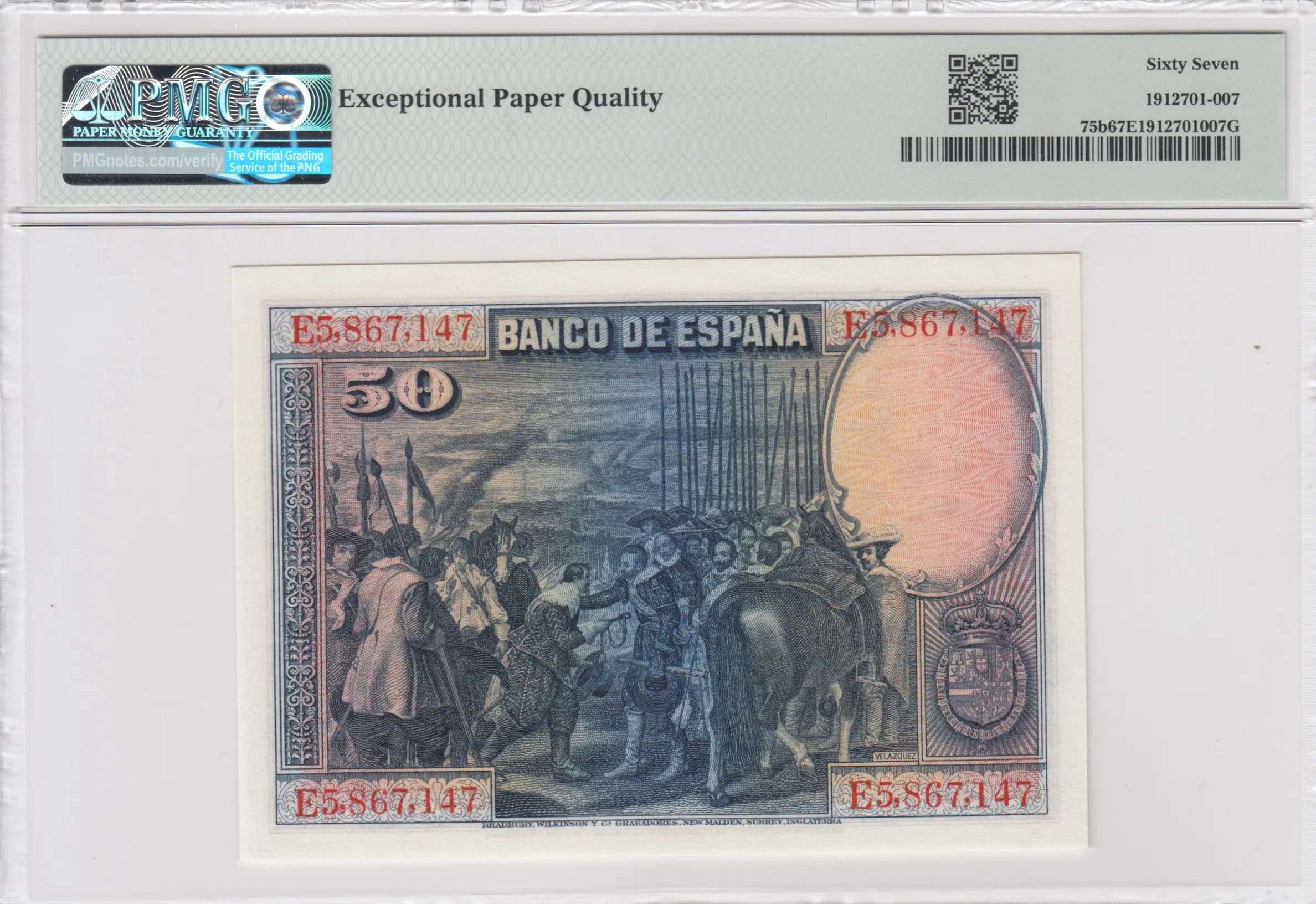
This is an exceptional example of Spain's 1928 50 pesetas note, graded PMG 67 Superb Gem Uncirculated, representing a masterpiece of early 20th-century currency design. The note features a striking portrait of Diego Velázquez on the obverse and his famous painting 'La Rendición de Breda' on the reverse, both rendered in the purple and mauve tones characteristic of this issue. In this exceptional condition with sharp printing, vibrant colors, and no visible wear, this note exemplifies the artistic and technical achievements of Bradbury Wilkinson's engraving work.
Common. This is a regular issue from a major Spanish bank with substantial print runs typical of 1928 currency production. The eBay price history provided shows consistent market activity across all grades, with PMG 67 examples trading in the $75-88 range historically but establishing a broader market value around $30-60. The availability of multiple examples across various grades in the eBay database, combined with catalog values in the $25 UNC range, confirms this as a common note despite its artistic merit. The denomination (50 pesetas) was widely circulated, and surviving examples are readily available to collectors.
Issued during the late Spanish Monarchy period (1928), this banknote celebrates Spain's artistic heritage by featuring Diego Velázquez, one of the nation's greatest painters from the 17th century. The obverse portrait and the reproduction of 'La Rendición de Breda' (The Surrender of Breda) on the reverse serve as powerful symbols of Spanish cultural pride and artistic achievement during a period of relative stability before the tumultuous Spanish Civil War. The Prado Museum depicted on the front underscores the note's connection to Spain's institutional preservation of its cultural legacy.
The obverse features a three-quarter profile portrait of Diego Velázquez positioned at right, rendered with the fine detail characteristic of master engraving. The left and center portions display the Prado Museum in Madrid, shown as a grand classical institutional building that anchors the composition. The entire design is framed by an ornate decorative border with elaborate scrollwork and corner ornaments typical of early 20th-century security currency design. The reverse depicts Velázquez's monumental historical painting 'La Rendición de Breda,' showing multiple figures in 16th-17th century military dress arranged in a ceremonial moment of surrender, with architectural fortifications visible in the background. A large profile portrait appears on the right side in peachy-salmon tones, complementing the historical narrative. The note employs purple and mauve as primary colors with black line work on a cream underprint, creating a sophisticated and dignified aesthetic. The watermark depicts a woman's head, serving as an additional security feature.
FRONT SIDE: 'EL BANCO DE ESPAÑA' (The Bank of Spain) / 'PAGARÁ AL PORTADOR' (Will pay to bearer) / 'CINCUENTA PESETAS' (Fifty pesetas) / 'MADRID, 15 DE AGOSTO DE 1928' (Madrid, August 15, 1928) / 'EL GOBERNADOR' (The Governor) / 'EL INTERVENTOR' (The Auditor/Comptroller) / 'EL CAJERO' (The Cashier) / Serial number 'E5.867.147'. BACK SIDE: 'BANCO DE ESPAÑA' (Bank of Spain) / Denomination '50' (Fifty) / Serial number 'E5.867.147' / 'WILKINSON & CO ENGRAVERS NEW MAIDEN SURREY ENGLAND' (Printer's credit for Bradbury Wilkinson & Company, located in New Malden, Surrey, England).
This note was produced using steel engraving and intaglio printing, the premium security printing method of the era. Bradbury Wilkinson & Company of New Malden, Surrey, England—one of the world's foremost currency printers—executed the detailed engraving work visible in the fine line work, complex cross-hatching, and intricate ornamental patterns throughout. The multi-color printing was achieved through successive passes, with careful registration evident in the precise alignment of purple, mauve, and black elements. The fine geometric patterns and detailed artistic rendering served both aesthetic and anti-counterfeiting functions, making reproduction extremely difficult with contemporary technology.
This note is the Pick-75b variety, identified by the absence of a series letter (distinguished from other series assignments). The serial number observed is 'E5.867.147'. The note was issued on August 15, 1928, as indicated by the date inscription. No significant printing varieties (such as signature variations, overprints, or printing errors) are apparent in this example. The standard design remained consistent throughout the issue, making this a straightforward representative of the 1928 50 pesetas type.