50 pesetas 1928
Market Prices
50 salesAbout This Note
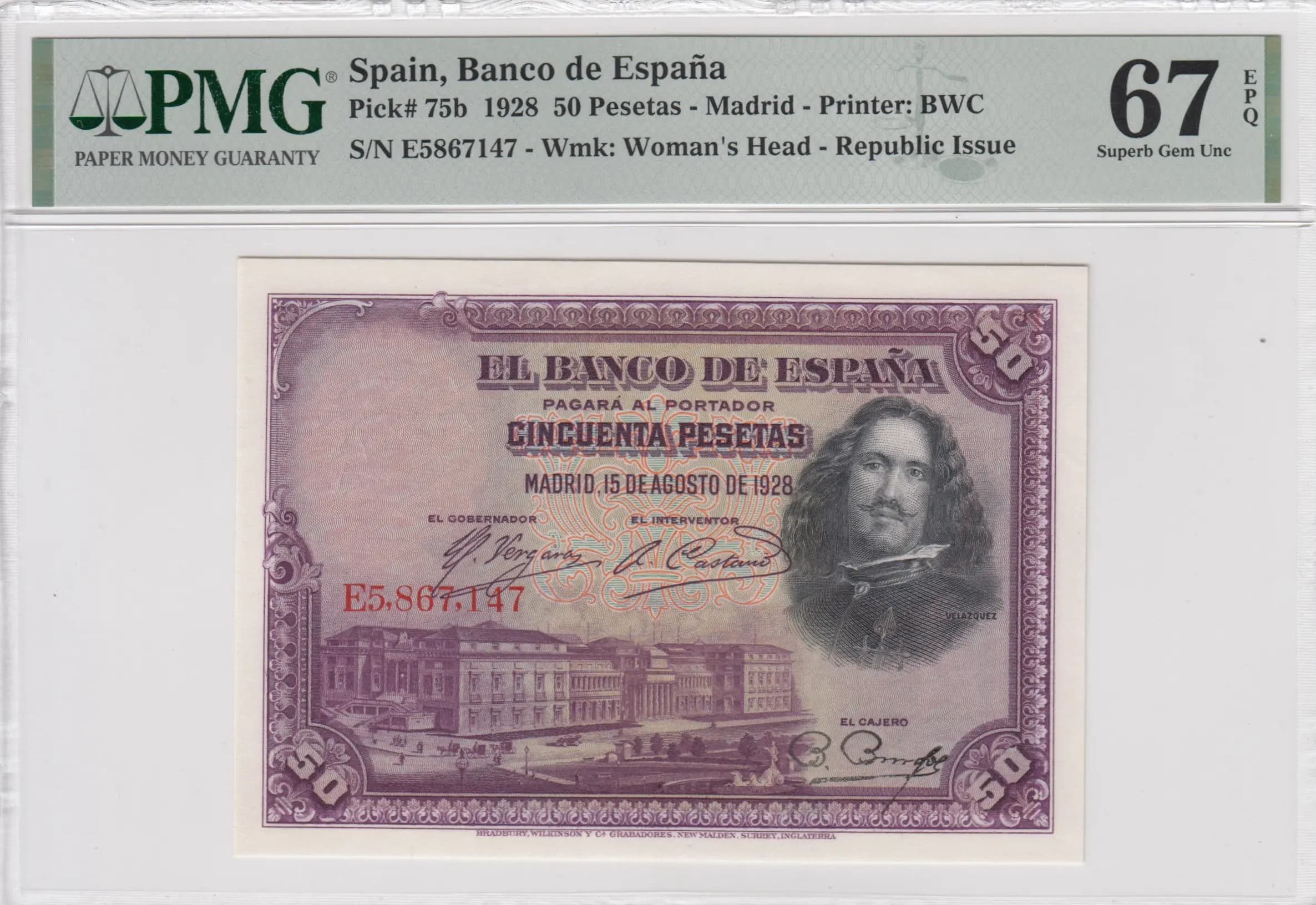
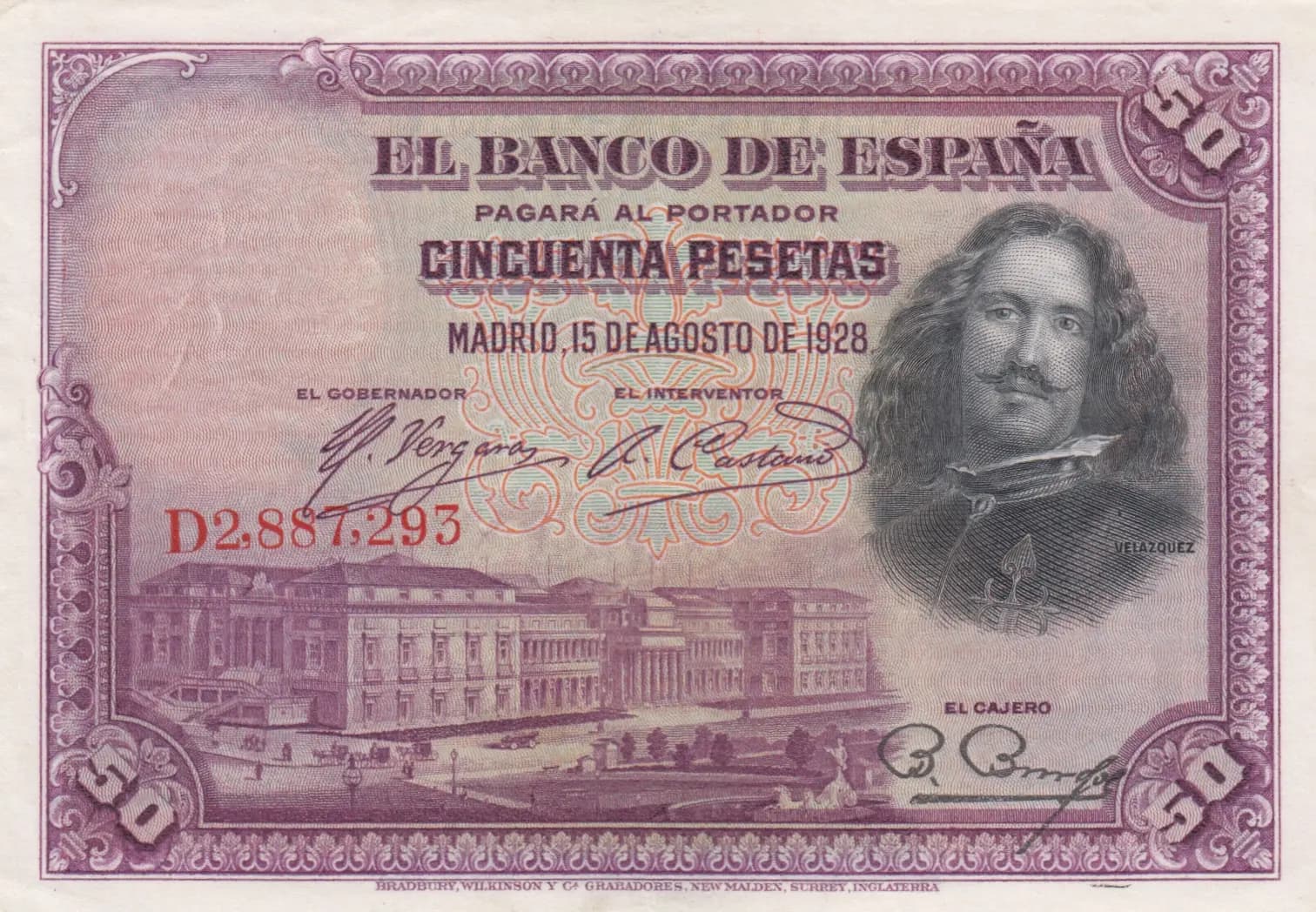
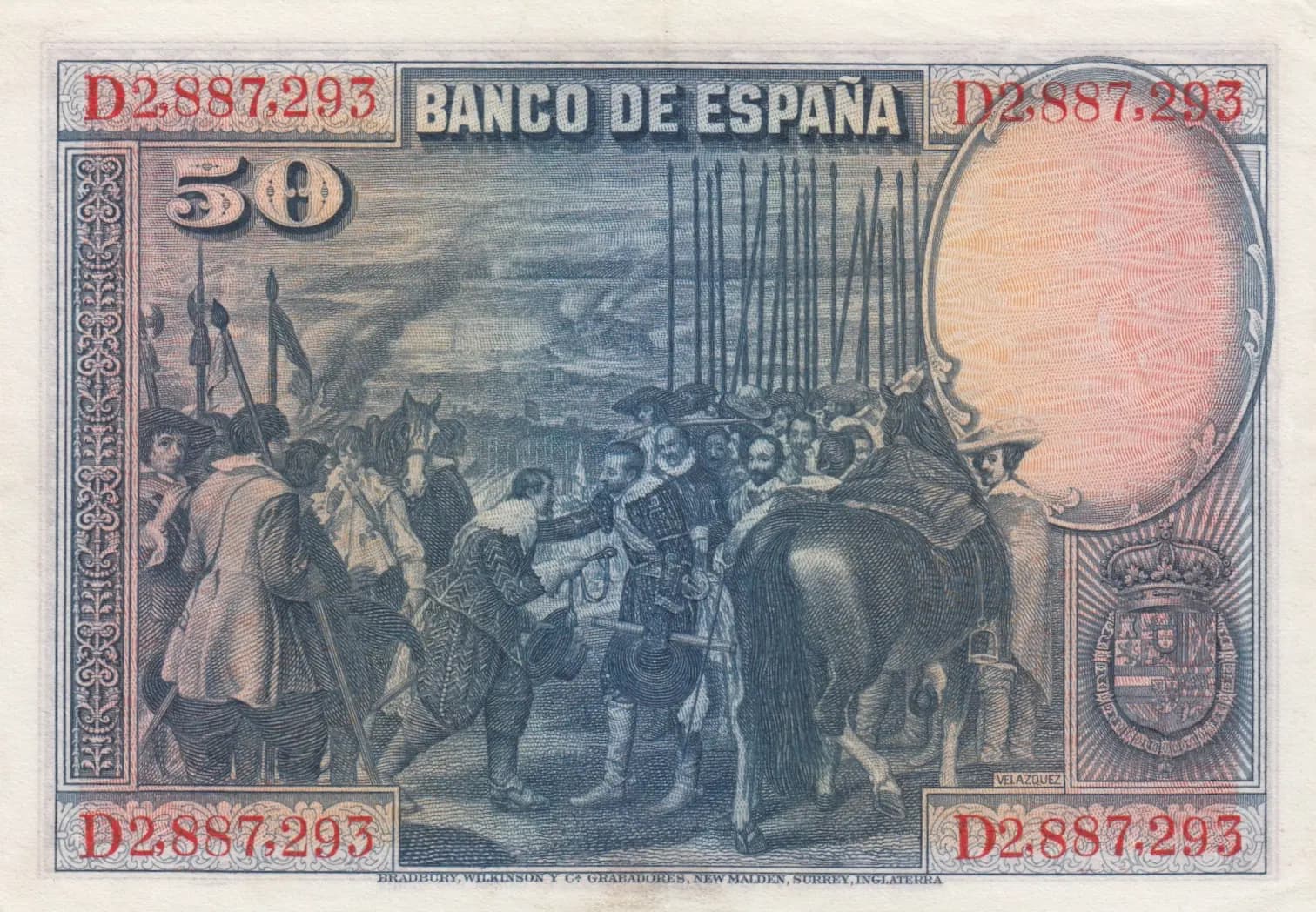
This is a Spanish 50 Pesetas note from 1928, issued by Banco de España on August 15, 1928, and printed by Bradbury Wilkinson in England. The note is presented in AU (About Uncirculated) condition, displaying sharp engraving, vibrant colors in purple/mauve and blue tones, and minimal wear. The obverse features a portrait of Diego Velázquez, the renowned 17th-century Spanish painter, alongside an image of the Prado Museum, while the reverse depicts Velázquez's famous painting 'La Rendición de Breda' (The Surrender of Breda), making this a culturally significant note celebrating Spanish artistic heritage.
Common. The eBay market data shows consistent sales activity with specimens regularly selling in the $1-75 range depending on condition grade, with most ungraded notes selling for under $20 and PMG-graded specimens (65-67) selling in the $35-88 range. AU examples are not exceptional in the market, indicating this was a substantial print run that remains readily available to collectors. Catalog values support this assessment with UNC specimens listed at only $25.
Issued in 1928 during Spain's Second Republic period, this banknote commemorates Diego Velázquez (1599-1660), one of Spain's greatest painters and court artist to King Philip IV. The reverse features 'La Rendición de Breda,' one of Velázquez's masterpieces housed in the Prado Museum in Madrid, depicting a significant moment during the Eighty Years' War. This choice of imagery reflects Spain's effort during this era to celebrate its cultural and artistic legacy during a period of political transition and modernization.
The obverse (front) features a three-quarter portrait of Diego Velázquez positioned on the right side, depicted with characteristic long hair and facial hair typical of 17th-century Spanish nobility. The lower center displays the Prado Museum's neoclassical architecture with multiple stories and columned facade. Ornate heraldic designs and decorative scrollwork frame the composition in mauve and purple tones with cream underlays. The reverse depicts the historical scene from 'La Rendición de Breda,' showing Spanish conquistadors/soldiers in armor encountering indigenous peoples, with a fortified structure with pointed palisades visible in the background. The composition includes Spanish coat of arms on the right, with the large numeral '50' prominently displayed on the left in decorative font. Both sides feature intricate geometric and floral border patterns with fine line engraving throughout.
FRONT SIDE: 'EL BANCO DE ESPAÑA' (The Bank of Spain), 'PAGARÁ AL PORTADOR' (Will pay to bearer), 'CINCUENTA PESETAS' (Fifty pesetas), 'MADRID, 15 DE AGOSTO DE 1928' (Madrid, August 15, 1928), 'EL GOBERNADOR' (The Governor), 'EL INTERVENTOR' (The Comptroller), 'EL CAJERO' (The Cashier), 'BRADBURY, WILKINSON Y Cía GRABADORES, NEW MALDEN, SURREY, INGLATERRA' (Bradbury, Wilkinson and Co. Engravers, New Malden, Surrey, England), Serial number: 'D2,887,293'. BACK SIDE: 'BANCO DE ESPAÑA' (Bank of Spain), denomination '50' (Fifty), 'VILAZQUEZ' (Velázquez artist signature), Serial numbers repeated in four corners: 'D2,887,293', 'BRADBURY, WILKINSON Y Cía GRABADORES, NEW MALDEN, SURREY, INGLATERRA' (Bradbury, Wilkinson and Co. Engravers).
Intaglio engraving, specifically line engraving with fine cross-hatching techniques, produced by Bradbury Wilkinson and Company, the renowned British security printer based in New Malden, Surrey. The fine line engraving is evident from the sharp detail, intricate decorative patterns, and complex geometric borders visible throughout both sides of the note. The multi-color printing (purple, blue, and cream tones) was achieved through multiple engraved plates, a standard technique for high-security banknote production during this era.
This note represents Pick catalog #75b, indicating it is the second variety of the 1928 50 Pesetas issue. The note is without a series letter (as confirmed in catalog references), and bears the date August 15, 1928. The serial number observed is D2,887,293. This Pick designation (75b) distinguishes it from Pick 75a, reflecting different printing sessions or serial number ranges. The lack of a series letter is a notable characteristic of this particular variety.