50 pesetas 1938
Market Prices
2 salesAbout This Note
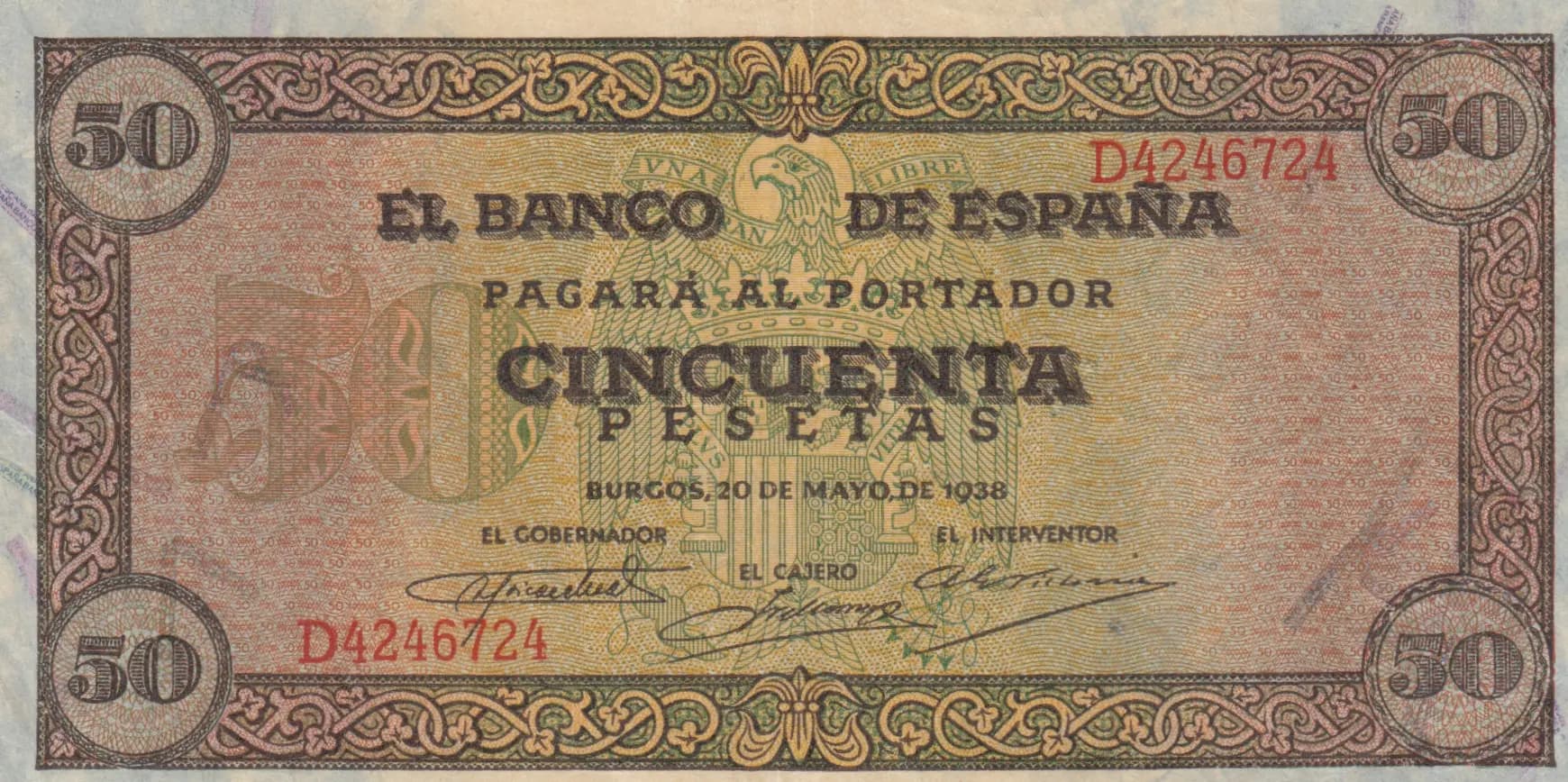
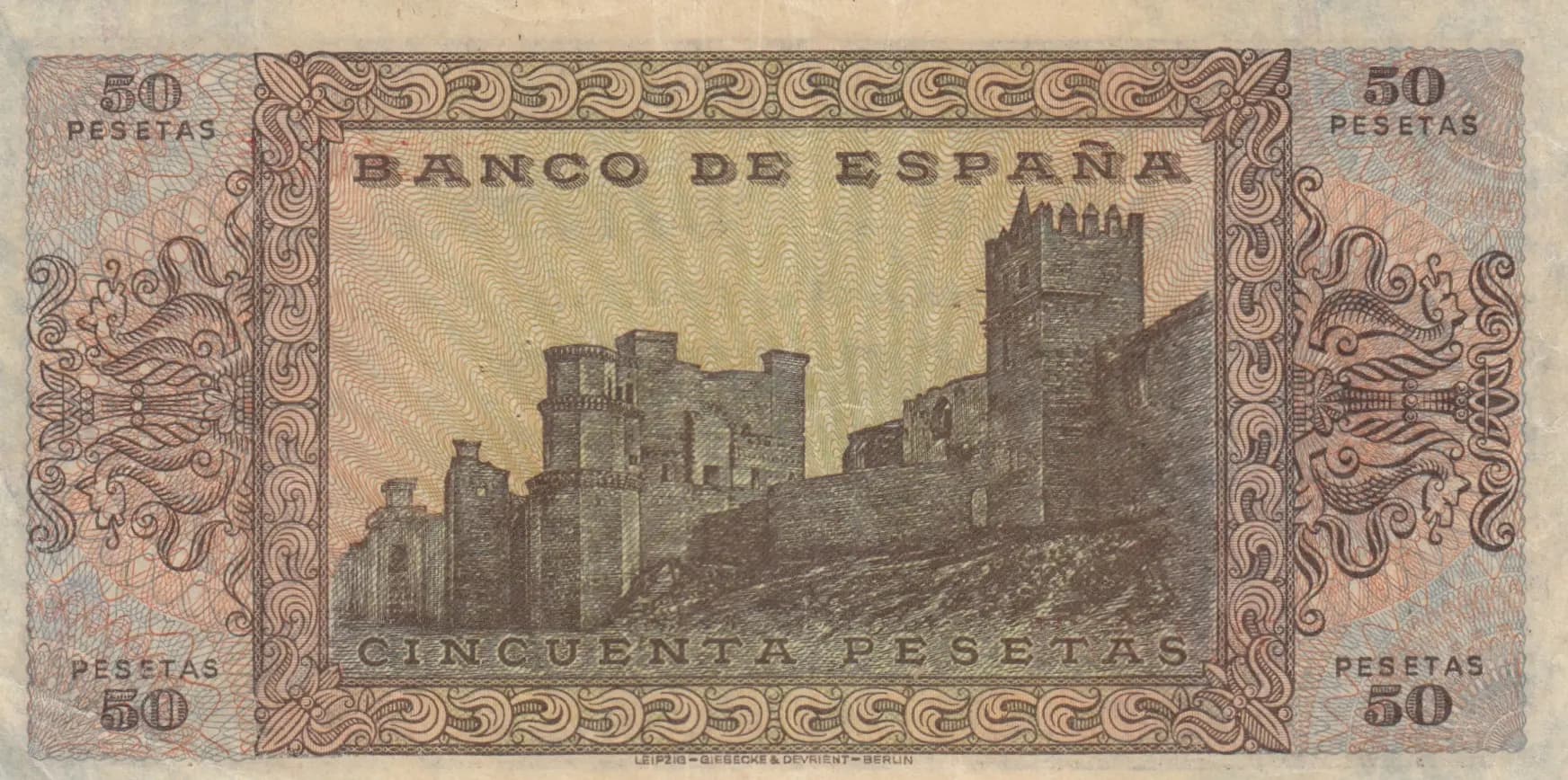
This is a VF-grade 50 Pesetas banknote from the Banco de España, issued May 20, 1938 during the Spanish Civil War from Burgos. The note features an impressive central eagle emblem with ornate geometric borders in brown and gold tones, with red serial numbers (D4246724) visible in corners. The reverse depicts a detailed medieval castle fortification, likely Olite Castle, characteristic of Spanish heritage imagery. The note shows age-appropriate patina with minor foxing but maintains sharp printing and good color registration throughout.
Common. The 1938 50 Pesetas (Pick 112) was a regular issue banknote with substantial circulation during and after the Civil War period. eBay price tracking shows VG and F grades selling for $12-13 in the early 2010s, with 2016 catalogue values of $140 for VF grade. The moderate catalogue value combined with consistent low eBay transaction prices ($12-13) indicates this is a well-supplied note in the collector market. No evidence suggests limited print runs or early recall. This variety remains readily available to collectors at reasonable prices.
This 1938 issue was released from Burgos, the seat of Franco's Nationalist government during the Spanish Civil War, representing the Republican-era Banco de España but operating under Nationalist control. The eagle emblem and castle imagery reflect traditional Spanish heraldic and architectural symbolism, emphasizing national continuity and legitimacy during a period of profound political division. The May 20, 1938 date places this note midway through the civil conflict, before the Republican collapse in March 1939.
The obverse features a commanding heraldic eagle with spread wings as the central motif, symbolizing Spanish authority and sovereignty. The eagle is rendered in fine detail within an ornate rectangular border composed of interlocking geometric and floral patterns in brown and gold, typical of early 20th-century security printing aesthetics. The reverse depicts what is identified as Olite Castle (Castillo de Olite), a major medieval fortress in Navarre with distinctive crenellated towers and defensive walls, rendered in perspective against a landscape background. Both sides employ fine horizontal line work and intricate engraved patterns as anti-counterfeiting measures. The color scheme—tan/beige base with brown, gold, and red accents—creates visual hierarchy and security differentiation.
FRONT: 'EL BANCO DE ESPAÑA' (The Bank of Spain), 'PAGARÁ AL PORTADOR' (Will pay to the bearer), 'CINCUENTA PESETAS' (Fifty pesetas), '50' (denomination), 'BURGOS, 20 DE MAYO DE 1938' (Burgos, May 20, 1938), 'EL GOBERNADOR' (The Governor), 'EL INTERVENTOR' (The Auditor), 'EL CAJERO' (The Cashier), 'D4246724' (serial number). BACK: '50' and 'PESETAS' (denomination markers), 'BANCO DE ESPAÑA' (Bank of Spain), 'CINCUENTA PESETAS' (Fifty pesetas), 'LEIPZIG - G.BEGUCKE & DEVRIENT - BERLIN' (printer attribution).
Intaglio (engraved) printing produced by Giesecke & Devrient (G&D), the renowned Leipzig/Berlin security printer. The fine line work, sharp detail in the castle engraving, and crisp color registration visible throughout indicate high-quality steel plate engraving with multi-color sequential printing. The decorative borders and security patterns are characteristic of G&D's interwar production standards, using precisely controlled line density and register for counterfeiting resistance.
This note is identified as Pick 112a (Burgos issue), as confirmed by the 'BURGOS, 20 DE MAYO DE 1938' inscription visible on the obverse. The PMG population report indicates this is the only known variety catalogued for Pick 112. The serial number D4246724 places this within the D-series printing, though without comprehensive serial number research, the full range of D-series varieties cannot be determined from the visual evidence alone. No overprints, signatures variations, or other secondary characteristics distinguishing additional varieties are apparent on this example.