50 pesetas 1936
Market Prices
2 salesAbout This Note
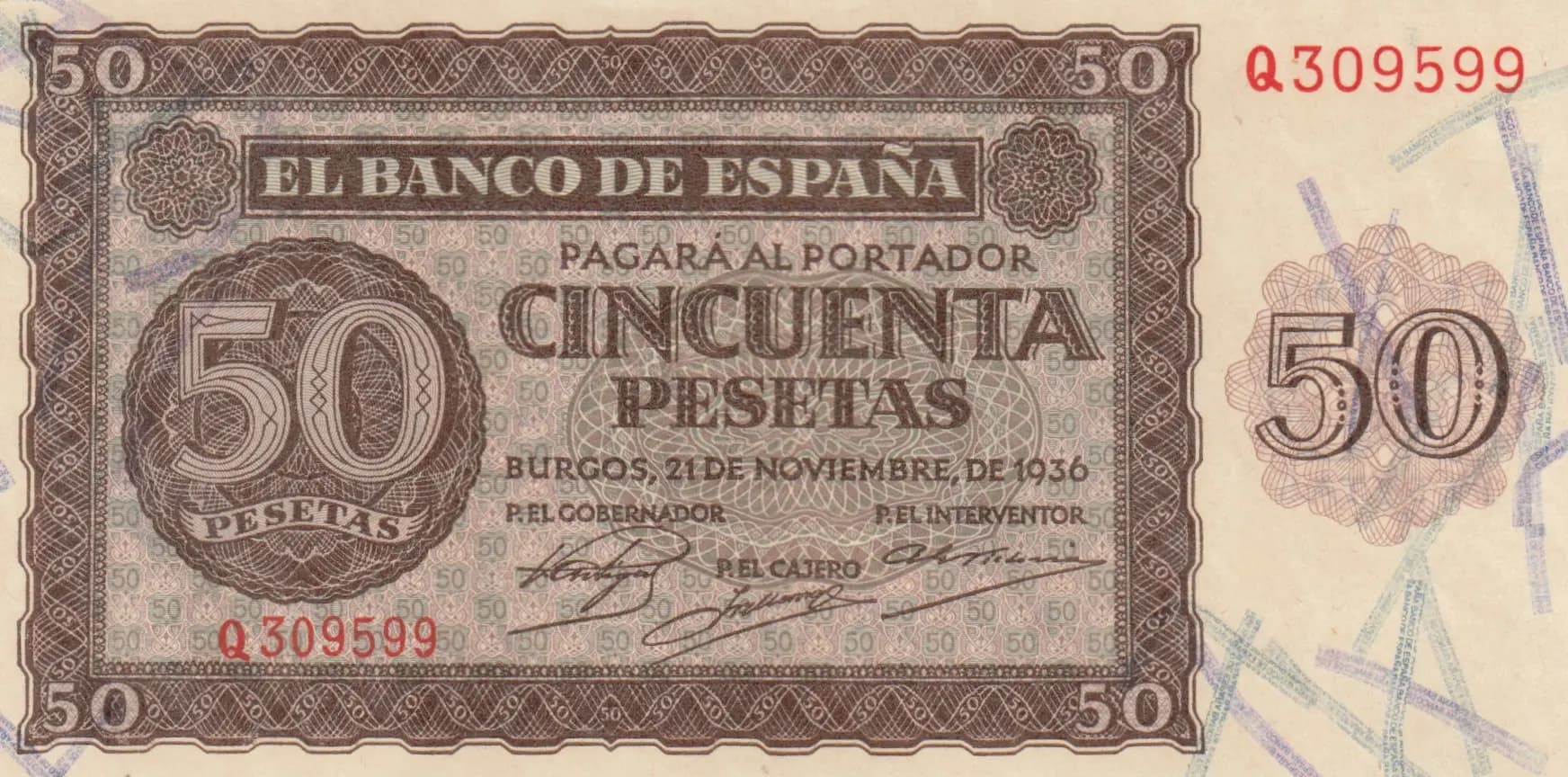
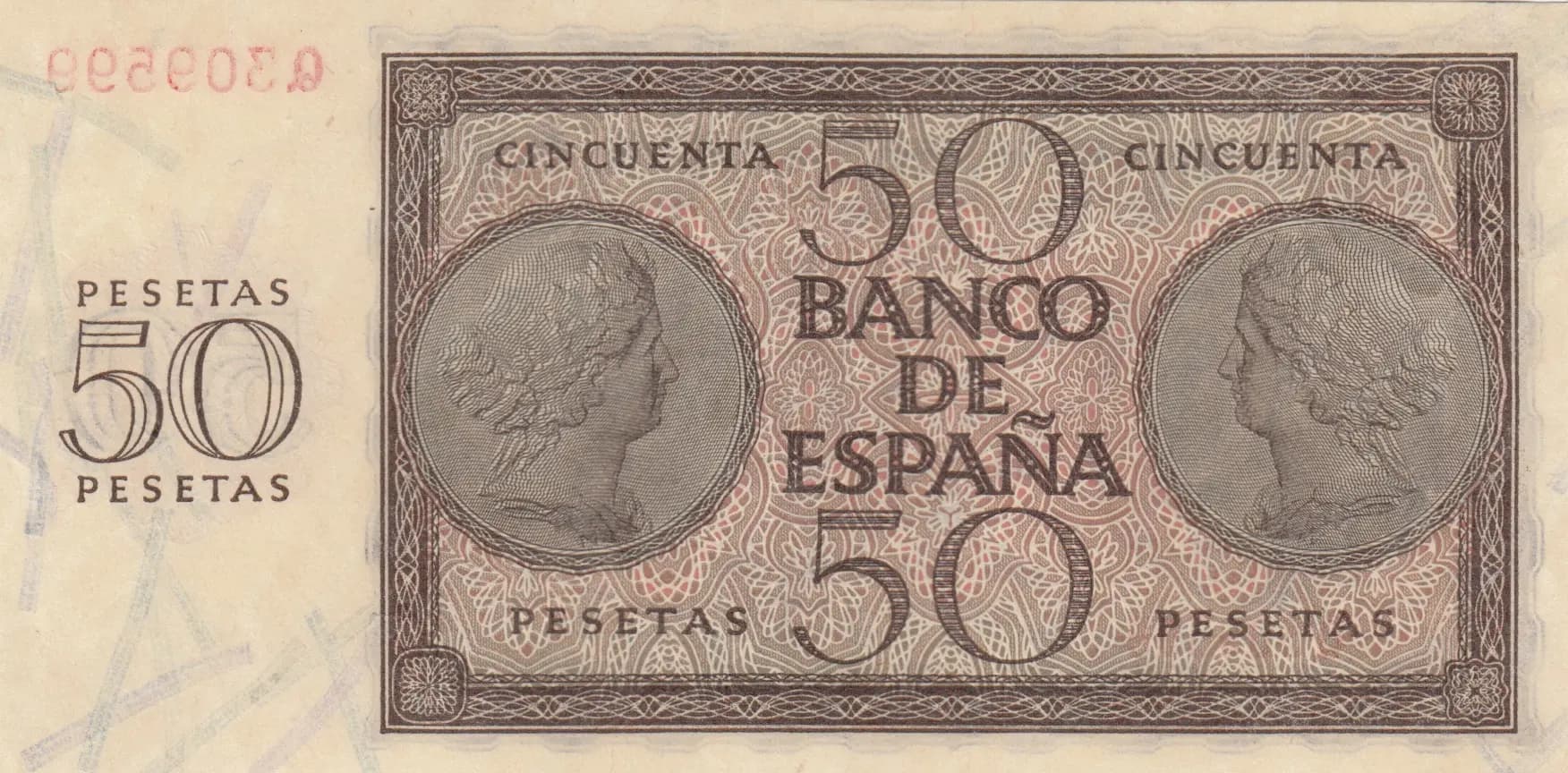
This is a 50 pesetas banknote issued by Banco de España on November 21, 1936, during the Spanish Civil War, in EF condition. The note features an elegant brown and sepia color scheme with ornate geometric borders and a central circular medallion containing the denomination. The reverse displays two male profile portraits facing right, characteristic of Spanish banknote design from this period. Despite showing expected age-related yellowing and foxing typical of an 86-year-old note, the fine line engraving remains crisp and clearly visible.
Common. While this is a historically significant note from the Spanish Civil War period, the catalog reference data showing eBay transactions in the $9-12 range for lower grades (VG-F) clearly indicates this is not a scarce or rare variety. The 2016 catalog values of $120-325 for VF grades and recent market sales below $13 confirm high availability. This is a regular issue from an active issuing period with substantial print runs. The EF condition may command a modest premium over heavily circulated examples, but the note itself is fundamentally common in the market.
This note was issued from Burgos on November 21, 1936, a significant date marking the establishment of the Nationalist government's financial authority during the Spanish Civil War. The formal 'PAGARÁ AL PORTADOR' (will pay to the bearer) inscription reflects the classical banking conventions of the era, while the dual signature blocks for the Governor, Intervener, and Cashier demonstrate the institutional oversight of the period. The portraits on the reverse likely represent prominent Spanish historical or financial figures, though their specific identities reflect the Nationalist regime's iconography of the time.
The obverse features a classical symmetrical design centered on a large ornamental circular medallion containing the numeral '50' with decorative flourishes. The background incorporates a sophisticated repeating pattern of '50' denominators integrated into an ornate geometric framework with interlocking designs and rosette patterns in the corners. The note uses a cream or off-white paper stock with brown and sepia inks applied in fine parallel line engraving. The reverse presents a more portrait-focused composition with two male profile heads positioned on either side of a central area containing the denomination and bank name. Both sides employ elaborate decorative borders featuring floral and geometric motifs. The portraits on the reverse represent significant Spanish figures of the period, though their specific identities remain characteristic of Nationalist-era iconography. The fine detail work throughout demonstrates high-quality intaglio printing with carefully controlled ink density.
FRONT SIDE: 'EL BANCO DE ESPAÑA' (The Bank of Spain); 'PAGARÁ AL PORTADOR' (Will pay to the bearer); 'CINCUENTA PESETAS' (Fifty pesetas); 'BURGOS, 21 DE NOVIEMBRE DE 1936' (Burgos, November 21, 1936); 'P. EL GOBERNADOR' (For the Governor); 'P. EL INTERVENTOR' (For the Intervener); 'EL CAJERO' (The Cashier); Serial number Q309599; Denomination '50' in corners. REVERSE SIDE: 'CINCUENTA' (Fifty); 'BANCO DE ESPAÑA' (Bank of Spain); 'PESETAS' (Pesetas); Denomination '50'; The reverse displays the institution name vertically in the central area.
Intaglio engraving (line engraving) throughout, characteristic of security banknote production of the era. The printer is identified as G&D (Giesecke & Devrient) without imprint mark visible on the note. The fine parallel line patterns, ornate borders, and detailed portrait work are signatures of the highest-quality intaglio techniques employed by this security printer. The controlled application of brown and sepia inks on the cream paper stock required precision registration typical of professional currency production.
This is identified as Pick P-100, the standard 1936 issue of 50 pesetas from Banco de España. The serial number Q309599 indicates a mid-range serial from the printing series. No significant varieties are noted beyond standard serial number progression. The signature block configuration and the Burgos date (indicating the Nationalist government's seat) are consistent with the regular issue type. Giesecke & Devrient printing without imprint is the standard for this Pick number.