5 pesetas 1947
Market Prices
13 salesAbout This Note
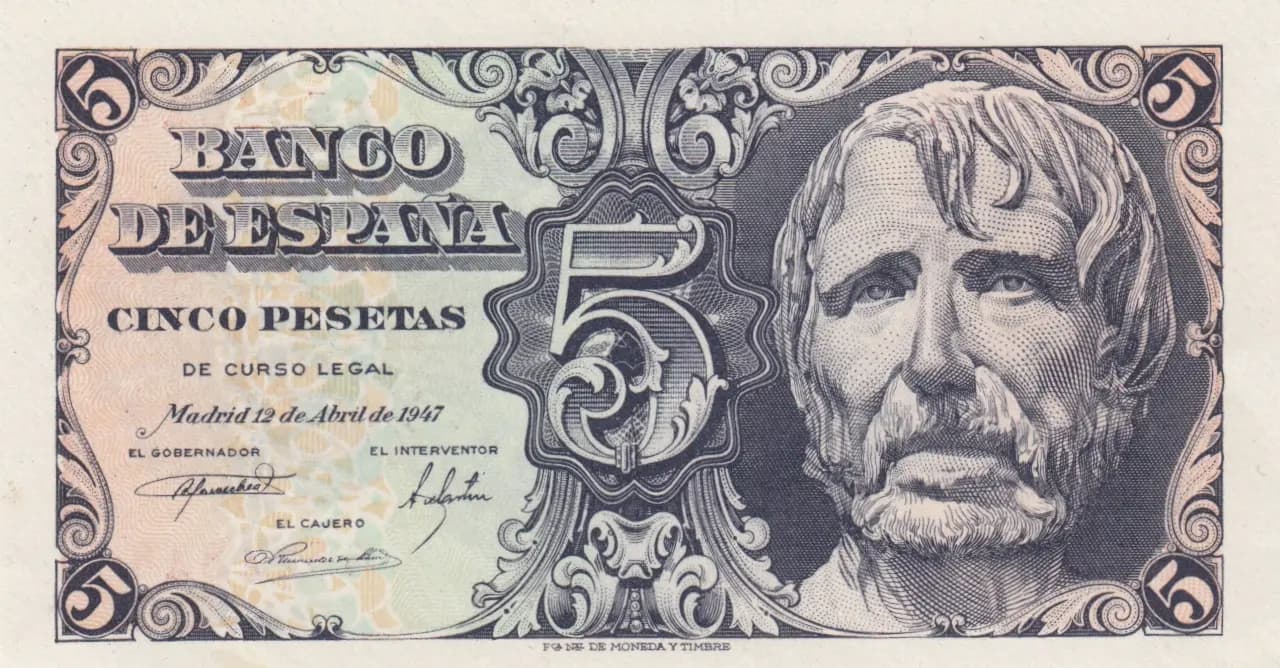
This is a well-preserved UNC example of the 1947 Spanish 5 pesetas (Pick P-134), featuring an elegant portrait of the Roman Stoic philosopher Lucius Annaeus Seneca on the obverse. The note displays the characteristic blue-grey and cream coloring with ornate engraved borders and floral motifs typical of mid-20th century Spanish currency design. Light aging is visible in the cream-colored areas, but the note exhibits no major creases, tears, or damage, with clear serial numbers and signatures throughout—making it a desirable specimen for Spanish numismatic collectors.
Common. While the eBay market data shows prices ranging from under $1 to $145 depending on condition and professional grading, most sales cluster in the $10-60 range for circulated to AU grades. The catalog 2016 value of $110 for UNC reflects a reasonable market price for this denomination and date. The 1947 series had substantial print runs as it was a regular issue of the Banco de España, and no historical sources indicate limited production or recall. The note appears on the numismatic market with reasonable frequency, particularly in lower grades.
Issued on April 12, 1947, this banknote reflects Spain's post-Civil War period under Franco's regime, when the peseta remained the national currency. The selection of Lucius Annaeus Seneca, the Roman philosopher and statesman born in Córdoba (modern-day Spain), represents a deliberate choice to connect Spain's classical heritage to its contemporary monetary authority. This 1947 series represents a significant issue in Spanish banknote history, as it was produced during the early stabilization period of the Spanish economy following the devastation of the Spanish Civil War.
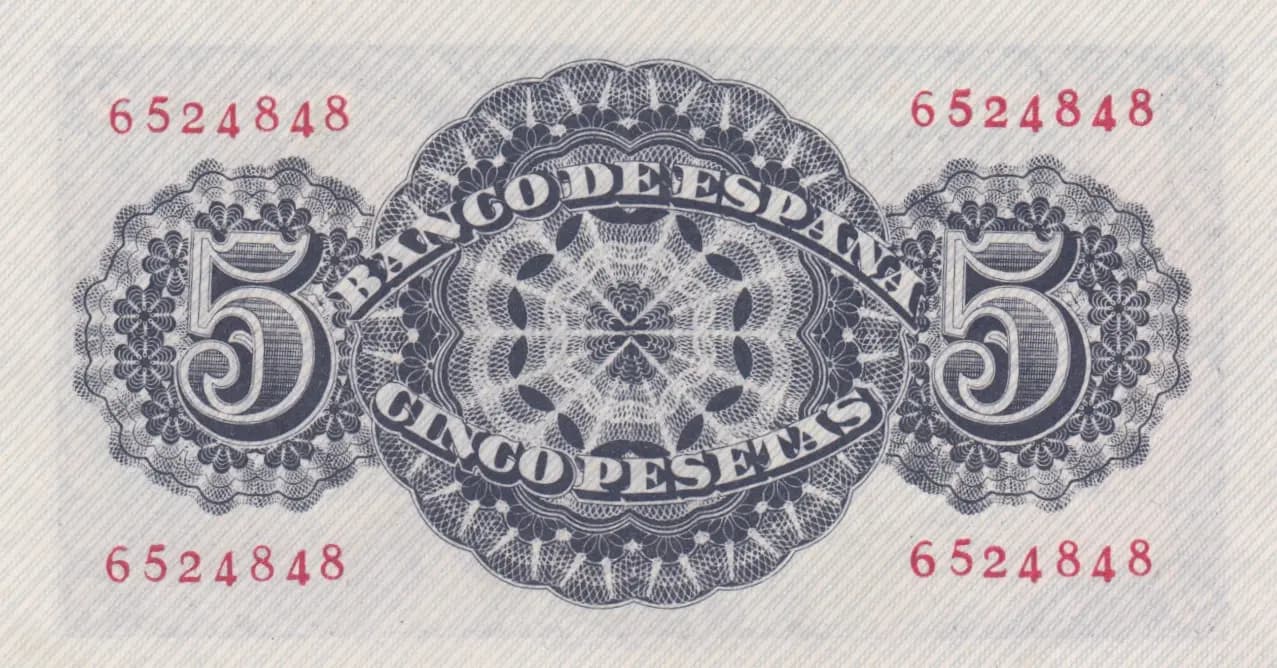
The obverse features a right-facing profile portrait of Lucius Annaeus Seneca (4 BC–65 AD), the Córdoban-born Roman philosopher, rendered in fine detail with his characteristic long beard and classical features. The portrait occupies the right portion of the note and is framed by ornate scrollwork and floral patterns in the corners, with a large ornamental numeral '5' in a decorative shield positioned center-right. The reverse presents a symmetrical, geometric design centered on an elaborate circular ornamental medallion with intricate geometric and floral patterns, with the numeral '5' repeated in ornate style in all four corners. The dominant color palette consists of blue-grey with cream-white backgrounds, creating a sophisticated and traditional appearance befitting the formal nature of Spanish state currency.
FRONT SIDE: 'BANCO DE ESPAÑA' (Bank of Spain), 'CINCO PESETAS' (Five Pesetas), 'DE CURSO LEGAL' (Legal Tender), 'Madrid 12 de Abril de 1947' (Madrid, April 12, 1947), 'EL GOBERNADOR' (The Governor), 'EL INTERVENTOR' (The Auditor), 'EL CAJERO' (The Cashier). BACK SIDE: 'BANCO DE ESPAÑA' (Bank of Spain), 'CINCO PESETAS' (Five Pesetas), Serial number '6524848' printed in red ink in all four corners.
Intaglio engraving (recess printing), the standard security printing method for banknotes of this era. The note was produced by the Fábrica Nacional de Moneda y Timbre (National Mint and Stamp Factory) in Madrid, Spain's official state security printer. The fine line work, intricate background patterns, ornamental borders, and detailed portrait engraving are characteristic hallmarks of intaglio printing, which provides both aesthetic appeal and anti-counterfeiting security through the depth and precision of the engraved designs.
The PMG population report identifies this as P-134a variant (Madrid issue). The visual analysis confirms this is the standard Madrid variety, as indicated by the inscription 'Madrid 12 de Abril de 1947' on the obverse. The serial number visible on this specimen (6524848) appears to be in the typical red ink format for this issue. No significant printing varieties (such as signature variations, date variants, or overprints) are evident in the visual analysis, suggesting this is a standard production specimen of the 1947 regular issue.