5 pesetas 1940
Market Prices
3 salesAbout This Note
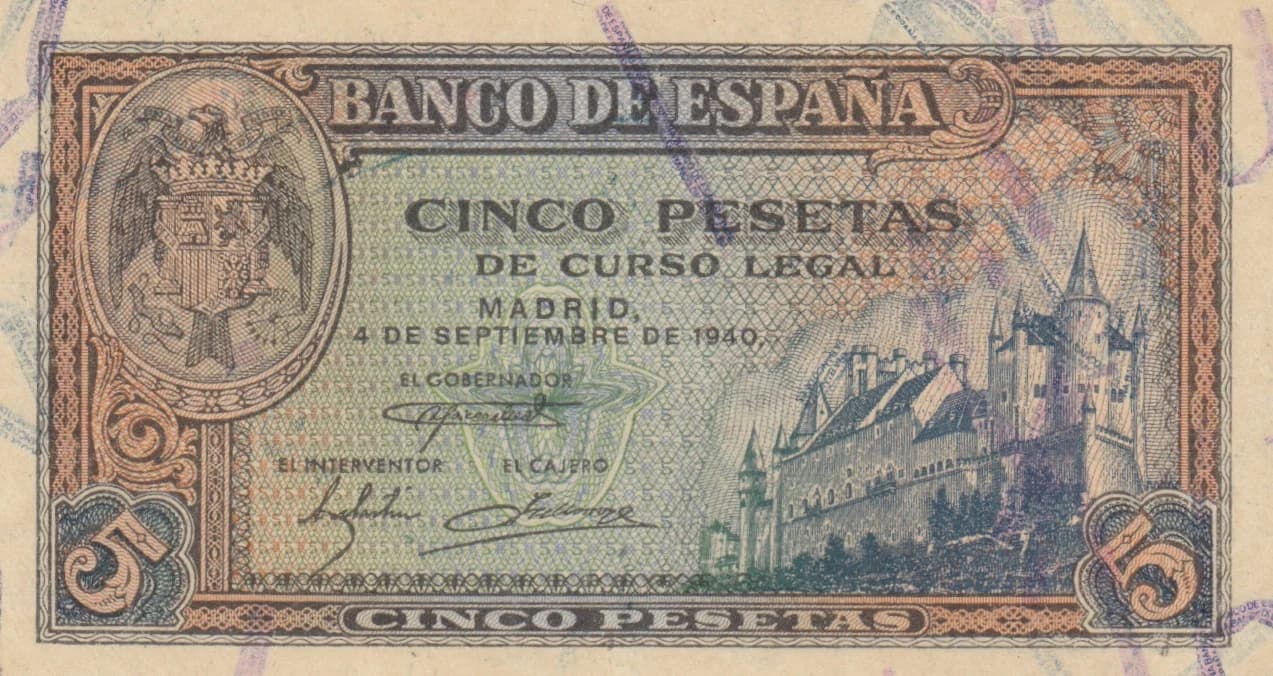
This is a Spanish 5 Pesetas banknote from 1940, issued by the Banco de España in UNC condition. The note features exceptional engraving quality with a striking design combining the royal coat of arms on the obverse and the Alcázar of Segovia fortress prominently displayed on the right side. Despite the visible purple stamp markings from banking circulation, the note retains its crisp appearance and vibrant color scheme of brown, green, and blue tones, making it an attractive example of Franco-era Spanish currency.
Common. This is a regular issue banknote from a major issuing authority with substantial print runs typical of the 1940 Spanish monetary system. The catalog value data supports this assessment: UNC examples sell for $122-127.50 on the secondary market, with VG examples at $20, indicating steady collector demand but no scarcity premium. The visible circulation marks and banking stamps on this example, while consistent with UNC grading standards, suggest these notes circulated widely. This Pick-123 variant is a standard, non-error issue without the scarcity factors (short print run, recall, early withdrawal) that would elevate its rarity classification.
This note was issued on September 4, 1940, during the early Franco regime in Spain, a period marked by post-Civil War reconstruction and the establishment of new monetary policies. The inclusion of the Alcázar of Segovia—one of Spain's most iconic medieval fortresses—reflects the nationalist government's emphasis on Spanish heritage and historical symbols. The royal coat of arms and formal heraldic imagery reinforce the authoritarian state's connection to Spanish imperial tradition during this formative period of Francoist Spain.
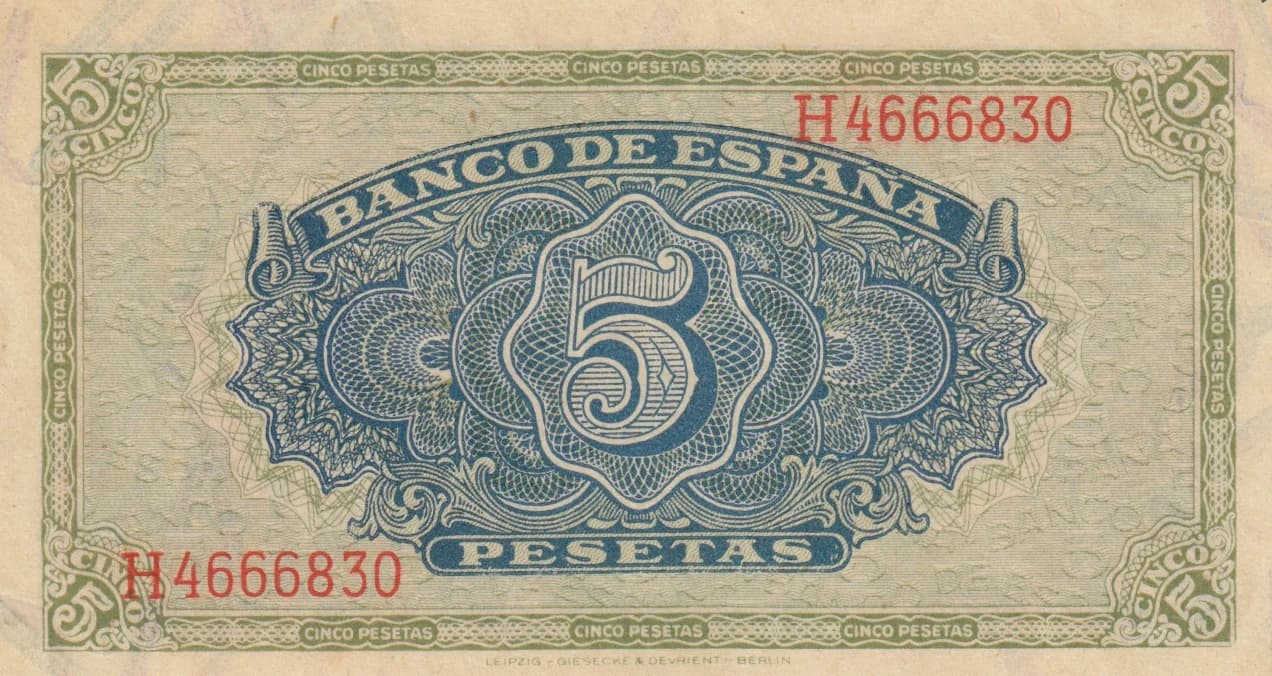
The obverse features a sophisticated multicolor design dominated by the Spanish royal coat of arms enclosed in an ornate oval cartouche on the left side, while the right side displays a detailed engraving of the Alcázar of Segovia, a Gothic-Renaissance fortress with characteristic crenellated towers and spires rendered in blue-gray tones against cream and orange underprinting. The center of the note contains the denomination text and official signatures for the Governor, Intervener, and Cashier of the Banco de España. The reverse displays a bold ornamental numeral '5' within an elaborate shield-shaped medallion surrounded by intricate scrollwork and botanical filigree patterns, with the serial number 'H4666830' printed in red. The overall design employs classical Spanish heraldic and architectural symbolism appropriate to the Franco-era nationalism.
FRONT SIDE: 'BANCO DE ESPAÑA' (Bank of Spain), 'CINCO PESETAS' (Five Pesetas), 'DE CURSO LEGAL' (Legal Tender), 'MADRID, 4 DE SEPTIEMBRE DE 1940' (Madrid, September 4, 1940), 'EL GOBERNADOR' (The Governor), 'EL INTERVENTOR' (The Intervener), 'EL CAJERO' (The Cashier). BACK SIDE: 'BANCO DE ESPAÑA' (Bank of Spain), '5' (denomination numeral), 'PESETAS' (Pesetas), 'CINCO PESETAS' (Five Pesetas), 'H4666830' (Serial Number), 'LEIPZIG · GIESECKE & DEVRIENT · BERLIN' (Printer attribution).
Intaglio (copperplate) engraving, the standard security printing method for banknotes of this era. The fine line engraving patterns, ornate decorative borders with intricate details, and the depth of impression visible throughout the note are characteristic of intaglio work. The note was produced by Giesecke & Devrient, Leipzig/Berlin, one of Europe's premier security printers, as confirmed by the printer attribution on the reverse. The multicolor printing involved separate engraved plates for different color layers, with brown/tan, green, blue, and red inks applied in sequence.
Pick-123a (Madrid) is the catalogued variant for this Pick number. The observed example shows the issue date of 4 September 1940 and includes the standard signatures for the Governor, Intervener, and Cashier positions. The serial number prefix 'H' followed by '4666830' is noted. No error varieties, overprints, or significant printing anomalies are apparent in the visual analysis. This appears to be a standard printing of the regular Madrid issue without notable variety characteristics such as signature variations or date changes that would distinguish it as a separate sub-variety.