5 pesetas 1938
Market Prices
6 salesAbout This Note
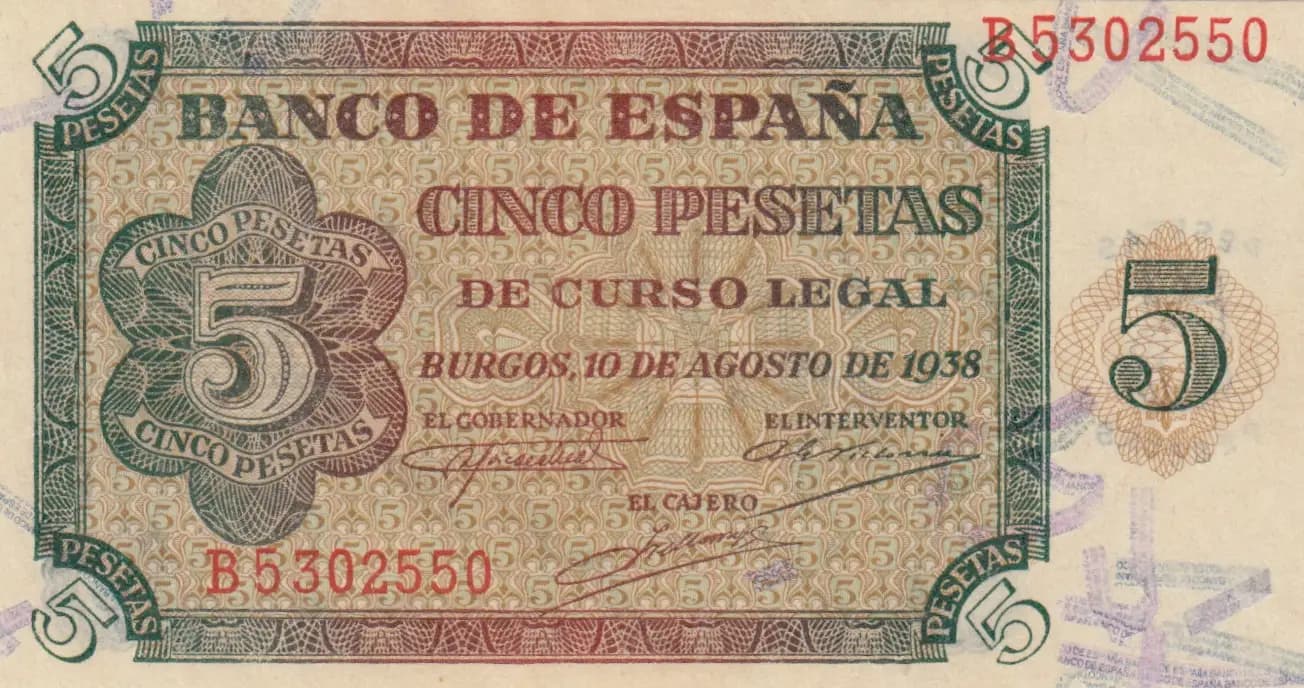
This is a 5 Pesetas banknote issued by Banco de España on August 10, 1938, during the Spanish Civil War, representing the Nationalist (Burgos) government's currency. The note displays the characteristic ornate Art Deco design of the period with green and red coloring on a cream underprint, featuring prominent denomination numerals in decorative oval and star-shaped medallions. Despite its UNC catalog grade, the physical specimen shows visible foxing, light discoloration, and violet stamps scattered across both sides, indicating age and historical handling rather than pristine preservation.
Common. The eBay price data shows recent sales ranging from $10.51 to $36.75 for circulated examples, with even a PMG 65 graded specimen selling for $229.99, which is typical market pricing for this issue. The 2016 catalog value of $120 for UNC is moderate. The note was issued in substantial quantities during the Spanish Civil War period, and examples remain readily available to collectors. No evidence suggests limited print runs, recalls, or rarity factors for this Pick number.
This 5 pesetas note was issued from Burgos on August 10, 1938, during the Spanish Civil War when Francisco Franco's Nationalist government established its own banking authority separate from the Republican government in Madrid. The deliberate issuance location of Burgos (a Nationalist stronghold) and the formal 'legal tender' designation ('DE CURSO LEGAL') on the note underscored the Nationalist government's claim to legitimate authority. The ornate, traditional design reflects the conservative aesthetic favored by the Franco regime during this transitional period of Spanish monetary and political reorganization.
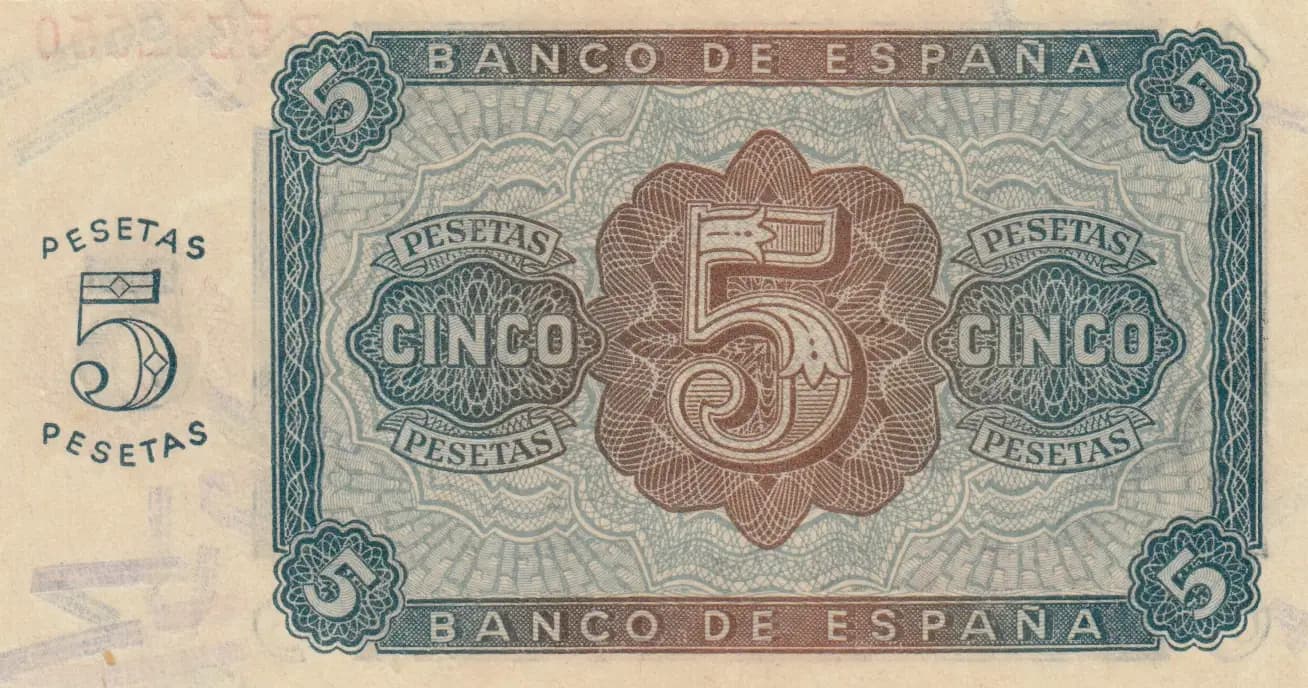
The obverse features a balanced classical design centered on a large numeral '5' enclosed in an ornamental oval frame with geometric detailing on the left side, flanked by decorative rosette patterns in the corners. The center contains the issuer, denomination, and legal status text in formal typography. Three signature lines at the bottom represent the three official signatories (Governor, Auditor, Treasurer) required for the note's validity. The reverse presents a more elaborate design with a prominent star or flower-shaped medallion in the center containing the numeral '5', with 'CINCO PESETAS' text symmetrically positioned on both sides, and radiating line patterns creating depth in the background. No portraits or specific landmarks are depicted; the design relies entirely on classical ornamental and geometric patterns characteristic of interwar European banknote design.
FRONT SIDE: 'BANCO DE ESPAÑA' (Bank of Spain), 'CINCO PESETAS' (Five Pesetas), 'DE CURSO LEGAL' (Legal Tender), 'BURGOS 10 DE AGOSTO DE 1938' (Burgos, 10th of August 1938), 'EL GOBERNADOR' (The Governor), 'EL INTERVENTOR' (The Auditor/Inspector), 'EL CAJERO' (The Treasurer/Cashier), 'PESETAS' (Pesetas), and serial number 'B5302550'. BACK SIDE: 'BANCO DE ESPAÑA' (Bank of Spain), 'CINCO' (Five), 'PESETAS' (Pesetas), and the numeral '5'. All inscriptions are in Spanish.
This note was printed using intaglio engraving (recess printing), evidenced by the intricate guilloche designs, fine line work, and complex decorative patterns visible throughout both sides. The printer is identified as G&D (Giesecke+Devrient), a leading German security printer. The multi-color printing (green, red, blue-green, and burgundy) on a light brown/cream underprint demonstrates the advanced polychromatic intaglio capabilities typical of professional banknote production during this era.
This specimen is identified as Pick P-110a (Burgos variant), which is the standard variety for this denomination and date. The serial number 'B5302550' with the 'B' prefix appears consistent with Burgos-issue specimens. The PMG population report indicates this is the cataloged variant for P-110. No overprints, replacement notes, or other distinguishing varieties are evident in the visual analysis. The August 10, 1938 date places this among the earliest Nationalist currency issues from the Burgos government during the Civil War period.