25 pesetas 1931
Market Prices
32 salesAbout This Note
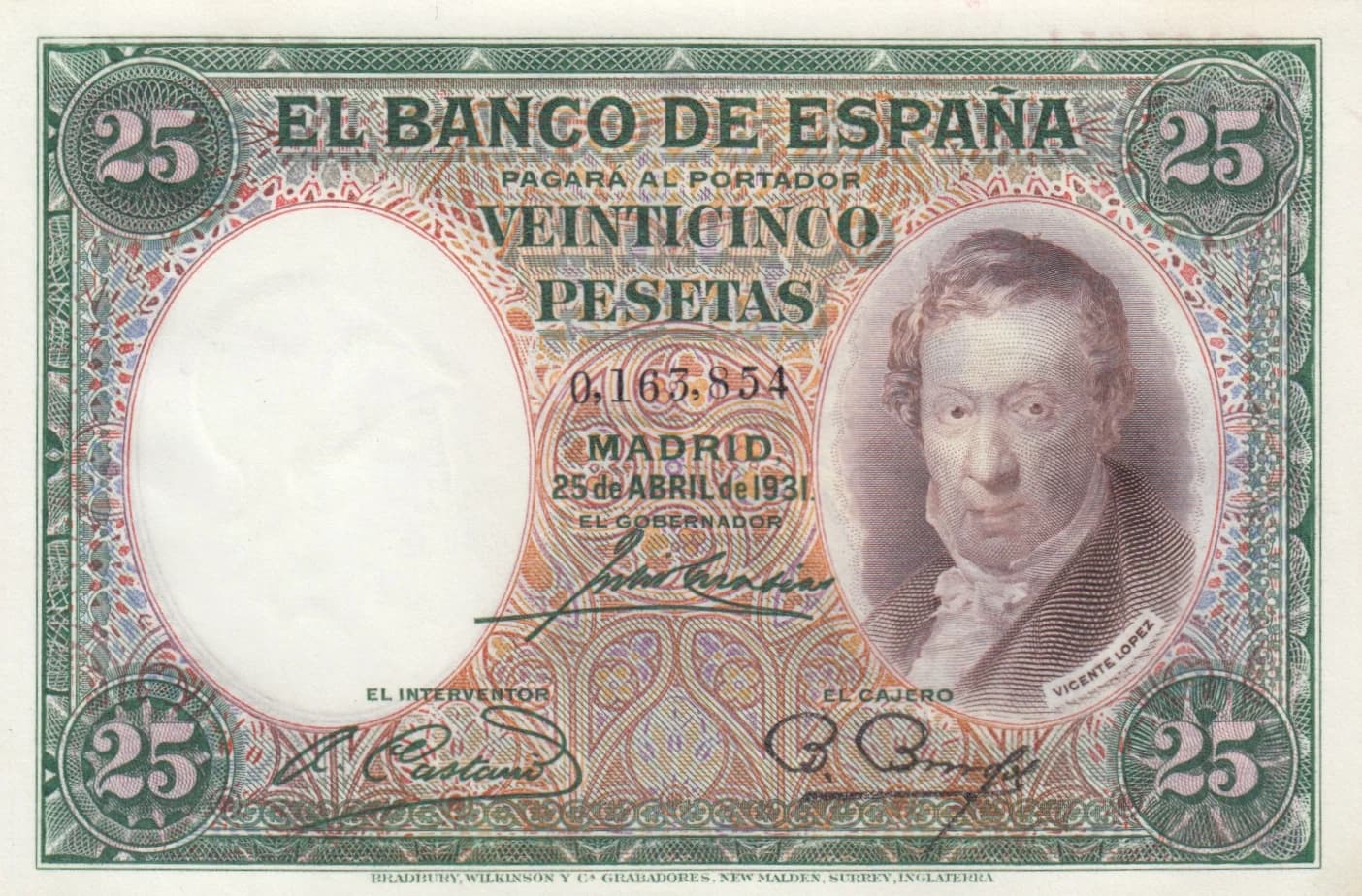
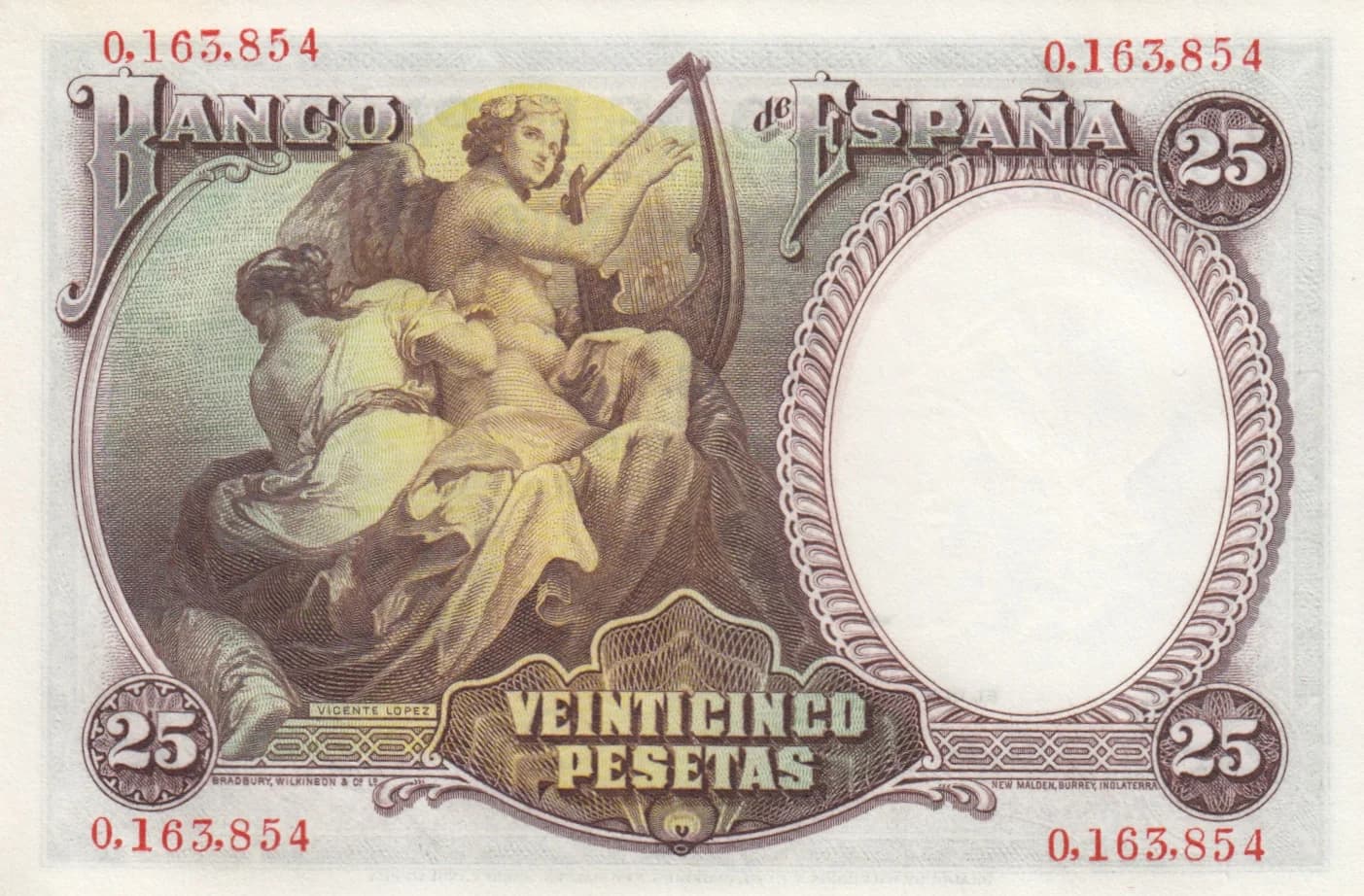
This is a 25 pesetas banknote from the Spanish Second Republic (1931), issued by Banco de España and printed by Bradbury Wilkinson of New Malden, England. The note features Vicente López, a prominent Spanish artist, on the obverse in profile and an allegorical winged figure (representing 'Music') on the reverse set against a yellow circular background. While the visual analysis indicates visible wear with creasing and fold marks suggesting circulation, the catalog grading of UNC (Uncirculated) represents the specimen's current professionally assessed condition, making this a historically significant example of early Republican-era Spanish currency.
Common. The eBay market data shows consistent sales activity across various condition grades, with UNC examples selling in the $140-145 range in recent years (2024), while lower grades trade for $2-15. The presence of multiple PMG-graded examples in circulation records and regular eBay transactions indicates this is a widely available banknote in the collector market. Print runs for this 1931 issue were substantial enough to support ongoing trading at modest price levels, and the note was not recalled or subject to special scarcity conditions that would elevate it beyond common status.
Issued on 25 April 1931, just days after the proclamation of the Second Spanish Republic, this banknote represents the transitional monetary period between the Spanish monarchy and the new democratic government. The choice to honor Vicente López, a renowned 19th-century Spanish painter, reflects the Republic's cultural emphasis, while the allegorical figure of 'Music' on the reverse symbolizes the artistic and intellectual values the new regime sought to promote. The English printer Bradbury Wilkinson, a major security printer of the era, was responsible for the banknote's production, indicating Spain's reliance on established international printing expertise during this politically volatile period.
The obverse features a formal portrait of Vicente López positioned in profile facing right within an ornamental oval frame, labeled 'EL CAJERO' (The Cashier), wearing period formal attire with a cravat. The reverse showcases an allegorical winged cherub or angelic figure in classical style seated against a prominent yellow circular background, holding what appear to be measuring or surveying implements, representing the allegorical concept of 'Music' as attributed to López's artistic tradition. Both sides feature elaborate ornamental geometric borders in green, red, orange, and brown tones with intricate fine-line engraving throughout. The denomination '25' appears in circular markers at each corner of both sides. The overall design demonstrates the high-security printing standards of Bradbury Wilkinson, with colored background printing integrated with finely detailed engraved elements to prevent counterfeiting.
FRONT SIDE: 'EL BANCO DE ESPAÑA' (The Bank of Spain) / 'PAGARÁ AL PORTADOR' (Will pay to bearer) / 'VEINTICINCO PESETAS' (Twenty-five pesetas) / 'MADRID' (Madrid) / '25 de ABRIL de 1931' (25th of April of 1931) / 'EL GOBERNADOR' (The Governor) / 'EL INTERVENTOR' (The Inspector/Auditor) / 'EL CAJERO' (The Cashier) / 'VIGENTE LOPEZ' (Vigente López - artist's name) / Serial number: 0.165.854 / 'BRADBURY, WILKINSON & C° GRABADORES. NEW MALDEN, SURREY, INGLATERRA' (Bradbury, Wilkinson & Co Engravers. New Malden, Surrey, England). REVERSE SIDE: 'BANCO DE ESPAÑA' (Bank of Spain) / 'VEINTICINCO PESETAS' (Twenty-five pesetas) / 'VICENTE LOPEZ' (Vicente López) / Serial number: 0.163.854 / '25' (denomination) / 'BRADBURY, WILKINSON & C° GRABADORES. NEW MALDEN, SURREY, INGLATERRA' (Bradbury, Wilkinson & Co Engravers. New Malden, Surrey, England).
Intaglio engraving combined with colored lithographic background printing. The note was produced by Bradbury Wilkinson & Co., a renowned English security printer specializing in banknote production. The fine-line engraved details of the portraits, allegorical figures, and ornamental borders were combined with multi-color background printing (green, brown, red, and yellow) to create security features through color variation and intricate pattern complexity. This combination of intaglio and lithographic techniques was the standard security printing method for high-quality banknotes of the 1930s era.
The observed specimen represents the standard Madrid issue (confirmed by 'MADRID' inscription on obverse). The visual analysis shows this specific example with serial number 0.165.854 on the front and 0.163.854 on the reverse. PMG records indicate one catalogued variant for Pick 81 (Madrid issue). No notable overprints, signatures variations, or emergency issue characteristics are evident in the analyzed images. The note conforms to the standard design issued on 25 April 1931 by the newly established Second Republic's central bank.