25 pesetas 1946
Market Prices
21 salesAbout This Note
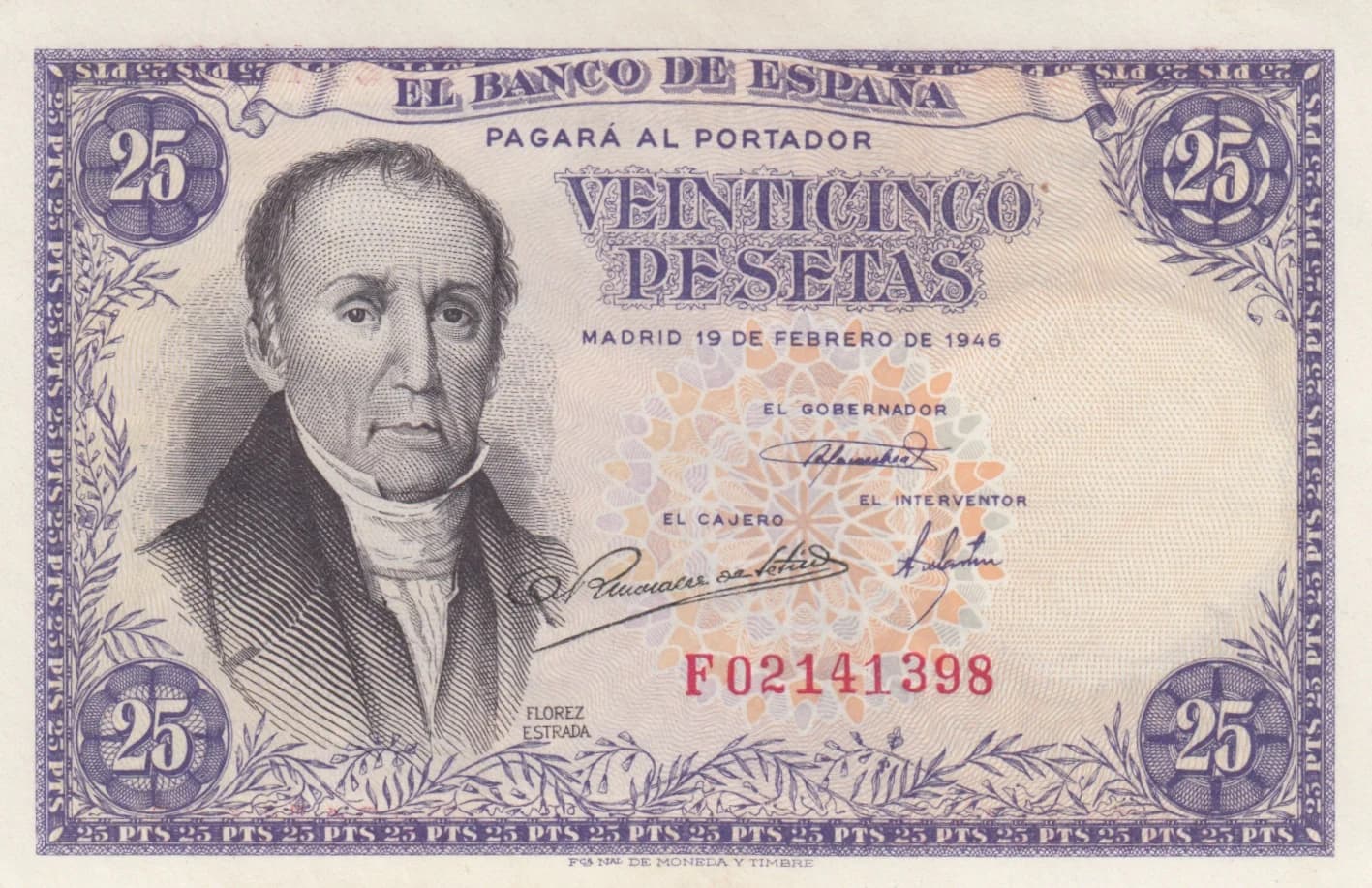
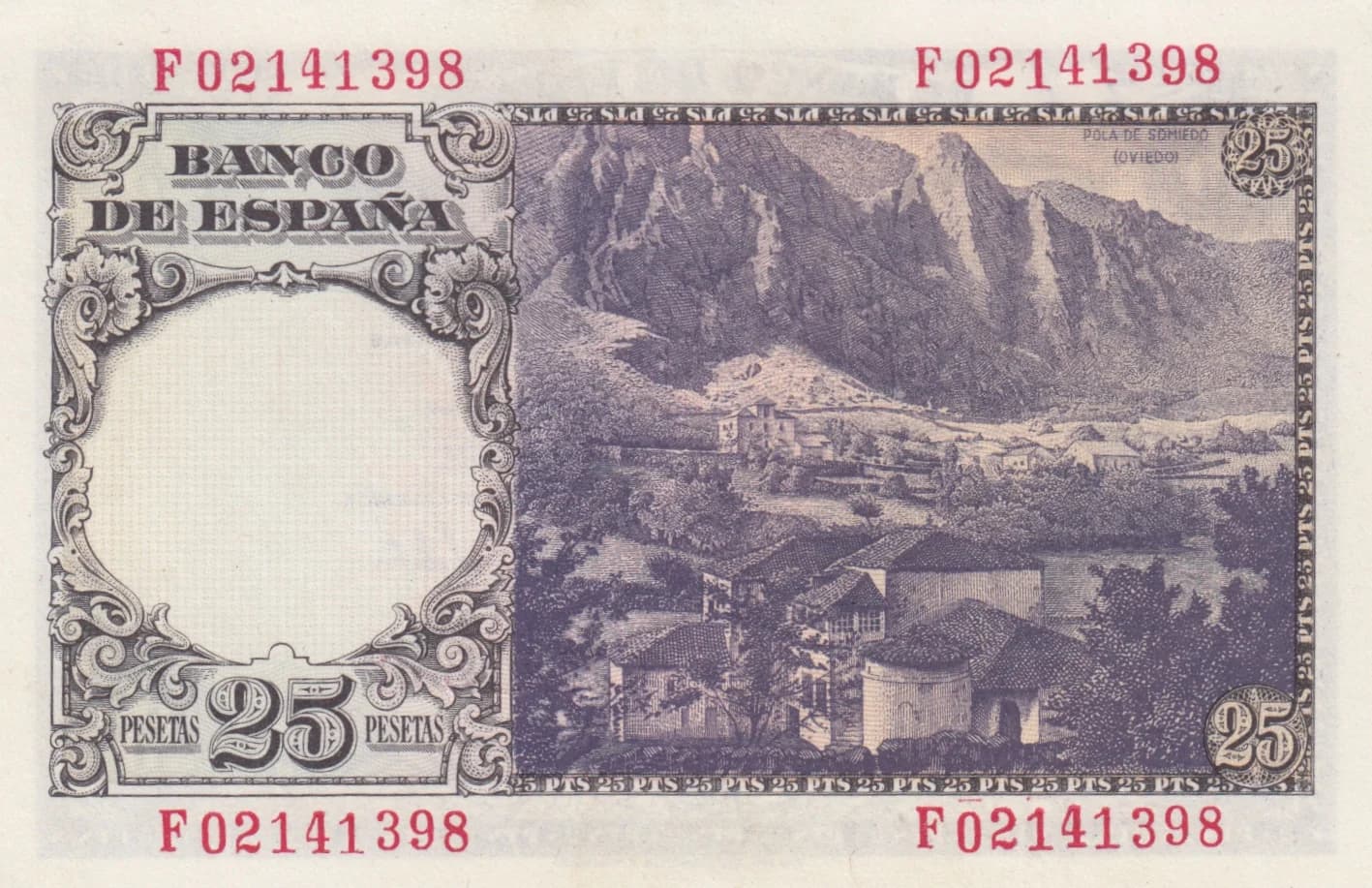
This is a well-preserved example of Spain's 25 pesetas banknote from 1946, issued by Banco de España and printed by Fábrica Nacional de Moneda y Timbre in Madrid. The note displays the classic design elements of mid-20th century Spanish currency: a portrait of economist Florez Estrada on the front in purple and blue tones, complemented by a detailed landscape engraving of Pola de Somiedo (near Oviedo) on the reverse. In the observed UNC condition, this note exhibits sharp printing, vibrant colors, and no signs of handling or wear, making it an attractive example for Spanish currency collectors.
Common. Market data shows this Pick number regularly appears in secondary market sales with UNC examples selling in the $18-$32 range as of 2023-2024, with historical UNC sales ranging from $18.50 to $103.50 over the past decade. The 2016 catalogue value for UNC was listed at $150, suggesting some softening in market demand. The print run for this issue was substantial, and the note remains readily available to collectors. The frequency of eBay sales and the consistent availability in multiple conditions indicate this is a standard issue without significant rarity.
Issued on 19 February 1946, shortly after the Spanish Civil War (1936-1939) during Francisco Franco's early dictatorship, this note represents the post-war reconstruction period of Spain's monetary system. The portrait of Florez Estrada (1765-1851), a 19th-century Spanish economist and statesman, reflects the Banco de España's practice of honoring historical figures of economic significance. The reverse depicts Pola de Somiedo, a settlement in Asturias in northwestern Spain, representing the nation's regional diversity and natural heritage at a time when Spain was reasserting its institutional stability.
The obverse features a formal portrait of Álvaro Florez Estrada, the 19th-century Spanish economist and liberal statesman, positioned at the left side in period formal dress with a characteristic high white collar. The portrait is rendered in fine engraved line work typical of security printing. The note's predominant colors are purple and deep blue with black line work, framed by ornamental baroque-style scrollwork and leafy border designs in all four corners. Four corner denomination circles display '25' in classical numeral style. Signature panels for the Governor, Treasurer, and Comptroller appear in the center-right. The reverse presents an elaborate landscape engraving of Pola de Somiedo in the Picos de Europa region near Oviedo, depicting a mountainous valley with a river, settlement structures, vegetation, and rocky peaks rendered through meticulous cross-hatching and stippling. A large ornamental cartouche with decorative scrollwork occupies the left side. The serial number appears in red at cardinal positions.
FRONT: 'EL BANCO DE ESPAÑA' (The Bank of Spain) | 'PAGARÁ AL PORTADOR' (Will pay to the bearer) | 'VEINTICINCO PESETAS' (Twenty-five pesetas) | 'MADRID 19 DE FEBRERO DE 1946' (Madrid, 19 February 1946) | 'EL GOBERNADOR' (The Governor) | 'EL CAUDERO' (The Treasurer) | 'EL INTERVENTOR' (The Comptroller) | 'FLOREZ ESTRADA' (Florez Estrada - portrait identification). BACK: 'BANCO DE ESPAÑA' (Bank of Spain) | '25 PESETAS' (Twenty-five pesetas) | 'OVIEDO' (Oviedo - regional location identifier) | '25 PTS 25 PTS' (repeated denomination markers). Serial number F02141398 appears on both sides.
Intaglio (engraved) printing, the standard security printing method for high-value banknotes of this era. The note was produced by Fábrica Nacional de Moneda y Timbre (FNMT) in Madrid, Spain's official state printer. The fine line work, detailed cross-hatching in the landscape, and depth achieved in the portrait and scenic elements are characteristic of steel-plate engraving. Security features include ornamental line patterns, fine engraved portraiture, and complex decorative elements designed to deter counterfeiting.
PMG catalogs this as Pick 130a (Madrid variant). The observed note carries the serial number F02141398 with the 'F' prefix, suggesting a Madrid print location designation. The date of 19 February 1946 is consistent with the initial release. Signature varieties exist depending on which government officials were in office during the note's circulation period, though the visual analysis does not permit precise identification of signature variants from this single example.