2000 pesetas 1980
Market Prices
16 salesAbout This Note
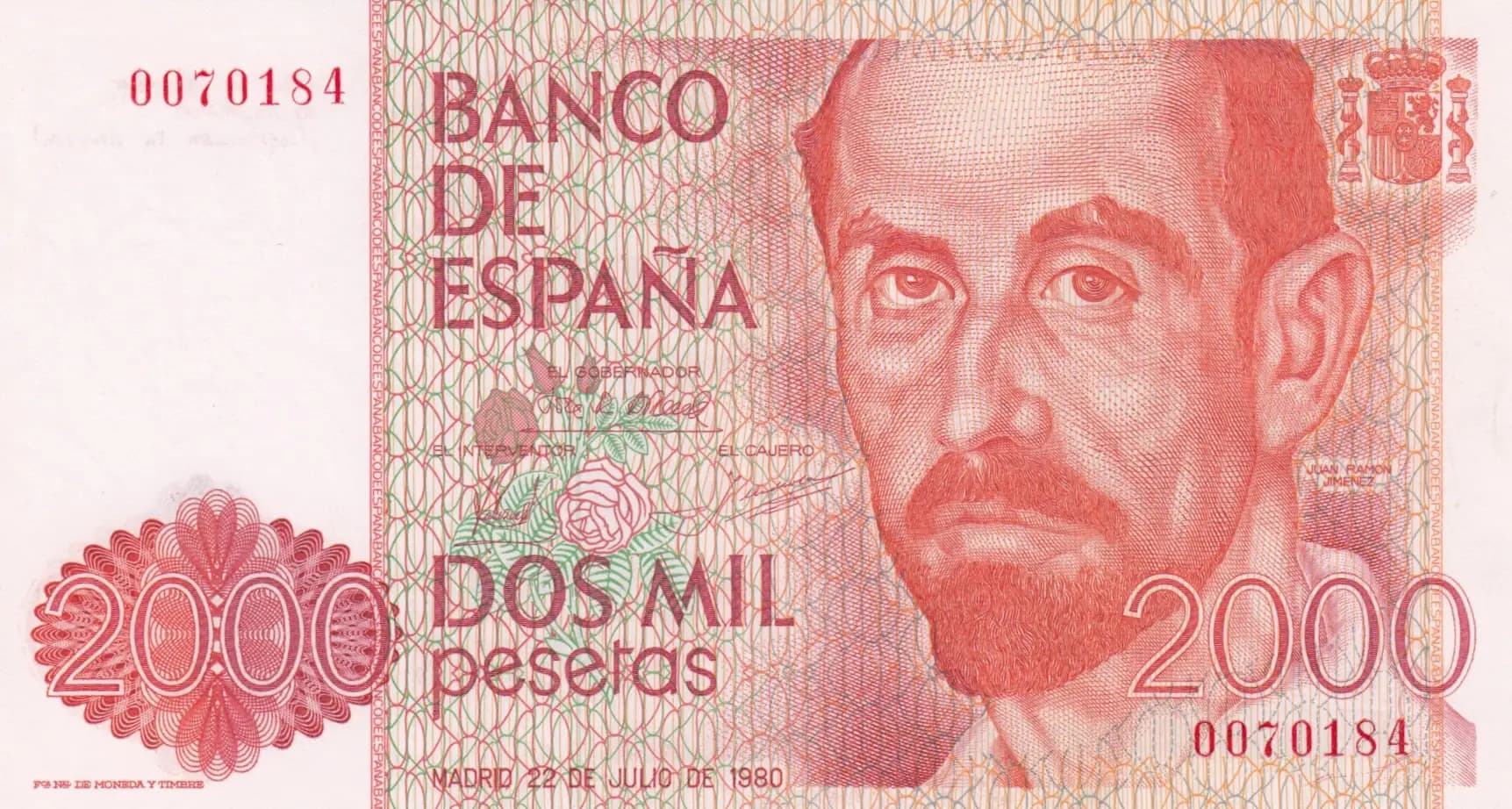
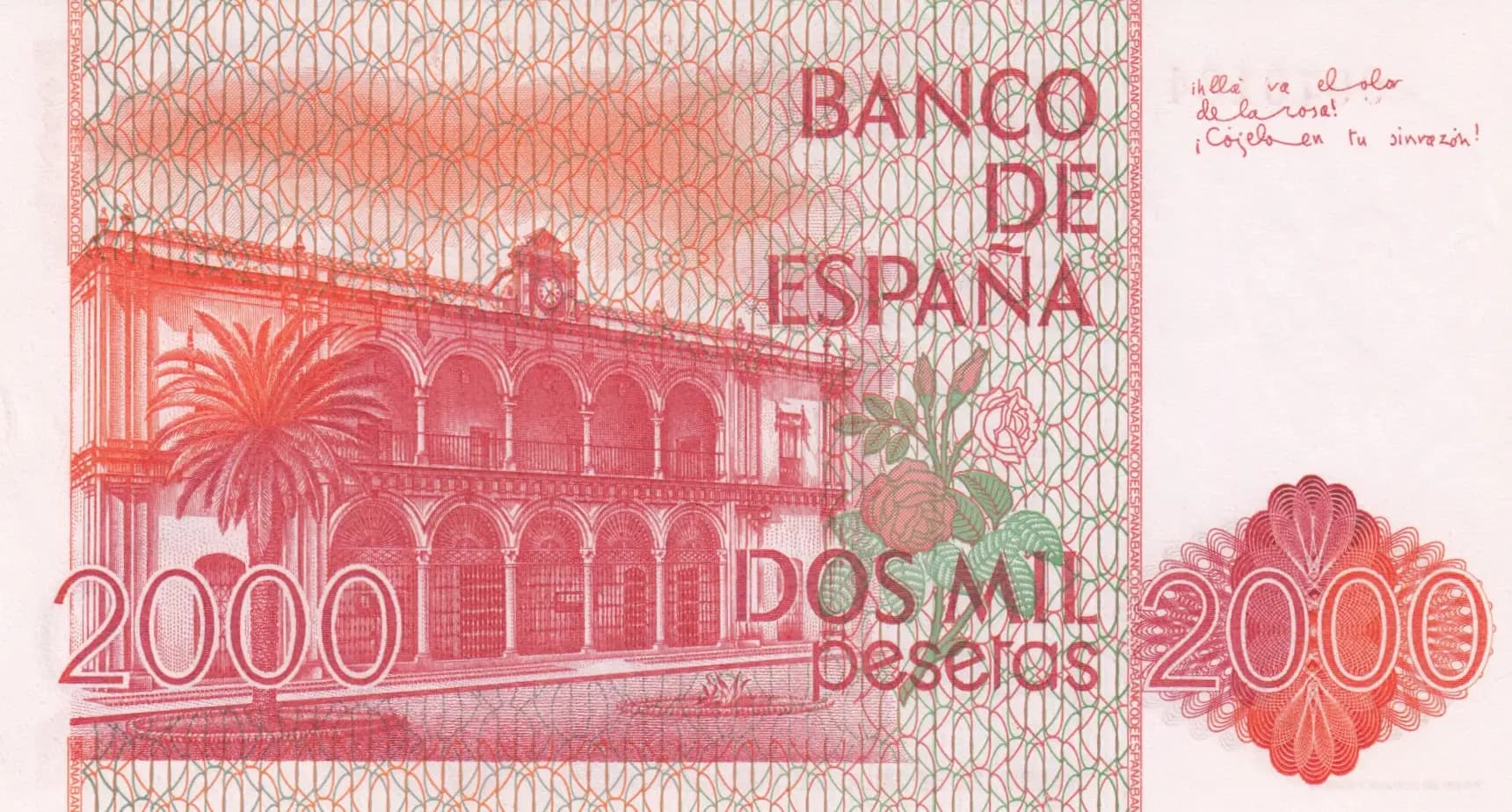
This is an uncirculated 2000 pesetas note from 1980, issued by Banco de España and printed by the Fábrica Nacional de Moneda y Timbre in Madrid. The note features a striking design with deep red and orange tones, displaying a portrait of poet Juan Ramón Jiménez on the obverse and the Villa de la Rosa architectural landmark on the reverse, both rendered in fine engraving with intricate crosshatch security patterns. In pristine condition with sharp printing and no visible wear, this note exemplifies the high-quality currency design standards of Spain's late-twentieth-century monetary production.
Common. The 2000 pesetas denomination from 1980 is a regular-issue banknote with substantial print runs characteristic of a major denomination in Spain's peseta currency system. Secondary market eBay transaction data shows consistent sales in the $10-$40 range depending on condition, with UNC examples regularly trading around $37-$85 according to catalog values. The note was in circulation for over two decades until the peseta's retirement in 2002, ensuring wide availability in all grades. No specific print run restrictions, short-term issues, or recall notices apply to this Pick number.
This 2000 pesetas note was issued in 1980, during Spain's transition to modern democratic governance following the death of Francisco Franco in 1975. The selection of Juan Ramón Jiménez—one of Spain's most celebrated modernist poets and 1956 Nobel Prize laureate—reflects the Spanish state's cultural priorities during this period of national renewal. The depiction of the Villa de la Rosa on the reverse celebrates Spanish architectural heritage and regional identity within the broader context of the peseta currency system that would remain in use until Spain's adoption of the euro in 2002.
The obverse features a formal portrait of Juan Ramón Jiménez, the renowned Spanish poet, rendered in classical engraving style facing forward in the center-right portion of the note. The reverse displays the Villa de la Rosa, a colonial-style architectural landmark with characteristic arched windows and doors arranged in two visible levels, accompanied by palm tree landscaping, illustrating Spanish architectural heritage. Both sides are dominated by deep red, pink, and green color schemes with intricate geometric crosshatch patterns serving as security features. The Spanish coat of arms (shield with crown) appears in the upper right of the obverse, while ornamental rosette designs frame the denomination numerals on both sides. The overall design reflects 1980s Spanish currency aesthetics with emphasis on national cultural figures and architectural patrimony.
FRONT SIDE: 'BANCO DE ESPAÑA' (Bank of Spain) — issuing authority; 'DOSMIL pesetas' (Two thousand pesetas) — denomination; 'EL GOBERNADOR' (The Governor) — signature line; 'EL CAJERO' (The Cashier) — signature line; Serial number '0070184' and denomination numerals '2000'. BACK SIDE: 'BANCO DE ESPAÑA' (Bank of Spain); 'DOSMIL pesetas' (Two thousand pesetas); Handwritten inscription (non-standard): '¡Allá va el oro de la rosa! ¡Cosas en tu simrazón!' (There goes the gold of the rose! Things in your heart!) — this appears to be a user-added annotation and is not part of the official note design.
Intaglio engraving, executed by the Fábrica Nacional de Moneda y Timbre (FNMT) in Madrid, the official Spanish state printer. The note exhibits the characteristic fine detail, sharp line work, and dimensional quality produced by the intaglio process. The multicolor printing incorporates deep reds, oranges, greens, and earth tones achieved through sequential intaglio plate passes, with the intricate crosshatch background patterns serving as anti-counterfeiting security features typical of currency production standards of this era.
This note corresponds to Pick catalog P-159 with the potential for variant classification P-159* according to PMG population records. The specific variety would be determined by examination of signature combinations, exact date of issue within 1980, and any printer marks. The visual analysis shows serial number 0070184, which should be cross-referenced against known serial ranges to establish the precise variety within the 1980 issue. No overprints, commemorative markings, or other distinguishing features are evident in the standard design, though the handwritten inscription observed is a post-production user annotation rather than a cataloging variety.