1000 pesetas 1928
Market Prices
22 salesAbout This Note
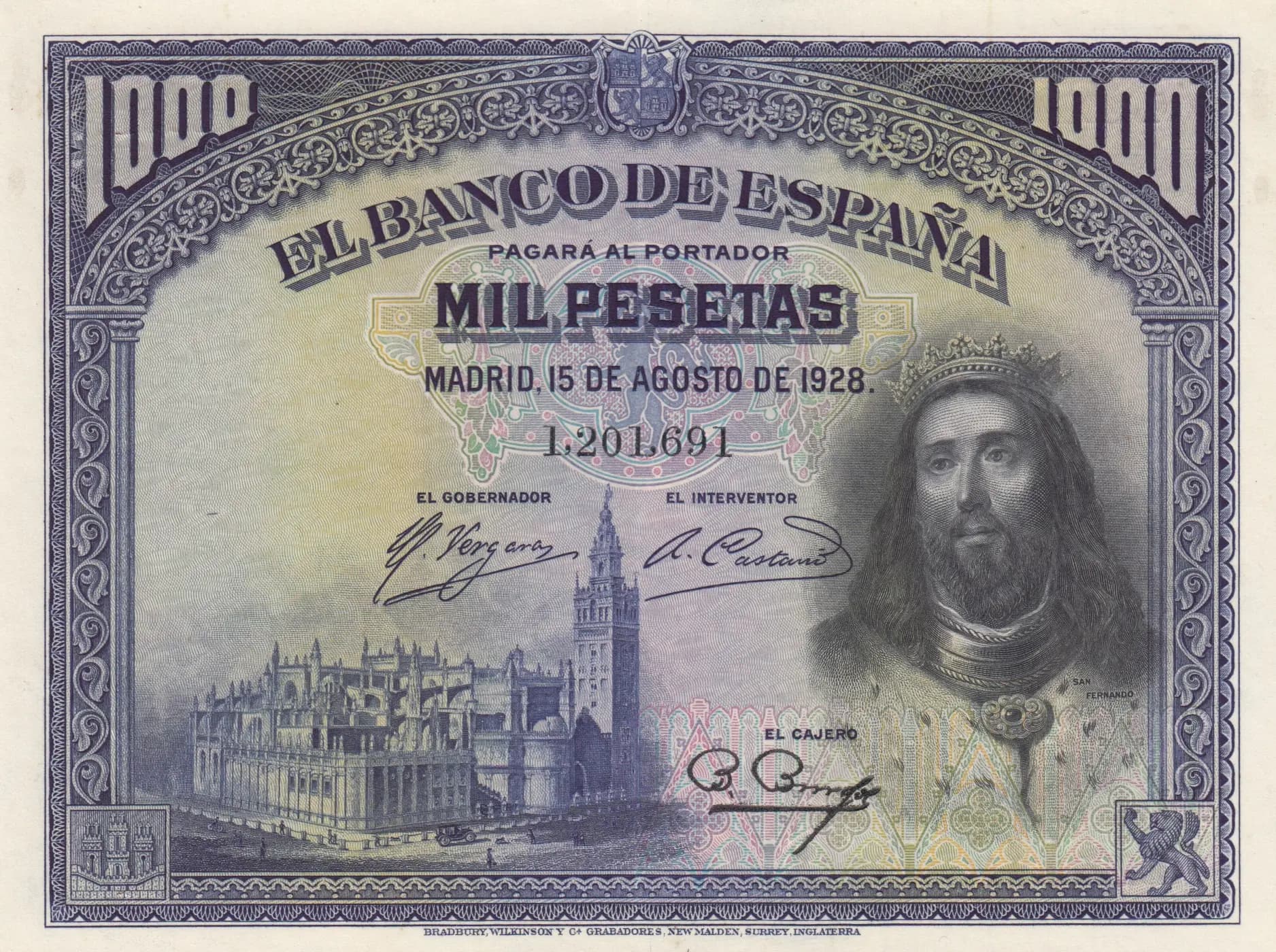
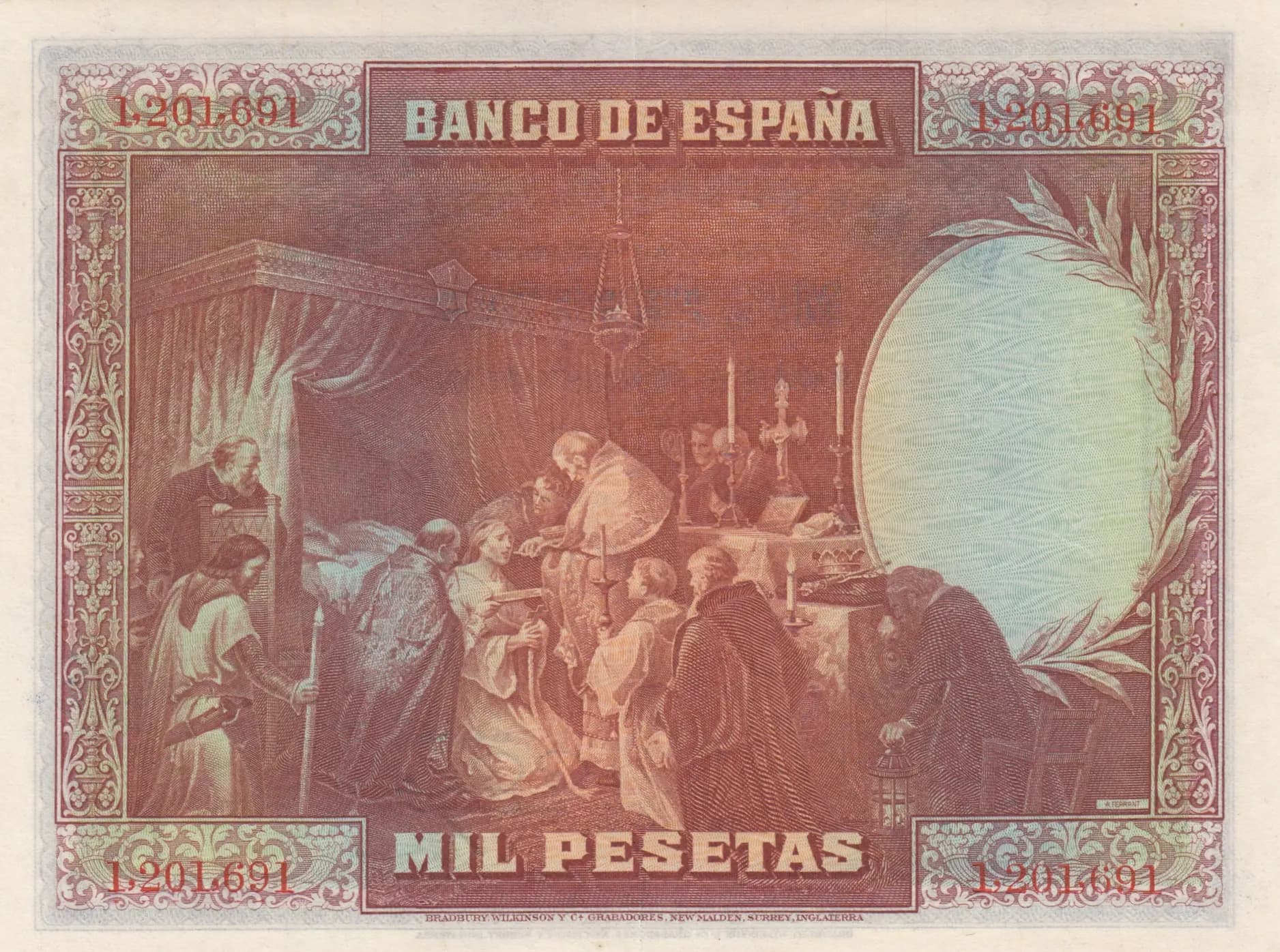
This is an exceptional example of Spain's 1928 1000 pesetas note (Pick P-78) in EF condition, featuring the striking portrait of King Ferdinand I of Castile and León on the obverse alongside a detailed architectural engraving of the Cathedral of Seville. The reverse displays a magnificent historical scene depicting King Ferdinand receiving communion, rendered by artist A. Ferrant in rich reddish-brown tones. The note exhibits crisp, sharp impressions throughout with no visible wear, creases, or foxing, making it a desirable specimen for Spanish currency collectors.
Common. The 1000 pesetas denomination from 1928 is a regular issue with substantial circulation, evidenced by the eBay market data showing consistent sales in the $15-75 range for EF condition specimens, with prices typically $25-35 for this grade. The note was issued in significant quantities and survives in reasonable numbers today. While attractive and historically interesting, it is not scarce or rare.
Issued on August 15, 1928, during Spain's Second Spanish Republic period, this note commemorates King Ferdinand III ('El Santo'), the 13th-century monarch who unified Castile and León and conquered Seville from Moorish rule. The Cathedral of Seville depicted on the obverse (with its iconic La Giralda bell tower) stands as a direct architectural legacy of Ferdinand's reconquest, while the reverse's religious imagery of Ferdinand receiving communion reflects the historical narrative of the monarchy's Catholic piety and legitimacy that was particularly relevant to Spain's political climate of the late 1920s.
The obverse features King Ferdinand I ('San Fernando') in right-facing profile, depicted as a bearded medieval monarch, positioned prominently on the right side. Below the portrait is a detailed architectural engraving of the Catedral Metropolitana de Sevilla (Cathedral of Seville) with its distinctive La Giralda bell tower, rendered in fine line-work style. The note's color scheme employs purple and blue tinting over a cream and beige background, with yellow-gold accents in ornamental elements. The reverse showcases a large historical engraving titled 'King Fernando Receiving Communion,' executed by artist A. Ferrant, depicting Ferdinand in a religious ceremony surrounded by clergy and nobility in period dress within an arched interior setting. Both sides are framed by ornate decorative borders featuring intricate scrollwork, floral garlands, geometric patterns, and cross designs. The Spanish coat of arms appears at the top center of the obverse, with a heraldic eagle in the bottom right corner. The printing features fine cross-hatching and complex line-work characteristic of high-security banknote production.
FRONT SIDE: 'EL BANCO DE ESPAÑA' (The Bank of Spain) | 'PAGARÁ AL PORTADOR' (Will pay to bearer) | 'MIL PESETAS' (One thousand pesetas) | 'MADRID, 15 DE AGOSTO DE 1928' (Madrid, August 15, 1928) | Serial number: 1.201.691 | 'EL GOBERNADOR' (The Governor) | 'EL INTERVENTOR' (The Auditor) | 'EL CAJERO' (The Cashier) | 'BRADBURY, WILKINSON Y Cª GRABADORES NEW MALDEN, SURREY, INGLATERRA' (Bradbury, Wilkinson and Co., Engravers, New Malden, Surrey, England). BACK SIDE: 'BANCO DE ESPAÑA' (Bank of Spain) | 'MIL PESETAS' (One thousand pesetas) | Serial number: 1.201.691 | 'BRADBURY WILKINSON Y Cª GRABADORES NEW MALDEN, SURREY, INGLATERRA' (Bradbury, Wilkinson and Co., Engravers, New Malden, Surrey, England).
Intaglio engraving (line engraving/steel plate engraving), executed by the renowned British security printer Bradbury, Wilkinson & Co. of New Malden, Surrey, England. The note demonstrates sophisticated security printing techniques typical of the period, including fine detailed line-work, complex cross-hatching in the historical scenes, multi-layered color separation using purple, blue, red-brown and cream inks, and intricate border patterns designed to prevent counterfeiting. The crisp, sharp impressions and fine detail preservation evident in this example reflect the high quality of Bradbury Wilkinson's production standards.
This specimen is consistent with Pick P-78a (Madrid printing), the primary variety for this Pick number. The date of issuance is August 15, 1928 ('MADRID, 15 DE AGOSTO DE 1928'), confirming the standard first issue. The serial number observed (1.201.691) is consistent with early printing runs. No evidence of overprints, error varieties, or unusual printing characteristics that would denote a scarcer sub-variety.