1000 pesetas 1979
Market Prices
91 salesAbout This Note
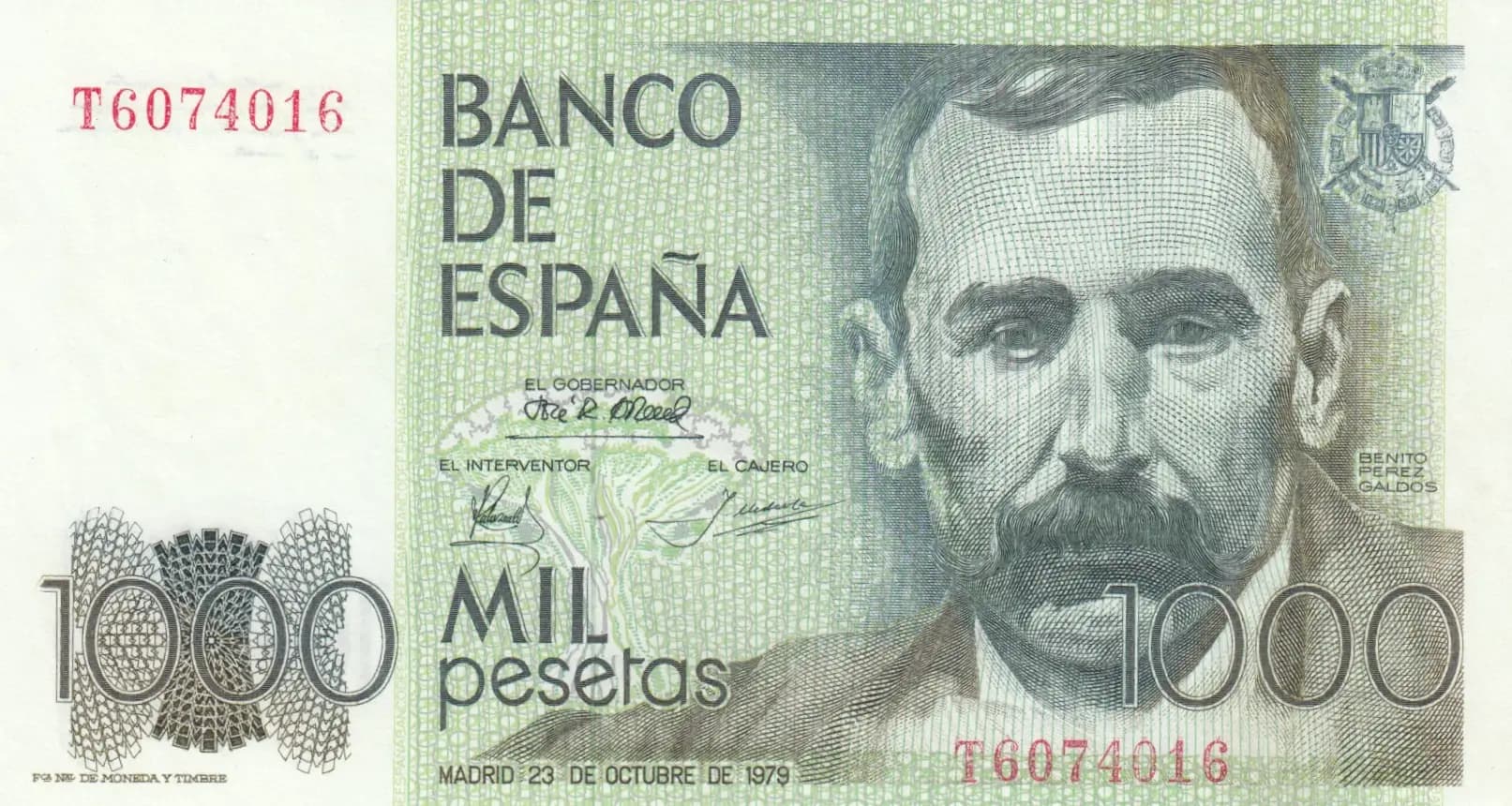
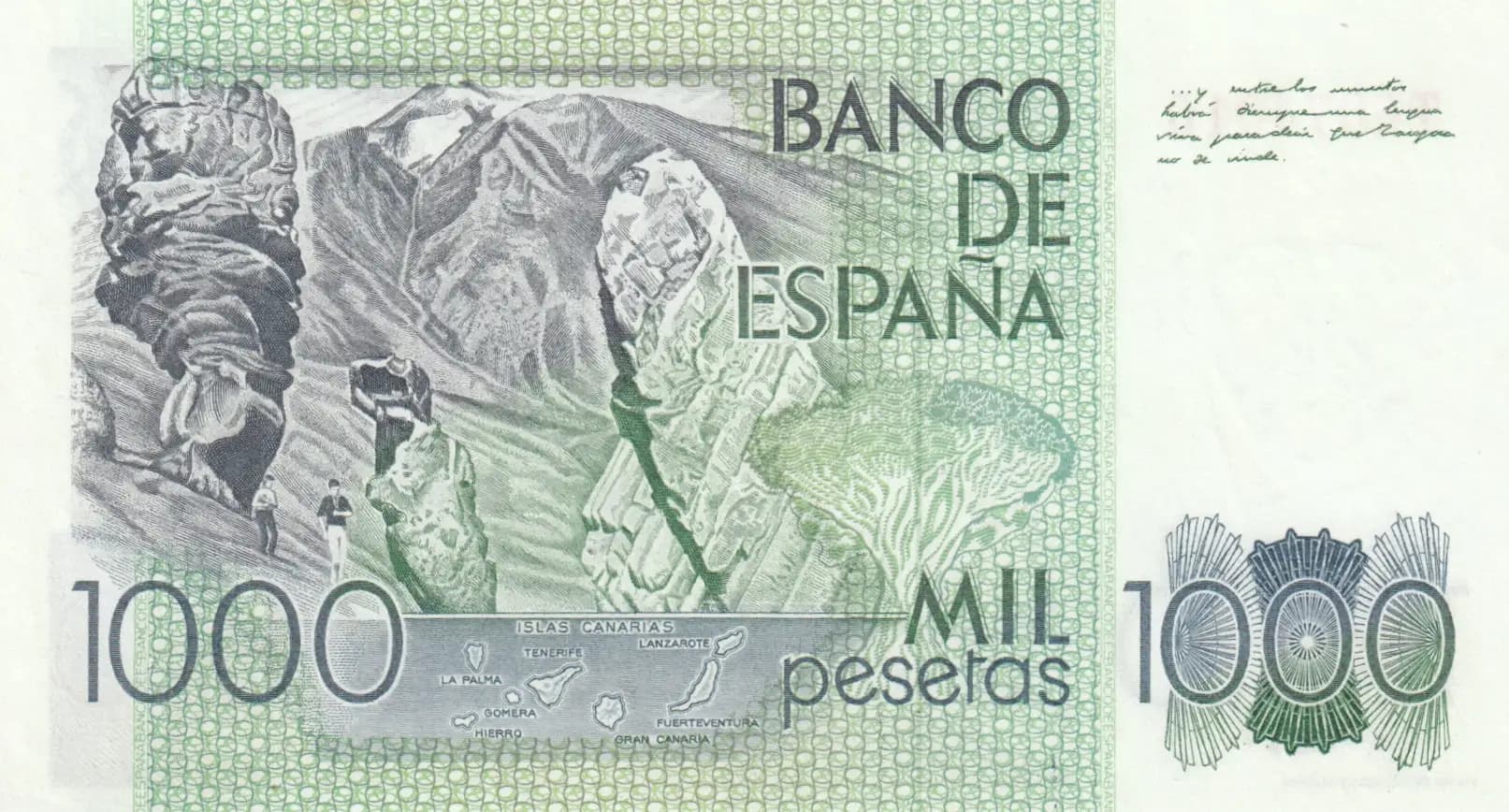
This 1000 pesetas banknote from Spain (Pick P-158) is presented in uncirculated condition with crisp, clean surfaces displaying no wear, creases, or damage. The note features a striking portrait of Benito Pérez Galdós on the obverse and a dramatic mountain landscape with climbers and the Canary Islands map on the reverse, both rendered in green and gray tones with exceptional engraving detail. This October 23, 1979 issue represents a well-executed example of late-20th century Spanish currency design during the post-Franco transition period.
Common. This is a standard circulation issue from the Banco de España's regular 1979 series with presumably substantial print run. eBay market data shows consistent sales at modest prices ($3-20 for circulated examples, $6-25 for uncirculated examples) with no scarcity indicators. PMG-graded examples command higher premiums (typically $15-56 depending on grade), but ungraded UNC examples regularly sell for $6-25, indicating steady availability in the collector market. This note lacks the characteristics of a rare or scarce issue.
Issued in October 1979, this banknote commemorates Benito Pérez Galdós (1843-1920), one of Spain's greatest novelists and literary figures of the 19th century, reflecting Spain's cultural heritage during the early years of the Spanish Constitution (adopted 1978). The reverse design celebrating the Canary Islands emphasizes Spain's geographic and cultural diversity, particularly significant following regional devolution in the newly democratic Spanish state. The denomination and design reflect the peseta's status as Spain's national currency before adoption of the euro in 2002.
The obverse features a right-profile portrait of Benito Pérez Galdós, Spain's renowned 19th-century novelist, positioned in the upper right corner with the Spanish coat of arms above. The left side displays an ornate circular design with concentric patterns and repeated '1000' denominations, framing three signature lines for the Governor, Comptroller, and Cashier. The reverse presents a romantic landscape composition depicting mountain climbers ascending rocky terrain (representing Spanish mountaineering culture or the dramatic landscape of the Canary Islands), with a detailed cartographic representation of the seven Canary Islands (Tenerife, La Palma, Gomera, Hierro, Gran Canaria, Fuerteventura, and Lanzarote) in the lower portion. Decorative fan or shell-like circular patterns frame the denomination on the right side of the reverse. The note's color scheme employs green and gray tones throughout, creating visual distinction and security enhancement.
FRONT: 'BANCO DE ESPAÑA' (Bank of Spain); 'BENITO PÉREZ GALDÓS' (portrait identification); 'MIL pesetas' (One thousand pesetas); 'MADRID-23 DE OCTUBRE DE 1979' (Madrid - October 23, 1979); 'EL GOBERNADOR' (The Governor); 'EL INTERVENTOR' (The Comptroller); 'EL CAJERO' (The Cashier); Serial number 'T6074016' appearing twice. BACK: 'BANCO DE ESPAÑA' (Bank of Spain); 'MIL pesetas' (One thousand pesetas); 'ISLAS CANARIAS' (Canary Islands); Island names: 'TENERIFE', 'LA PALMA', 'GOMERA', 'HIERRO', 'GRAN CANARIA', 'FUERTEVENTURA', 'LANZAROTE'; 'POR LA MONEDA Y TIMBRE' (For Currency and Stamps - printer attribution).
Intaglio engraving (recess printing), the standard security printing method for Spanish banknotes of this era, executed by the Fábrica Nacional de Moneda y Timbre (F.N.M.T.) in Madrid. The detailed line work, fine engraving patterns, and complex background security motifs visible throughout both sides are characteristic of high-security intaglio production. Security features include intricate engraving, watermark area (watermark features Benito Pérez Galdós's portrait), and complex repeating geometric patterns designed to prevent counterfeiting.
Variety P-158a (Madrid) is catalogued by PMG. The visible specimen with serial number T6074016 appears to be the standard Madrid printing variety. The October 23, 1979 date is consistent with the initial issue. No obvious overprints, color variations, or printing anomalies are visible in the analyzed images that would distinguish this as an error note or special variety. The serial number prefix 'T' should be noted for variety identification purposes.