100 pesetas 1928
Market Prices
27 salesAbout This Note
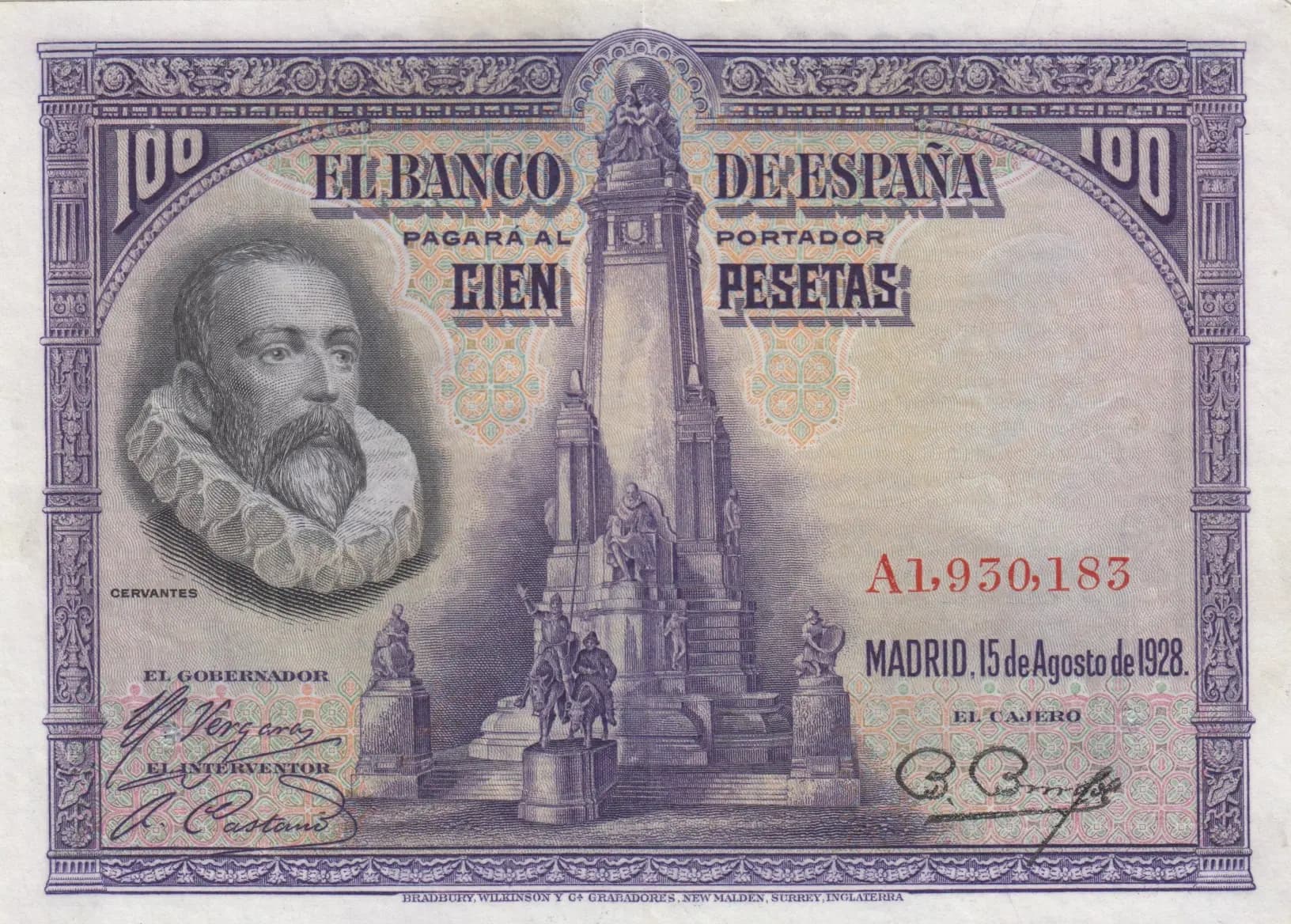
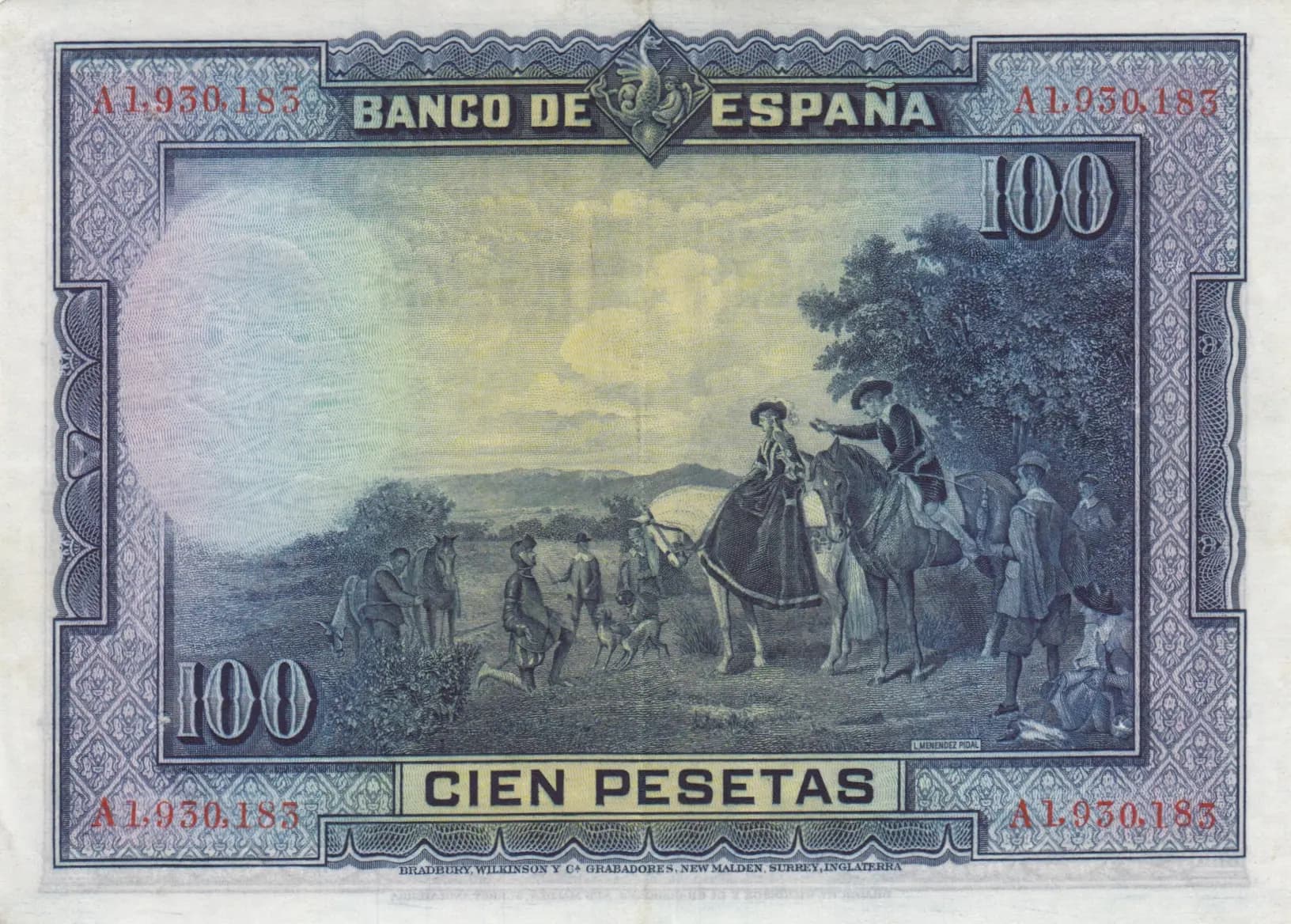
A beautifully engraved Spanish 100 pesetas banknote from 1928, issued by Banco de España and printed by the prestigious security printer Bradbury Wilkinson. The note displays exceptional preservation in EF condition with no visible wear, featuring Miguel de Cervantes on the obverse alongside a classical monument, and a finely detailed landscape scene depicting Don Quijote on the reverse in multiple colors including purple, blue, and green.
Common. Despite the note's historical significance and artistic merit, market data from realbanknotes.com shows consistent eBay sales ranging from $1.25 to $60 across various condition grades over more than a decade, with EF condition examples regularly selling in the $2.55–$6.01 range. The catalog value for VF is listed at $15 and UNC at $35. The consistent supply and moderate pricing indicate this note was produced in substantial quantities and remains readily available to collectors, placing it squarely in the common category.
Issued during Spain's Second Spanish Republic period (1928 specifically during the later years of the Primo de Rivera dictatorship), this note commemorates Miguel de Cervantes Saavedra, Spain's most celebrated author. The reverse design references Cervantes' masterwork 'Don Quijote,' reflecting the cultural pride in Spanish literature during this era. The choice of Cervantes as the portrait subject underscores the importance of national intellectual heritage in Spanish monetary design.
The obverse features a portrait of Miguel de Cervantes Saavedra at left, depicted as a bearded man wearing a ruffled collar characteristic of 16th-17th century Spanish dress. The central design element is an ornate classical monument or memorial tower with statuary at its base, representing Cervantes' cultural legacy. The reverse showcases a dynamic landscape scene illustrating an episode from Don Quijote, with multiple figures including horsemen and pedestrians rendered in period dress against a rural countryside setting with hills and vegetation. The entire note is framed by elaborate heraldic borders and classical ornamental scrollwork. The color palette combines purple and black on the obverse with multicolor underprinting, while the reverse employs blue, green, gray, and yellow/cream tones, characteristic of fine security banknote printing of the period.
FRONT: 'EL BANCO DE ESPAÑA' (The Bank of Spain) / '100 PESETAS' (One Hundred Pesetas) / 'PAGARÁ AL PORTADOR CIEN PESETAS' (Will pay to bearer one hundred pesetas) / 'CERVANTES' / 'EL GOBERNADOR' (The Governor) / 'EL INTERVENTOR' (The Auditor) / 'EL CAJERO' (The Cashier) / 'MADRID 15 de Agosto de 1928' (Madrid, August 15, 1928) / Serial number 'A1.950.183' / 'BRADBURY, WILKINSON Y C° GRABADORES. NEW MALDEN, SURREY, INGLATERRA' (Bradbury, Wilkinson and Co. Engravers. New Malden, Surrey, England). BACK: 'BANCO DE ESPAÑA' (Bank of Spain) / '100 CIEN PESETAS' (One Hundred Pesetas) / Serial number 'A1.950.183' / 'BRADBURY, WILKINSON Y C° GRABADORES. NEW MALDEN, SURREY, INGLATERRA' (Bradbury, Wilkinson and Co. Engravers. New Malden, Surrey, England).
Steel engraving (intaglio printing), executed by Bradbury Wilkinson & Co., a leading British security printer. The fine line engraving work throughout both sides, the elaborate border patterns, and the detailed portraiture are hallmarks of high-quality intaglio production. The multicolor printing technique visible in the reverse design indicates sophisticated color separation and alignment capabilities typical of specialized banknote printers of the 1920s. The security features include fine line engraving density and complex border patterns designed to deter counterfeiting.
This example bears serial number A1.950.183 with the series letter 'A,' consistent with regular issue specimens from 1928. The date 'Madrid 15 de Agosto de 1928' (August 15, 1928) matches the official issue date. Varieties for this Pick number typically relate to different series letters and signature combinations representing different periods of circulation authority, but without numismatic literature indicating significant scarcity variations among series, this represents a standard circulation issue variety.