100 pesetas 1936
Market Prices
9 salesAbout This Note
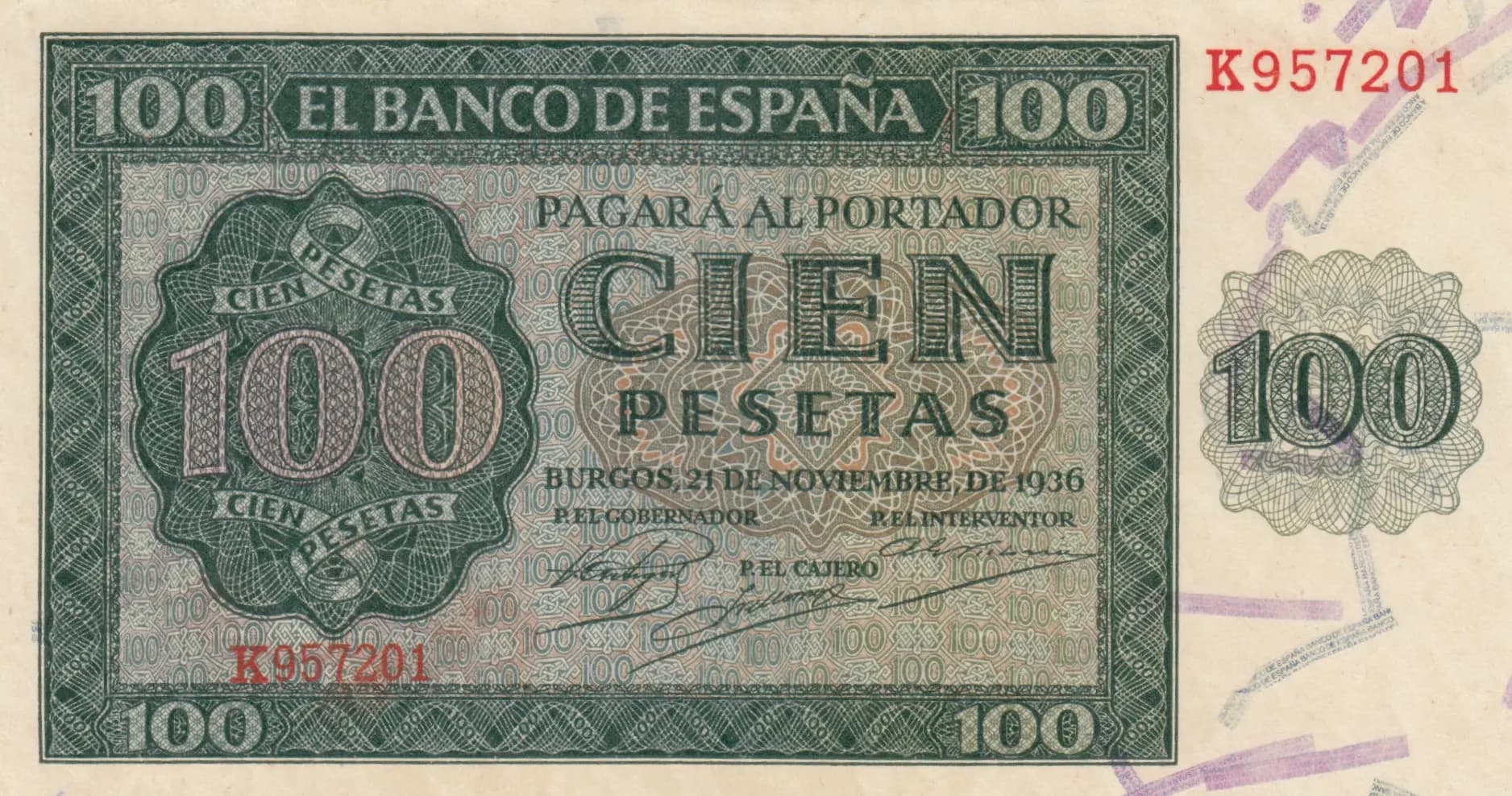
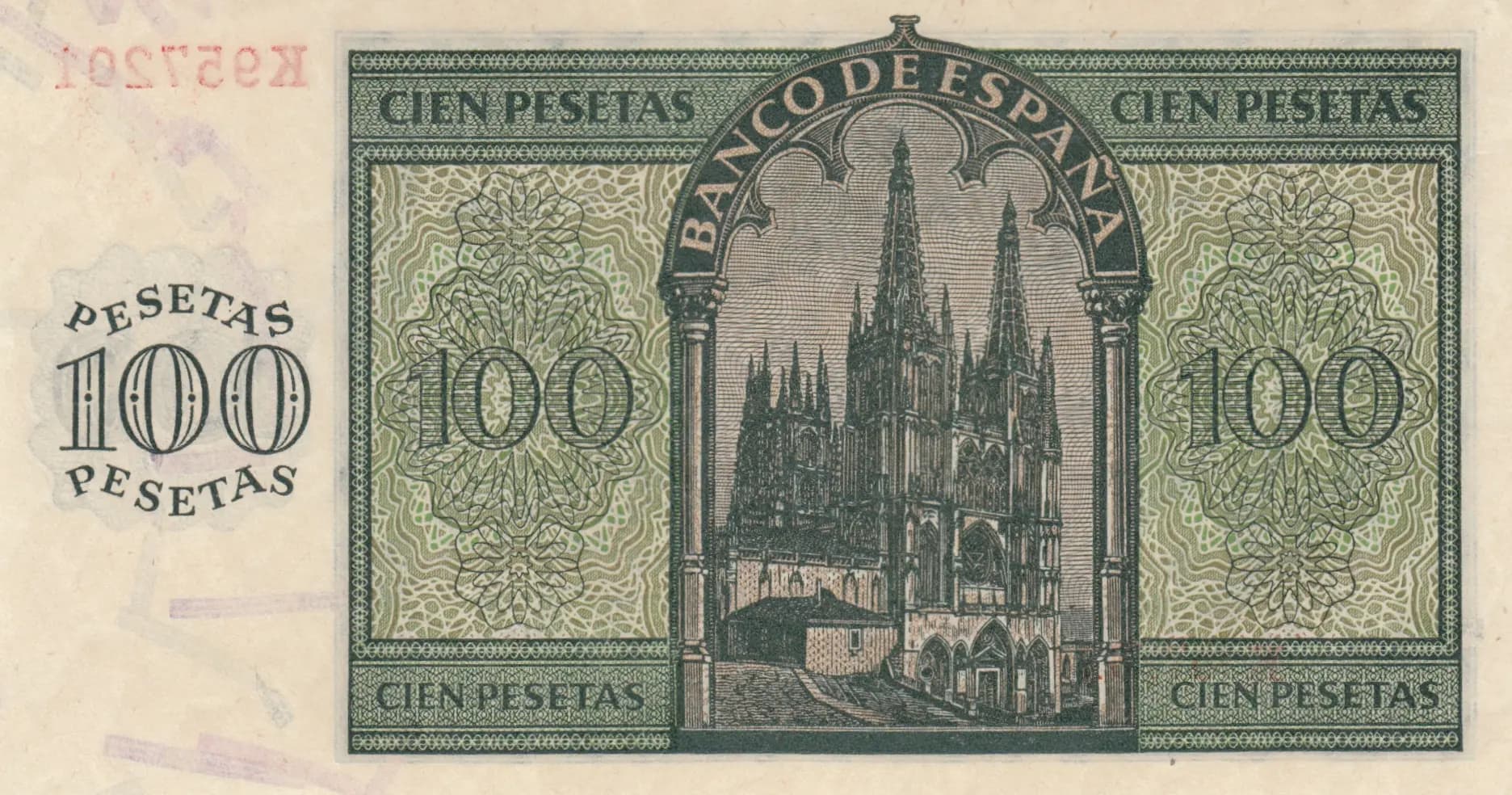
This is a 100 pesetas banknote issued by Banco de España on November 21, 1936, during the Spanish Civil War period, graded in AU condition. The note features striking green and black printing with ornate geometric patterns on the front and the iconic Cathedral of Burgos prominently displayed on the reverse. Despite visible aging including purple stamps and light creases consistent with circulation, the printing remains clear and the note represents an important piece of Spanish monetary history from a turbulent era.
Common. Although this is a historical note from the Spanish Civil War period, eBay sales data shows consistent market activity with examples in F-VF condition selling between $4-$47 over the past decade, averaging around $20-25 for circulated examples. The 2016 catalog value of $85 for VF and $250 for UNC suggests moderate collector interest, but the frequency of sales and relatively modest prices indicate this is not a scarce issue. Print runs for this denomination were substantial enough that examples remain readily available to collectors.
This note was issued from Burgos on November 21, 1936, during the early months of the Spanish Civil War when the Nationalist government controlled the city. The Cathedral of Burgos depicted on the reverse is a UNESCO World Heritage Gothic masterpiece and one of Spain's most significant architectural landmarks, chosen to symbolize Spanish heritage and legitimacy during the conflict. The issuing authority's location in Burgos rather than Madrid reflects the political division of Spain during this period.
The obverse features a classical bearer bond design with a decorative scalloped shield containing the denomination on the left side, surrounded by ornate rosette patterns and geometric designs. The center displays 'PAGARÁ AL PORTADOR' above 'CIEN PESETAS' with the denomination '100' prominently featured. The reverse depicts the Cathedral of Burgos (Catedral de Burgos), a masterwork of Spanish Gothic architecture, rendered in fine engraved detail with multiple pointed spires and ornamental architectural elements. Decorative floral and geometric columns flank the cathedral on both sides. The overall design emphasizes institutional authority through the Bank of Spain's seal and elegant classical ornamentation throughout.
FRONT: El Banco de España (The Bank of Spain) / CIEN PESETAS (One Hundred Pesetas) / PAGARÁ AL PORTADOR (Will Pay to Bearer) / BURGOS, 21 DE NOVIEMBRE DE 1936 (Burgos, November 21, 1936) / EL GOBERNADOR (The Governor) / EL INTERVENTOR (The Interventor) / EL CAJERO (The Cashier) / Serial Number: K957201. BACK: BANCO DE ESPAÑA (Bank of Spain) / CIEN PESETAS (One Hundred Pesetas) / 100 PESETAS (One Hundred Pesetas) / PESETAS (Pesetas).
Intaglio engraving (line engraving), as evidenced by the fine detailed linework, complex geometric background patterns, ornate decorative elements, and the precision of the architectural rendering of the Cathedral of Burgos. Printed by Giesecke & Devrient (G&D) without imprint mark, utilizing multiple color passes (green, black, and red for serial numbers) typical of high-security currency production of the 1930s.
Serial number K957201 observed on this example. The note is from the November 21, 1936 issue (dated BURGOS, 21 DE NOVIEMBRE DE 1936). This represents the regular issue type of the 100 pesetas from the Banco de España's Burgos-issued series during the Spanish Civil War. Signature varieties may exist based on different officials serving as Governor, Interventor, and Cashier, though these are not distinctly visible in the visual analysis provided.