1 peseta 1945
Market Prices
18 salesAbout This Note
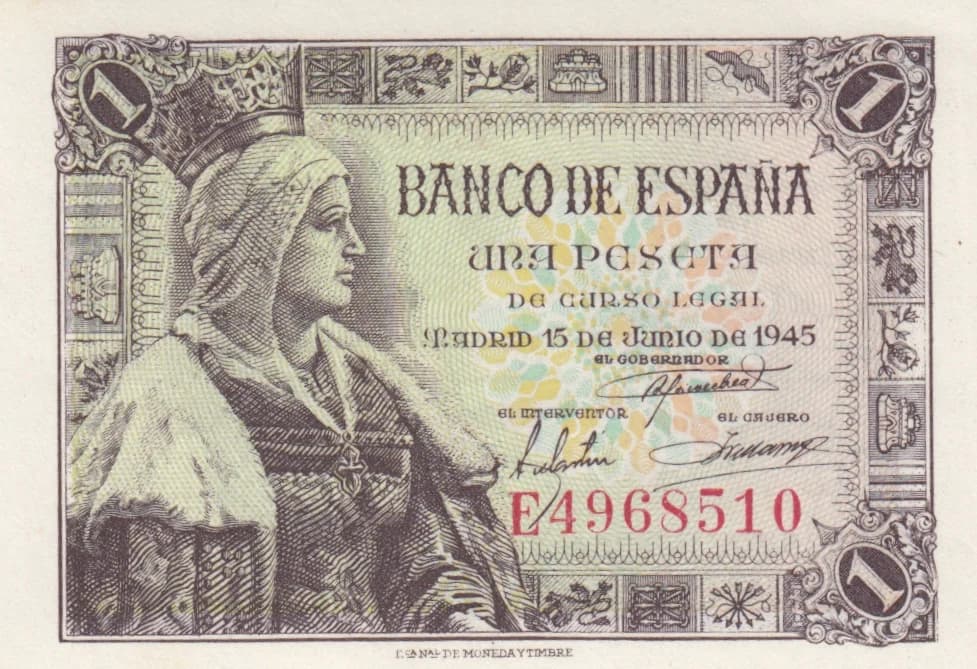
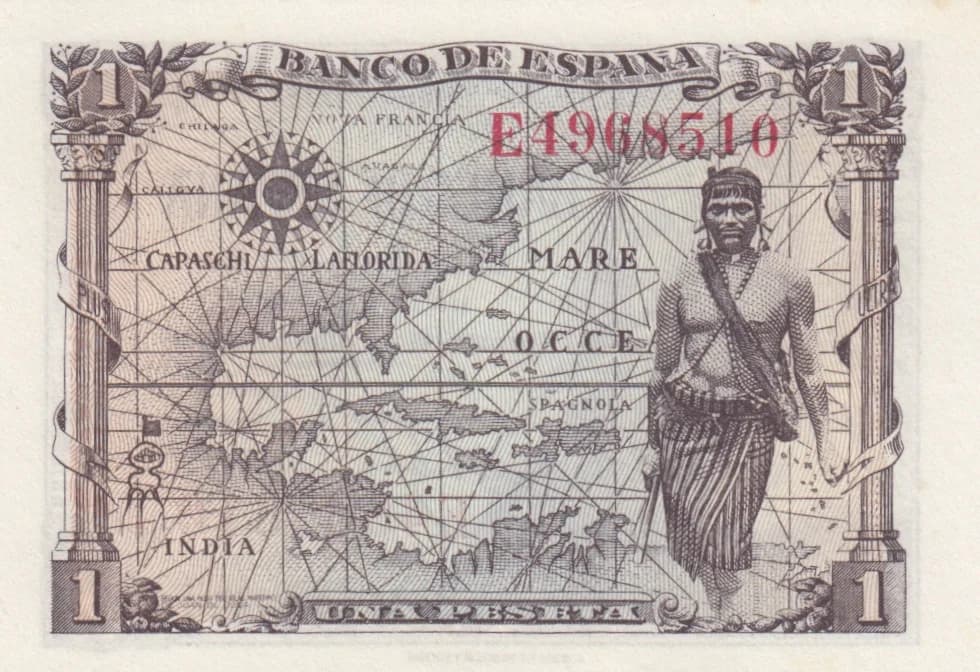
This is a stunning UNC example of Spain's 1 peseta note from 1945, issued by the Banco de España during the early Franco period. The note features exceptional engraving quality with a classical female portrait on the obverse and an elaborate nautical/cartographic design on the reverse, both rendered in fine detail with minimal wear and excellent color retention. The combination of historical significance, artistic merit, and pristine condition makes this a notable piece for Spanish currency collectors.
Common. This is a regular issue peseta from 1945 with no indication of limited print run or recall status. eBay market data confirms common status: UNC examples consistently sell in the $13–20 range, with the catalog value for UNC listed at $40 (suggesting market prices are below catalog estimates). Professionally graded examples (PMG 63–66) show more variation, with premium grades reaching $30–54, but this reflects grading rather than rarity. The note was part of the standard circulating currency of post-war Spain and remains readily available to collectors.
This 1945 peseta was issued just after the conclusion of the Spanish Civil War, reflecting Spain's post-conflict economic stabilization under Franco's government. The iconography emphasizes Spain's historical maritime power and exploration—the reverse depicts what appears to be a 16th-century navigation chart showing routes to the Americas and India, with allegorical figures representing commerce and discovery. The classical female portraits on both sides evoke Spain's Golden Age heritage, connecting the contemporary regime to Spain's glorious past.
The obverse features a classical portrait in right profile of what the catalog identifies as Queen Isabel I of Castile (Isabel la Católica), rendered in the tradition of historical numismatic portraiture. She wears a head covering and classical draped garments, occupying the central field within an ornate frame of scrollwork, heraldic elements, and geometric patterns. The reverse presents an elaborate historical navigation chart or portolan map, likely depicting 16th-century Spanish maritime routes to the Americas and Asia. A standing allegorical female figure in classical dress appears on the right, presumably representing Commerce or Navigation. The map includes radiating navigation lines (rhumb lines), a compass rose, and labeled geographical regions—Francia, La Florida, Spagnola (Hispaniola), India—emphasizing Spain's role as a maritime and colonial power. Both sides employ ornamental columns, laurel wreaths, and fine decorative border elements typical of classical currency design.
Front side: 'BANCO DE ESPAÑA' (Bank of Spain), 'UNA PESETA' (One Peseta), 'DE CURSO LEGAL' (Of Legal Tender), 'MADRID 15 de Junio de 1945' (Madrid June 15, 1945), 'EL INTERVENTOR' (The Interventor), 'EL CAJERO' (The Cashier), 'E4968510' (Serial number). Back side: 'BANCO DE ESPAÑA' (Bank of Spain), '1' (denomination), 'E4906510' (Serial number), 'FRANCIA' (France), 'CAPASCHI' (Capaschi), 'LA FLORIDA' (Florida), 'MARE' (Sea), 'OCEANO' (Ocean), 'SPAGNOLA' (Hispaniola), 'INDIA' (India), 'VIAS DE ESPAÑA' (Ways/Routes of Spain).
This note was produced using traditional intaglio engraving by the Fábrica Nacional de Moneda y Timbre (FNMT) in Madrid, as noted in the catalog data. The visual characteristics confirm this: the intricate crosshatching, fine line work in backgrounds, precise portrait detail, complex map rendering, and multi-color printing technique (purple/mauve on obverse, brown on reverse with green overprinting) are hallmarks of high-quality engraved currency production. The security features evident in the design—fine linear patterns, complex borders, and detailed vignettes—were standard engraving-based security measures of the 1945 era.
This example is identified as Pick-128a (Madrid variety). The visual analysis shows serial number E4968510 on the obverse and E4906510 on the reverse, both in red, which are standard features for this issue. No overprints, signature variants, or other distinguishing features suggesting additional varieties are apparent in the images. The 1945 date and June 15 issuance date are standard for P-128.