1 peseta 1938
Market Prices
12 salesAbout This Note
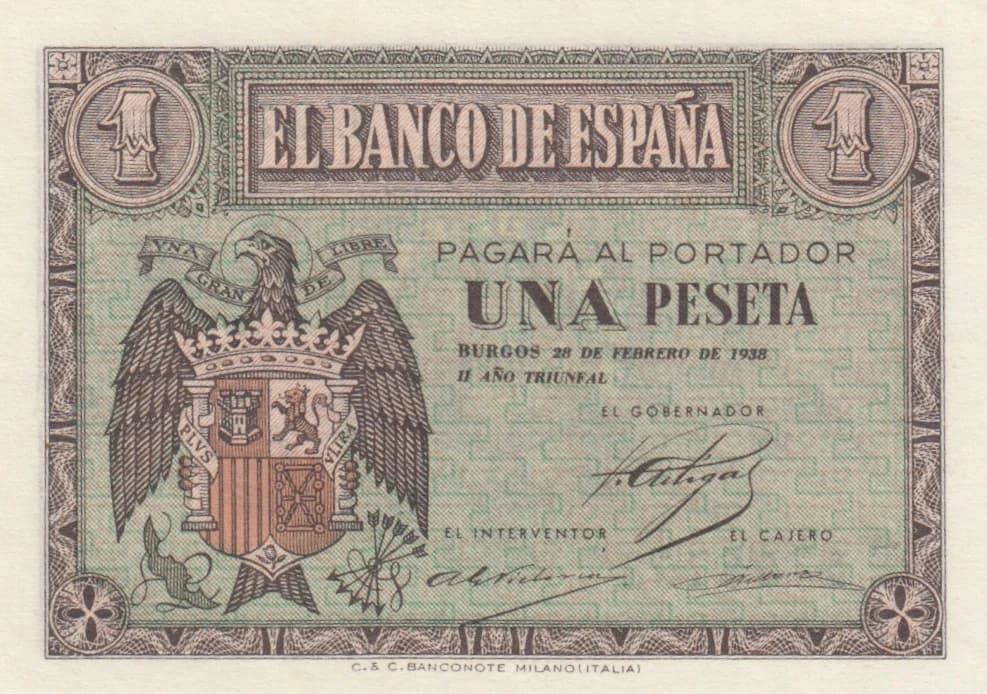
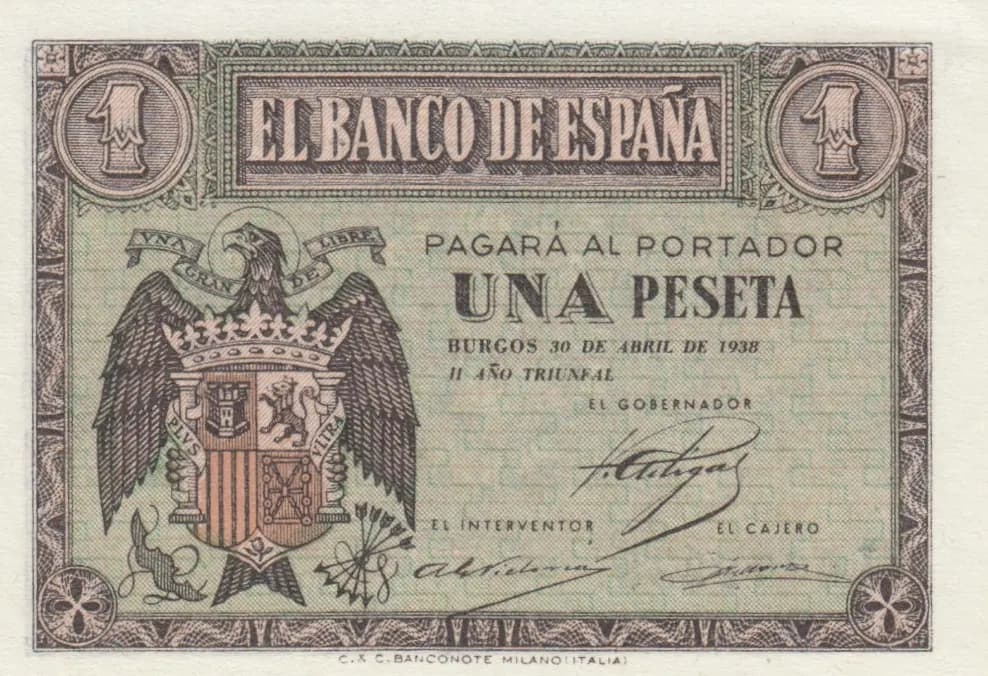
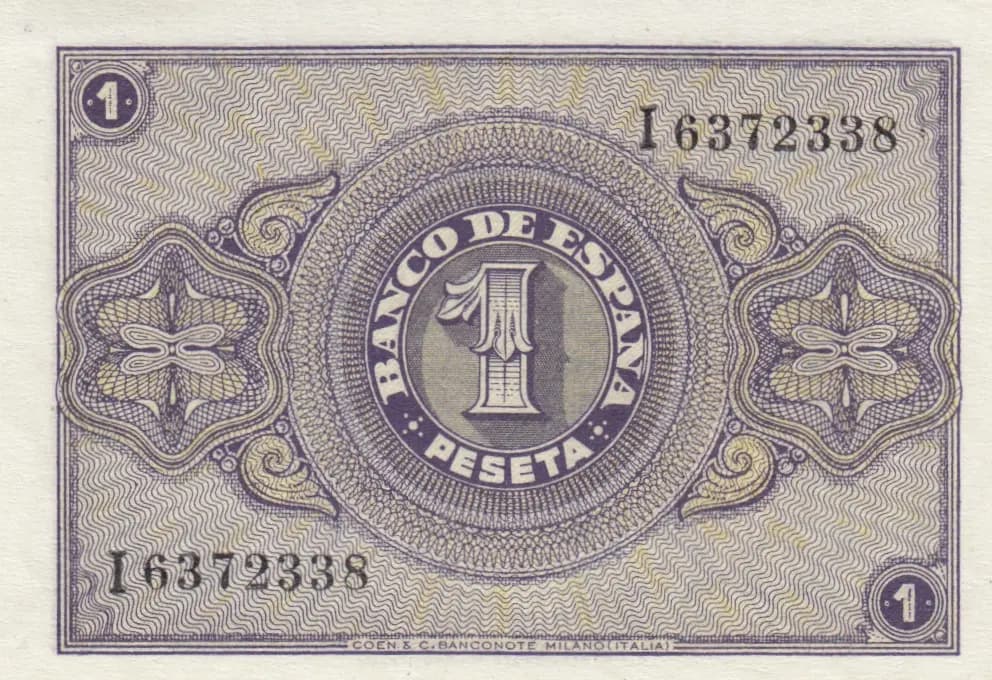
This Spanish 1 peseta note from 1938 (Pick P-108) presents in AU condition with crisp, well-defined details throughout both obverse and reverse. The note features the iconic Spanish coat of arms with imperial eagle on the front in brown and green tones, while the reverse displays an elegant purple geometric design centered on a large circular medallion. This is a historically significant Civil War-era issue dated 30 April 1938 from Burgos, marked as 'II Año Triunfal' (Second Triumphant Year), representing currency issued during Franco's nationalist government.
Common. Despite its historical significance as a Civil War-era issue, this note remains common in the collector market. eBay transaction data shows multiple sales across various conditions ranging from $3 to $50, with most examples selling for $8-$20 in circulated grades and under $70 even in UNC condition. The relatively high catalog values in 2016 ($17.50 for VF, $70 for UNC) contrast with actual market prices, indicating good availability. The large print run and surviving quantities make this a readily obtainable issue for Spanish peseta collectors.
This 1 peseta note was issued on 30 April 1938 by the Banco de España operating from Burgos, the nationalist stronghold during the Spanish Civil War. The 'II Año Triunfal' inscription and Burgos date reflect the Franco government's perspective during the final year of the conflict, with the heraldic eagle and Spanish shield prominently featured as nationalist symbols. The note's design represents an important transitional period in Spanish monetary history, issued when the nationalist government controlled monetary policy in their territories.
The obverse features an ornate border design framing the central coat of arms of Spain, which displays the imperial eagle with spread wings holding an olive branch and arrows, topped with a royal crown. The Spanish shield beneath the eagle shows the characteristic vertical red and gold stripes of the heraldic design. Decorative circular medallions in the top corners contain eagle motifs. The denomination 'UNA PESETA' and issue details appear below the arms. The reverse presents an elegant security design dominated by purple and blue-gray tones, with an intricate wavy-line background pattern serving as an anti-counterfeiting measure. A large central circular medallion contains the numeral '1' surrounded by 'BANCO DE ESPAÑA' and '1 PESETA' in concentric rings, with matching corner medallions containing the denomination numeral.
FRONT: 'EL BANCO DE ESPAÑA' (The Bank of Spain); 'PAGARÁ AL PORTADOR' (Will Pay to Bearer); 'UNA PESETA' (One Peseta); 'BURGOS 30 DE ABRIL DE 1938' (Burgos, 30 April 1938); 'II AÑO TRIUNFAL' (Second Triumphant Year); 'EL GOBERNADOR' (The Governor); 'EL INTERVENTOR' (The Interventor); 'EL CAJERO' (The Cashier); 'C.& C. BANCONOTE MILANO ITALIA' (C.& C. Banknote, Milan, Italy). BACK: 'BANCO DE ESPAÑA' (Bank of Spain); '1 PESETA' (One Peseta); 'COEN & C. BANCONOTE MILANO ITALIA' (Coen & C. Banknote, Milan, Italy); Serial number '1639238' appearing twice.
Intaglio engraving, executed by Coen & C. Banconote of Milan, Italy. The fine line engraving is evident throughout both sides, with intricate border designs, detailed heraldic work, and the security wavy-line pattern on the reverse. The crisp definition of ornamental elements and the precision of the circular medallions confirm professional bank note engraving standards of the period.
This note is related to Pick P-107, which represents an earlier 1938 issue. The P-108 designation indicates a distinct variety or printing from the 30 April 1938 issue date. The serial number visible on this example (1639238) represents a specific printing batch, though no major known varieties with distinct characteristics (such as signature variations, date changes, or significant overprints) are documented for this Pick number. The consistent design and printer attribution (Coen & C., Milan) indicate this is the standard type for P-108.