1 peseta 1938
Market Prices
4 salesAbout This Note
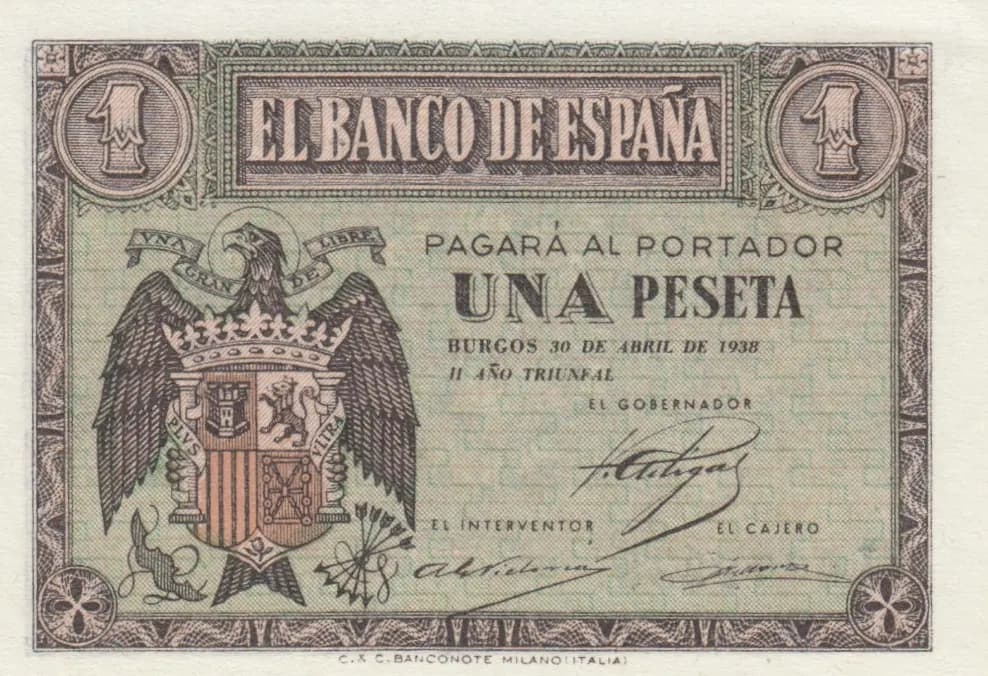
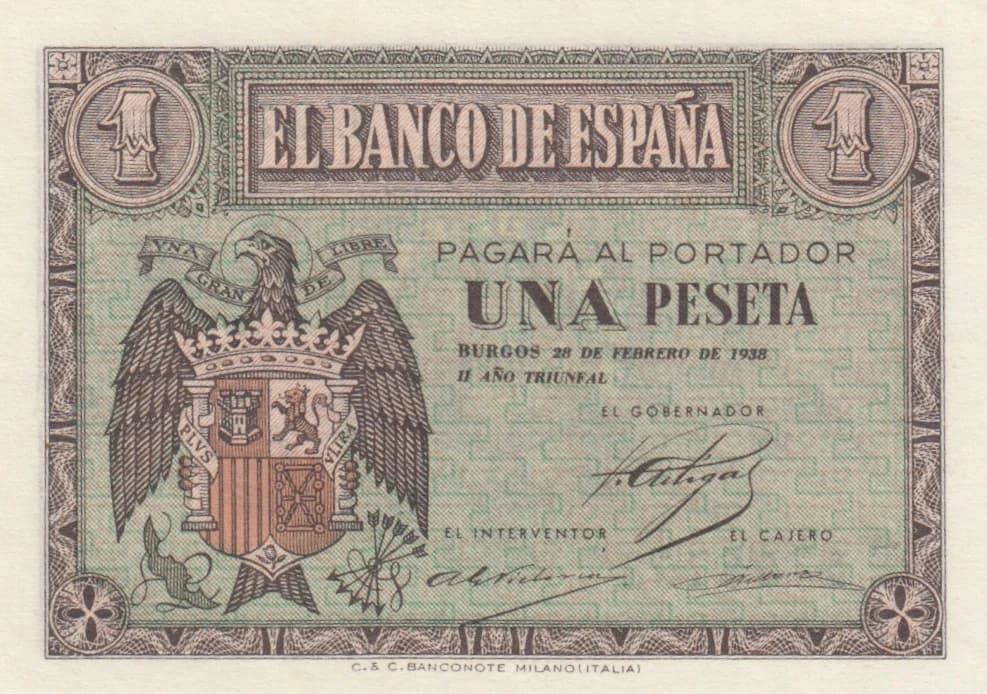
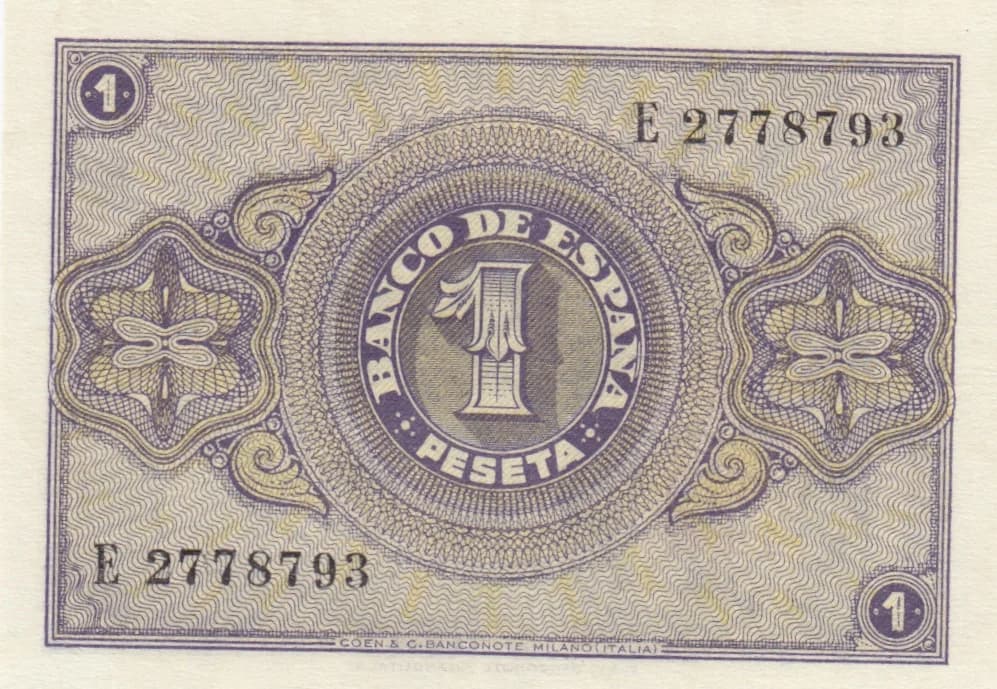
This is an exceptional example of the Spanish 1 Peseta note from 1938 (Pick P-107), graded UNC and issued by Banco de España during the Spanish Civil War. The note displays pristine condition with vibrant color preservation across both sides—featuring a striking beige and purple palette on the obverse with the Spanish coat of arms and double-headed eagle, and an intricate purple-blue reverse with geometric medallion design. This Burgos issue is historically significant as it was printed during the 'II Año Triunfal' (Second Triumphant Year) of Franco's regime and represents an important period of Spanish numismatic history.
Common. The eBay market data shows this note in UNC condition sold for $71 in 2018, with catalog values at $75 UNC (2016 estimate). The consistent availability of sales data across multiple condition grades (VG at $8-$6, VF at $15-$20, UNC at $71-$75) and regular appearance on the secondary market indicates this is a widely available note among collectors. While historically significant due to its Civil War-era Burgos provenance, the note was produced in sufficient quantities to remain common in the collecting market.
This note was issued on February 28, 1938, from Burgos, which served as the Nationalist headquarters during the Spanish Civil War (1936-1939). The inscription 'II AÑO TRIUNFAL' references the second year of Franco's military victory, reflecting the political circumstances of the Nationalist-controlled territory. The double-headed eagle and Spanish coat of arms prominently featured in the design symbolized the authority and legitimacy the Nationalist government sought to establish during this tumultuous period.
The obverse features a centralized heraldic composition dominated by Spain's coat of arms—specifically the shield with vertical stripes (representing the Kingdom of Aragon) and other heraldic elements—held by a crowned double-headed eagle, a symbol of Spanish sovereignty. This royal eagle is rendered in fine detail with intricate line work and serves as the primary focal point. Roman numerals 'I' appear in decorative circular frames at the top corners, emphasizing the denomination. The background employs a cream-beige base with purple and brown decorative elements, including ornamental flourishes and cross-hatching that provide security and aesthetic depth. The reverse displays a more geometric and symmetrical design with a large central medallion framed by ornamental quatrefoil or floral patterns. Large denomination numerals '1' in circles repeat at all four corners. The reverse palette shifts to purple and blue tones with elaborate wavy line patterns throughout the background, creating a distinct visual identity from the obverse while maintaining design cohesion.
FRONT SIDE: 'EL BANCO DE ESPAÑA' (The Bank of Spain) | 'PAGARÁ AL PORTADOR' (Will pay to bearer) | 'UNA PESETA' (One peseta) | 'BURGOS 28 DE FEBRERO DE 1938' (Burgos, February 28, 1938) | 'II AÑO TRIUNFAL' (Second Triumphant Year) | 'EL GOBERNADOR' (The Governor) | 'EL INTERVENTOR' (The Comptroller) | 'EL CAJERO' (The Cashier) | 'C.S. BANCONOTE MILANO(ITALIA)' (C.S. Banknote Milan, Italy - printer mark). BACK SIDE: 'BANCO DE ESPAÑA' (Bank of Spain) | '1 PESETA' (One peseta) | Serial numbers 'E 2771879' and 'I 2771879' | 'COEN & C. BANCONOTE MILANO(ITALIA)' (Coen & C. Banknote Milan, Italy - printer mark).
This note was produced using intaglio (engraved) printing, as evidenced by the fine line work, cross-hatching, and intricate detail visible throughout both sides. The printer, Coen & C. Banconote of Milan, Italy, was a renowned security printer specializing in high-quality banknote production. The complexity of the decorative borders, the precision of the heraldic imagery, and the fine wavy line patterns characteristic of anti-counterfeiting measures all confirm traditional engraved intaglio techniques were employed, which was standard practice for central bank notes of this era.
This specimen is identified as Pick P-107a (Burgos variety), as confirmed by the issue location 'BURGOS 28 DE FEBRERO DE 1938' printed on the obverse. The PMG population report indicates this is the catalogued variant for Pick P-107. The serial numbers visible (E 2771879 / I 2771879) represent a specific production batch. The note bears signatures for El Gobernador (Governor), El Interventor (Comptroller), and El Cajero (Cashier), which are standard for this issue type. No overprints or other distinguishing varieties are evident in this example.