5 rand 1978
Market Prices
12 salesAbout This Note
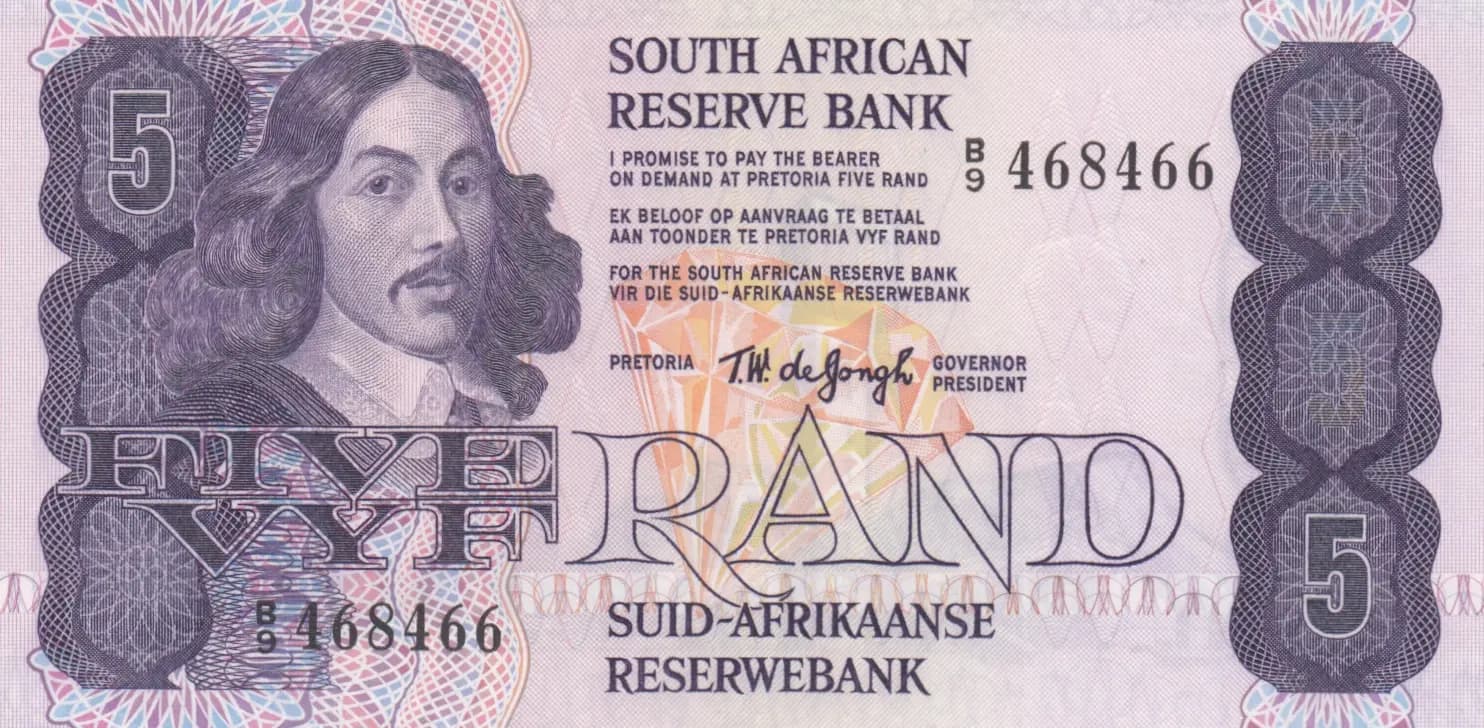
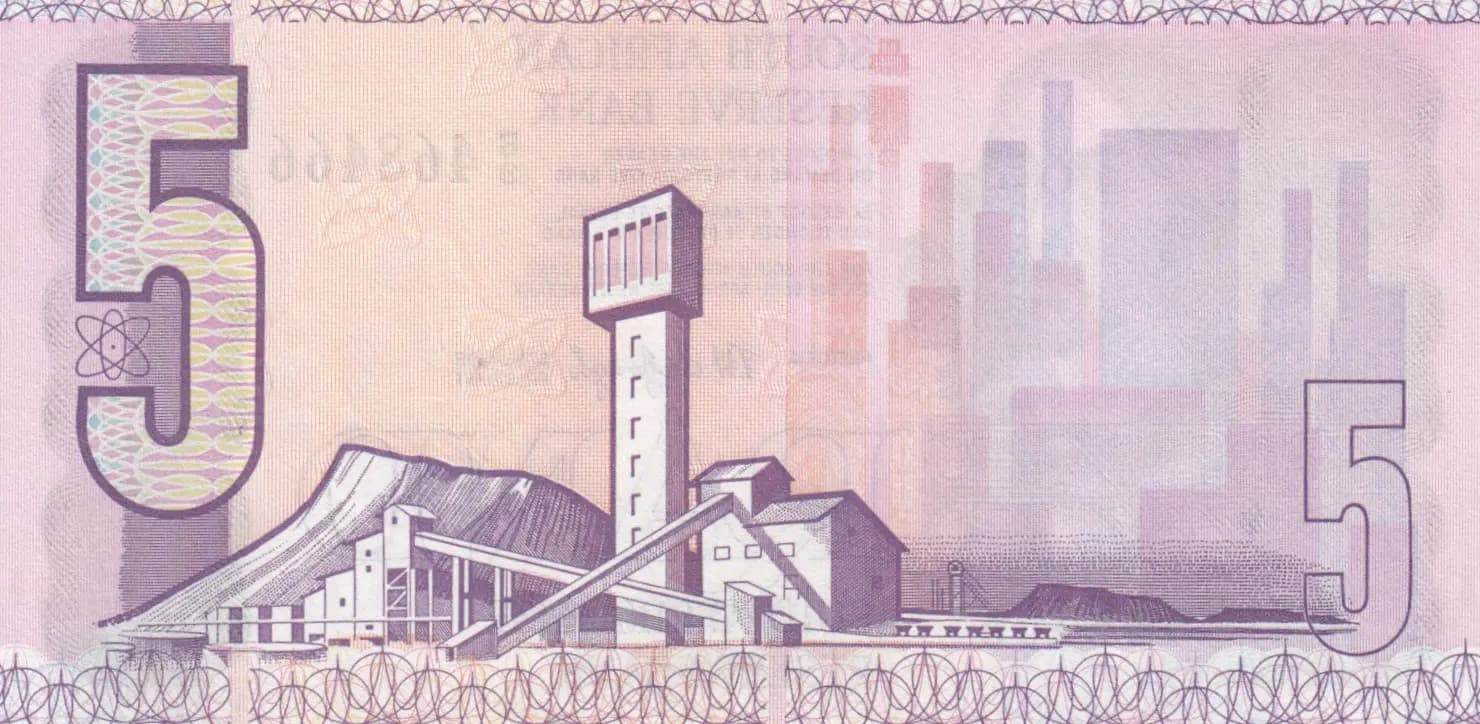
This is an uncirculated 1978 South African Reserve Bank 5 Rand note (Pick P-119a) featuring a striking purple and multicolor design. The obverse displays a portrait of a historically significant figure with distinctive long curled hair rendered in fine detail, while the reverse showcases an industrial mining scene with a prominent headframe—reflecting South Africa's crucial mining economy of the era. The note exhibits pristine condition with no wear, creases, or stains, making it a desirable example for collectors interested in South African currency or mid-20th century security printing.
Common. The 1978 5 Rand note (Pick P-119a) is a regular issue with substantial print runs typical of circulating currency denominations. eBay market data confirms common status: recent uncirculated examples sold for $1.99–$5.25 (2015–2022), with only premium graded specimens (PMG 66) commanding higher prices ($17.99). The 2019 catalog value of $7 UNC further supports a common classification. Unless this specific serial number or variety carries documented rarity, it should be considered a standard, readily available issue.
Issued in 1978 during the height of apartheid-era South Africa, this 5 Rand note reflects the country's economic foundation in mineral extraction and industrial development. The prominent mining headframe on the reverse—complete with processing facilities and stockpiles—symbolizes the centrality of the mining industry to South Africa's economy and national identity during this period. The bilingual inscriptions in English and Afrikaans represent the official languages of the apartheid government, with the note issued under Governor-President T.W. de Jongh of the South African Reserve Bank.
The obverse features a three-quarter portrait of a bearded man with long, elaborately curled hair characteristic of 17th-century Dutch portraiture, positioned on the left side of the note. This portrait is believed by the catalog references to depict either Bartholomeus Vermuyden or Jan van Riebeeck, foundational figures in European settlement at the Cape. The design incorporates the South African Reserve Bank emblem/seal on the right side, with intricate geometric patterns and ornamental borders with interwoven designs providing security through complexity. The reverse displays an industrial mining landscape dominated by a tall mine headframe (typical of South African deep-shaft mining operations) with adjacent processing buildings, conveyor systems, and stockpiles rendered in detailed line engraving. An atomic symbol appears near the left-side denomination numeral, suggesting the modernization and scientific advancement associated with mid-20th century South African industry. The color palette of purple, pink, gray, and light lavender creates a distinctive appearance characteristic of this series.
FRONT: 'SOUTH AFRICAN RESERVE BANK' / 'I PROMISE TO PAY THE BEARER ON DEMAND AT PRETORIA FIVE RAND' (English) / 'EK BELOOF OP AANVRAAG TE BETAAL AAN TOONDER TE PRETORIA VYF RAND' (Afrikaans: 'I promise to pay on demand to the bearer at Pretoria five rand') / 'FOR THE SOUTH AFRICAN RESERVE BANK' (English) / 'VIR DIE SUID-AFRIKAANSE RESWERWEBANK' (Afrikaans: 'For the South African Reserve Bank') / Signature: 'T.W de Jongh, GOVERNOR PRESIDENT' / Serial Number: 'B 9 468466' / BACK: Large denomination numeral '5' on both left and right edges. All text maintains the official bilingual format characteristic of South African currency from this era.
This note employs intaglio (line engraving) printing throughout, as evidenced by the fine line work, intricate geometric patterns, complex crosshatching, and stippling techniques visible in both the portrait rendering and the industrial landscape background. The detailed security-style border designs with repeated decorative elements and the precisely executed bilateral inscriptions are hallmarks of high-security intaglio production. This note was likely produced by the South African Reserve Bank's approved security printer; De La Rue or similar security printers of the era typically produced South African currency of this period.
This note is identified as Pick P-119a, indicating it is the first cataloged variety of the 1978 5 Rand issue. The serial number 'B 9 468466' with prefix 'B' is consistent with regular production. The signature of T.W. de Jongh as Governor-President is the standard signature for this series. No overprints, special markings, or documented scarce varieties are evident from the visual analysis. The 1978-1994 date range referenced in external catalogs suggests this design remained in use across multiple years, and the specific 1978 dating would relate to the first issue year of this particular design variant.