10 shillings 1940
Market Prices
8 salesAbout This Note
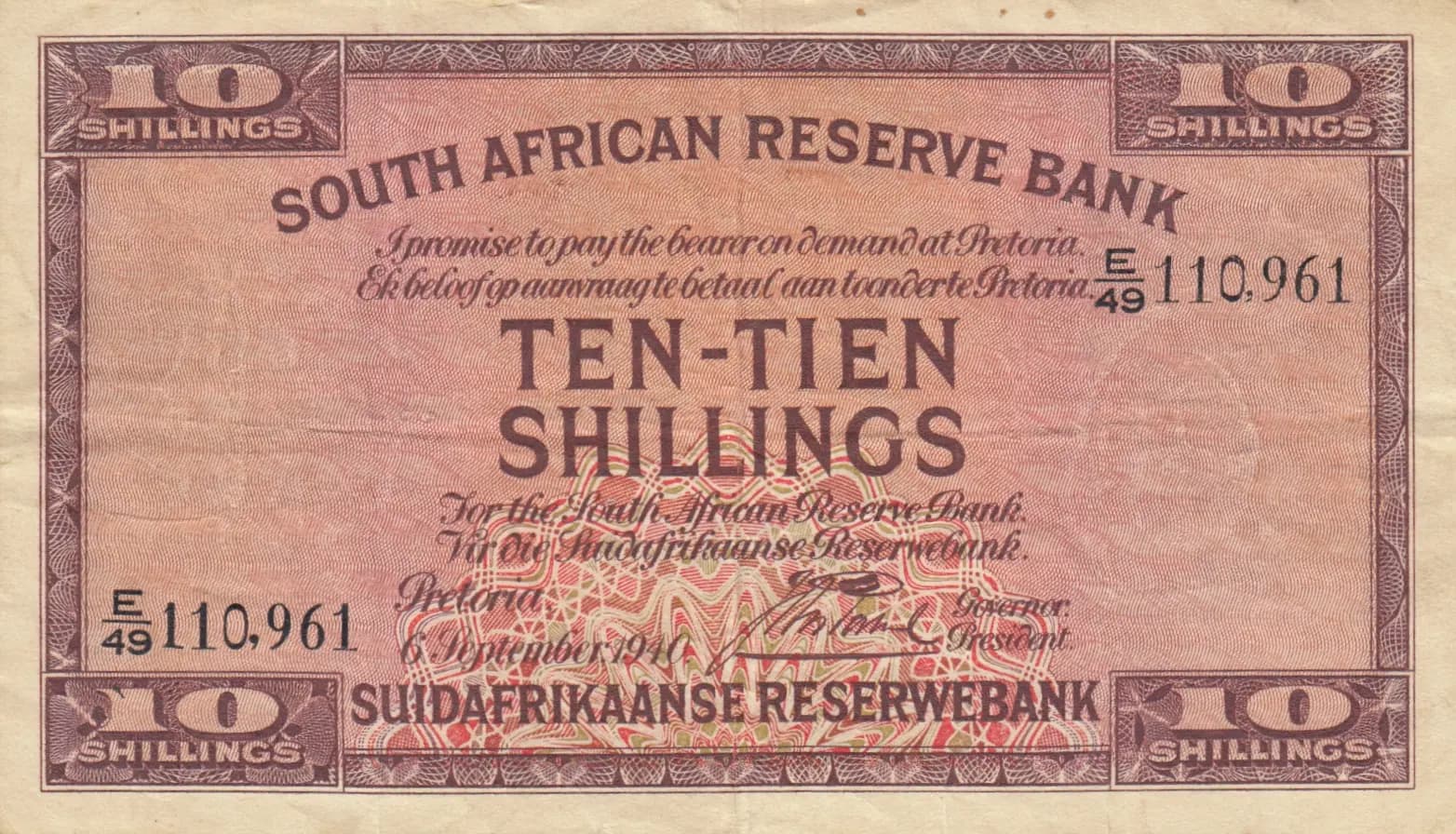
This is a South African Reserve Bank 10 Shillings note from September 1940 (Pick P-82d), displaying the bilingual English/Afrikaans design characteristic of the post-Union period. The note exhibits Fair condition with moderate foxing, discoloration, and creasing consistent with decades of circulation, but maintains structural integrity. The mauve and pink color scheme with intricate ornamental design on the obverse and the prominent South African coat of arms on the reverse make this a representative example of early SARB currency.
Common. This Pick P-82d variant was part of a regular issue with a lengthy circulation period (1932-1947 per external catalog data), indicating substantial print runs. eBay market data shows consistent sales of comparable VF examples in the $10-30 range, with even professionally graded PMG 40 examples selling at $117.50—indicative of a well-supplied market. Fair condition examples are among the most affordable grades available, suggesting no scarcity premium. The note is readily available to collectors and represents standard post-Union South African currency.
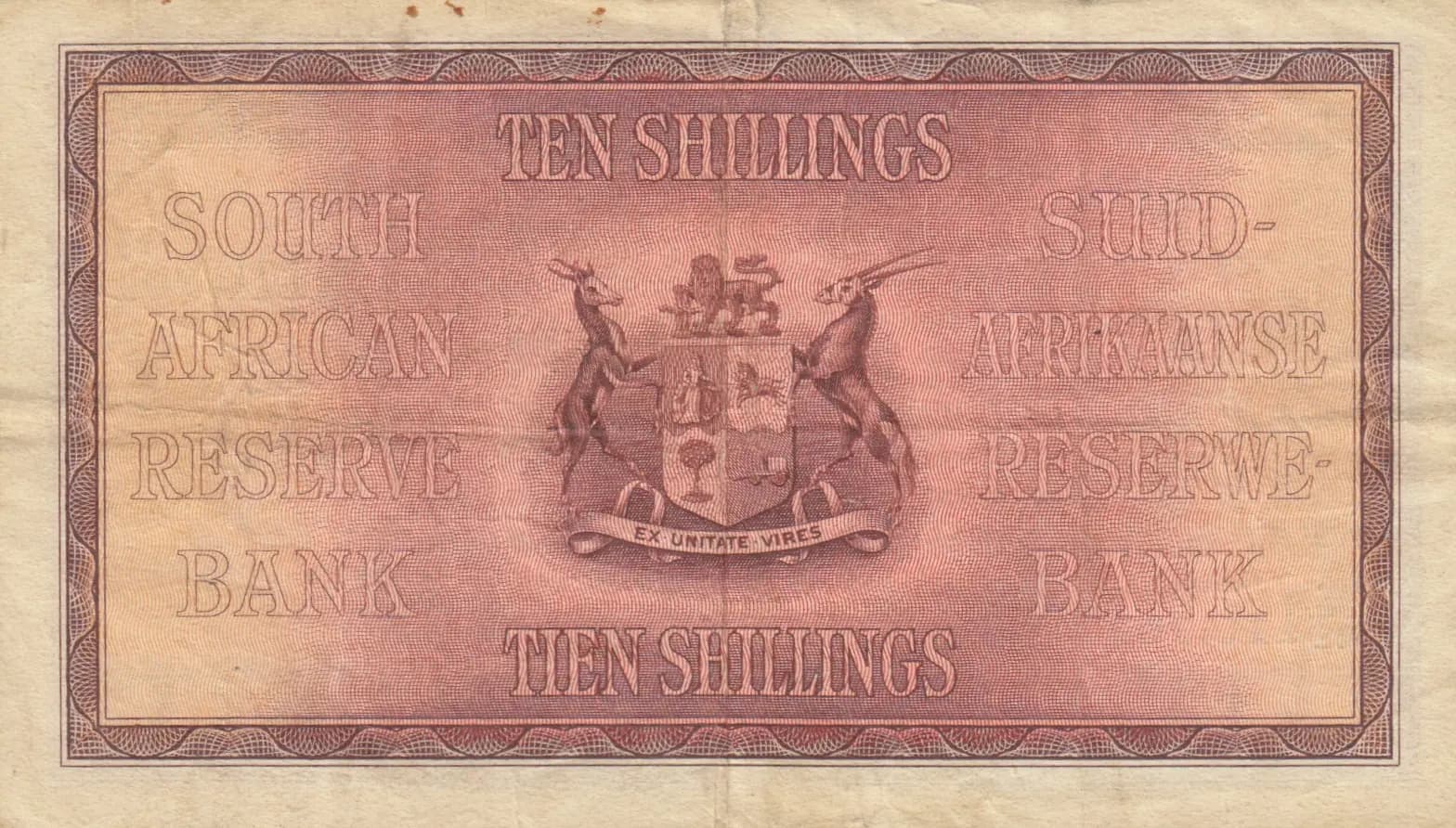
Issued during World War II when South Africa was actively involved in the Allied war effort, this note reflects the nation's bilingual policy through its parallel English and Afrikaans inscriptions and the prominently displayed South African coat of arms with its motto 'UNITE VIRES' (Unity is Strength). The September 1940 date places this within the early SARB era (founded 1921), during a period of significant economic and political transition in South Africa. The heraldic imagery, including the springbok and antelope supporters and crowned lion, represents the Union of South Africa's formal state symbolism during this period.
The obverse features an ornate central rosette pattern with complex geometric and floral design elements rendered in mauve, pink, and cream tones. The bilateral text arrangement reflects South Africa's official bilingualism policy of the era. The note includes dual denominations (English and Afrikaans), promise-to-pay clauses, issuer identification, and a serial number (E 49 110.961) dated September 1940. The reverse displays the South African coat of arms as the dominant central motif, featuring a shield surrounded by heraldic supporters—a springbok on the left and an antelope on the right—crowned by a lion atop. The shield is flanked by repeating denomination text in both languages and the Latin national motto 'UNITE VIRES' on a banner. The overall design employs ornamental borders with repeating patterns framing all four edges. No portrait figures appear on either side; the design relies entirely on heraldic symbolism and geometric ornamentation.
FRONT SIDE: 'South African Reserve Bank' / 'Suidafrikaanse Reserwebank'; 'Ten Shillings' / 'Tien Shillings'; 'I promise to pay the bearer on demand at Pretoria or Welgelegen' / 'Ek beloof om aan toonder betaal aan Pretoria'; 'for the South African Reserve Bank' / 'uitgegeven door de Zuidafrikaanse Reservebank Pretoria'; Serial number 'E 49 110.961'; Date 'September 1940'. BACK SIDE: 'South African' / 'Suid-Afrikaanse'; 'Reserve Bank' / 'Reserwebank'; 'Ten Shillings' / 'Tien Shillings'; Latin motto 'UNITE VIRES' (Unity is Strength/United Strength).
Intaglio printing with intricate engraving, evidenced by the fine line work, complex guilloche patterns, and the three-dimensional relief quality visible in the security features. The precision of the decorative rosette patterns and heraldic detail work is characteristic of high-security banknote production. The SARB notes of this era were typically printed by De La Rue or similar established security printers, though this specific note's printer mark is not clearly legible in the visual analysis provided.
This is cataloged as Pick P-82d with the characteristic watermark of a sailing ship and J. van Riebeeck portrait. PMG has cataloged at least two variants (P-82d and P-82e) for this base Pick number, differentiated by the ship and portrait watermark. The serial number prefix 'E' and the September 1940 date are consistent with the known range for this variety. No signature variants or significant overprints are visible in the visual analysis that would further differentiate this specific specimen.