1 pound 1939
Market Prices
17 salesAbout This Note
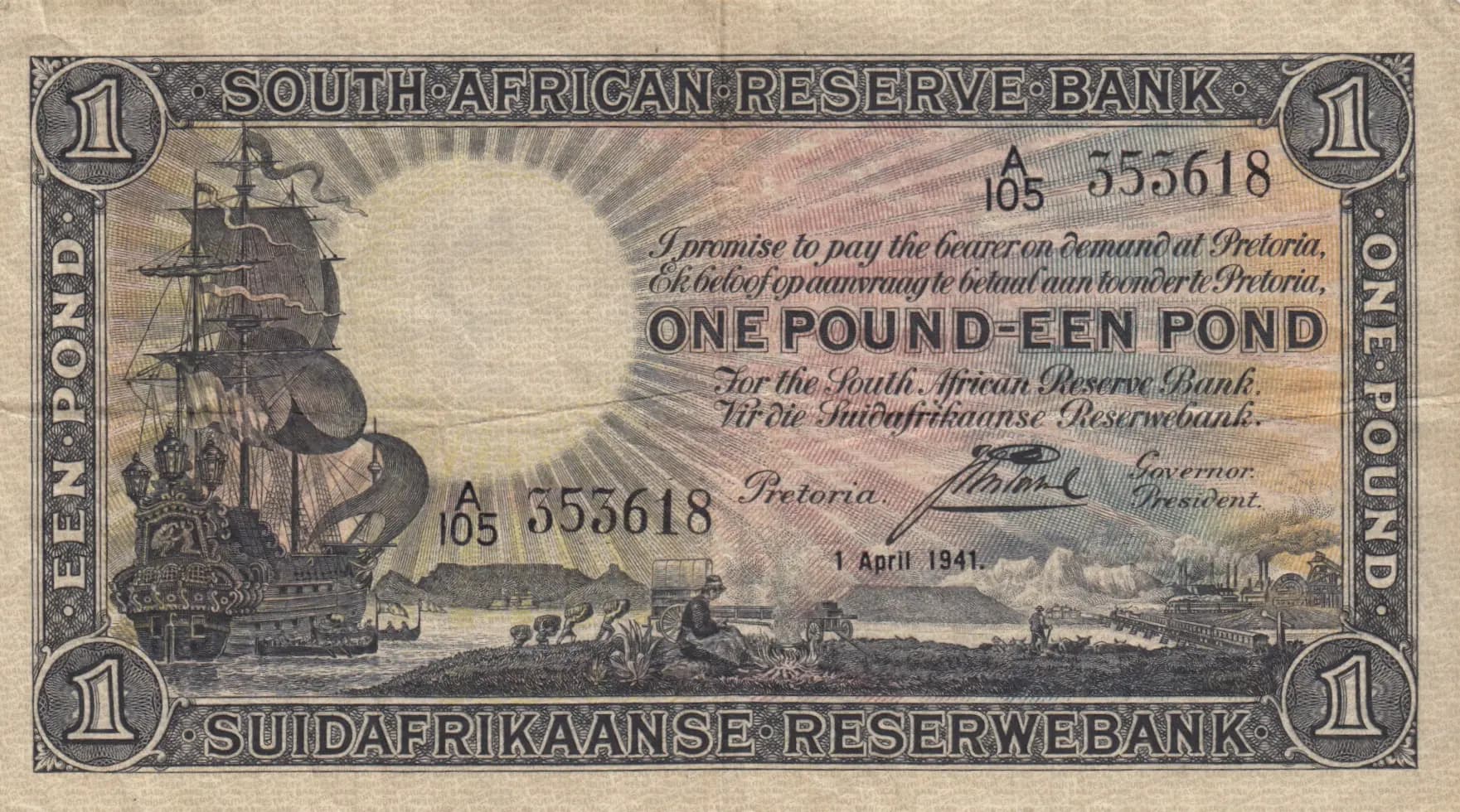
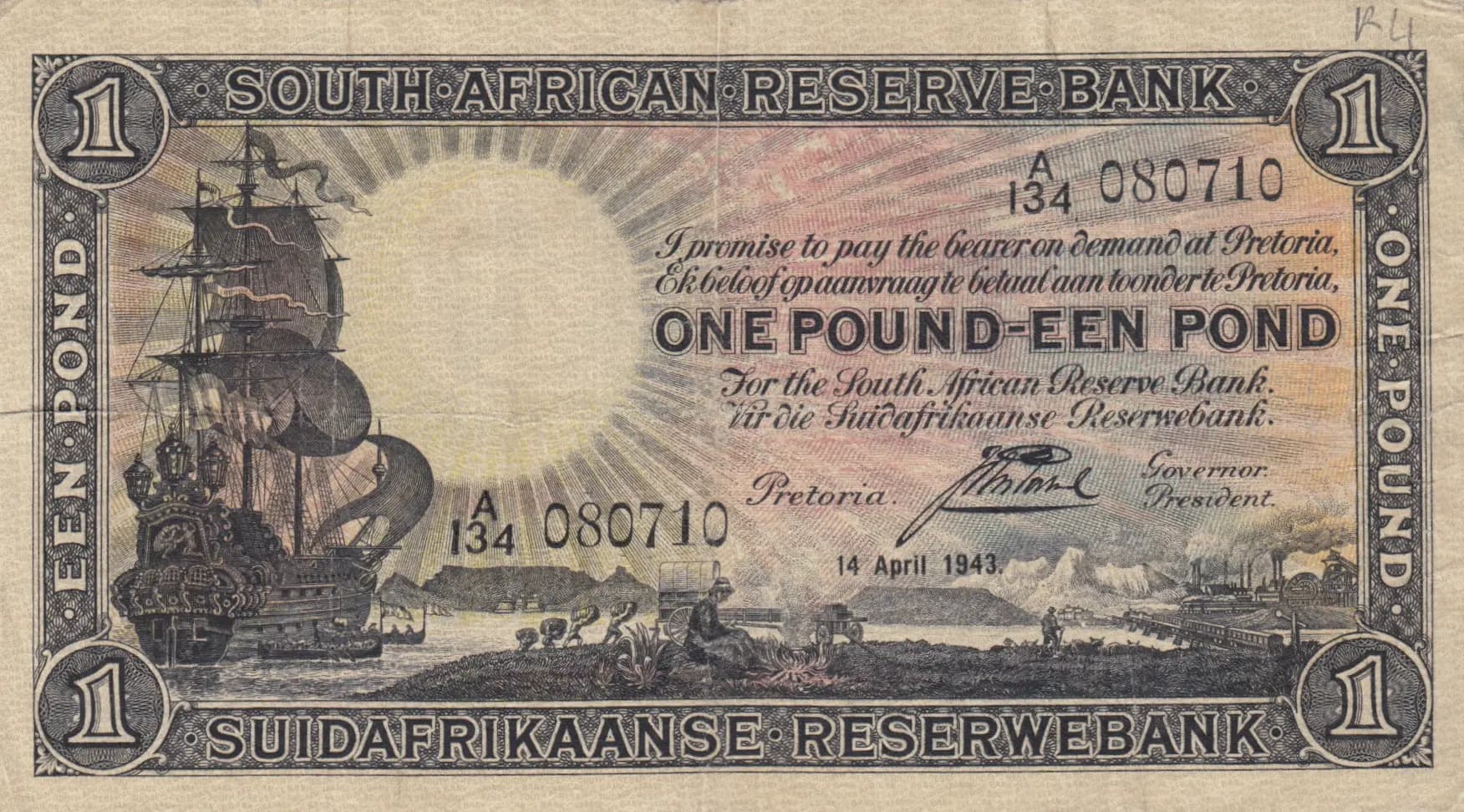
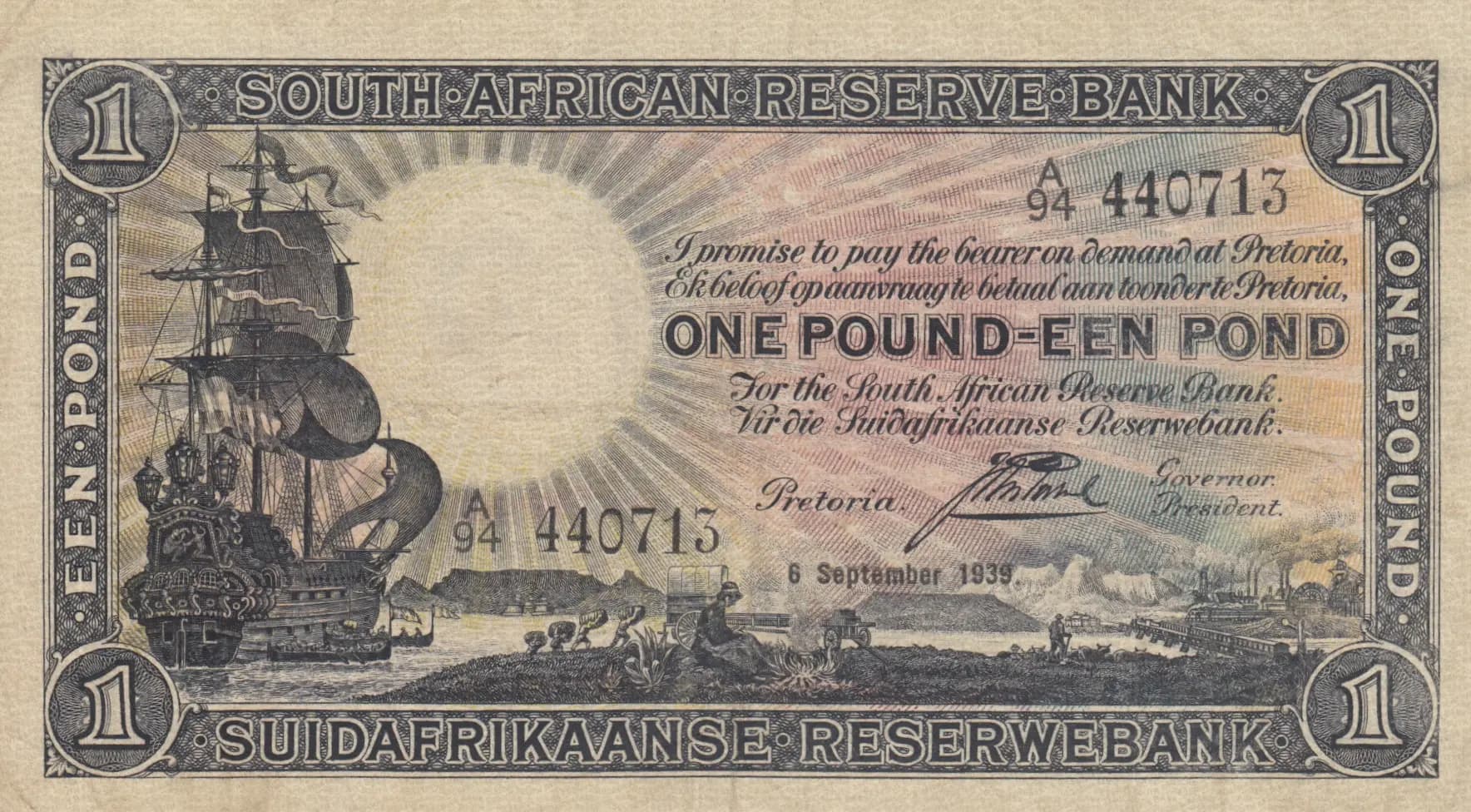
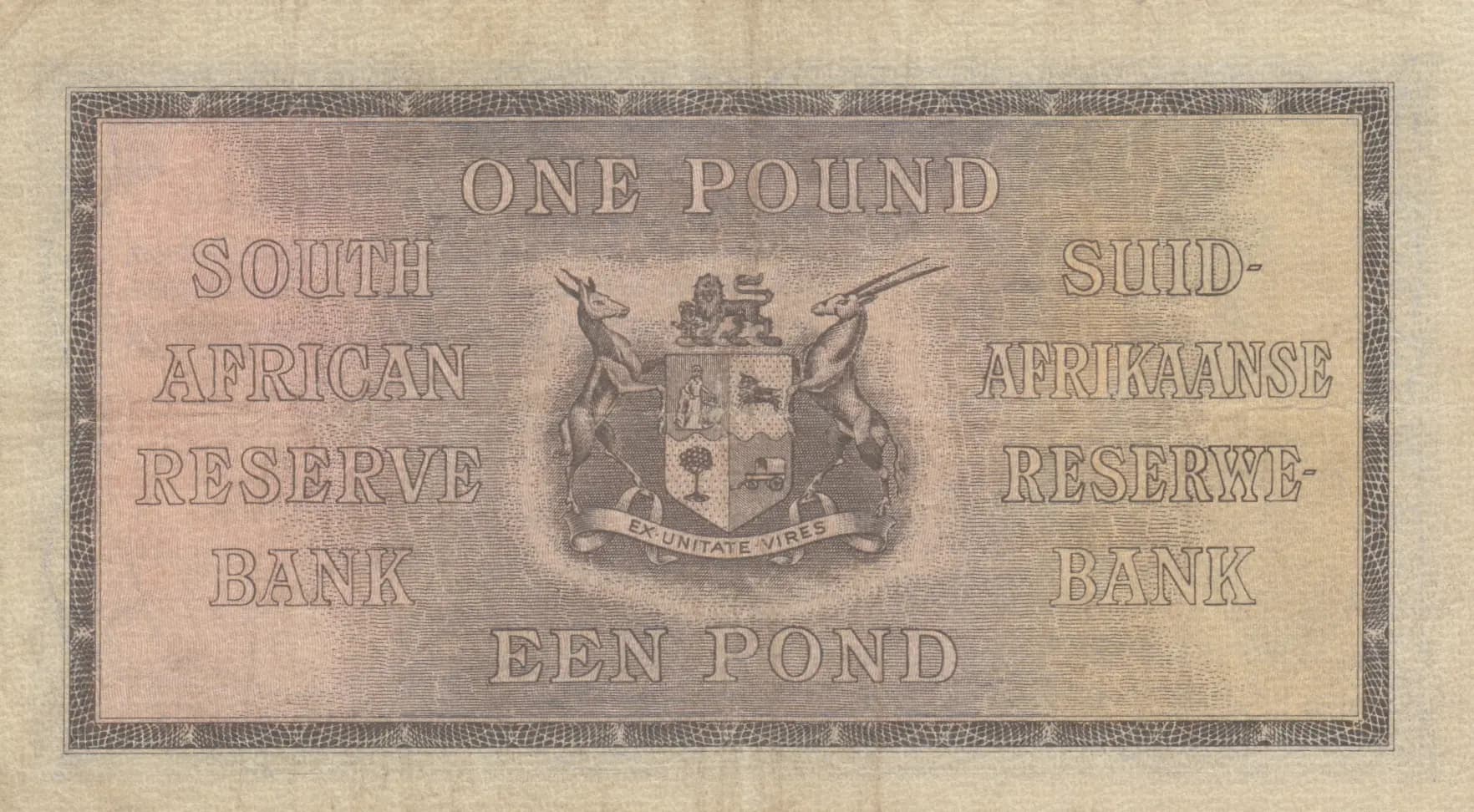
This South African one pound note from 1939 presents a well-preserved example of early Reserve Bank currency featuring distinctive maritime imagery and bilingual English-Afrikaans design elements. The note displays the characteristic cream-tan patina and minor creasing consistent with a Fine grade, with clear legibility of the detailed engraved sailing ship scene, circular sunburst watermark area, and reverse coat of arms. The 6 September 1939 issue date places this note historically at the outbreak of World War II, making it a significant artifact of South Africa's interwar monetary period.
Common. The eBay price history shows consistent sales of Fine-graded examples in the $8-$35 range over the 2010-2023 period, with an average around $20-$25 for this grade. The PMG population report indicates multiple cataloged varieties (P-84b, P-84c, P-84e, P-84f), suggesting a substantial print run across these variants. The P-84e variety specifically appears to be part of a regular currency series with no documented scarcity. The 1939 issue date represents a standard pre-war emission rather than a commemorative or limited release.
This banknote was issued during the early period of the South African Reserve Bank's currency operations and reflects the Union of South Africa's status as a British dominion through its pound sterling denomination and heraldic symbolism. The prominent sailing ship with crown depicted on the front references South Africa's maritime colonial heritage and the age of exploration, while the coat of arms on the reverse featuring the antelope supporters and 'E UNITATE VIRES' motto emphasizes the union of South Africa's diverse regions. The bilingual English-Afrikaans inscriptions document the linguistic and political tensions of the Union period, following the 1938-1939 celebrations of the Voortrekker centenary that preceded the Second World War.
The front of this note features a detailed maritime scene symbolizing South Africa's colonial heritage, with a fully-rigged historical sailing ship (likely representing a Dutch East India Company vessel given the crown at the stern) positioned on the left, accompanied by a coastal landing scene with figures depicting early colonial settlement activities. A prominent circular sunburst design in the center-right serves as the watermark area. Ornamental corner designs with circles containing the numeral '1' frame the composition in black line engraving on a cream field. The reverse displays the coat of arms of the Union of South Africa, featuring a quartered shield flanked by two antelope supporters (representing the fauna of the nation) with the national motto 'E UNITATE VIRES' on a banner below. The entire design employs fine line engraving with bilingual text emphasizing the Union's dual English-Afrikaans character.
FRONT SIDE: 'SOUTH AFRICAN RESERVE BANK' / 'SUIDAFRIKAANSE RESERWEBANK' (South African Reserve Bank in English and Afrikaans); 'ONE POUND-EEN POND' (One Pound in English and Afrikaans); 'I promise to pay the bearer on demand at Pretoria' / 'Sekbelof opaanvraag ie betaald aan toonder te Pretoria' (Promise to pay bearer on demand at Pretoria); 'For the South African Reserve Bank' / 'Vir oie Suudafrikaanse Restrewebank' (For the South African Reserve Bank); 'Governor' and 'President' (signature titles); '6 September 1939' (issue date); Serial number 'A 94 440713'. BACK SIDE: 'ONE POUND' / 'EEN POND' (One Pound in both languages); 'SOUTH AFRICAN RESERVE BANK' / 'SUID-AFRIKAANSE RESERWEBANK' (South African Reserve Bank in both languages); 'E UNITATE VIRES' (Latin: Strength in Unity - South African national motto).
This note was produced using intaglio engraving (recess printing), characteristic of high-security banknote production of the 1930s-1940s period. The fine line work visible throughout both sides, the precise registration of the bilingual text, and the detailed rendering of the sailing ship scene and heraldic coat of arms are consistent with steel plate engraving by a specialized security printer. For South African Reserve Bank notes of this era, the printing was likely executed by a major Commonwealth security printer such as De La Rue or similar establishment, though the specific printer attribution is not indicated on the note itself.
This note is identified as Pick P-84e, a variant of the South African £1 note series distinguished by the J. van Riebeeck watermark. The PMG population report confirms four cataloged varieties (P-84b through P-84f) for this base Pick number, with variations likely attributable to signature changes, date variations, or watermark differences across the issuance period. The observed serial number 'A 94 440713' and the 6 September 1939 date are consistent with the P-84e catalog entry. The signature blocks for Governor and President appear intact, which would be a key distinguishing feature among the variants.