2 rand 1961
Market Prices
6 salesAbout This Note
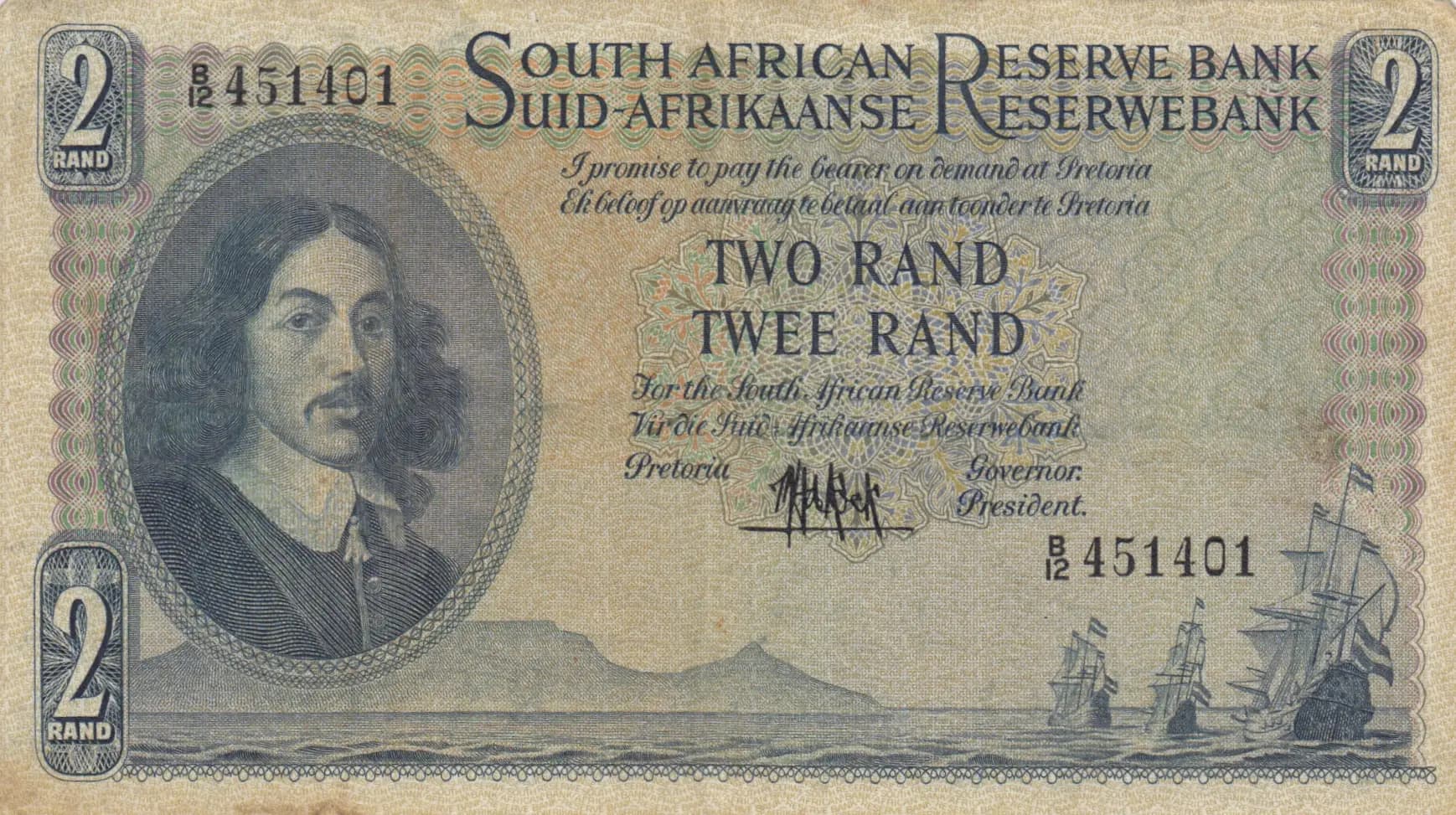
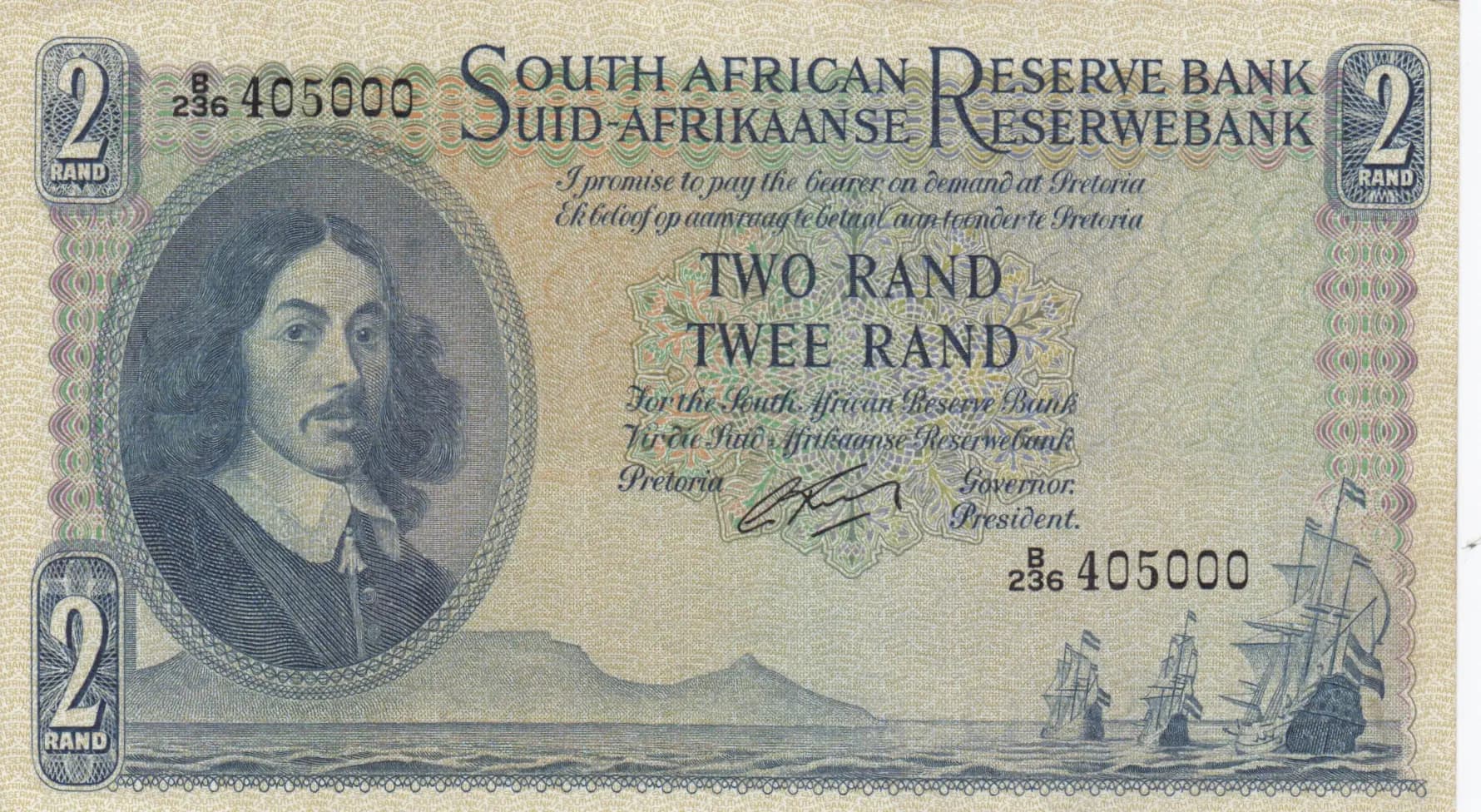
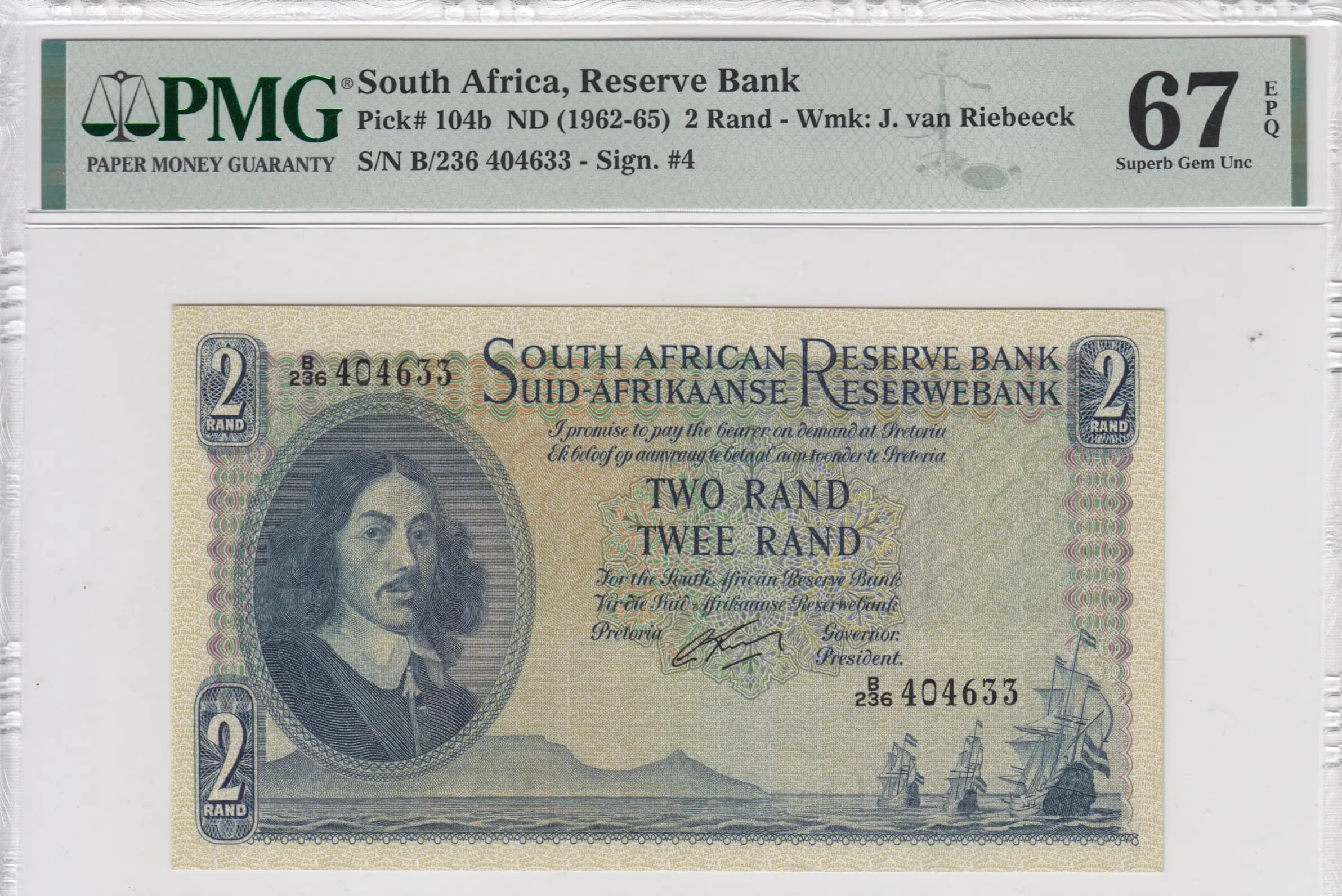
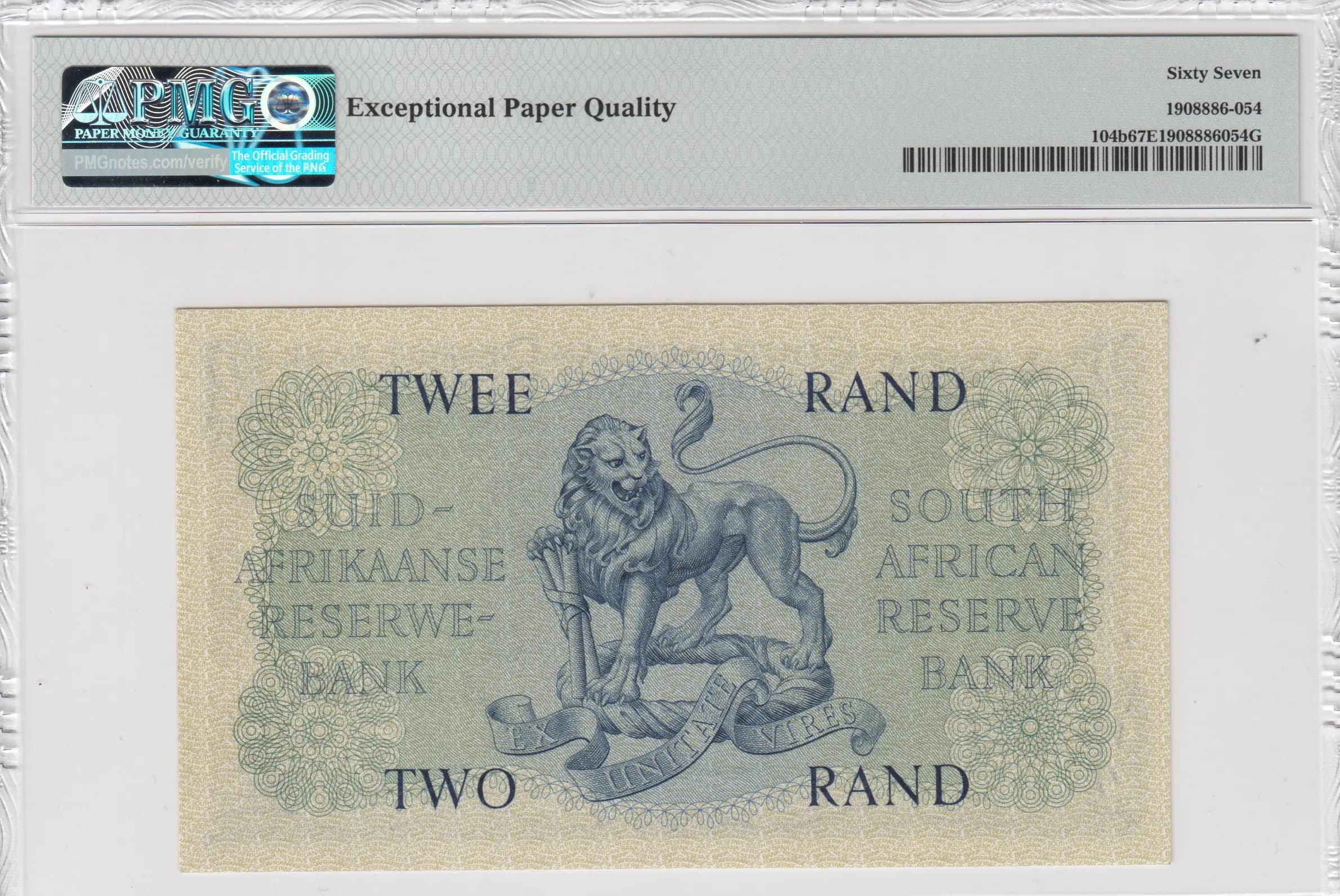
This is an exceptional PMG 67 EPQ example of the South African 2 Rand note from 1961-1965 (Pick P-104b), featuring the English-language first line text variety. The note displays the portrait of Jan van Riebeeck on the obverse with Table Mountain and period sailing ships depicted in the background, while the reverse showcases a heraldic lion standing prominently as the central design element. The banknote exhibits pristine condition with crisp, sharp printing, excellent color preservation in cream, tan, and blue-gray tones, and no visible wear, creases, or damage—a premium example of this regular-issue currency from the early post-apartheid Reserve Bank era.
Common. This is a regular-issue banknote from the early South African Reserve Bank period with substantial circulation and printing. eBay market data shows consistent trading in the $2-$15 range for VF condition, with 2019 catalogue values of $7 (VF) and $12 (UNC), indicating steady supply and moderate collector demand. The PMG 67 EPQ grade represents an above-average example, but the underlying note itself is not scarce. The pick number P-104b is a standard variety designation without special scarcity characteristics.
This note was issued during the early years of the South African Reserve Bank's independent currency operations, following the transition from sterling-based currency to the Rand in 1961. Jan van Riebeeck, depicted on the obverse, was the 17th-century Dutch East India Company administrator who founded the Cape Colony in 1652, making him a foundational figure in South African colonial history. The lion on the reverse serves as the heraldic symbol of South Africa, while the dual English-Afrikaans text reflects the official bilingual policy of the apartheid-era Republic of South Africa.
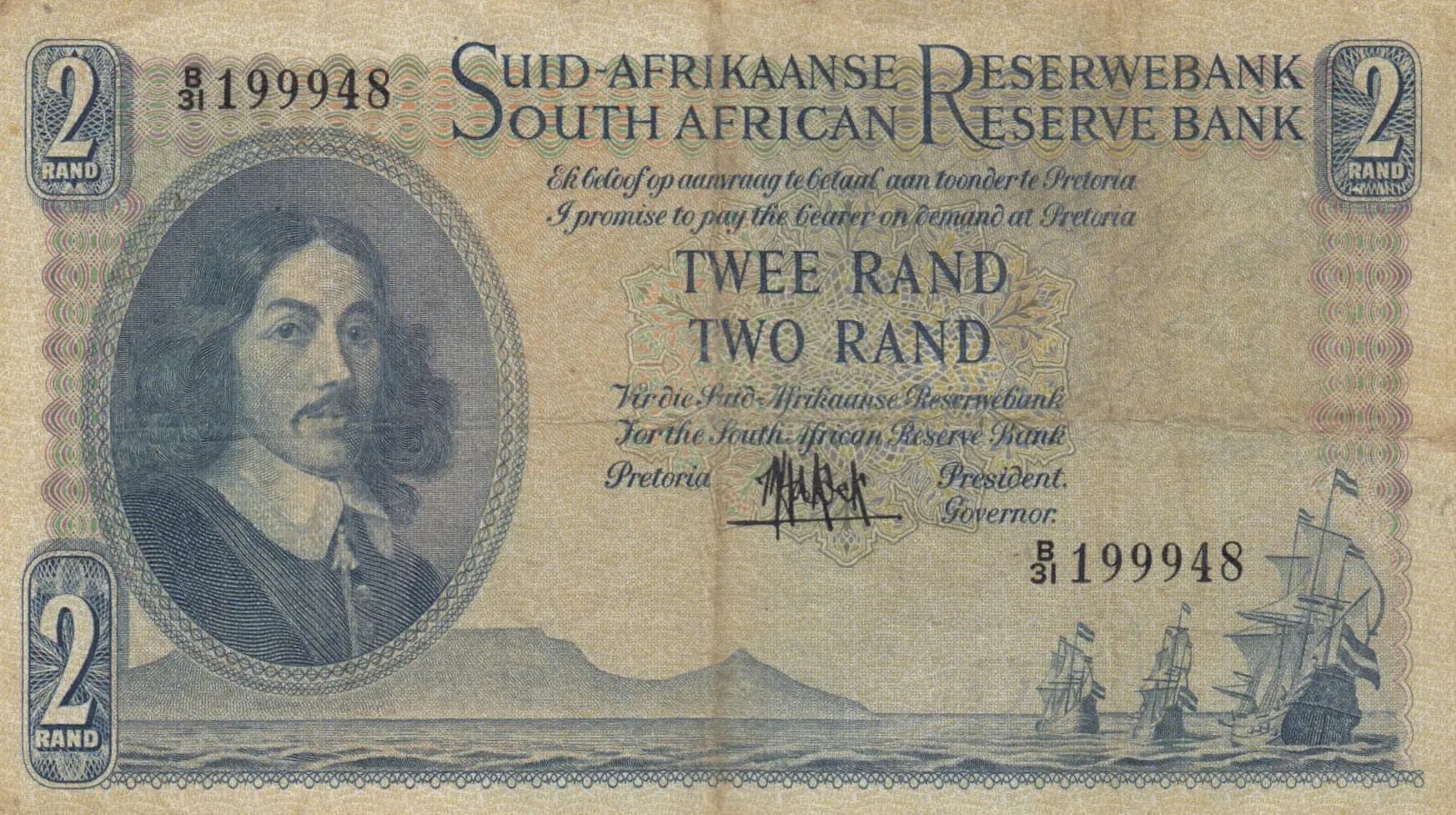
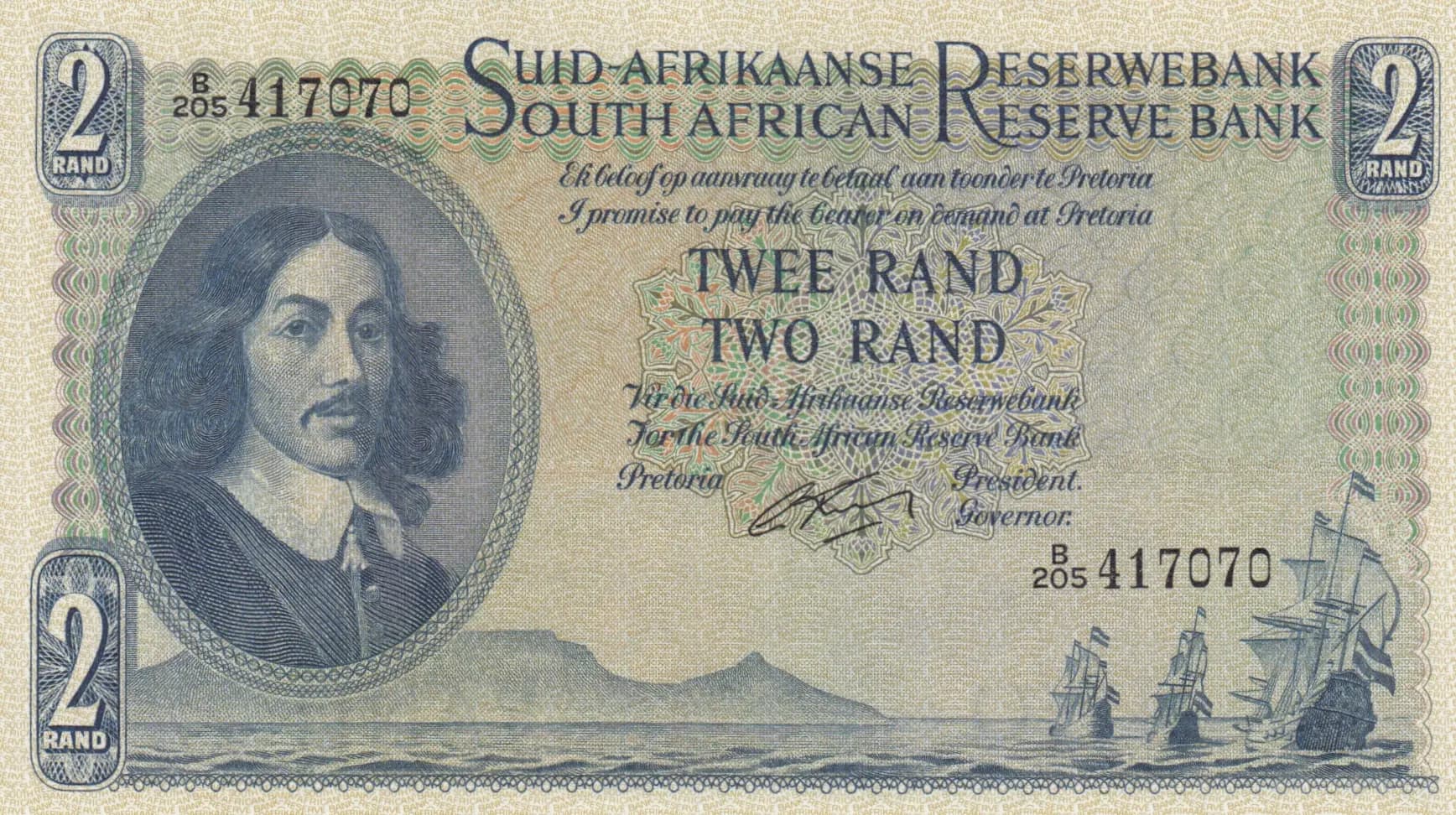
The obverse features a portrait of Jan van Riebeeck (1618-1677), the Dutch colonizer, rendered in an oval frame positioned on the left side of the note. The portrait depicts him as a bearded historical figure with long, curled hair wearing period clothing, facing left. Behind the portrait, a detailed landscape vignette shows Table Mountain—the iconic geographical landmark of Cape Town—along with three period sailing ships on the water, representing the maritime heritage of South African colonial history. The reverse is dominated by a heraldic lion standing on a rocky mound, serving as the national symbol. Both sides feature ornamental scrollwork, geometric border patterns, and decorative circular emblems containing the denomination '2' and 'RAND' in the top-left and bottom-left corner positions. The note measures 150 x 85mm and displays a watermark of Jan van Riebeeck.
{"front":{"English":["SOUTH AFRICAN RESERVE BANK","I promise to pay the bearer on demand at Pretoria","TWO RAND","For the South African Reserve Bank","Governor"],"Afrikaans":["SUID-AFRIKAANSE RESERWEBANK","Ek beloof op aanvraag te betaal aan toonder te Pretoria","TWEE RAND","Vir die Suid-Afrikaanse Reserwebank"]},"back":{"English":["SOUTH AFRICAN RESERVE BANK","TWO RAND"],"Afrikaans":["SUID-AFRIKAANSE RESERWEBANK","TWEE RAND"]},"note":"Serial number observed: B/236 404633. Text appears in both English (first line) and Afrikaans (second line) on denomination and bank name designations throughout both sides."}
The note was produced using traditional intaglio/engraving printing methods, evidenced by the crisp, deeply incised line work visible throughout the design, particularly in the portrait detail, the lion rendering, and the fine ornamental border patterns. The multi-color printing combines a cream/tan base with blue-gray and dark blue design elements and gold accents. South Africa's currency notes during this period were typically produced by De La Rue and Company (a leading British currency printer), though verification of the specific printer for this Pick number would require additional documentation. The fine line security features and ornamental patterns are characteristic of high-security intaglio production standards of the 1960s.
This note is catalogued as Pick P-104b, which specifically denotes the variety with the English-language first line (SOUTH AFRICAN RESERVE BANK in English) and English value text. The related variety P-105 features Afrikaans as the first line instead. The serial number format B/236 404633 and signature block placement would help identify the specific printing run within the 1961-1965 issue period, though no specific variety rarity information distinguishes this particular serial range. Collectors typically differentiate between the English (P-104b) and Afrikaans (P-105) varieties, with relative scarcity depending on printing allocations for each language variant.