10 pounds 1961
Market Prices
10 salesAbout This Note
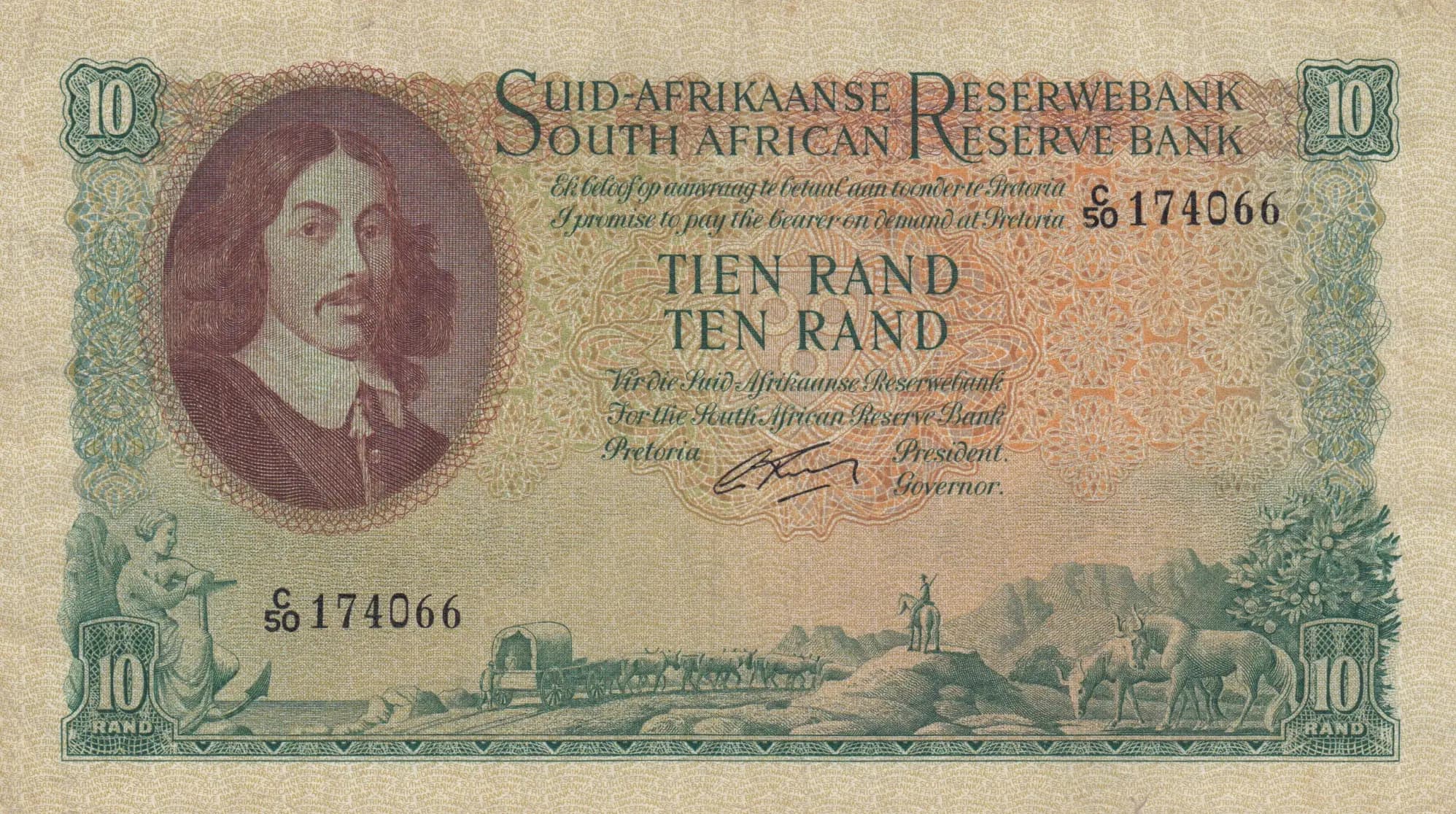
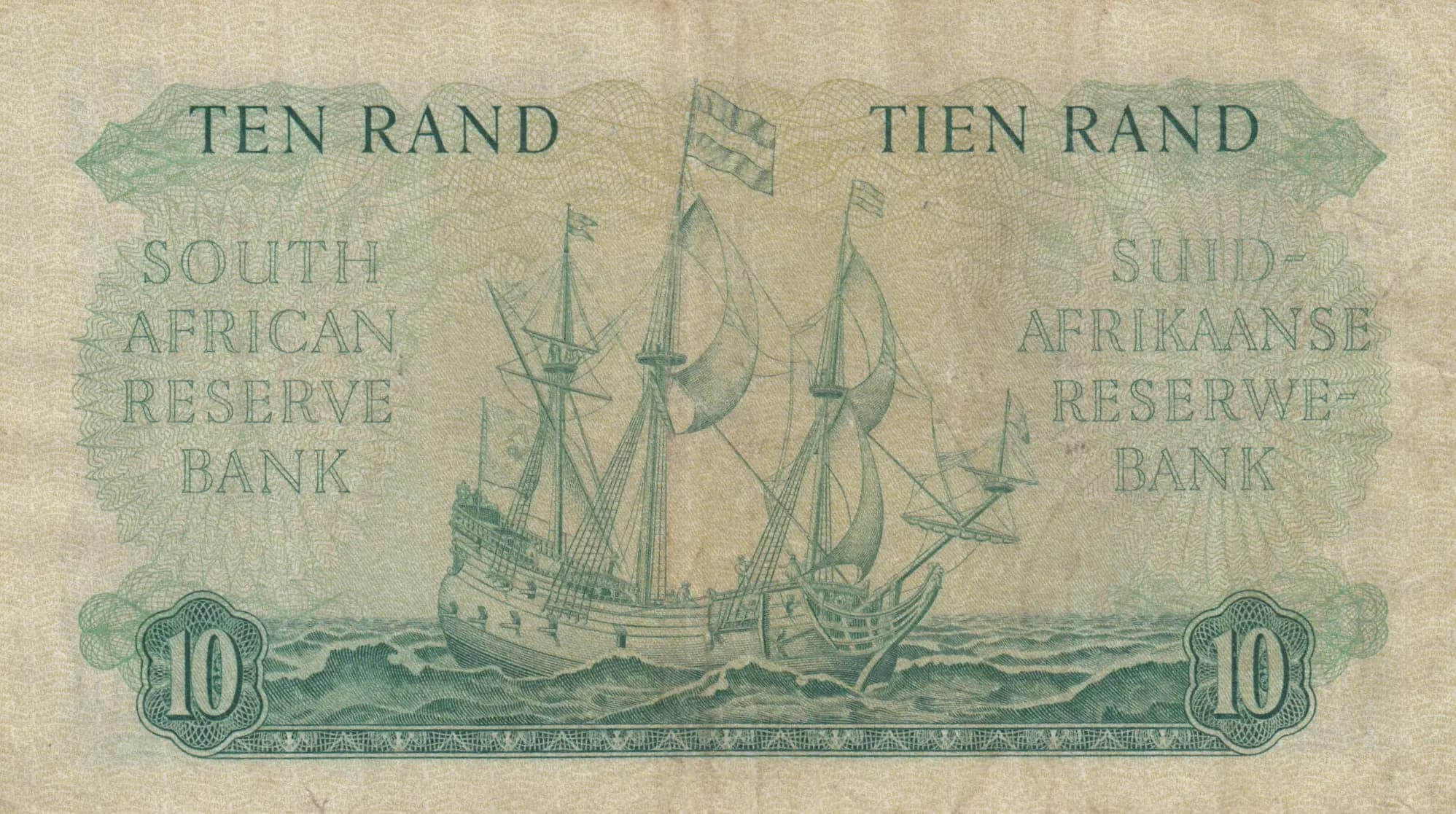
This is a South African 10 Rand note from the 1961-1965 series (Pick P-107b), presented in VF condition. The note features bilingual Afrikaans/English inscriptions and displays the classic design elements of early post-independence South African currency, with a portrait on the obverse and a detailed sailing ship on the reverse. The note shows excellent preservation with crisp engraving detail and no visible damage, representing a well-maintained example of this foundational issue.
Common. eBay sales data shows consistent market activity with VF-graded examples selling in the $12-22.50 range from 2012-2017, and catalog values (2019) listing VF at $5 and UNC at $18. The note was issued in significant quantities during a 4-year production window (1961-1965), resulting in ready availability in the secondary market. The combination of modest pricing, regular sales activity, and straightforward identification indicates this is a standard issue with no rarity premium.
Issued during the early years of the Republic of South Africa (established 1961), this banknote reflects the nation's transition to independence and its dual-language policy. The portrait depicted represents a key historical figure from the colonial period (either Bartholomeus Vermuyden or Jan van Riebeeck, depending on the specific printing), while the sailing ship on the reverse symbolizes South Africa's maritime heritage and connection to European exploration and settlement. The bilingual design accommodates both English and Afrikaans speakers during this pivotal period of South African nation-building.
The obverse features a portrait of a bearded historical figure in circular frame positioned at the left, identified as either Bartholomeus Vermuyden or Jan van Riebeeck (catalog sources vary on attribution). The lower portion displays a pastoral scene depicting pioneer settlement elements including a covered wagon drawn by oxen, cattle, and hilly landscape, symbolizing early European colonization. The reverse showcases a prominent multi-masted sailing vessel under full sail upon waves, representing the maritime heritage and mercantile history of South Africa. Both sides employ ornate decorative borders with interlocking geometric and floral patterns, with the denomination '10' displayed in ornamental corner frames on all four corners. The color scheme utilizes tan/beige, green, brown/maroon, and red-brown tones creating a visually balanced and professionally composed design.
FRONT: 'SUID-AFRIKAANSE RESERWEBANK' (Afrikaans: South African Reserve Bank) / 'SOUTH AFRICAN RESERVE BANK' (English) / 'TIEN RAND' (Afrikaans: Ten Rand) / 'TEN RAND' (English) / 'For the South African Reserve Bank, Pretoria' / 'Promise to pay the bearer on demand at Pretoria' / 'President' and 'Governor' (signature lines). Serial number: C S0174066. BACK: 'TEN RAND' (English) / 'TIEN RAND' (Afrikaans) / 'SOUTH AFRICAN RESERVE BANK' (English) / 'SUID-AFRIKAANSE RESERWEBANK' (Afrikaans: South African Reserve Bank).
The note employs traditional intaglio (engraved) printing, evidenced by the fine line engraving patterns, detailed cross-hatching visible particularly in the sailing ship rendering, and the crisp definition of decorative borders. The intricate geometric patterns and portrait rendering are characteristic of security-oriented engraving practices employed by central bank currency printers of the period. This represents the standard printing methodology for South African Reserve Bank note production during the 1960s.
Pick P-107b is identified as a variant within the 10 Rand series, distinguished by the watermark of Jan van Riebeeck (shared with P-107a). The specific distinguishing feature of P-107b versus P-107a is likely related to signature varieties or subtle printing characteristics during the 1961-1965 production period. The observed note carries serial number prefix 'C', which may indicate a specific printing batch or signature variety. The bilingual presentation (Afrikaans first line, then English) is noted in catalog references as distinguishing these notes from earlier P-106 variants. No notable overprints or error characteristics are evident in this example.