20 francs 1976
Market Prices
31 salesAbout This Note
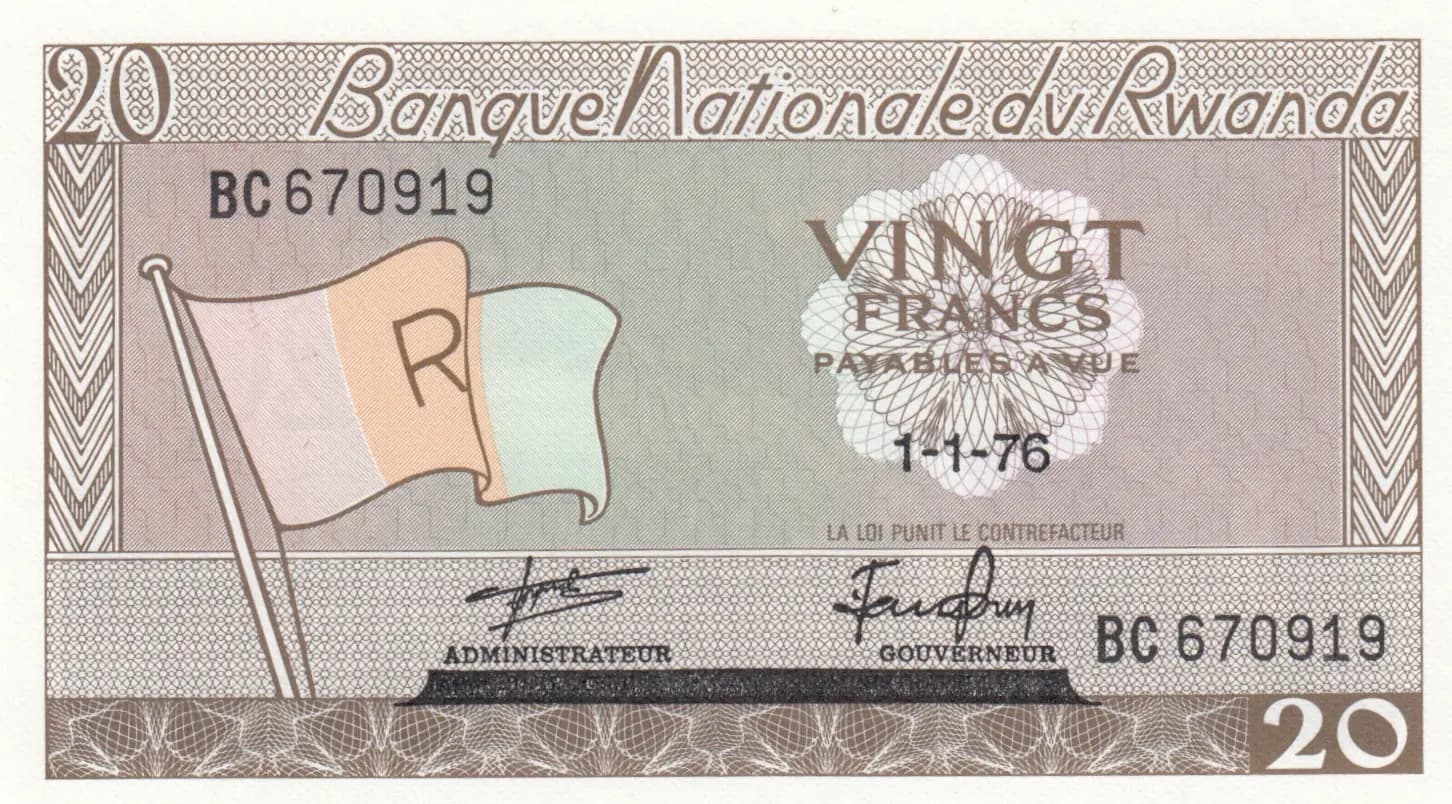
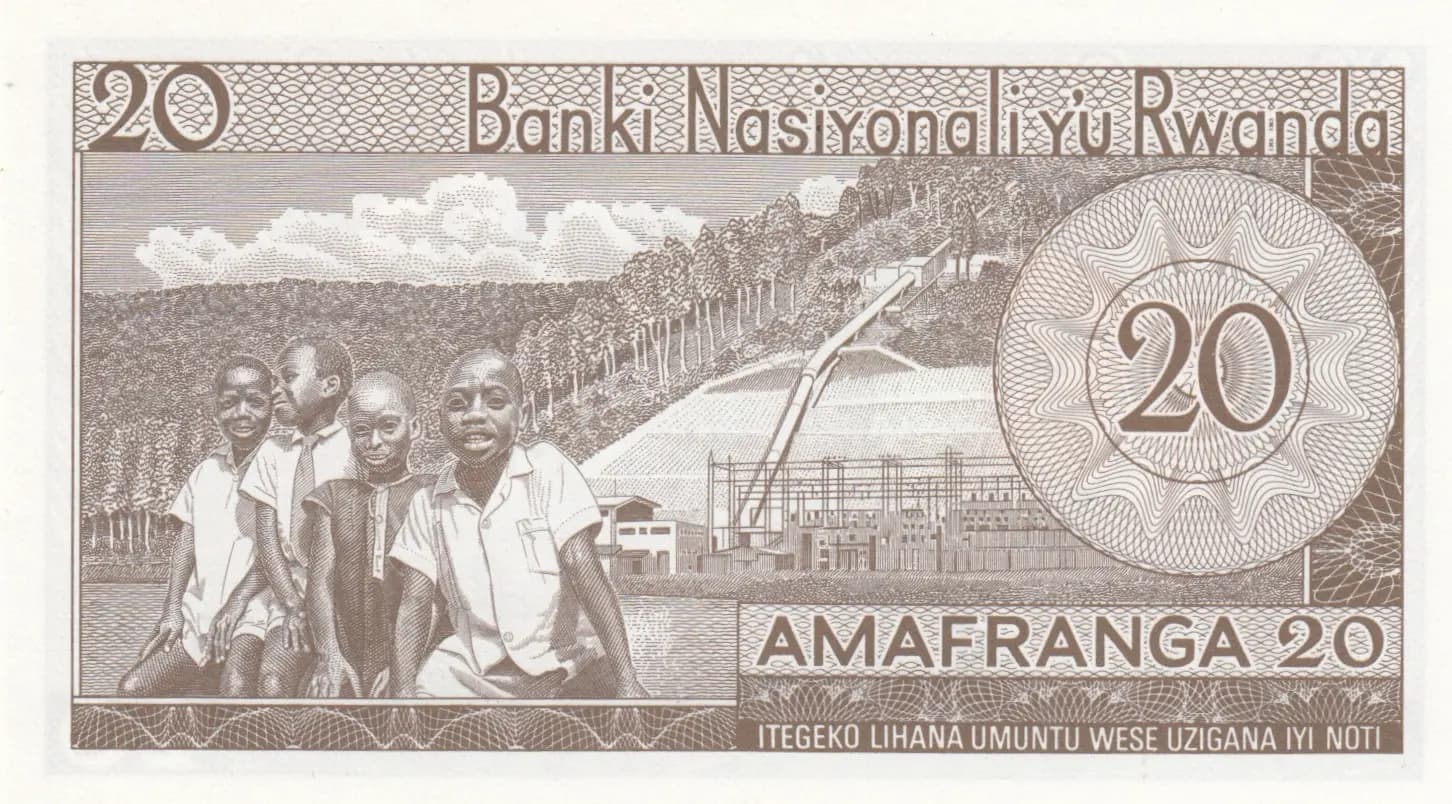
This is an uncirculated 1976 Rwanda 20 Francs note (Pick P-6e) from the Banque Nationale du Rwanda, featuring crisp, pristine condition with no visible wear or circulation. The obverse displays the Rwandan tricolor flag with distinctive 'R' marking alongside an ornate white flower illustration, while the reverse showcases four African men in traditional dress with an agricultural landscape and industrial facility, symbolizing the nation's development focus during the post-independence era. The note exhibits excellent preservation of its fine guilloche patterns and geometric security features, making it an appealing example for collectors of East African currency.
Common. The eBay price history provided demonstrates consistent, modest market values for this note in all conditions, with UNC examples routinely selling in the $2.25–$7.00 range across multiple sales from 2014–2026, and catalog valuation of $5 for UNC as of 2019. The high volume of sales (30+ transactions recorded) and low price point indicate strong availability in the collector market. The 1976 issue date and production run by the Banque Nationale du Rwanda were substantial, and no evidence exists of recall, short production runs, or significant supply constraints that would elevate this note to scarce or rare status. Standard post-independence currency from a stable issuing authority.
Issued during Rwanda's post-independence period under President Juvénal Habyarimana's rule, this 20 Francs note reflects the country's emphasis on agricultural development and modernization through hydroelectric and industrial infrastructure. The depicted young men and cultivated landscape represent Rwanda's aspirations toward economic growth and self-sufficiency during the mid-1970s. The bilingual inscriptions in French and Kinyarwanda demonstrate the nation's linguistic and cultural identity while under the governance of the Banque Nationale du Rwanda.
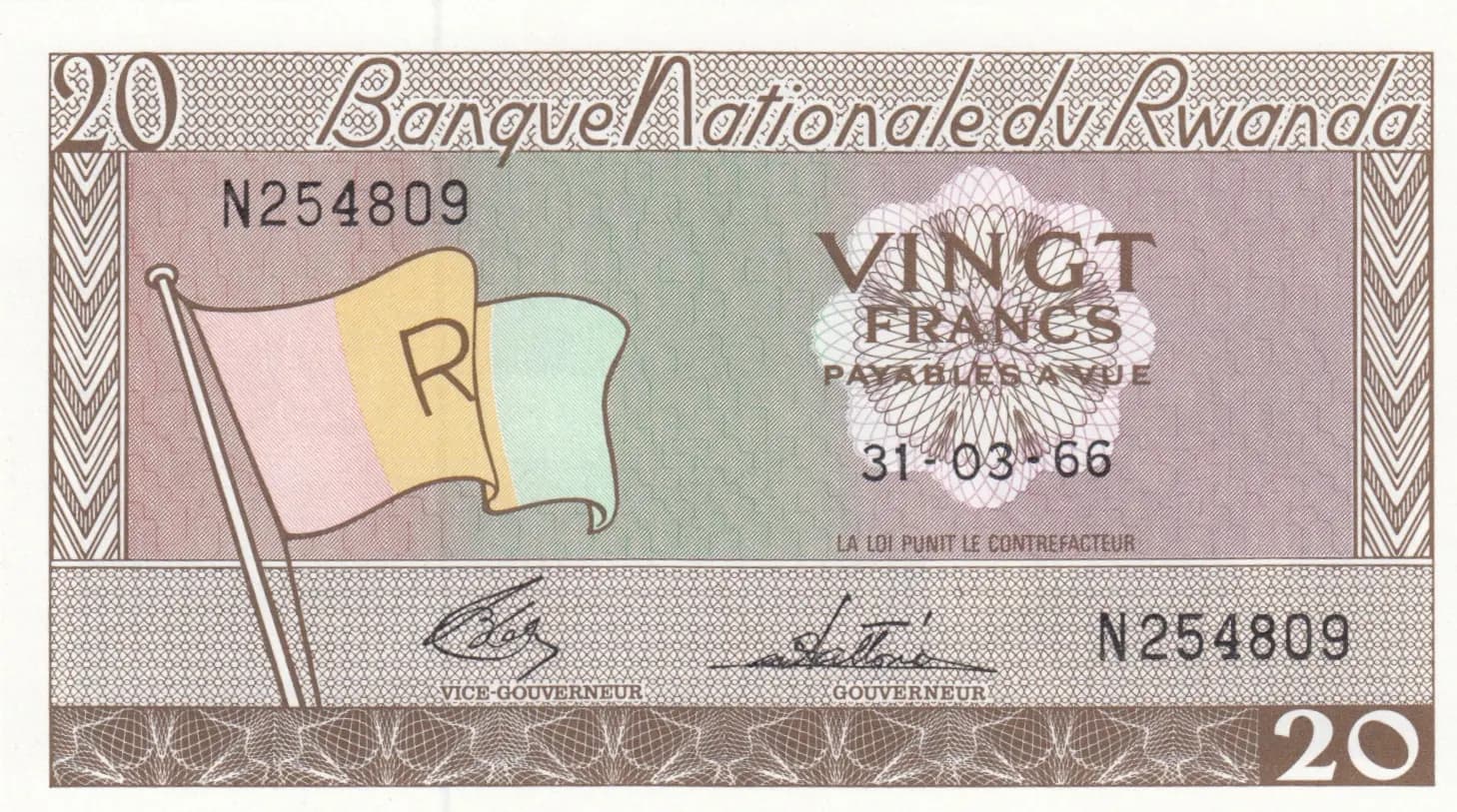
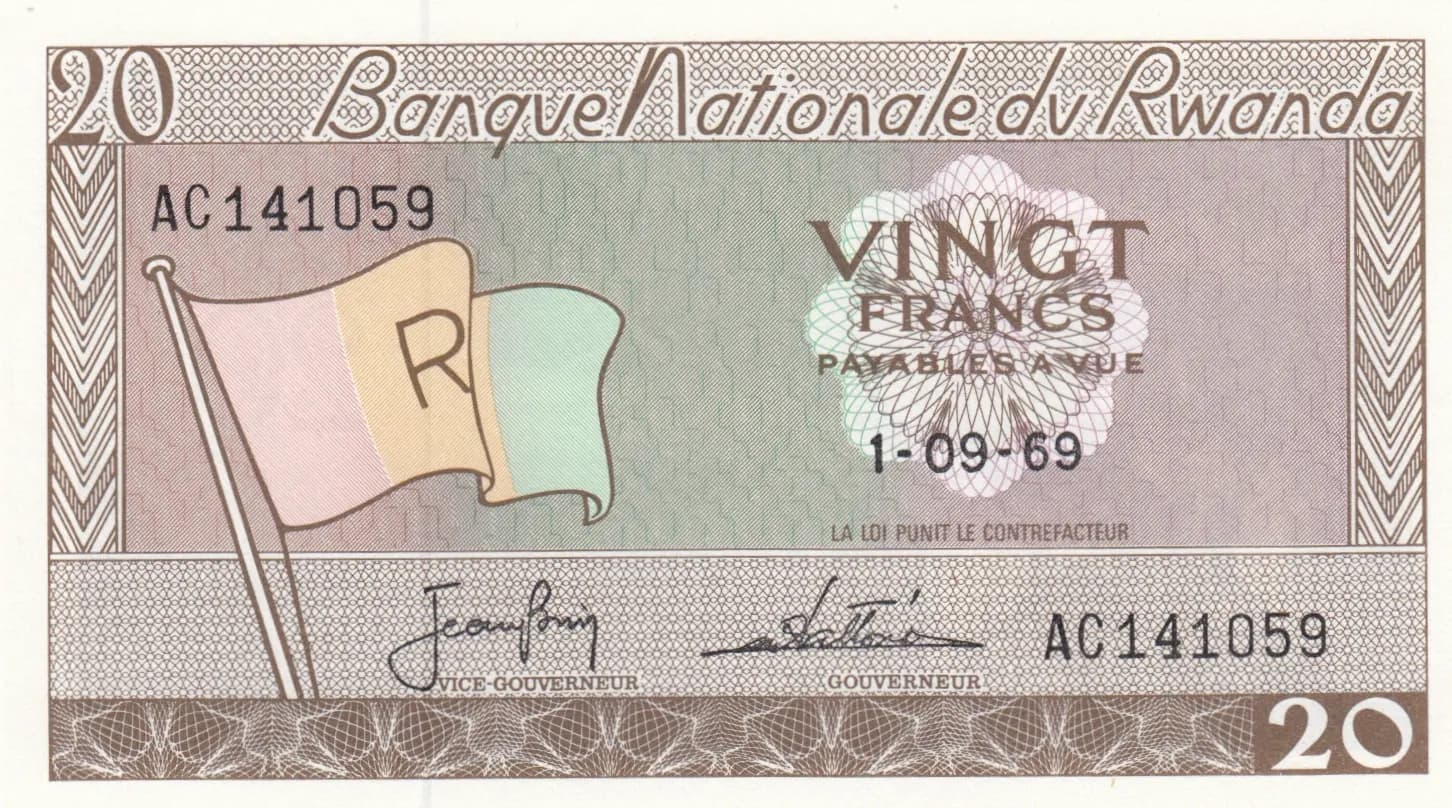
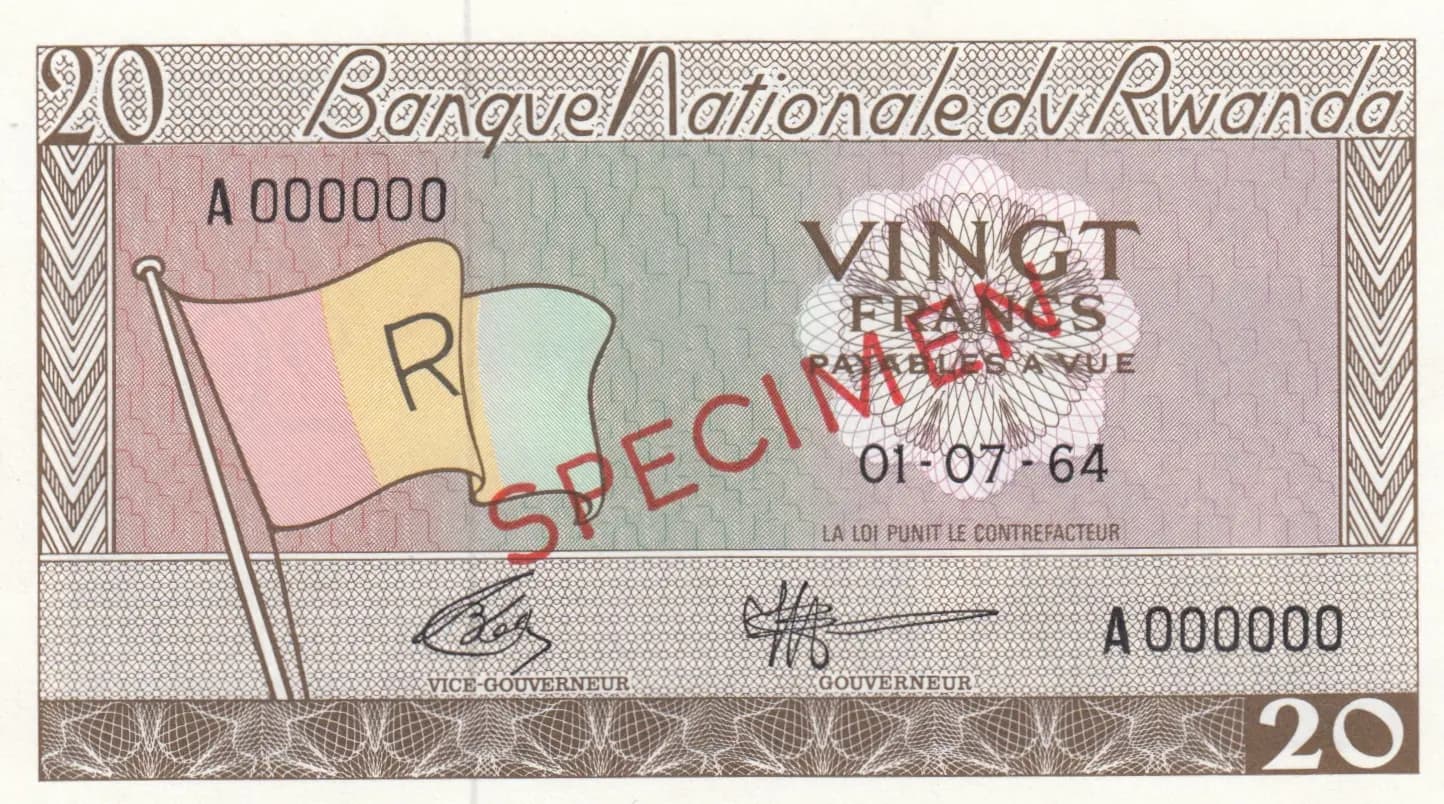
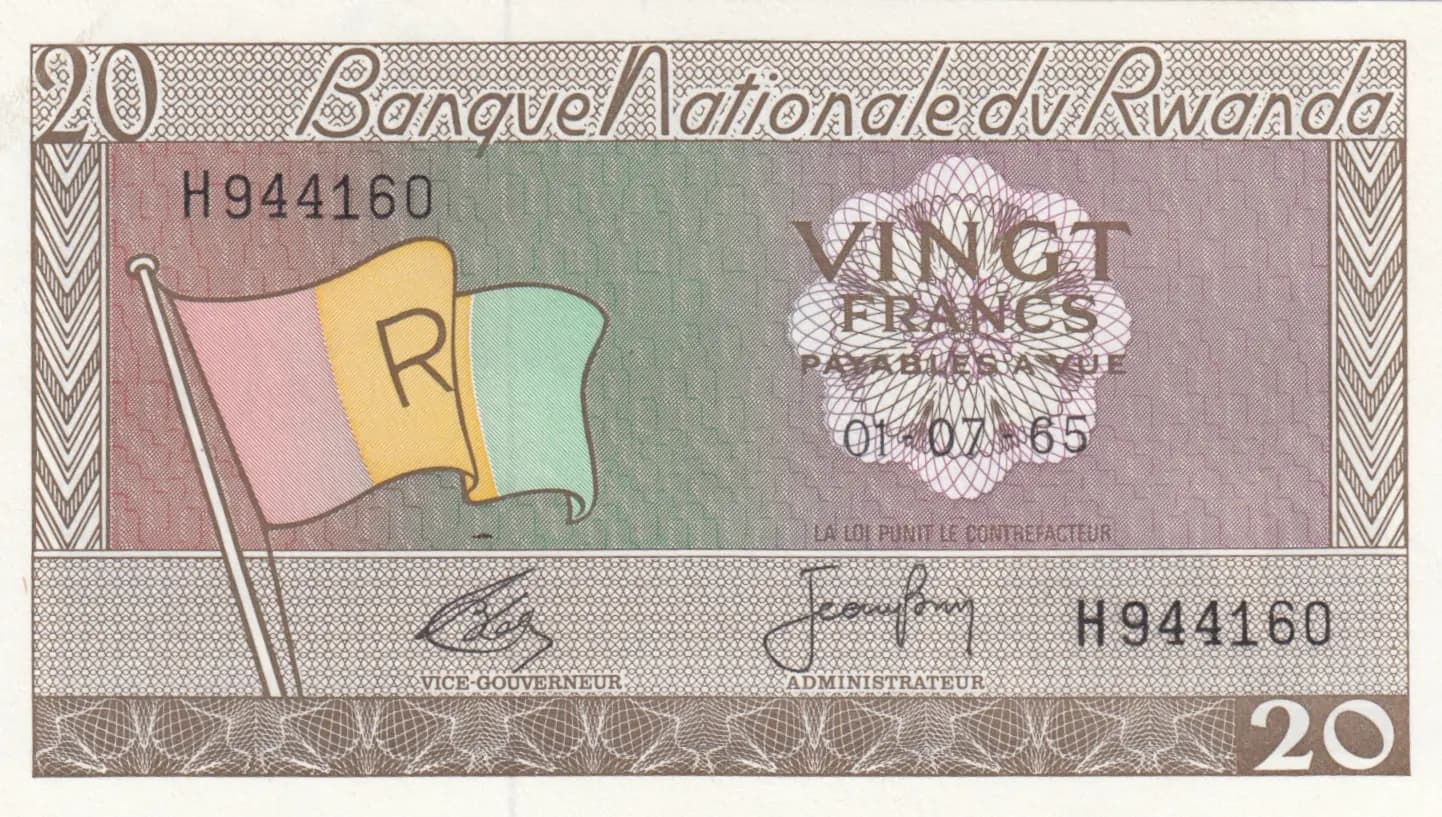
The obverse features the green, yellow, and red tricolor flag of Rwanda with the 'R' emblem positioned on the left side, a heraldic symbol of national identity. The central motif is a white pyrethrum flower (daisy-like bloom), which is botanically and economically significant to Rwanda's agricultural heritage; this flower illustration may be referenced by the 'PARACHUTE' inscription, possibly a codename or security designation. The reverse depicts four young African men wearing white shirts in a group composition, positioned left of center, representing Rwanda's youth and labor force. Behind them stretches a rural agricultural landscape with organized rows of planted fields extending to the horizon, flanked by trees and vegetation. An industrial or hydroelectric processing facility building is visible on the right side of the landscape, symbolizing modern infrastructure and the nation's development agenda. A large circular rosette design with ornate geometric patterns containing the numeral '20' is prominently placed on the right side of the reverse. The entire design employs fine line guilloche work and microprint borders characteristic of mid-20th century currency security practices.
FRONT: 'Banque Nationale du Rwanda' (French: National Bank of Rwanda) / 'VINGT FRANCS' (French: Twenty Francs) / 'PARACHUTE' (French designation, possibly referring to the flower species or a security feature name) / Date '1.4.76' (April 1, 1976) / 'LA LOI PUNIT LE CONTREFACTEUR' (French: The law punishes counterfeiters) / Signature titles 'ADMINISTRATEUR' and 'GOUVERNEUR' (Administrator and Governor). BACK: 'Banki Nasiyonali y'u Rwanda' (Kinyarwanda: National Bank of Rwanda) / 'AMAFRANGA 20' (Kinyarwanda: 20 Francs) / 'ITEGEKO LIHANA UMUNTU WESE UZIGANA IYI NOTI' (Kinyarwanda: The law punishes anyone who counterfeits this note).
Intaglio (recess) printing, evidenced by the fine detail of the guilloche patterns, delicate line work visible in borders and background areas, and the dimensional quality of geometric designs. The microprint geometric patterns and the ornate rosette design are consistent with engraved security printing methods. The color separation and multicolor underprint noted in catalog references indicate multiple passes of intaglio printing. Security printers for Rwandan notes during this period typically included British or European security printing firms specializing in African currency; specific printer attribution for Pick P-6e is not definitively established from available documentation.
This specific note carries serial number BC670919 with standard ADMINISTRATEUR and GOUVERNEUR signature titles dated 1.4.76 (April 1, 1976). Catalog references indicate various date and signature title varieties exist for the P-6e pick number across its 1964–1976 issue span. Replacement notes are identified by serial number prefix 'ZZ'; the present example with 'BC' prefix indicates it is from the standard issue series, not a replacement. No security thread is present, consistent with the catalog specification for this issue. The absence of a ZZ prefix and the standard BC serial number prefix confirm this is a regular-issue note rather than an emergency or replacement variant.