20 francs 1965
Market Prices
2 salesAbout This Note
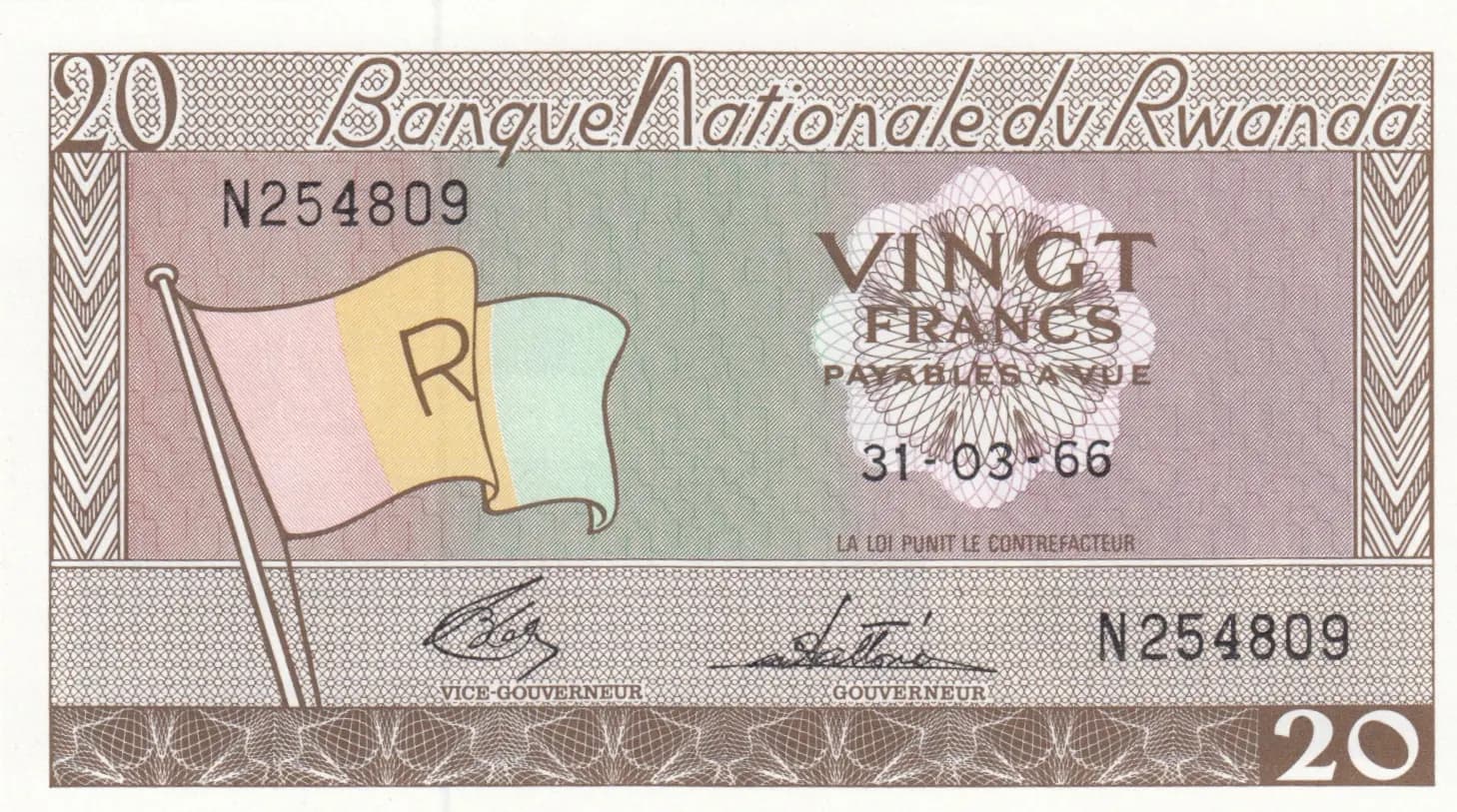
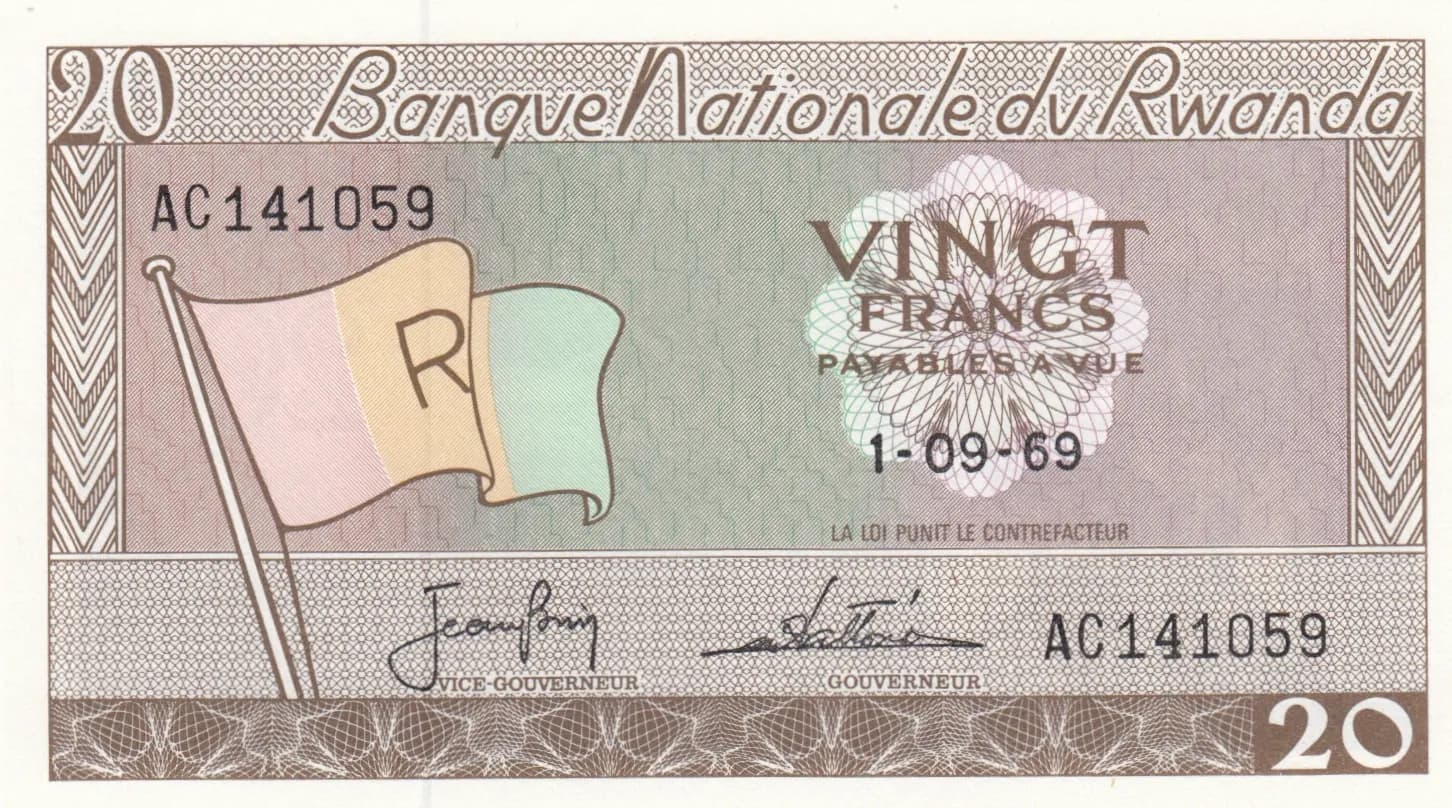
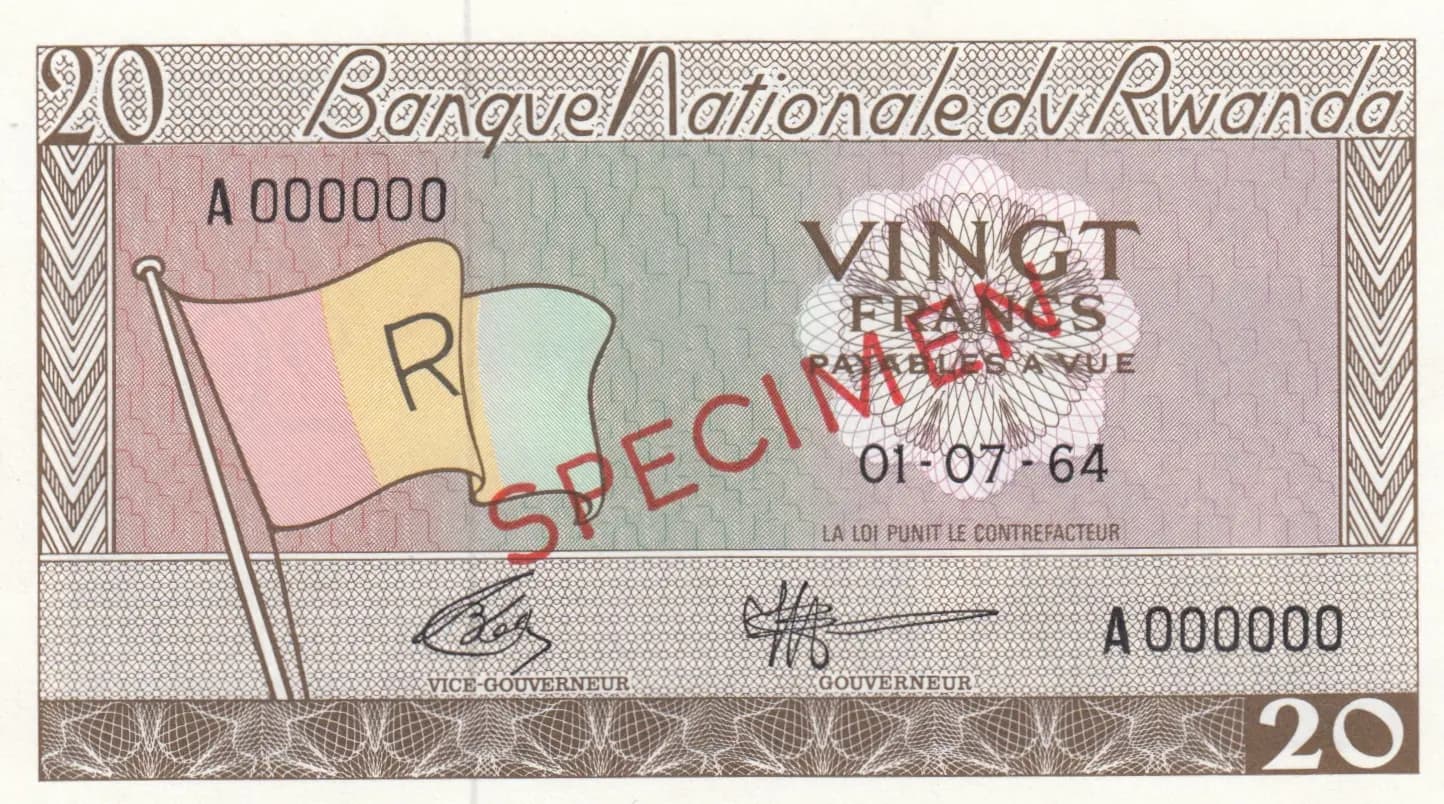
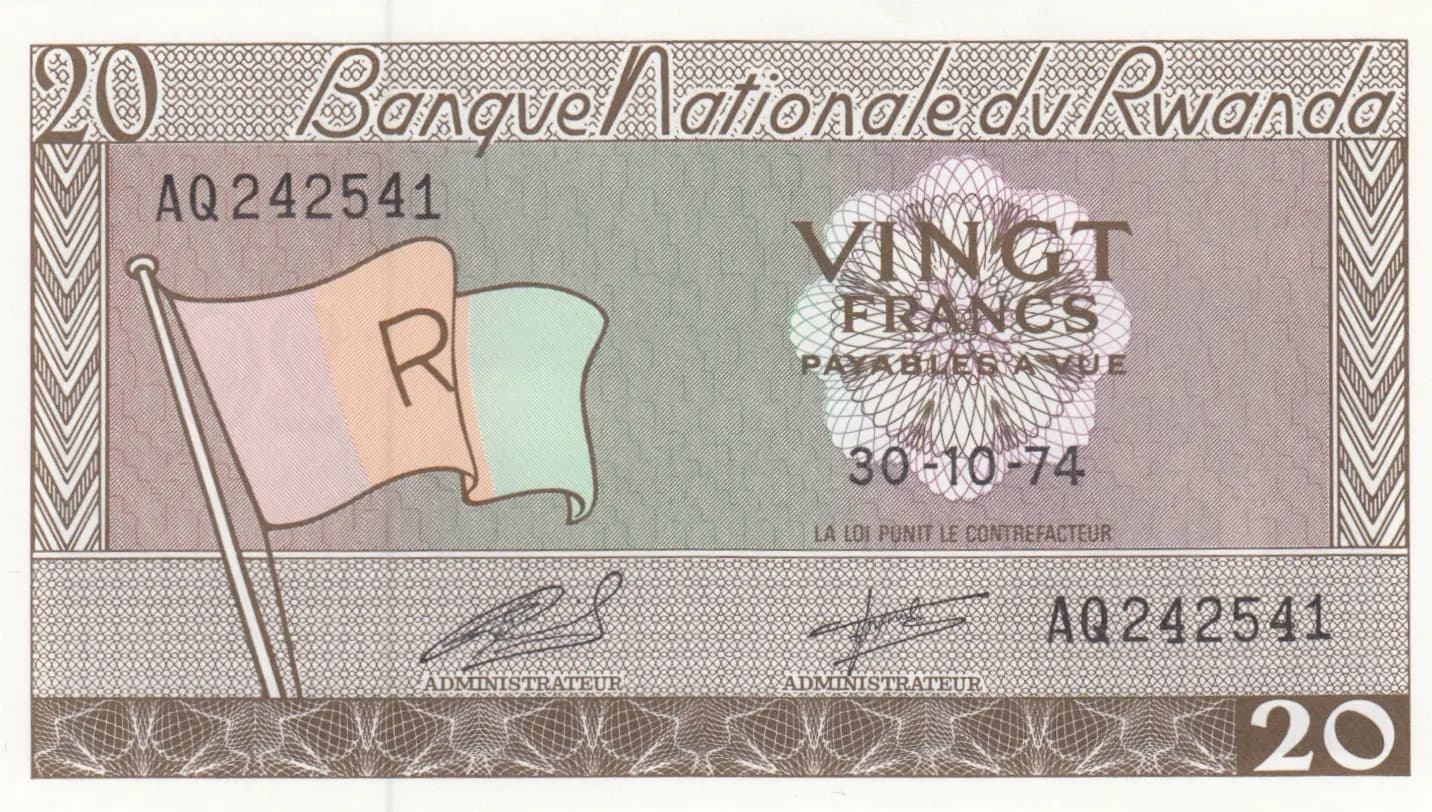
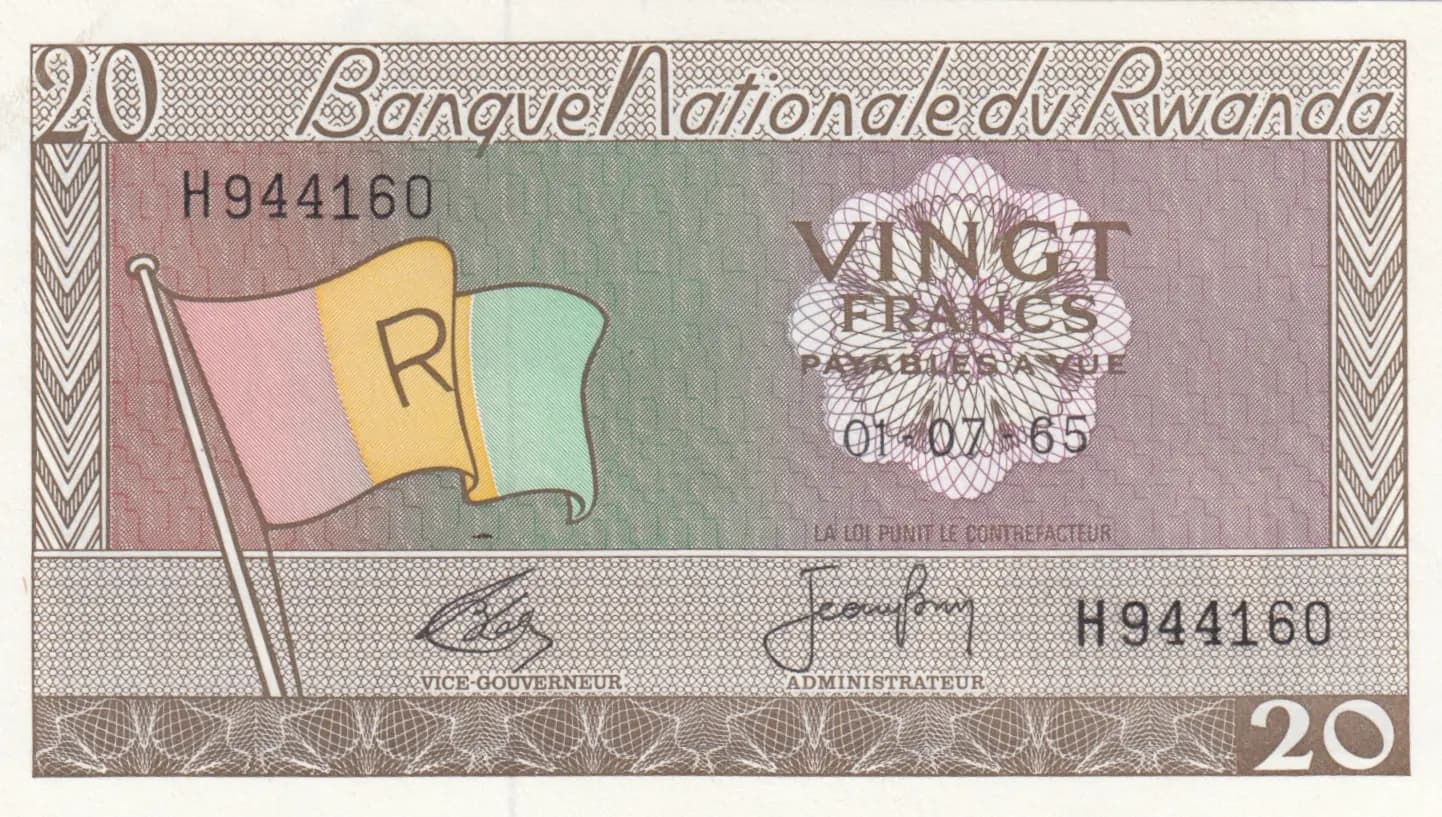
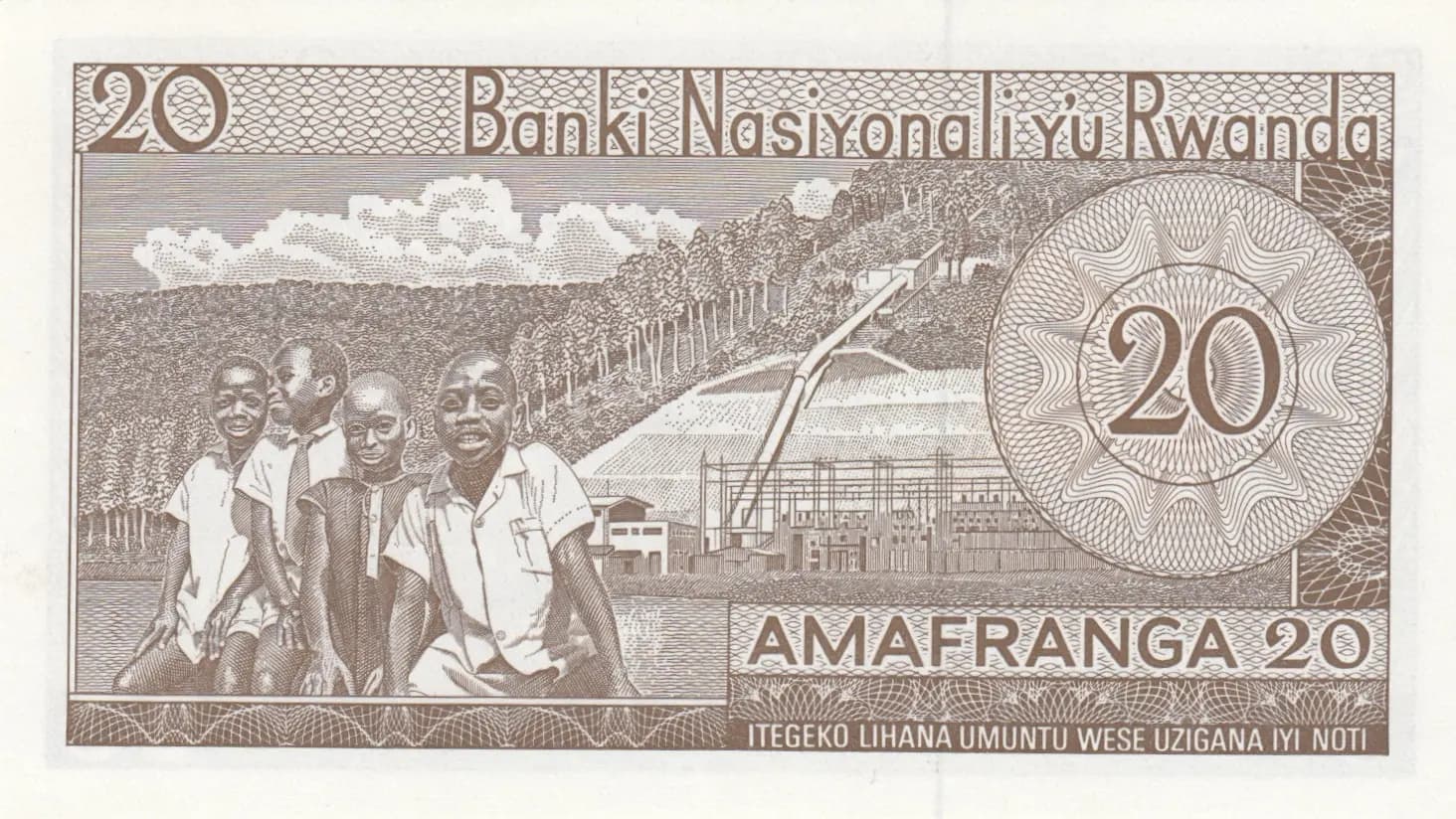
An uncirculated example of Rwanda's 1965 20 franc banknote featuring the distinctive Rwandan flag with its 'R' emblem on the obverse and a compelling scene of four young workers with industrial and agricultural development imagery on the reverse. This Pick-6b note displays excellent preservation with crisp printing, vibrant colors, and no signs of circulation, representing an important early issue from the Banque Nationale du Rwanda during the post-independence period.
Common. The 1965 20 franc note (Pick-6b) was part of a regular issue spanning 1964-1976 with substantial circulation. Contemporary eBay market data shows specimens selling in the $5-13 range for circulated examples, with UNC examples commanding approximately $40, indicating healthy supply in the collector market. No specific print run restrictions, recall events, or limited-issue indicators apply to this Pick number.
Issued during Rwanda's formative post-colonial years (1964-1976 series), this note celebrates the nation's development priorities through its reverse imagery of young laborers, terraced agricultural fields, and an industrial hydroelectric or processing facility—visual symbols of Rwanda's modernization efforts and commitment to harnessing both agricultural and industrial potential. The bilingual French and Kinyarwanda inscriptions reflect Rwanda's linguistic and cultural identity during this period of nation-building.
The obverse features the tri-color Rwandan flag (yellow, green, red with the letter 'R') positioned at the left, with ornate geometric borders framing the design in the characteristic style of mid-20th century African banknotes. A large decorative floral watermark occupies the center-right. The reverse depicts four young Rwandan men in traditional white and patterned garments in a laborers' scene, representing the nation's youth and workforce. Behind them extends a landscape of terraced agricultural fields demonstrating Rwanda's hillside farming practices, with an industrial complex featuring multiple buildings and what appears to be a hydroelectric facility or processing plant visible in the middle distance—symbolizing Rwanda's vision of combining traditional agriculture with modern industrial development. The right side bears a large ornate circular numeral '20' with intricate geometric patterns.
OBVERSE: 'Banque Nationale du Rwanda' (National Bank of Rwanda), 'VINGT FRANCS' (Twenty Francs), 'LA LOI PUNIT LE CONTREFACTEUR' (The law punishes the counterfeiter), signature titles 'VICE-GOUVERNEUR' (Vice-Governor) and 'ADMINISTRATEUR' (Administrator). REVERSE: 'Banki Nasiyonali yu Rwanda' (National Bank of Rwanda in Kinyarwanda), 'AMAFRANGA 20' (20 Francs in Kinyarwanda), 'ITEGEKO LIHANA UMUNTU WESE UZIGANA IYI NOTI' (The law punishes anyone who counterfeits this note in Kinyarwanda).
Intaglio engraving (line engraving) throughout, evidenced by the fine detail work visible in the border patterns, portrait rendering, and the ornate geometric designs. The security features and overall design quality suggest professional production by a European security printer, likely Bradbury Wilkinson & Company or a similar establishment specializing in African central bank currency during this period.
The observed specimen displays the standard signature titles 'VICE-GOUVERNEUR' and 'ADMINISTRATEUR' without the ZZ replacement prefix, indicating this is from the regular production run rather than a replacement note. The date visible on the obverse (01.07.85) represents a later printing within the 1964-1976 authorization period, suggesting this note was printed well after the 1965 issue date, which is typical for long-running series. Varieties for Pick-6b are primarily distinguished by signature combinations and printing date variations rather than major design changes.