20 francs 1964 specimen
Market Prices
5 salesAbout This Note
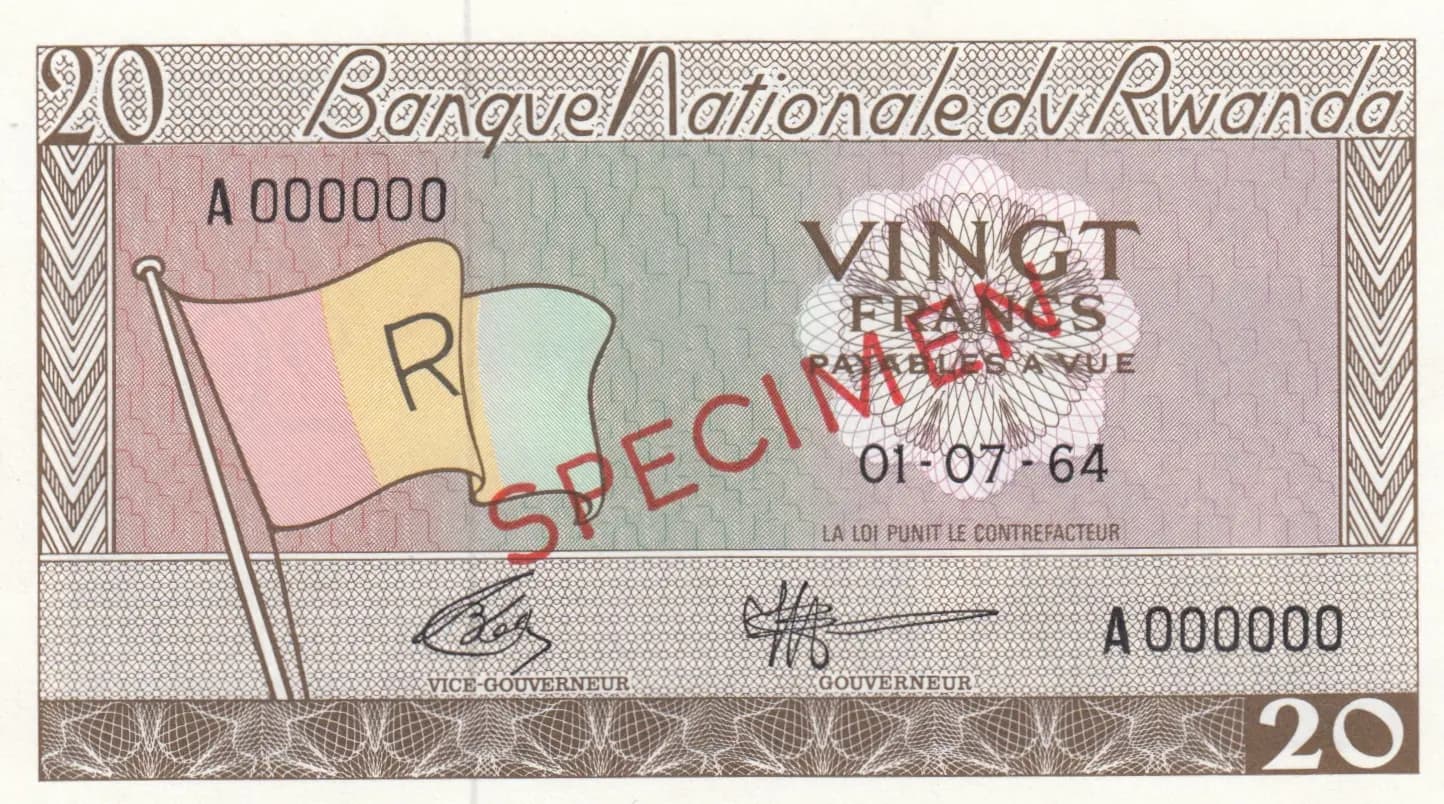
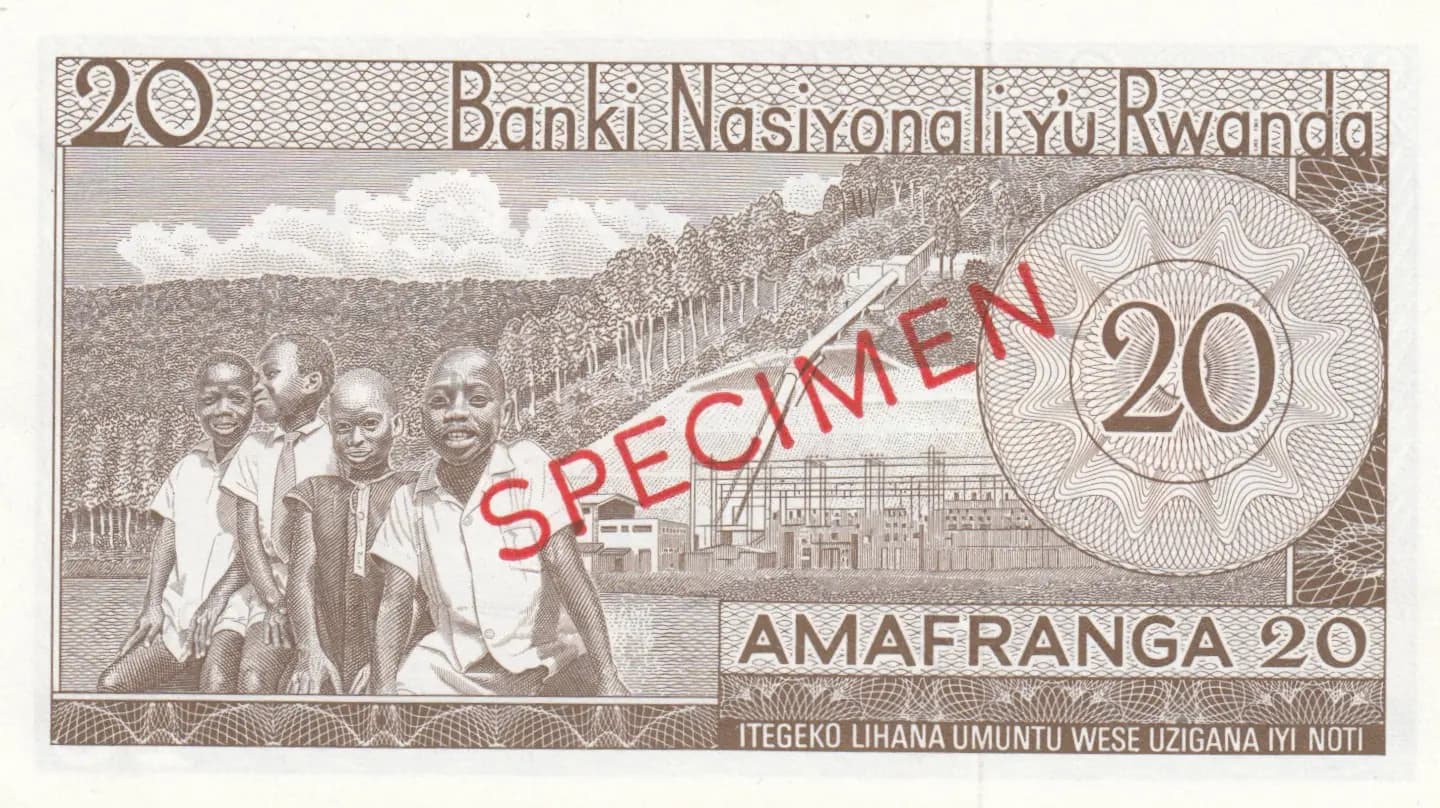
This is a 1964 Rwandan 20 francs specimen note in uncirculated condition, representing an early emission from the newly independent Banque Nationale du Rwanda. The note features the Rwandan flag prominently on the obverse with a pale lavender background and detailed floral motifs, while the reverse depicts four young Rwandan children alongside a landscape of agricultural terraces and a cityscape, exemplifying the nation's development aspirations in the post-independence era. As a specimen note with red overprints and serial number A 000000, this is a specialized non-circulating issue that appeals to both Rwandan collectors and specialist banknote enthusiasts.
Common. While this is a specimen note (a non-circulating issue), Rwanda's 1964 20 francs note was part of the initial currency issue of an independent nation and had a substantial print run. eBay historical sales data shows UNC examples selling in the $11–$34 range, with 2019 catalog values listing UNC at $30—pricing consistent with common banknotes. Specimen notes of this era are regularly encountered in the collector market. No evidence of extreme scarcity, short print runs, or recall status exists for this Pick number.
Rwanda achieved independence in 1962, and the Banque Nationale du Rwanda was established to issue the nation's first modern currency. The 1964 20 francs note reflects this new national identity through the prominent display of the Rwandan flag and bilingual French-Kinyarwanda inscriptions. The reverse imagery—featuring young children, agricultural terraces, and urban development—symbolizes Rwanda's commitment to modernization, education, and economic progress during this optimistic post-colonial period.
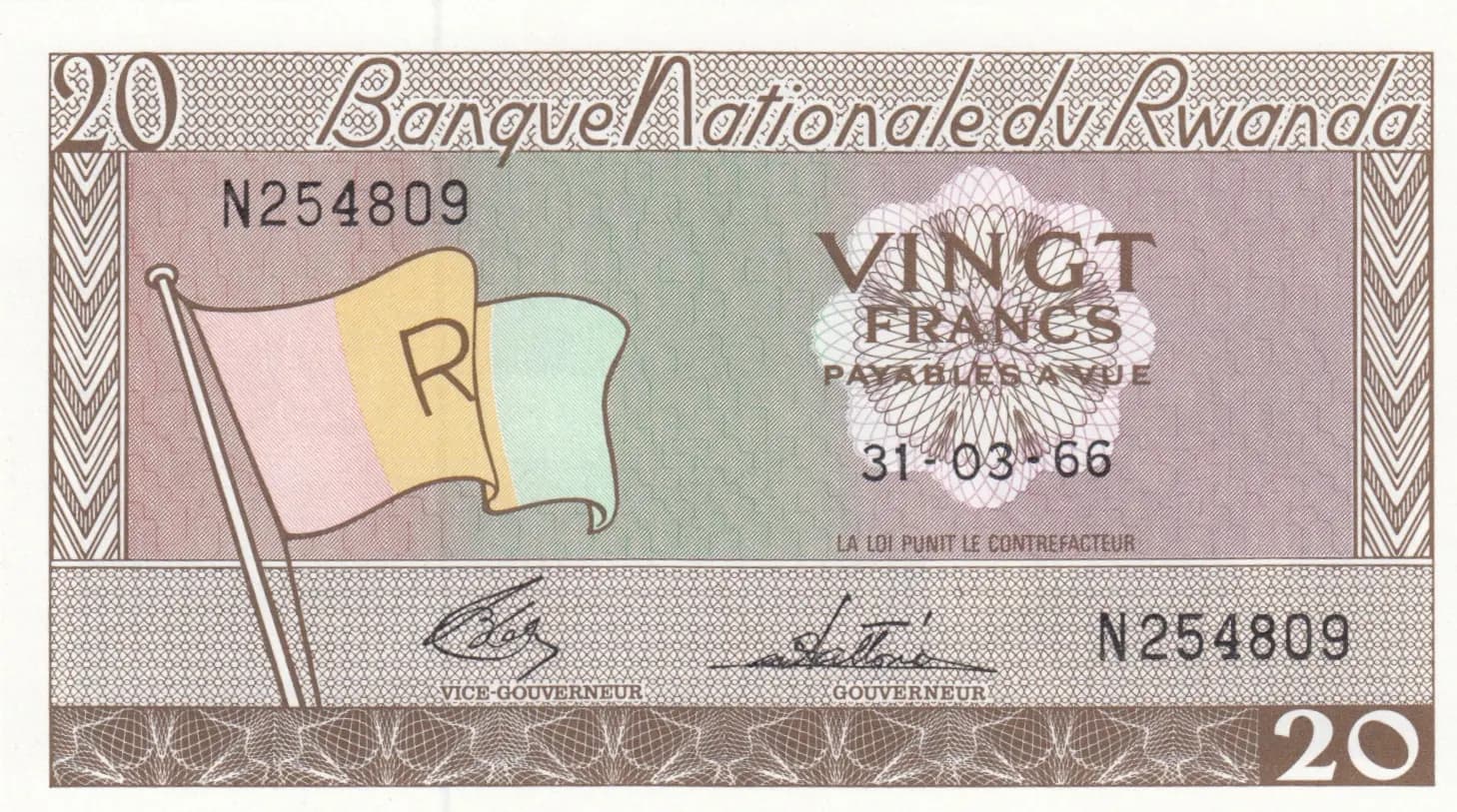
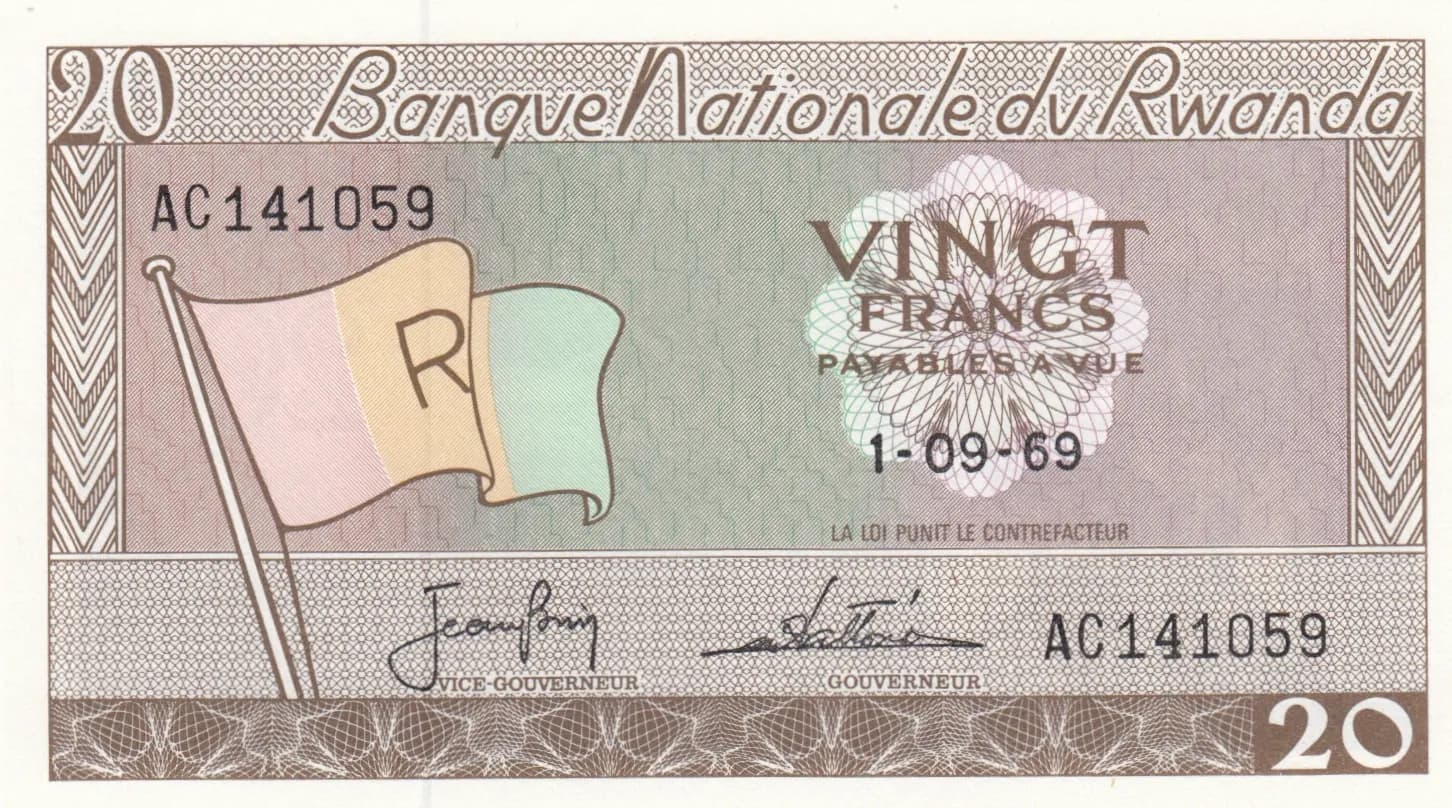
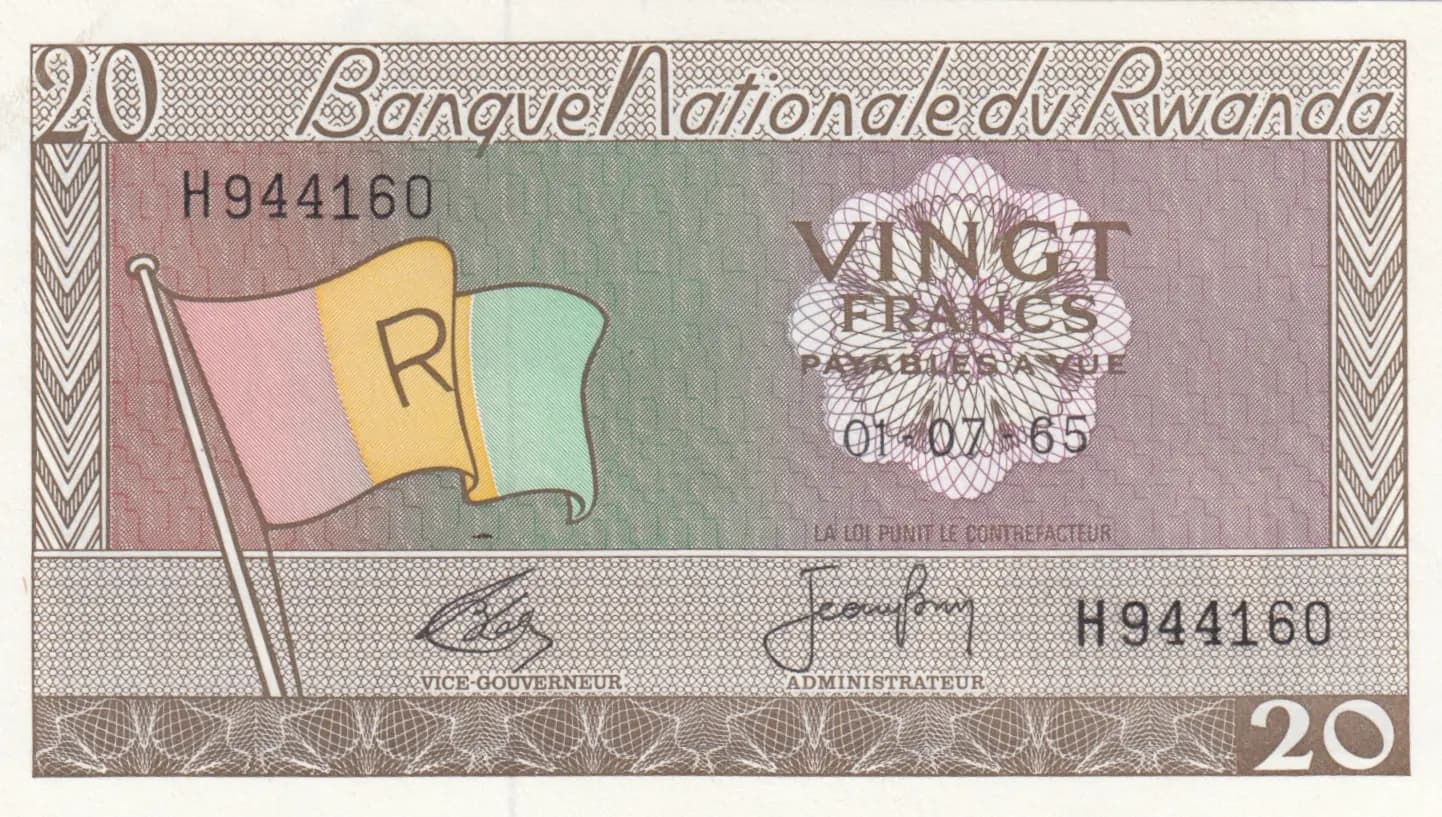
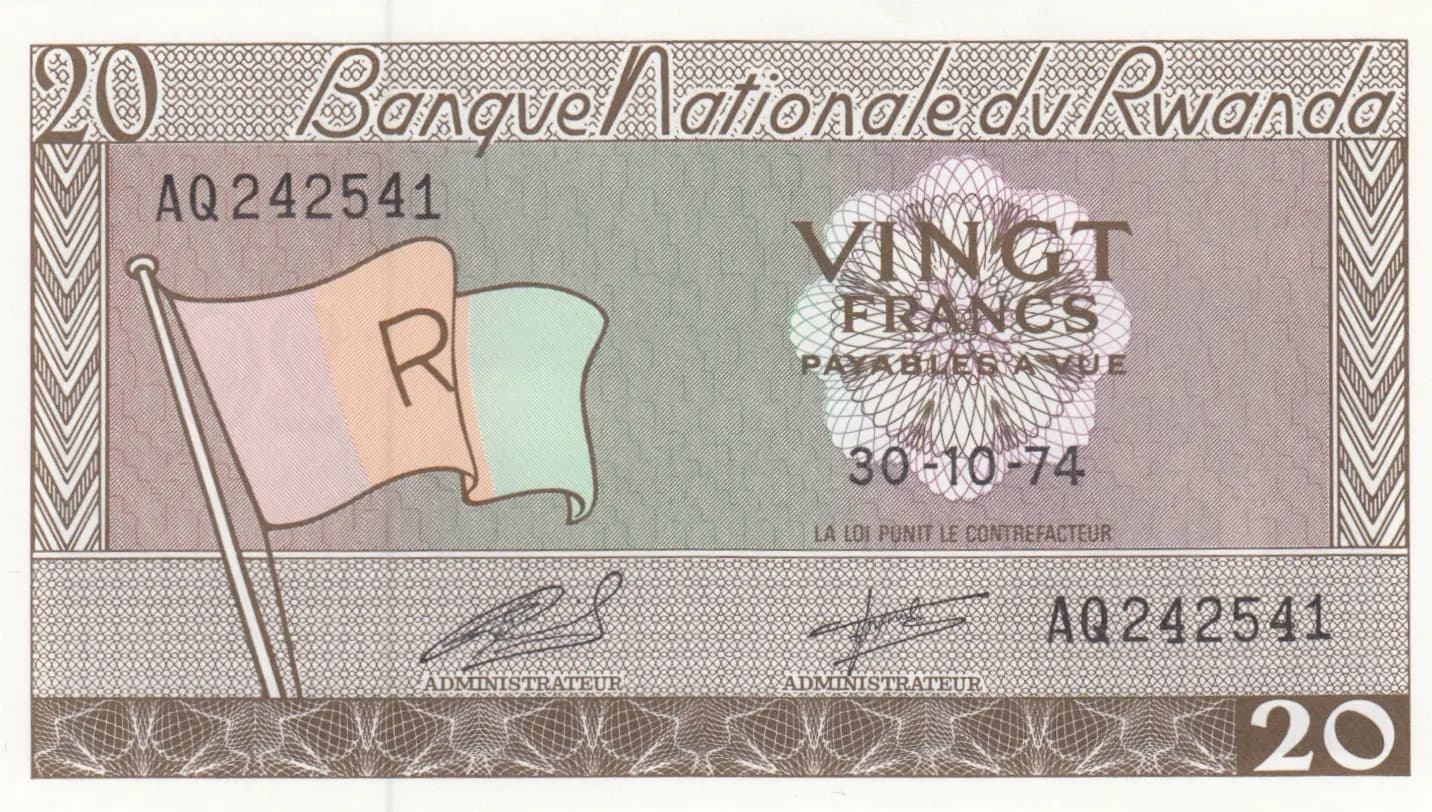
The obverse features the flag of Rwanda (yellow, green, and red horizontal stripes with the national emblem) positioned at the left side against a pale lavender background. A detailed floral design with ornate petals appears in the upper right, serving as a security element. The denomination '20' appears in the top left and bottom right corners. The reverse depicts a development-themed composition: four young Rwandan boys in white shirts are positioned in the lower left, symbolizing youth and education. Behind them, a pipeline representing industrial/hydroelectric infrastructure is visible at center, while the background shows agricultural terraces—a distinctive feature of Rwanda's landscape—with mountains in the distance. A modern cityscape with multi-story buildings is rendered in the lower right, representing urban progress. A circular ornamental frame containing the denomination '20' is positioned on the right side. Both sides employ fine engraved guilloche patterns and decorative borders typical of 1960s banknote design.
FRONT: '20' (denomination), 'VINGT FRANCS' (Twenty francs in French), 'BANQUE NATIONALE' (National Bank), 'Banque Nationale du Rwanda' (National Bank of Rwanda), '01-07-64' (Issue date: July 1, 1964), 'LA LOI PUNIT LE CONTREFACTEUR' (The law punishes counterfeiters), 'VICE-GOUVERNEUR' (Vice-Governor signature title), 'GOUVERNEUR' (Governor signature title), 'A 000000' (Specimen serial number), 'SPECIMEN' (Specimen overprint). BACK: '20' (denomination), 'AMAFRANGA 20' (Twenty francs in Kinyarwanda), 'Banki Nasiyonal'yU Rwanda' (National Bank of Rwanda in Kinyarwanda), 'ITEGEKO LIHANA UMUNTU WESE UZIGANA IYI NOTI' (The law punishes anyone who counterfeits this note in Kinyarwanda), 'SPECIMEN' (Specimen overprint).
Intaglio (engraved) printing, the standard security printing method for banknotes of this era. The fine line work, detailed guilloche patterns, and sharp portrait renderings visible in the specimen are characteristic of intaglio production. The color separation and multicolor printing technique employed suggests production by a specialized security printer, likely a European or American firm contracted by the Banque Nationale du Rwanda, though the specific printer is not visually identifiable from the note itself.
This note is identified as Pick P-6as, the 'specimen' variety of the 1964 issue. The 'as' designation indicates specimen status, confirmed by the red 'SPECIMEN' overprints and dummy serial number (A 000000) visible on both sides. The catalog notes indicate multiple date and signature title varieties exist for the regular circulation issues (dated 31.3.1966, 15.3.1969, 1.9.1969, etc.), but this specimen represents the original 01-07-64 (July 1, 1964) date. Replacement notes are noted to carry the serial number prefix 'ZZ' in regular circulation, but this specimen retains the standard 'A' prefix. No significant varieties are apparent within the specimen classification itself.