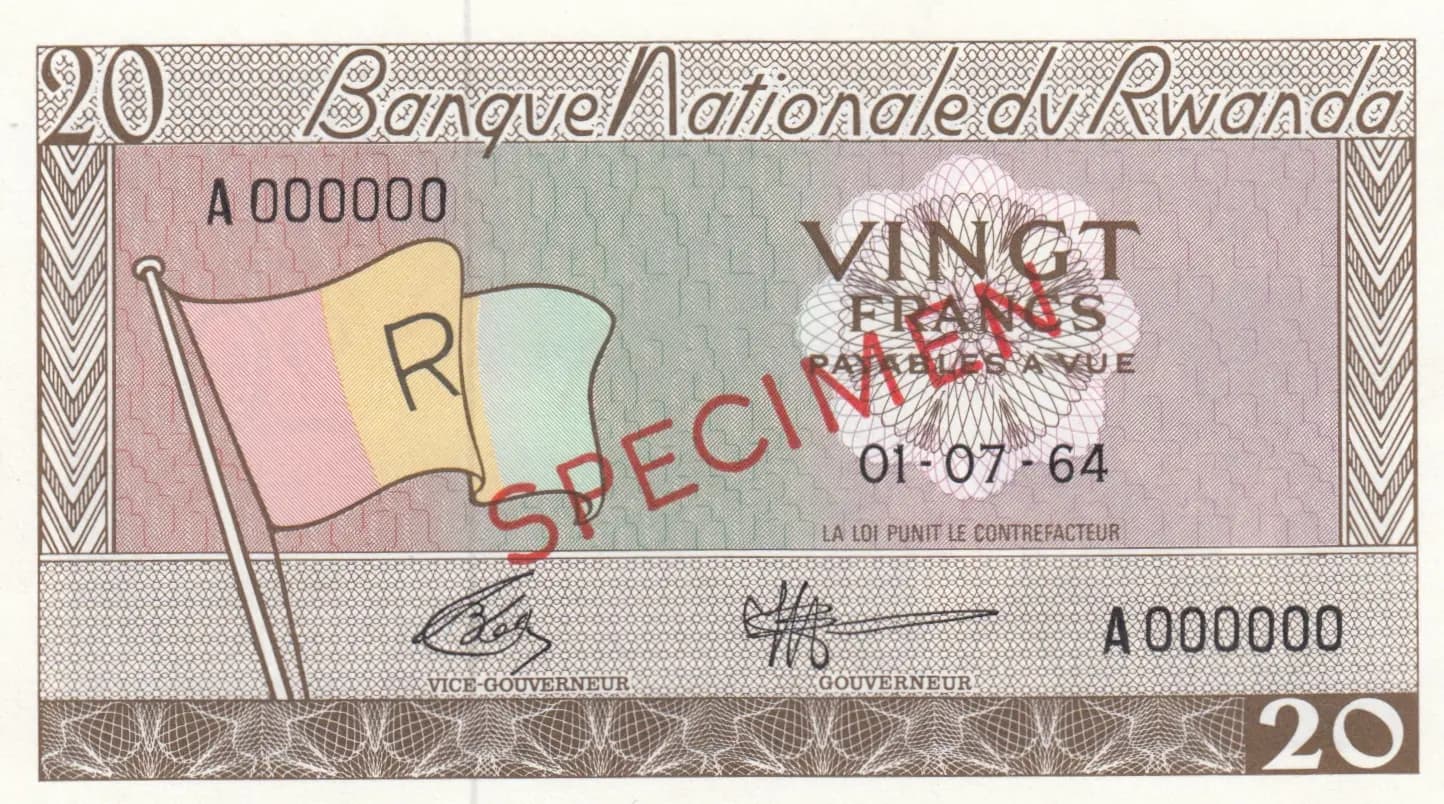
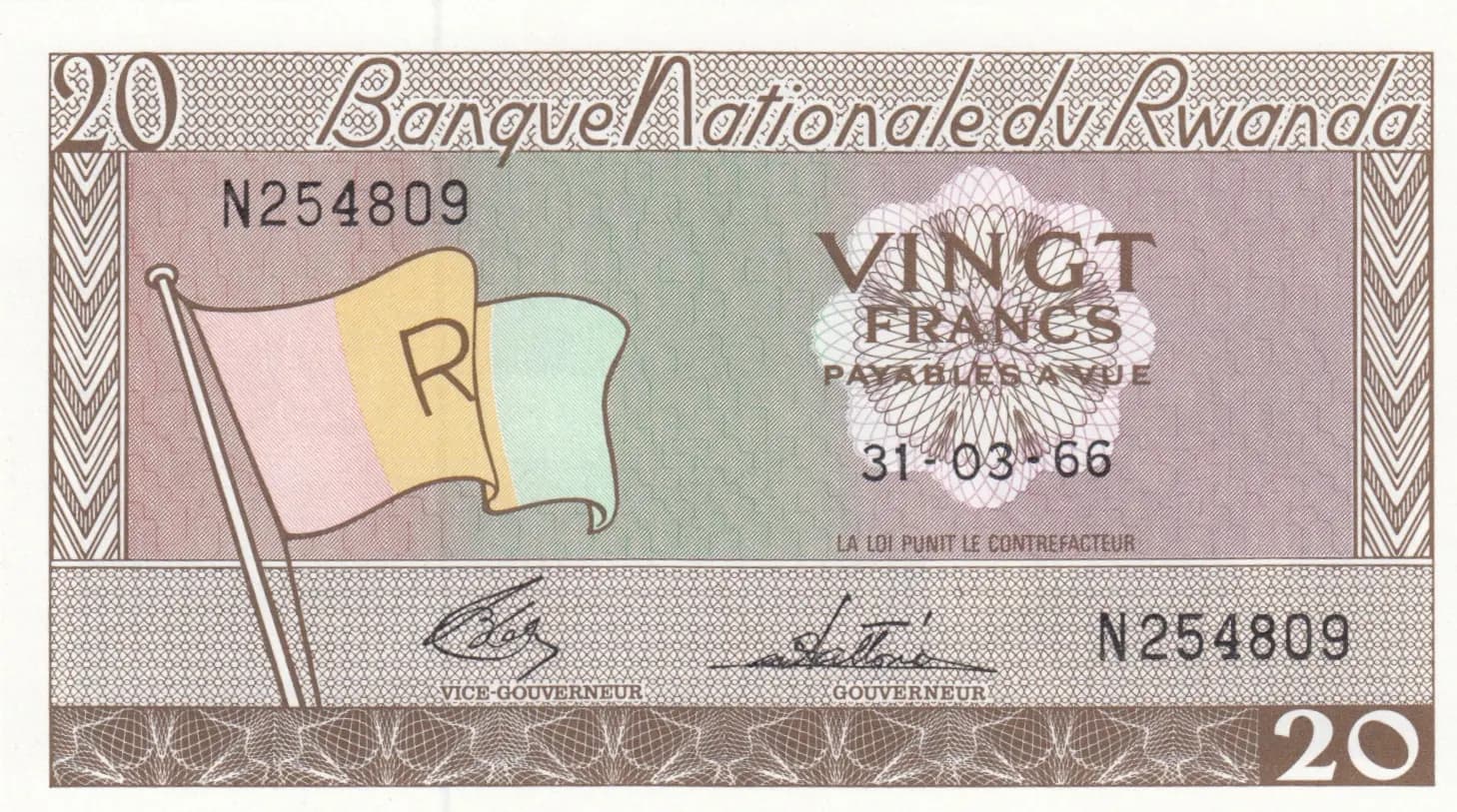
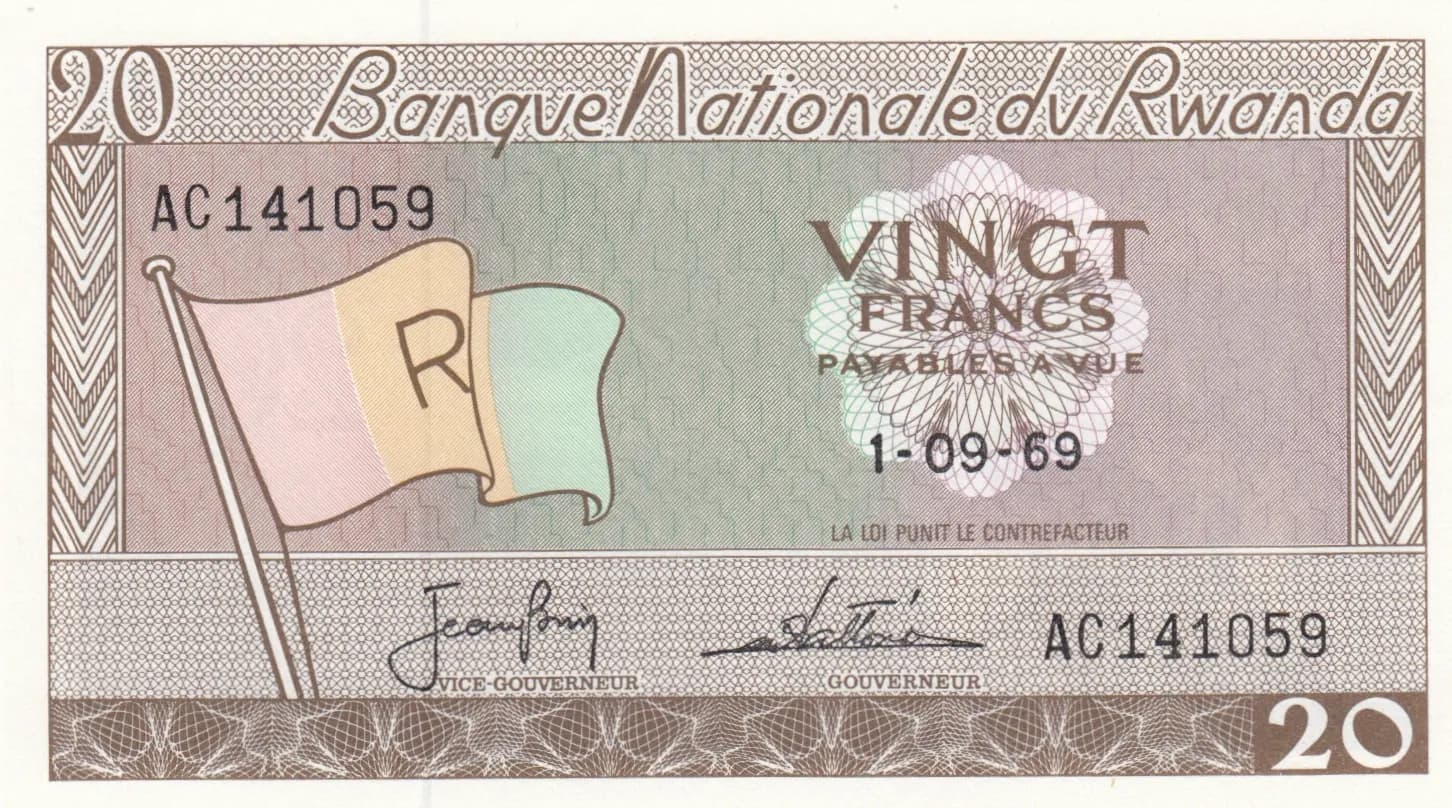
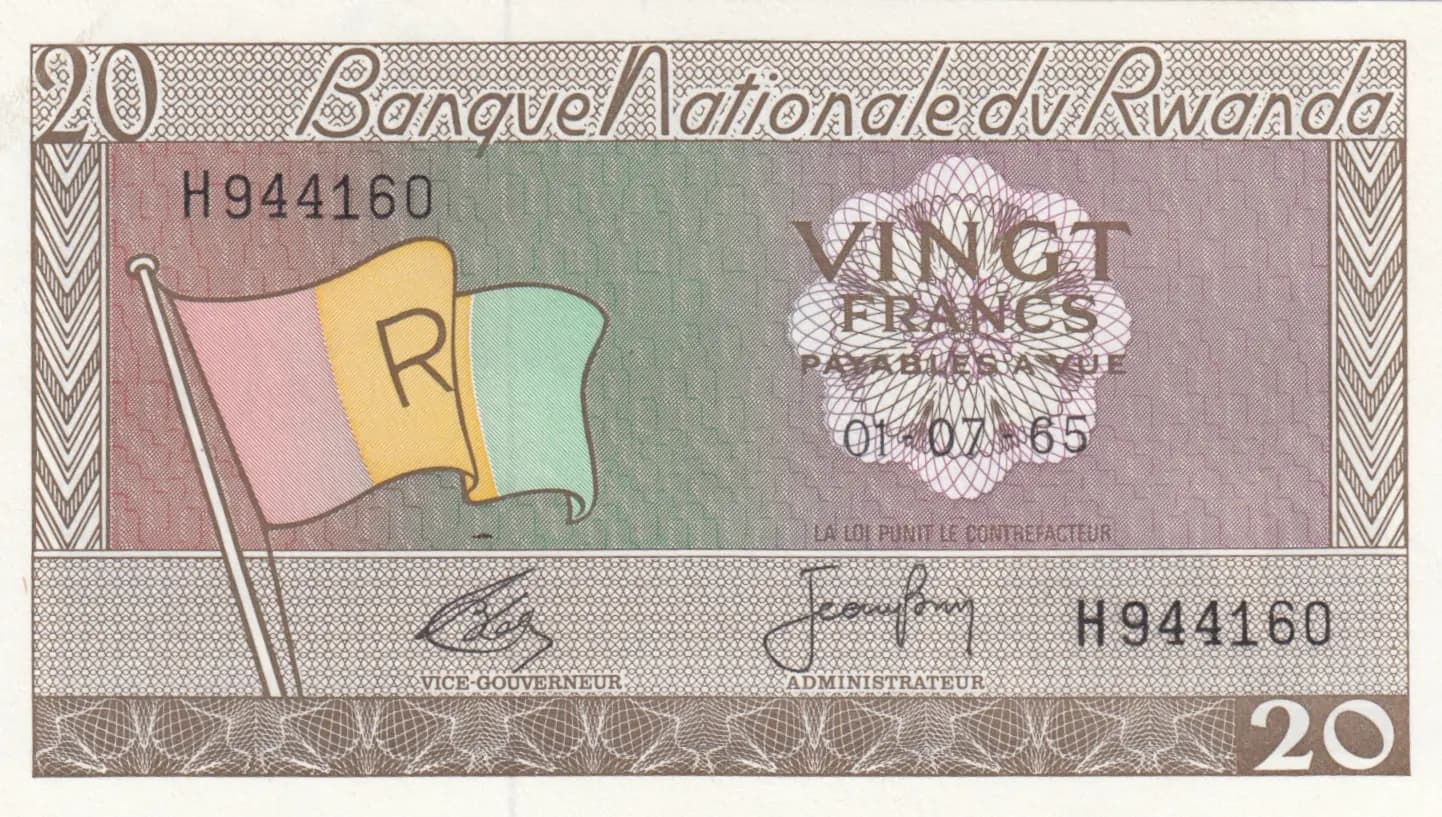
1000 francs 1974 specimen
Market Prices
3 salesAbout This Note
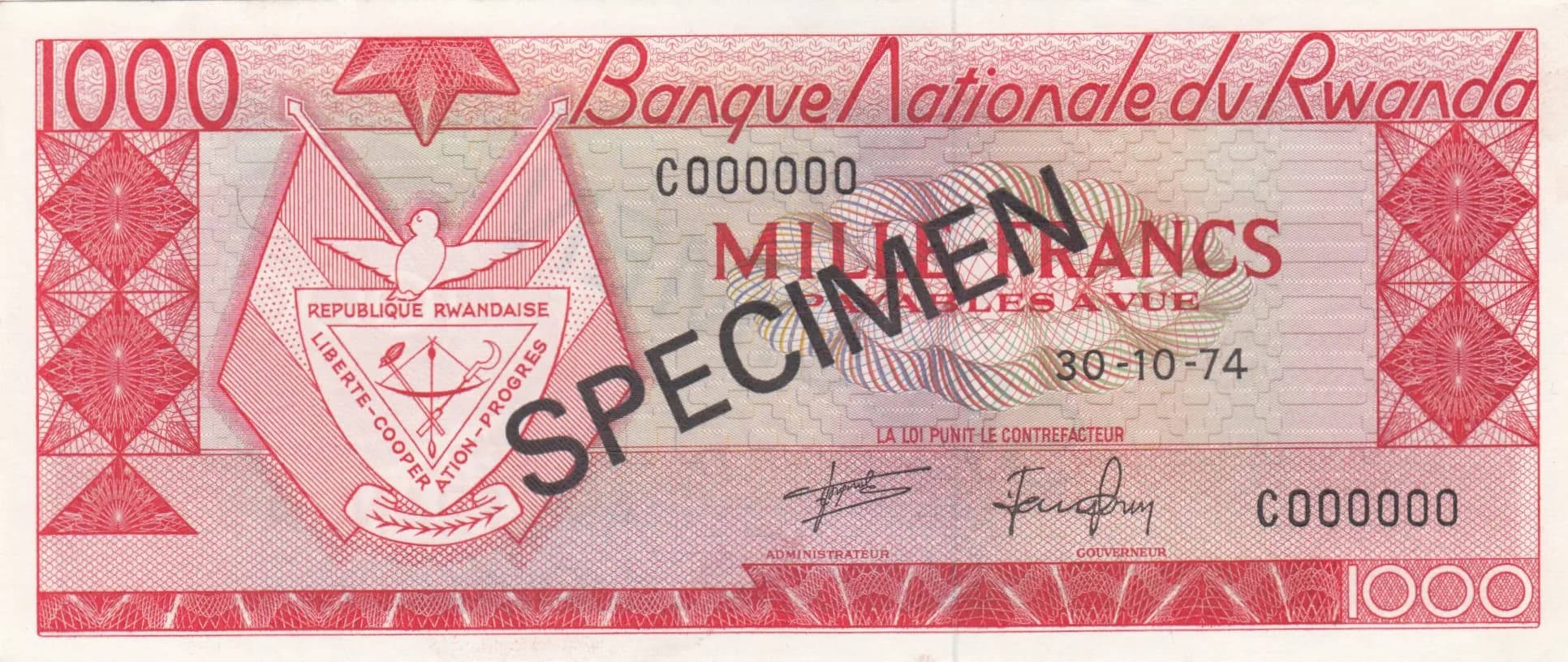
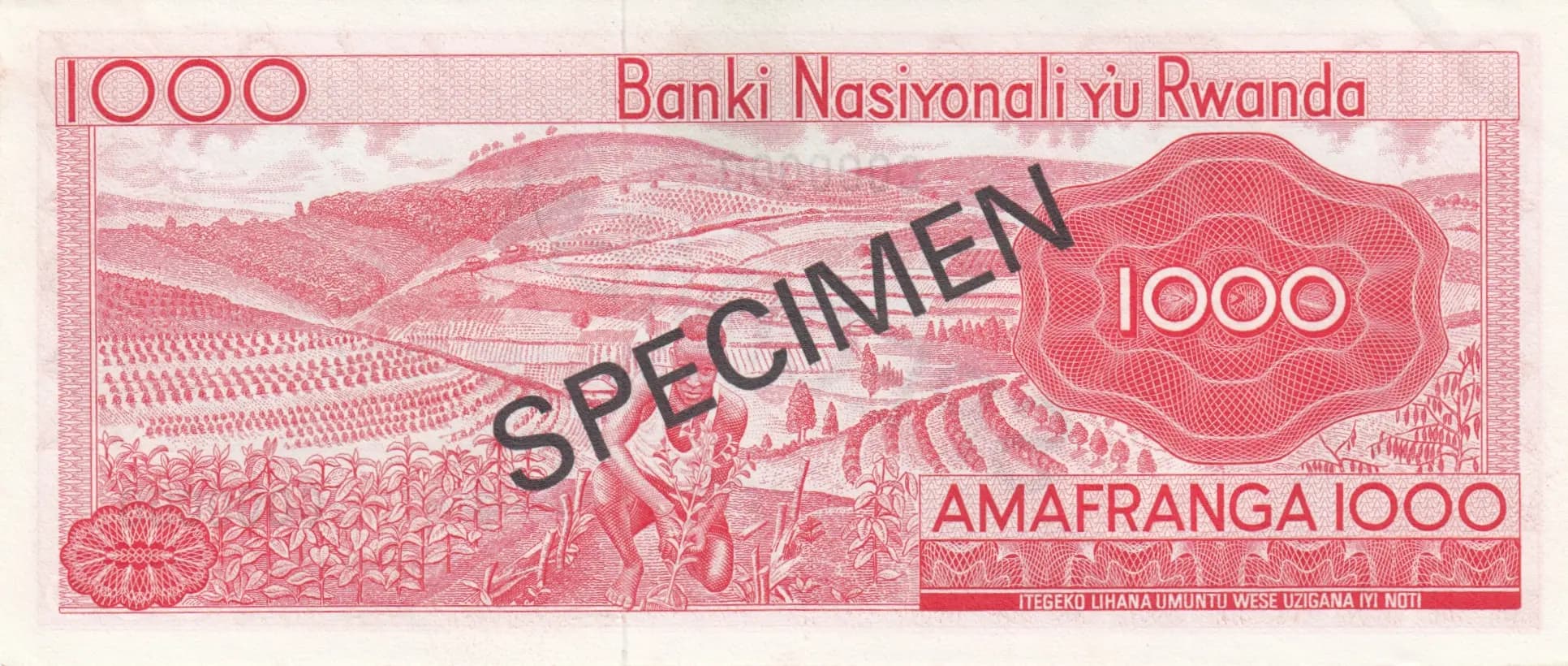
This is a pristine specimen example of the 1000 Francs Rwandan banknote from 1974 (Pick-10bs), issued by the Banque Nationale du Rwanda. The note features striking red/pink engraving with the national coat of arms prominently displayed on the obverse, while the reverse depicts a beautifully detailed agricultural landscape with terraced farming, mountain peaks, and a peasant figure—iconic imagery celebrating Rwanda's agricultural heritage. As an uncirculated specimen note with the characteristic diagonal 'SPECIMEN' overprint in black ink, this example exhibits sharp printing clarity and pristine paper condition with no signs of wear or handling.
Common. This is a regular-issue banknote from the long-running 1964-1976 series with substantial circulation. The eBay market data provided (notes in lower grades selling for $26-$61, with UNC catalog value of $300 in 2019) indicates moderate collector demand but regular availability. Specimen notes are typically printed in smaller quantities than circulation notes but were produced in sufficient numbers to remain common in today's secondary market. The catalog value of $300 UNC reflects the specimen status and pristine condition rather than inherent rarity of the type itself.
Issued during the 1964-1976 series period under the Banque Nationale du Rwanda, this 1000 Francs note (dated October 30, 1974) reflects post-independence Rwanda's national identity and economic priorities. The reverse's emphasis on terraced agricultural fields, cultivated crops (including banana plants), and the mountainous terrain directly illustrates Rwanda's agrarian economy and the critical importance of subsistence and export agriculture to the newly independent nation. The national motto visible on the front—'LIBERTÉ, COOPÉRATION, UNITÉ, PROGRÈS'—encapsulates the ideals of the Rwandan state during this period of nation-building.
The obverse features the national coat of arms of Rwanda—a shield emblem with a stylized dove or bird figure and scales of justice symbol—centered within an ornate geometric border of diamond-shaped patterns rendered in fine red engraving. The denomination '1000' appears in large numerals in opposite corners, with 'MILLE FRANCS' prominently displayed in the center-right. Bilingual text in French (administrative side) includes the issuing bank name, date, and government official titles (Administrator and Governor signature lines). The reverse presents an allegorical scene of Rwandan agricultural prosperity: a landscape with terraced hillside farming in the foreground, cultivated crops including banana plants, a peasant figure in traditional dress engaged in agricultural work, and a prominent mountain peak dominating the right side of the composition. The '1000' denomination is encased in a decorative circular frame on the right side, with Kinyarwanda text ('AMAFRANGA 1000') emphasizing the nation's indigenous language alongside French colonial-era administrative language.
FRONT SIDE: 'Banque Nationale du Rwanda' (National Bank of Rwanda); 'MILLE FRANCS' (One Thousand Francs); 'REPUBLIQUE RWANDAISE' (Rwandan Republic); 'LIBERTE COOPER UNITE-PROGRES' (Freedom, Cooperation, Unity-Progress); 'LA LOI PUNIT LE CONTREFACTEUR' (The Law Punishes the Counterfeiter); 'ADMINISTRATEUR' (Administrator); 'GOUVERNEUR' (Governor); '30-10-74' (October 30, 1974); denomination '1000' and serial number 'C000000'. BACK SIDE: 'Banki Nasiyonali Yu Rwanda' (National Bank of Rwanda—Kinyarwanda); 'AMAFRANGA 1000' (1000 Francs—Kinyarwanda); 'ITEGEKO LIHANA UMUNTU WESE UZIGANA IYI NOTI' (The Law Punishes the Counterfeiter—Kinyarwanda); denomination '1000' in decorative circular frame; 'SPECIMEN' overprint.
Intaglio engraving (copperplate/steel plate printing) is the primary technique, evidenced by the fine parallel line work, intricate geometric patterns, ornamental borders, and the detailed landscape rendering with precise field-line work visible throughout both sides. The sharp clarity of denominations, text, and security patterns—combined with the fine cross-hatching and line density observed in the specimen—is characteristic of high-security intaglio production. The security design elements include fine parallel line work creating texture fields and the ornamental geometric border patterns typical of 1970s African central bank note production. For this Pick number (P-10bs), the note was likely produced by the Banque Nationale du Rwanda's designated security printer; many Rwandan banknotes of this era were produced by European security printers, though the specific printer for this series requires confirmation.
This is a specimen overprint variety (denoted by the 'bs' suffix in Pick-10bs, indicating 'banknote specimen'). The diagonal 'SPECIMEN' stamp in black ink is the defining feature of this variety, distinguishing it from regular circulation notes (Pick-10b). Specimen notes were typically not released to circulation and were reserved for presentation, archival, and authorized distribution to banks and collectors. The serial number shown ('C000000') is consistent with specimen production protocols. No signature varieties or date variations are apparent from the visual analysis; the October 30, 1974 date appears to be the standard date for this issue.