100 francs 1964
Market Prices
6 salesAbout This Note
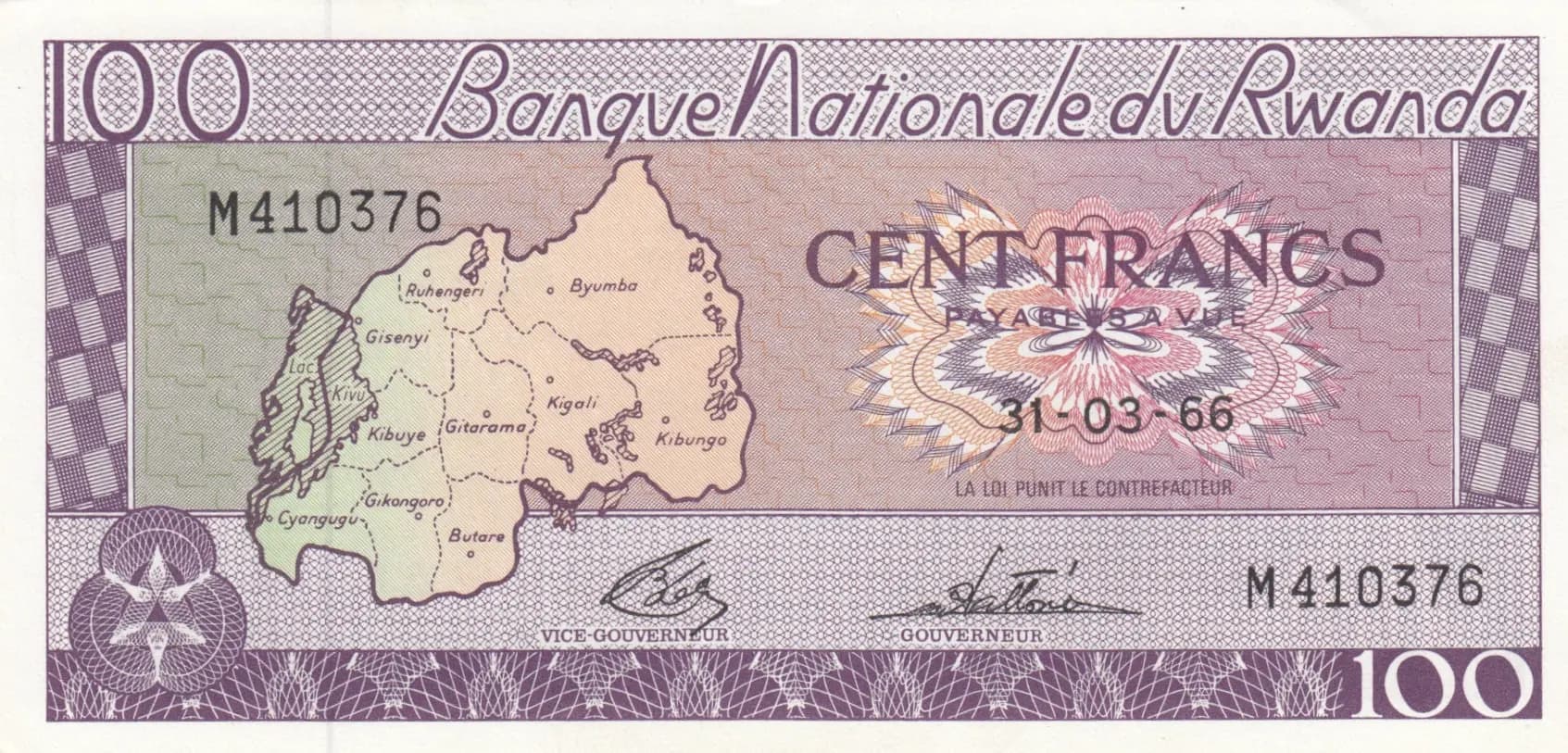
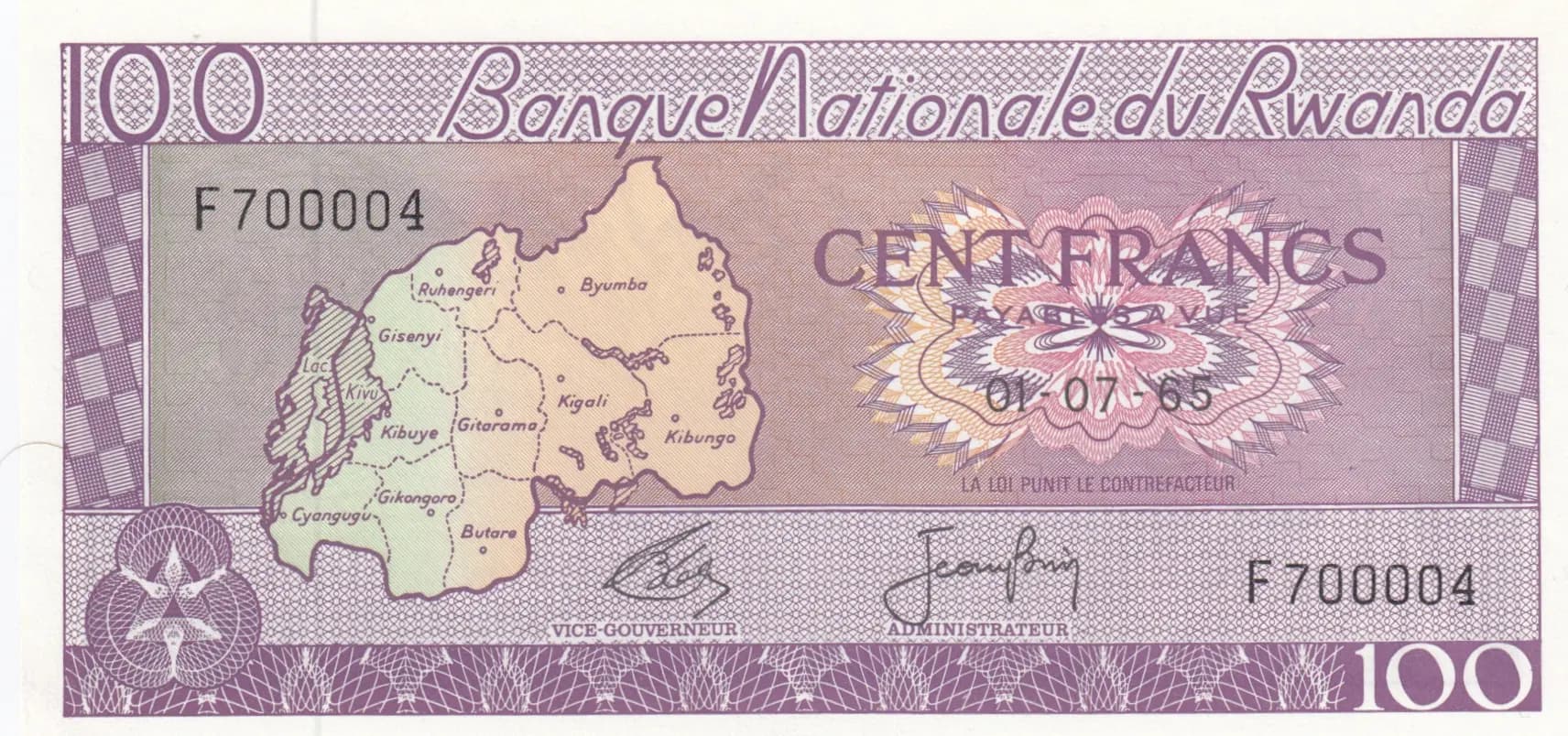
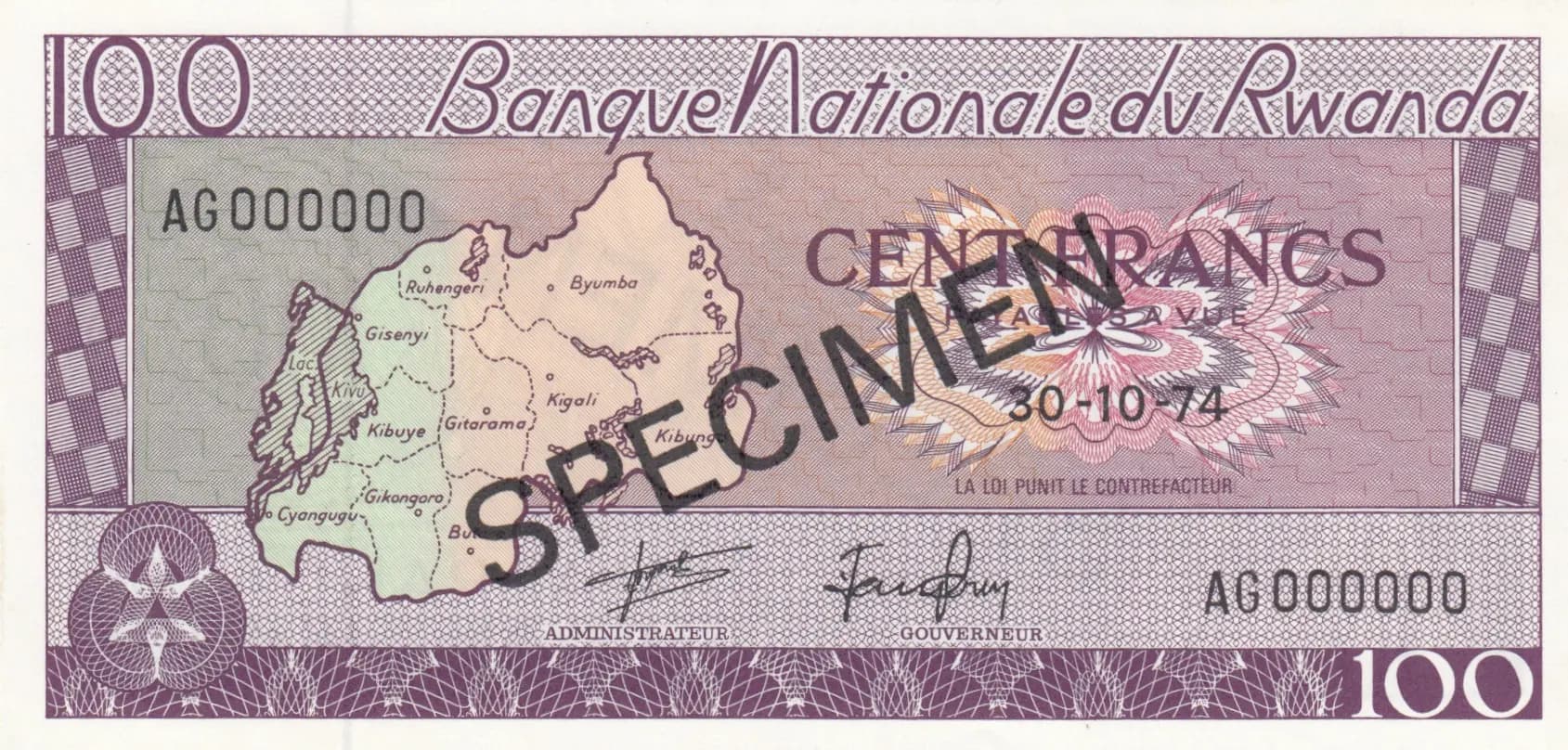
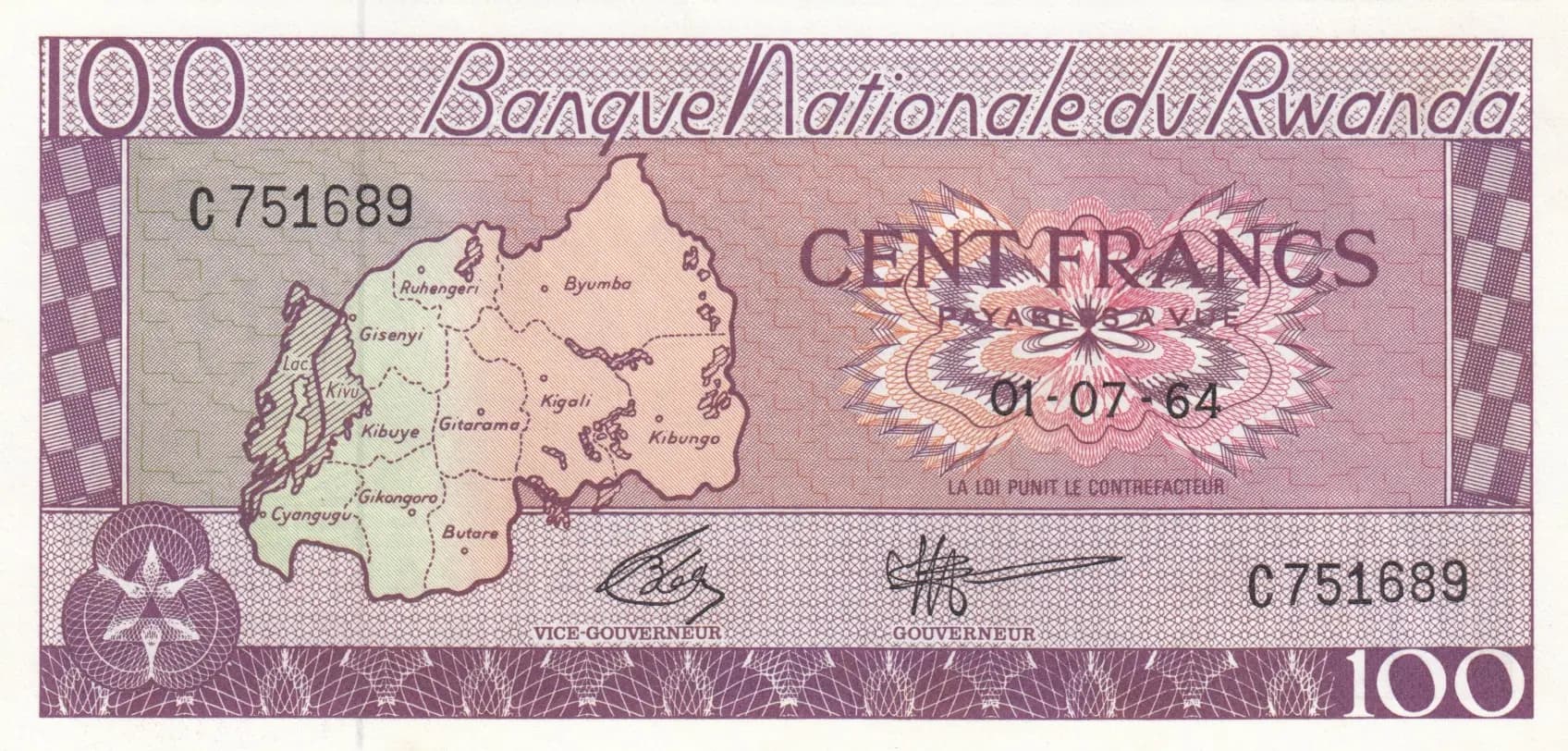
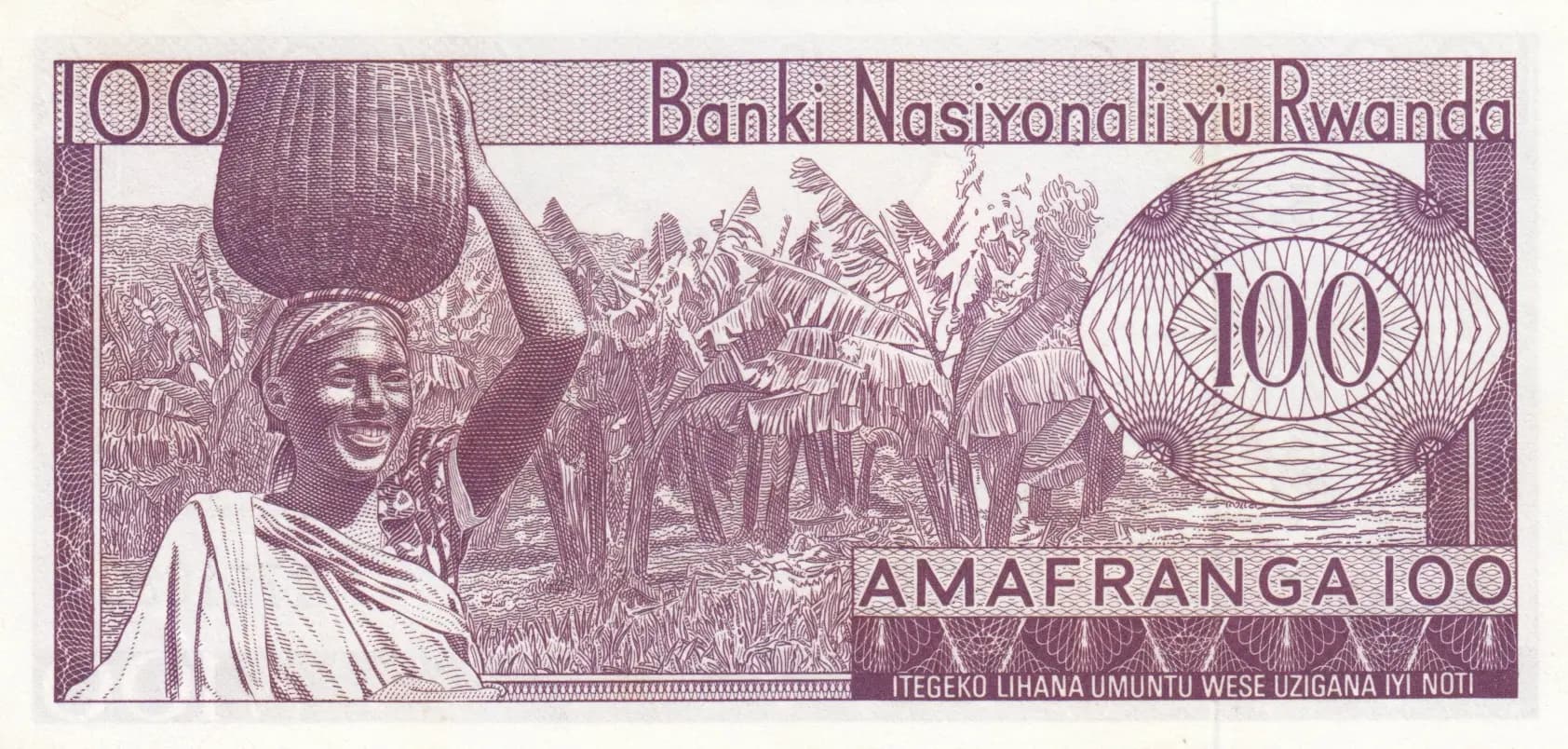
A pristine uncirculated example of Rwanda's inaugural 100 francs banknote from 1964, issued by the Banque Nationale du Rwanda shortly after independence. The note showcases exceptional engraving quality with a geographical focus—featuring a detailed map of Rwanda's provinces on the obverse and a celebratory scene of agricultural life on the reverse, reflecting the nation's economic foundation. The crisp, unblemished condition with vibrant purple and multicolor printing makes this an attractive example of early post-independence African currency.
Common. While this is an early post-independence Rwandan note with historical significance, the observed market data (eBay sold examples ranging from $6.50 to $52.50 with most UNC examples selling in the $15-31 range as of 2016-2020) indicates regular availability. The 2019 catalogue value of $50 UNC aligns with typical pricing for early African banknotes in uncirculated condition that are neither rare nor heavily collected. The existence of multiple date and signature varieties (1964, 1966, 1969 with VICE-GOUVERNEUR and GOUVERNEUR variants) and the absence of information about restricted print runs or recall status further supports a common classification.
Issued in 1964, just three years after Rwanda's independence from Belgium in 1962, this banknote represents the newly sovereign nation's establishment of its own central bank and monetary authority. The design deliberately emphasizes Rwanda's identity through the prominent geographical map showing provincial boundaries and major cities (Kigali, Butare, Gitarama, and others), while the reverse celebrates the agricultural economy with imagery of banana cultivation and rural community labor—staples of Rwanda's economy in this period. The bilingual inscriptions in French and Kinyarwanda reflect the post-colonial linguistic composition of the nation's official institutions.
The obverse features a detailed cartographic representation of Rwanda positioned at left-center, delineating the nation's provincial boundaries with city names clearly marked including Ruhengeri, Byumba, Gisenyi, Kibuye, Kigali, Gitarama, Kibugo, Kigongo, Cyangugu, and Butare. To the right is an ornamental floral medallion with radiating geometric patterns in coral and pink tones, framing the denomination '100 FRANCS' in large serif typography. The national coat of arms (circular geometric emblem) appears in the lower left. The reverse depicts a smiling woman in traditional wrapped cloth garment with her right arm raised, positioned prominently at left, with banana or plantain plants featuring characteristic large leaves behind her and a crowd of people in traditional dress gathered in the background, emphasizing communal agricultural activity. A large ornate concentric circle containing '100' dominates the right side. Both sides employ intricate crosshatch engraving, fine line work, and decorative borders with geometric repeating patterns characteristic of high-security currency engraving.
OBVERSE: 'Banque Nationale du Rwanda' (National Bank of Rwanda), '100 FRANCS' / 'CENT FRANCS' (One Hundred Francs), 'PAY ACTE' (Pay Act), '01-07-64' (July 1, 1964 - issue date), 'LA LOI PUNIT LE CONTREFACTEUR' (The law punishes the counterfeiter), 'VICE-GOUVERNEUR' (Vice-Governor), 'GOUVERNEUR' (Governor), Serial number 'C751689'. REVERSE: 'Banki Nasiyonal y'u Rwanda' (National Bank of Rwanda in Kinyarwanda), 'AMAFRANGA 100' (100 Francs in Kinyarwanda), 'ITEGEKO LIHANA UMUNTU WESE UZIGANA IYI NOTI' (The law punishes anyone counterfeiting this note, in Kinyarwanda).
Intaglio engraving (line engraving and steel plate printing), which is evident from the fine detail, precise crosshatching throughout both sides, crisp line definition, and the characteristic raised ink impression typical of currency production. This represents the standard security printing technique for banknotes of the 1960s. Based on the quality and the Pick catalog designation, this was likely produced by a European security printer, possibly Giesecke+Devrient or a similar established currency printer contracted by the Banque Nationale du Rwanda.
This specific note (Pick 8a) exhibits the first date variety of July 1, 1964 (01-07-64). Known varieties for this denomination include different signature title combinations (VICE-GOUVERNEUR and GOUVERNEUR), and later date variants from 31.3.1966 and 31.10.1969. Replacement notes are identified by serial number prefix 'ZZ'. This example displays serial number 'C751689' without the ZZ prefix, indicating a regular issue rather than a replacement note. The signature titles visible on this example would confirm which specific variety combination this represents (whether VICE-GOUVERNEUR, GOUVERNEUR, or both are present).