100 francs 1978
Market Prices
26 salesAbout This Note
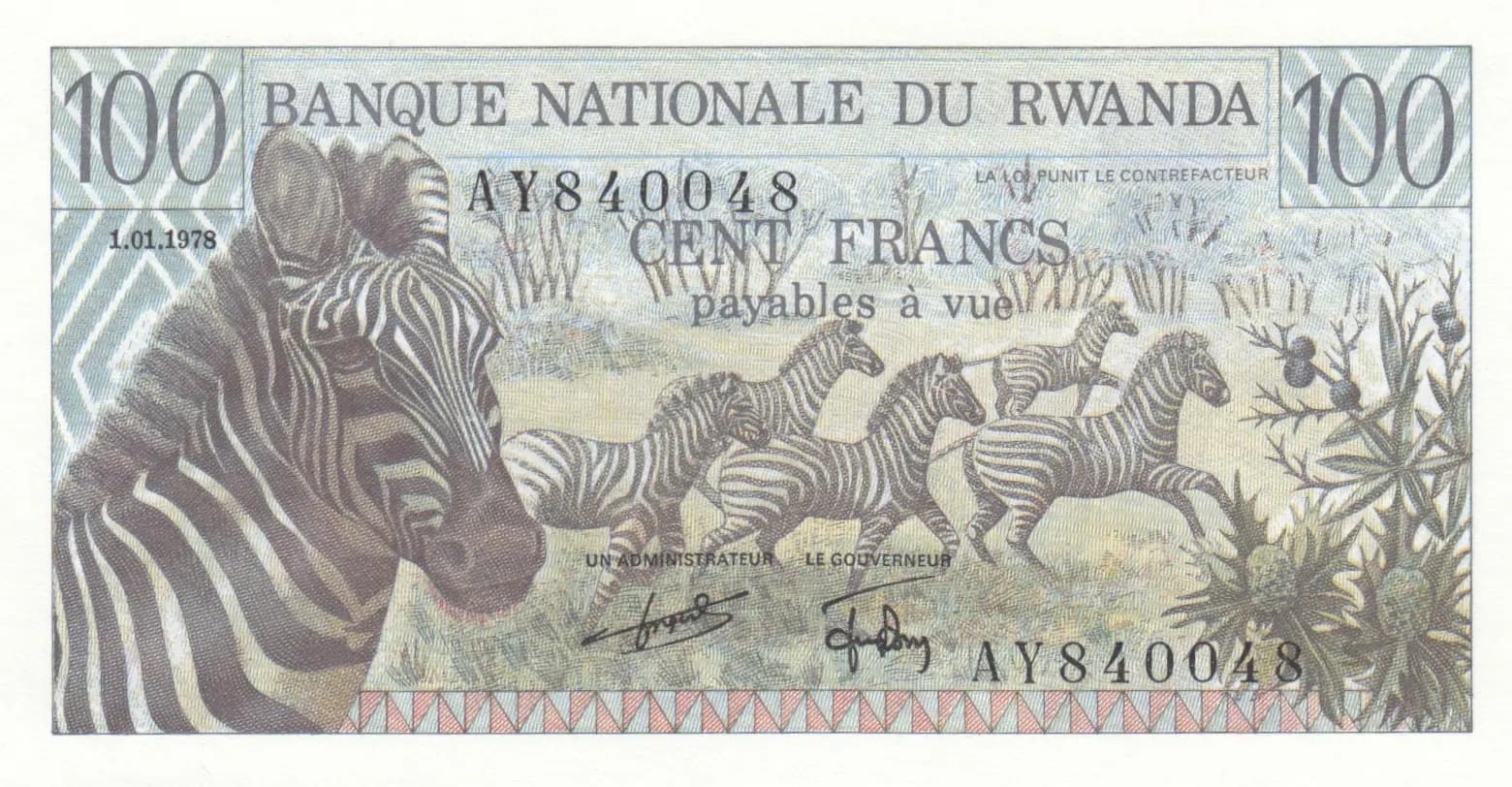
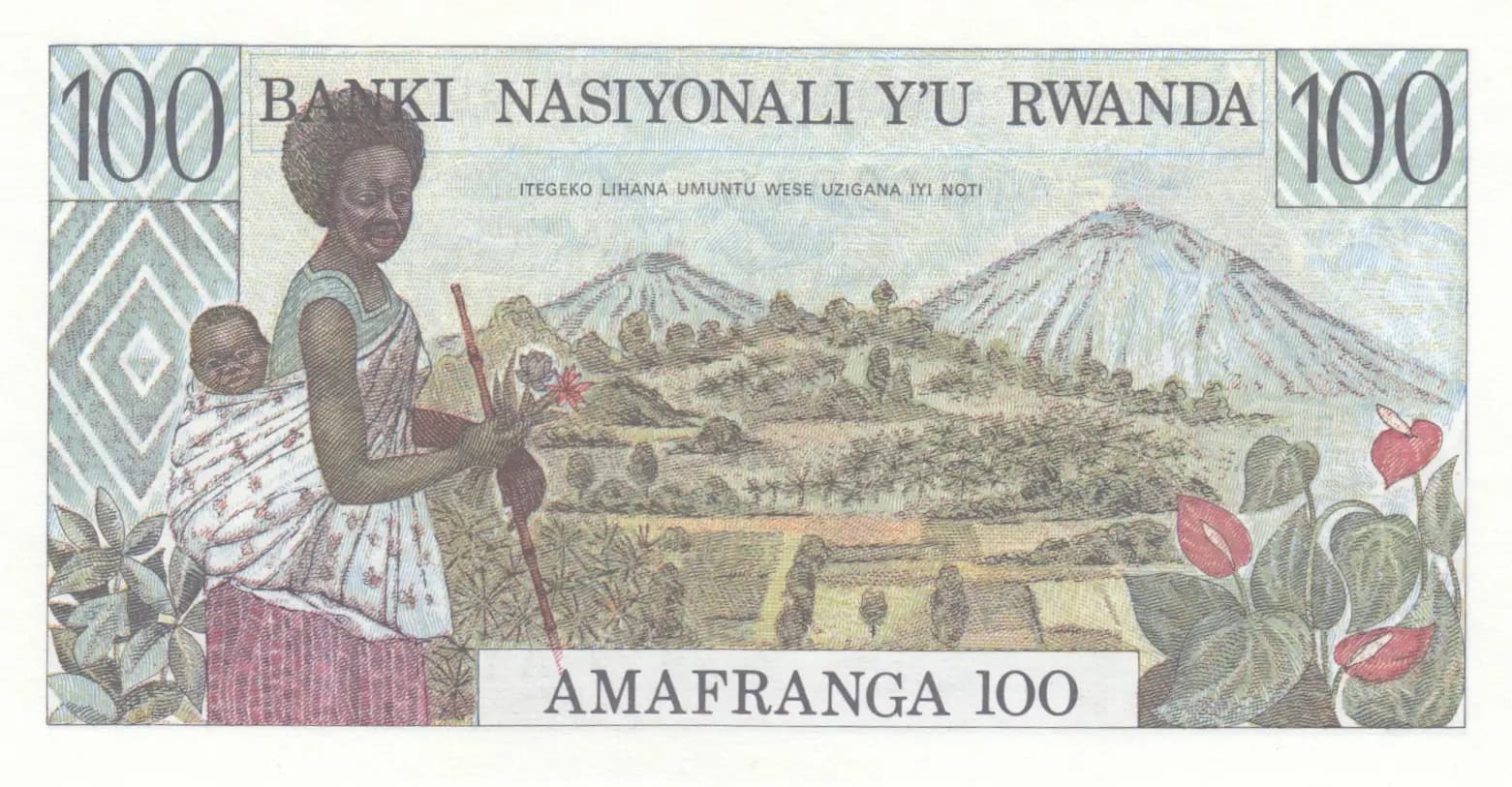
This is an uncirculated example of the Rwanda 100 Francs banknote from January 1, 1978, issued by the Banque Nationale du Rwanda (Pick P-12). The note features exceptional wildlife and cultural imagery: a detailed zebra portrait and savanna scene on the obverse, and a woman with child in traditional dress against a volcanic landscape on the reverse. In pristine condition with no visible wear, this note represents a classic African banknote design that has remained popular with collectors, with market prices for UNC examples typically ranging from $17–$40.
Common. Despite its age and distinctive design, this banknote remains common in the numismatic market. eBay transaction data spanning 2012–2026 shows consistent availability of UNC examples, with typical selling prices between $14–$40 USD, averaging around $20–$25. Over 50 documented sales in uncirculated condition across multiple years indicate steady collector demand but ample supply. The 1978 100 Francs (Pick P-12) was issued in significant quantities by the Banque Nationale du Rwanda and was not subject to recall or short-lived circulation. Its current catalog value of $20 in UNC condition (per 2019 Realbanknotes reference) aligns with common-grade African banknotes of similar vintage and issuer prominence.
Issued just a year after Rwanda's independence period consolidation, this 1978 banknote reflects the nation's commitment to showcasing its natural heritage and cultural identity through currency design. The zebra imagery on the front celebrates Rwanda's wildlife and African identity, while the reverse—depicting a woman with child, agricultural fields, and the iconic Virunga volcanoes (Karisimbi and Visoke)—emphasizes the country's rural character, fertility, and distinctive volcanic landscape that defines the Rwandan geography. The bilingual French and Kinyarwanda inscriptions underscore the post-independence linguistic restoration of Kinyarwanda alongside French administrative traditions.
The obverse features a large, meticulously engraved zebra head in profile on the left side, rendered in brown and tan tones against a light blue-green background. The right portion depicts a herd of zebras in an African savanna landscape with naturalistic vegetation and trees, creating a dynamic wildlife scene. Denomination numerals '100' appear in large type at top left and right. The reverse presents a woman in traditional Rwandan dress carrying an infant on her back, depicted in profile on the left side. The background landscape shows the Virunga volcanic range (specifically Karisimbi and Visoke volcanoes as noted in the catalog) with agricultural terraced fields and tropical flowers, particularly red floral motifs on the right side. A geometric diamond pattern adorns the left margin. The design's bilingual approach (French obverse, Kinyarwanda reverse) reflects Rwanda's linguistic heritage during this post-colonial period.
FRONT (French): 'BANQUE NATIONALE DU RWANDA' (National Bank of Rwanda); '100' and 'CENT FRANCS' (One Hundred Francs); '1.01.1978' (Issue date: January 1, 1978); 'payables à vue' (payable on demand); 'LA LOI PUNIT LE CONTREFACTEUR' (The law punishes the counterfeiter); 'UN ADMINISTRATEUR' (An administrator); 'LE GOUVERNEUR' (The governor); Serial number 'AY840048'. BACK (Kinyarwanda): 'BANKI NASIYONALI Y'U RWANDA' (National Bank of Rwanda); 'AMAFRANGA 100' (One Hundred Francs); 'ITEGEKO LIHANA UMUNTU WESE UZIGANA IYI NOTI' (The law punishes anyone who counterfeits this note).
The note exhibits fine line engraving throughout, evident in the detailed portraiture of both the zebra and the woman, the intricate landscape work, and the complex geometric security patterns. The precision of the animal illustration, the layered coloration achieved through multicolor printing (light blue, green, brown, tan, red, and black inks), and the fine detail work on background vegetation indicate high-security intaglio printing. This was characteristic of Banque Nationale du Rwanda issues from this period, likely produced by an established European security printer such as De La Rue or similar institutions contracted for Commonwealth and African central banks during the 1970s. The serial number application and overprint security text ('LA LOI PUNIT LE CONTREFACTEUR') were applied as secondary security features.
The observed serial number 'AY840048' indicates the AY prefix series. For the 1978 100 Francs Pick P-12, standard varieties include different serial number prefixes (AY, AZ, BA, etc.) and signature combinations from the Governor and Administrator. The specimen photographed bears standard signatures for this issue. No overprints, special commemorative markings, or error varieties are evident. The note represents the standard production variety of this Pick number. Collectors should note that minor variations in ink saturation and paper tone may occur across print runs, but the fundamental design and security features remain constant for all authentic examples of Pick P-12.