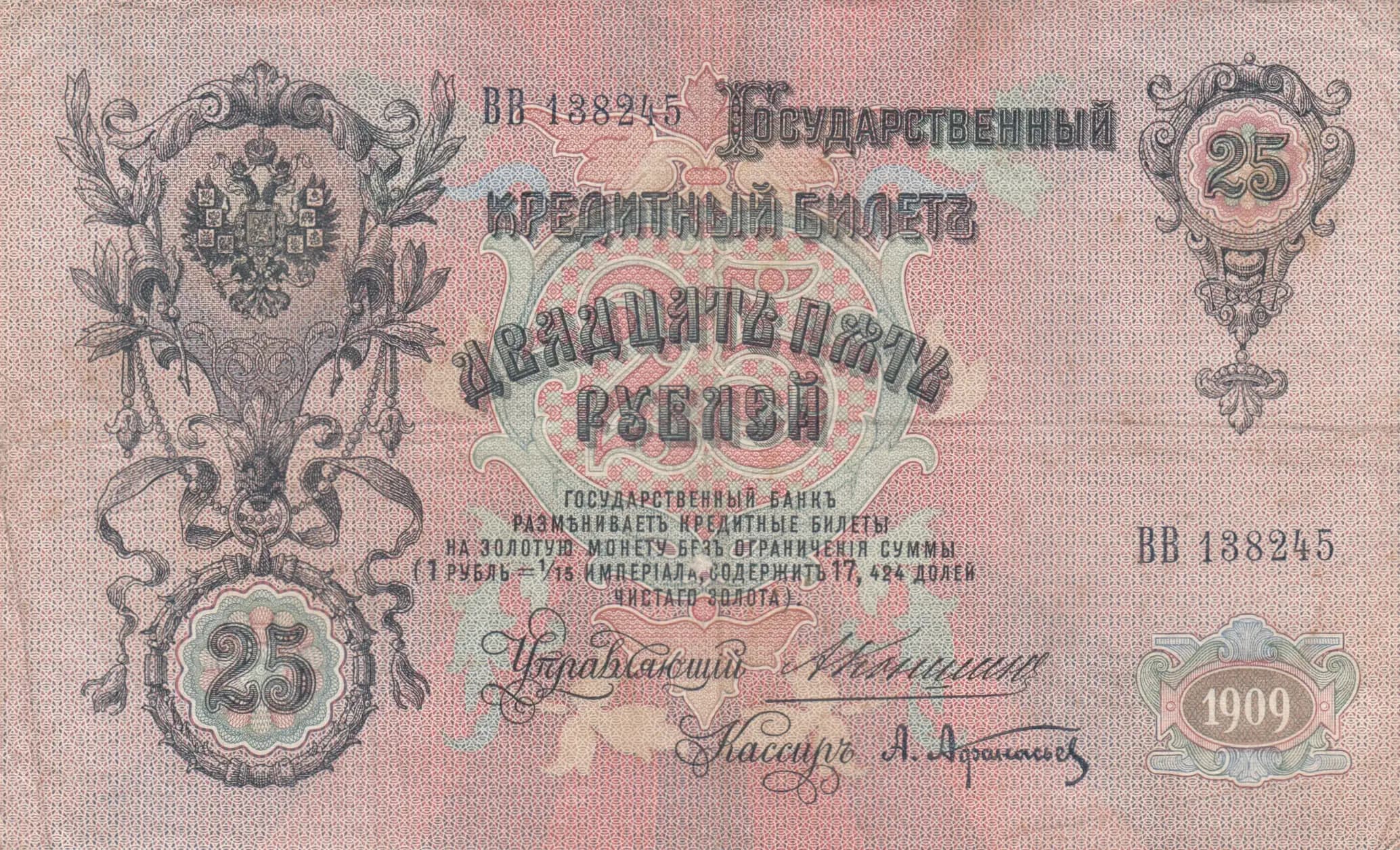
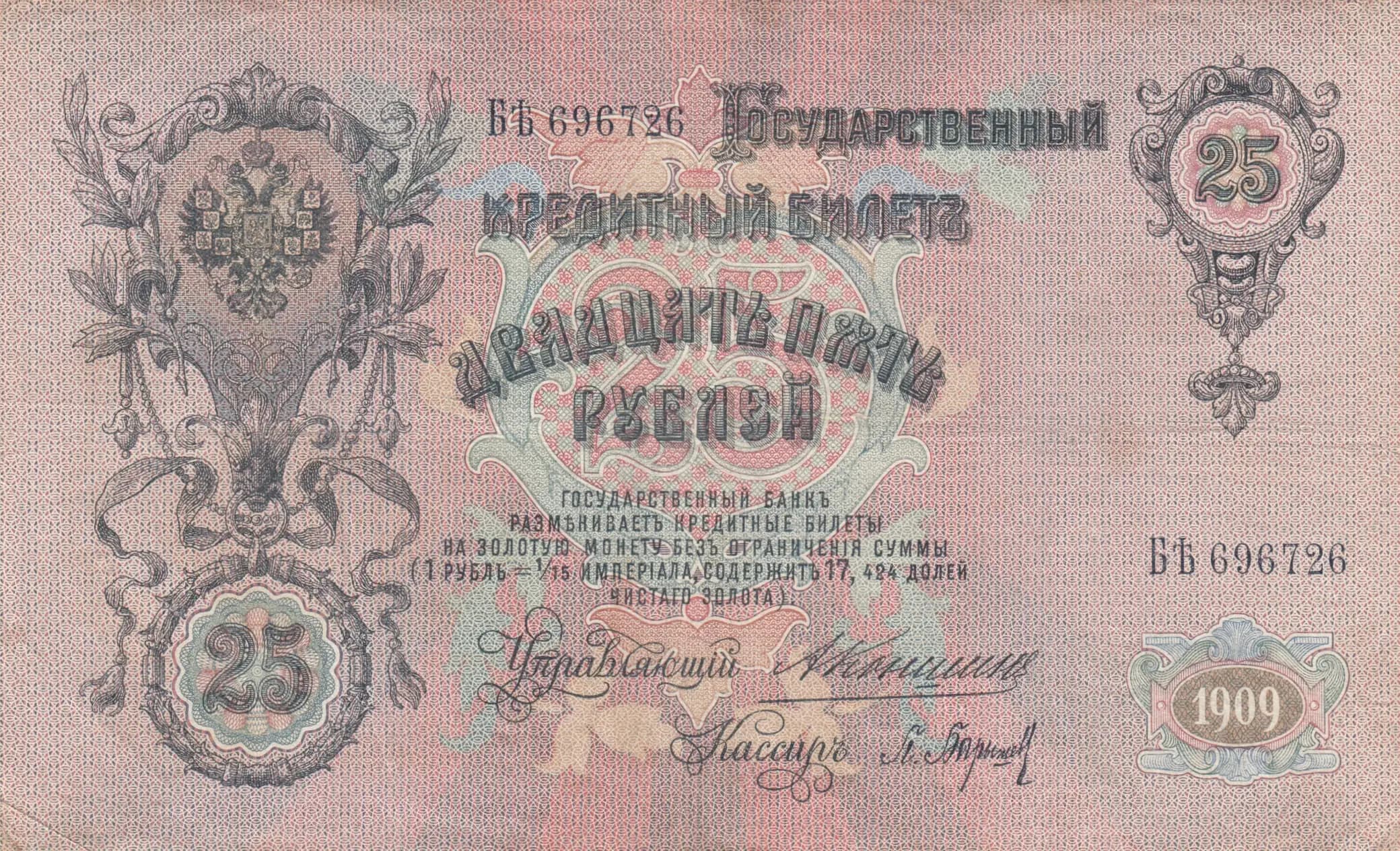
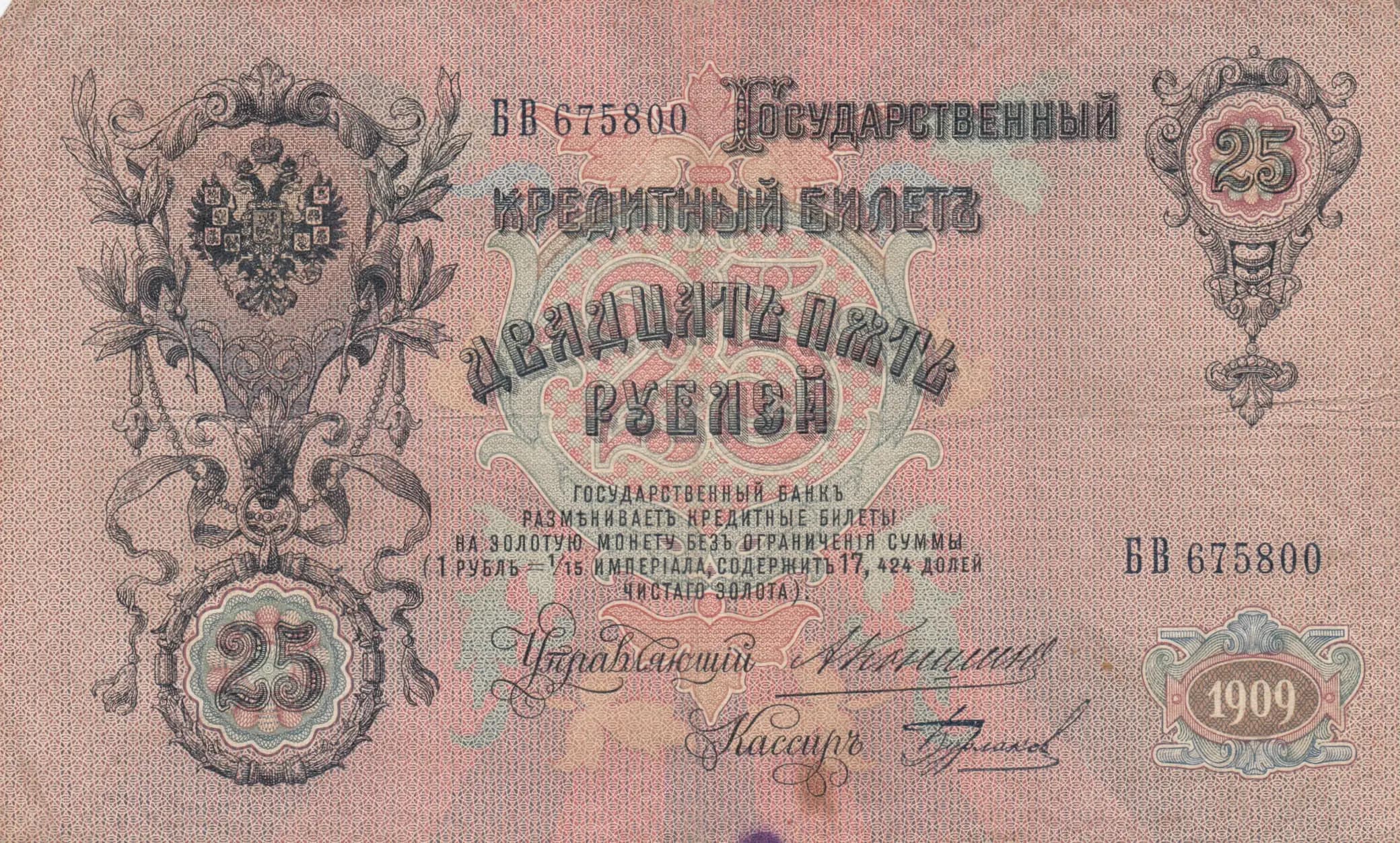
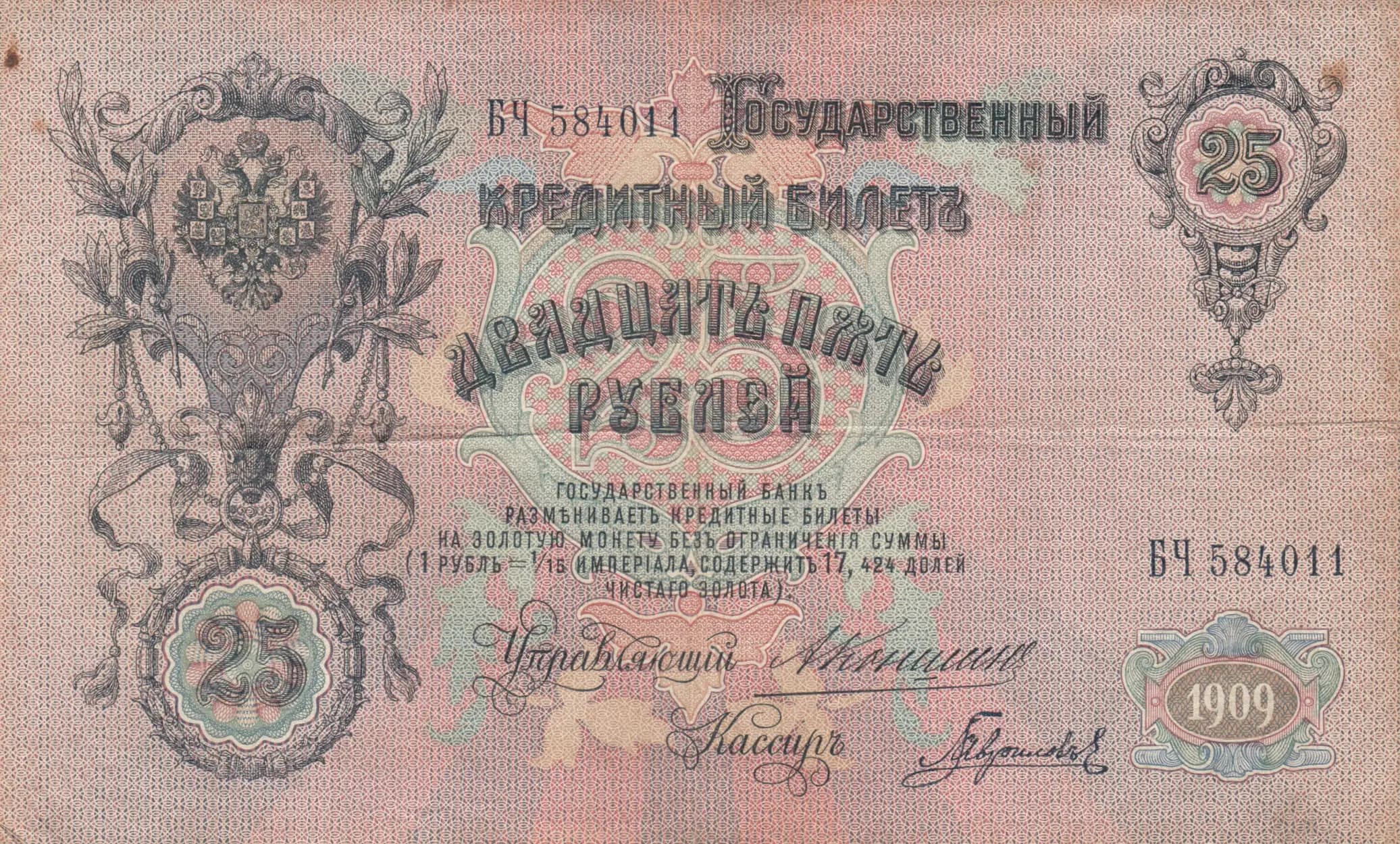
25 rublei 1909
“Sig.Shagin”
About This Note
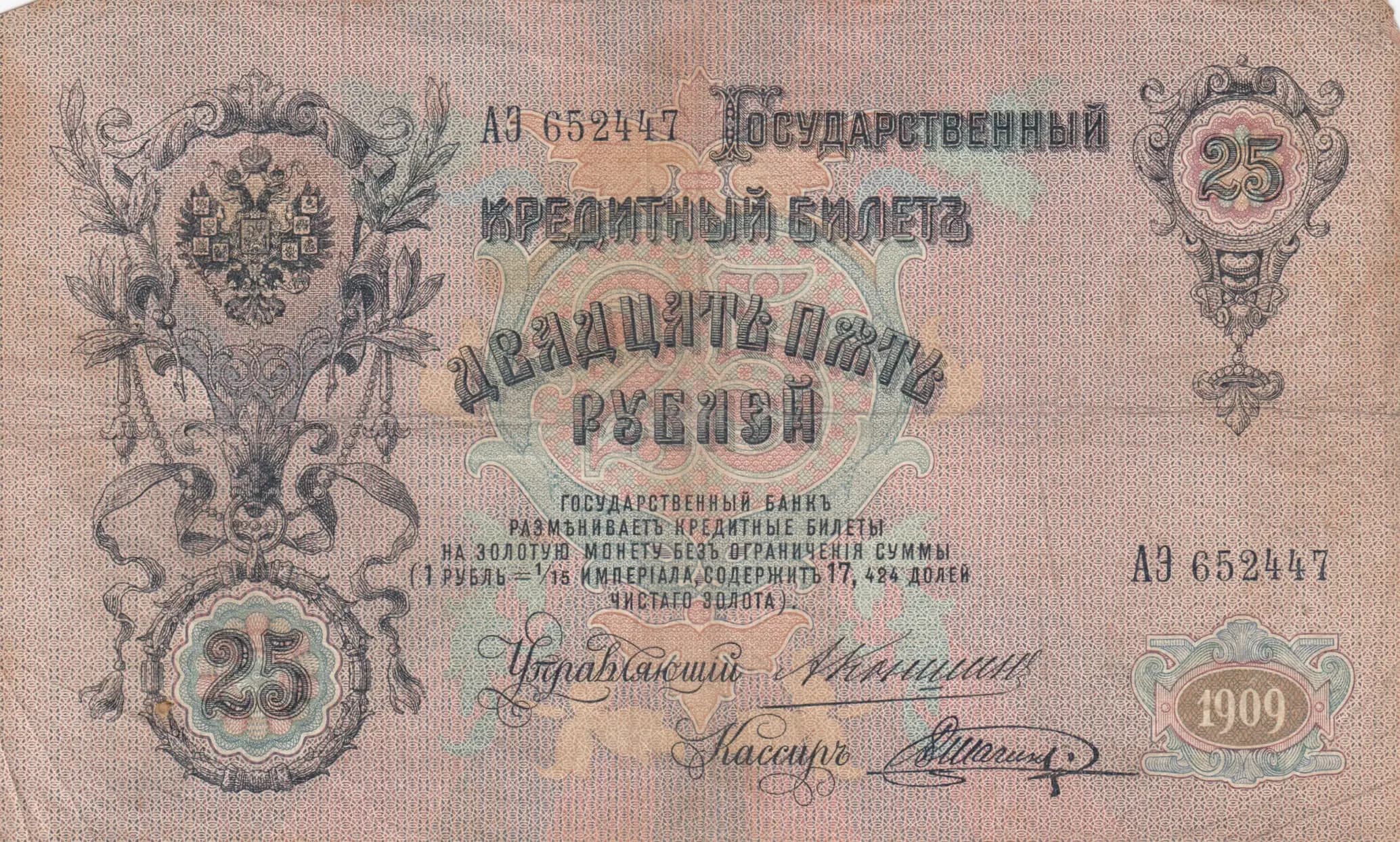
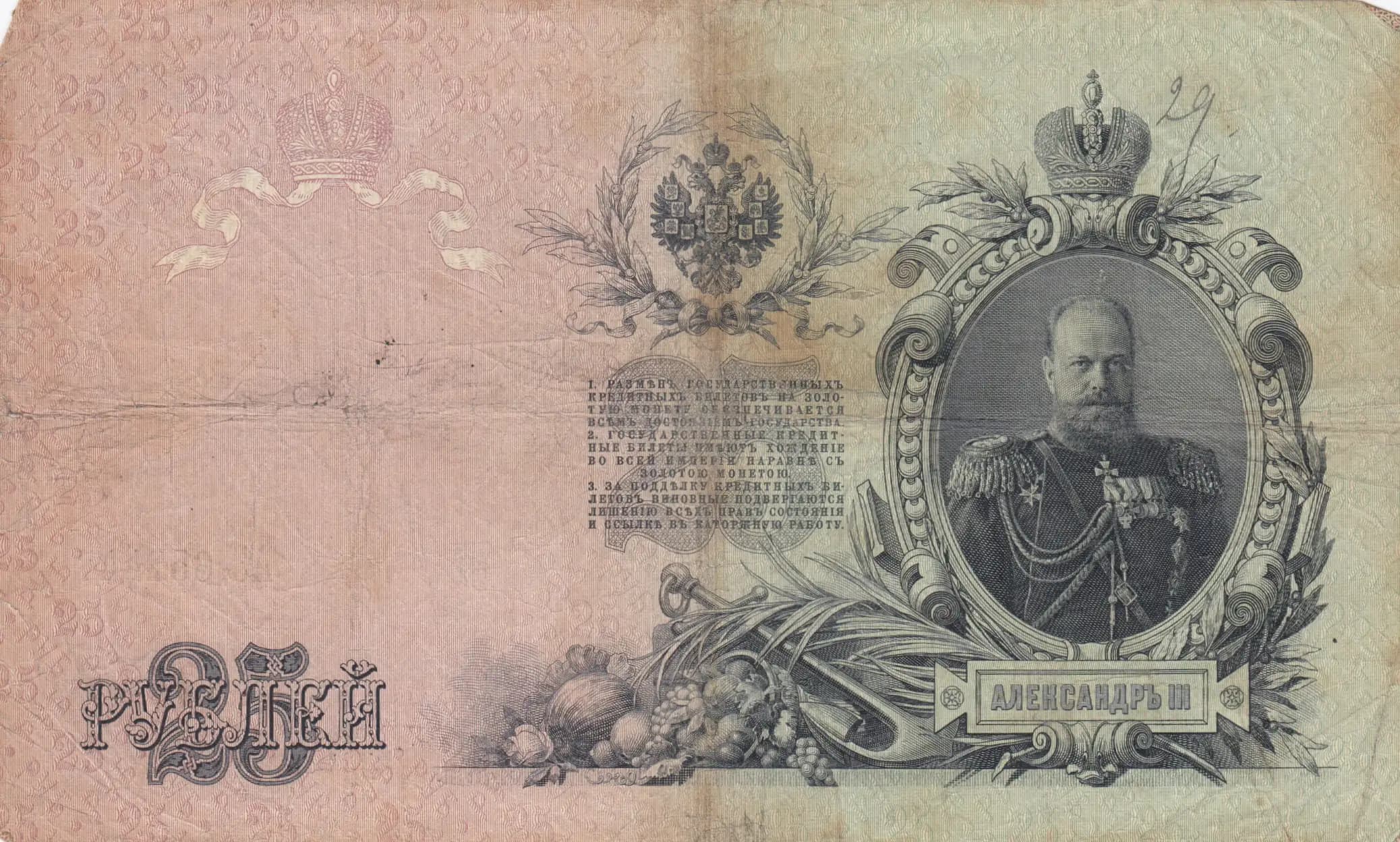
This is a Fine condition 25 Ruble State Credit Note from 1909, representing a significant piece of Imperial Russian monetary history. The note displays the characteristic rose-pink and green color scheme of this denomination, with the obverse featuring the imperial double-headed eagle beneath laurel wreaths and detailed filigree patterns, while the reverse presents an engraved portrait of Alexander III in military regalia within an ornate decorative frame. Despite visible aging with foxing, yellowing, and circulation wear, the note retains good legibility and the intricate security engraving remains well-preserved, making it a desirable example for collectors of Russian Imperial currency.
Common. The 1909 25 Ruble notes were issued in substantial quantities as standard circulation currency of the Russian Empire and represent one of the most frequently encountered denominations of Russian Imperial State Credit Notes in the numismatic market today. Millions of these notes were printed across various signature and serial number variants. While Fine condition examples show appropriate wear for circulated notes, the denomination and date are not scarce, and these notes regularly appear in collections and sales at modest valuations.
This 25 Ruble note was issued during the final years of Tsarist Russia under the gold standard, as evidenced by the inscription on the obverse guaranteeing exchange for gold coins at a fixed rate (1 ruble = 1/15 Imperial). The reverse portrait depicts Alexander III (1845-1894), the reformist Tsar whose reign preceded this note's 1909 issue, representing the continuity of imperial authority. These State Credit Notes (Государственный Кредитный Билет) were the principal circulating currency of the Russian Empire, backed by the State Bank and maintained under the stabilizing gold standard that would collapse following the Revolution of 1917.
The obverse (front) features a classical composition centered on the Russian Imperial coat of arms—the double-headed eagle—positioned prominently within laurel wreaths symbolizing imperial authority and stability. The denomination appears in two ornate circular cartouches (upper right and lower left), rendered in elaborate serif numerals. The background consists of intricate filigree and repeating decorative patterns in pink-rose and green inks, providing comprehensive anti-counterfeiting security through complexity. The reverse (back) displays an engraved portrait of Tsar Alexander III, depicted in formal military dress uniform with medals, decorations, and the imperial crown positioned above his head. The portrait is enclosed within an ornamental frame featuring scrollwork, laurels, and classical floral elements typical of 19th-century Russian Imperial currency design. Both sides incorporate multiple serial numbers and feature the characteristic fine-line engraving throughout that was standard for Russian State Credit Notes of this period.
OBVERSE: 'Государственный кредитный билет' (State Credit Note) | 'Двадцать пять рублей' (Twenty-Five Rubles) | '25' (denomination in numerals) | 'Государственный банк разменивает кредитные билеты на золотую монету без ограничения суммы (1 рубль = 1/15 империала; содержит 17,424 доли чистого золота)' (The State Bank exchanges credit notes for gold coins without limitation of amount [1 ruble = 1/15 Imperial; contains 17.424 parts pure gold]) | '1909' (year of issue) | 'АЭ 652447' (serial number). REVERSE: 'Рублей' (Rubles) | 'Александр III' (Alexander III) | Text regarding imperial authority and legal basis for note issuance under High Imperial Manifesto.
Intaglio engraving (line engraving), which was the primary method employed for Russian Imperial banknotes by the State Printing Works (Государственная типография). The detailed portraits, intricate background patterns, security filigree, and fine decorative borders were all executed through steel plate engraving, providing the three-dimensional raised ink effect visible in period impressions. The multi-color printing (pink, green, and black inks) was achieved through successive passes of engraved plates, a labor-intensive but highly secure method that was difficult to counterfeit with period technology.
Pick 12a(21) designation indicates this is a specific variety within the 25 Ruble 1909 series, classified by signature variant and serial number characteristics. The observed serial number AЭ 652447 and the 'Shagin' signature notation in collector notes suggest this represents a documented signature variety. Russian Imperial notes of this period were issued with multiple authorized signatures (typically a State Bank official and Finance Ministry representative), creating numerous recognized varieties within the same denomination and year. Further research would be required to definitively confirm all signature variants present on this particular specimen.