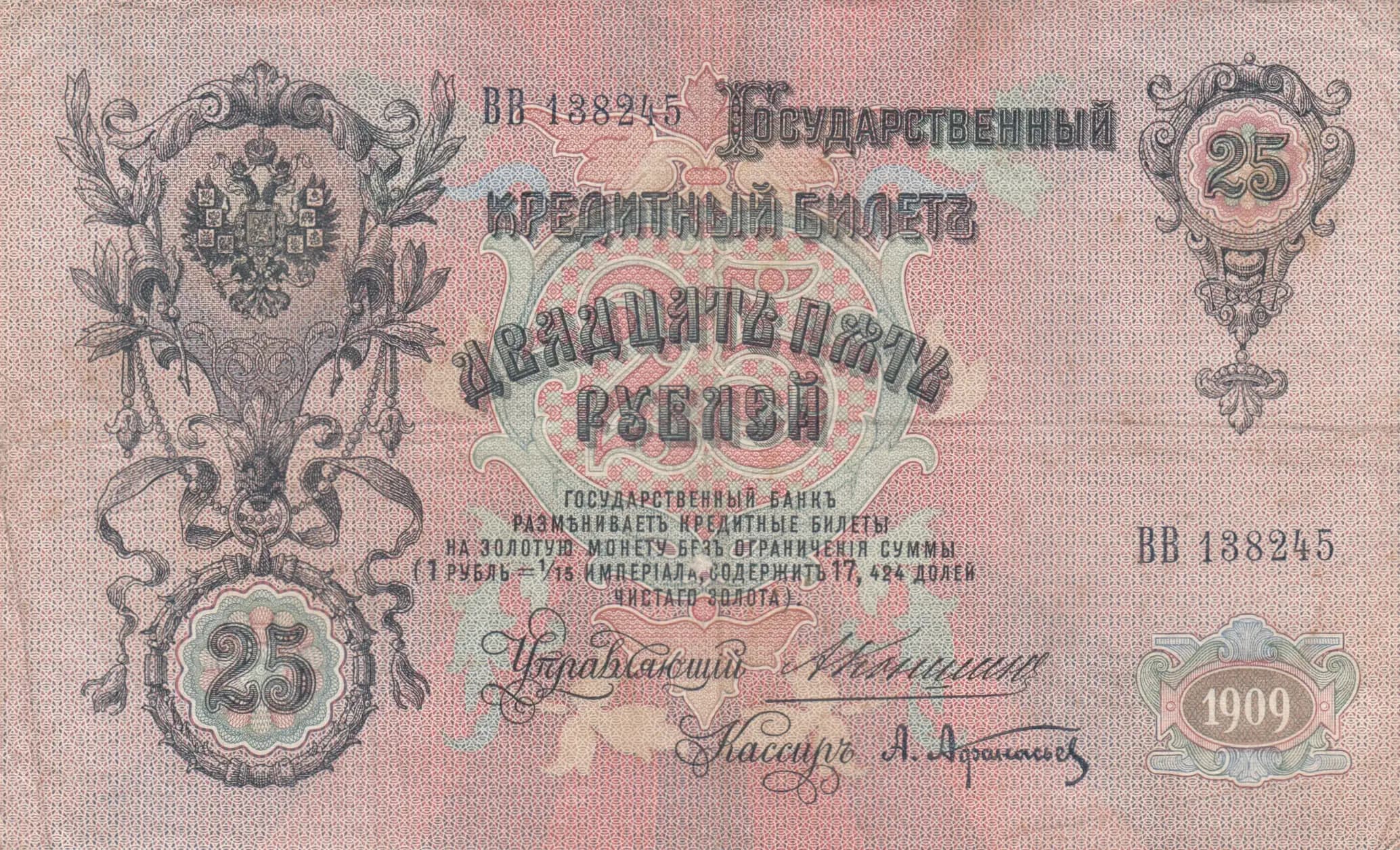
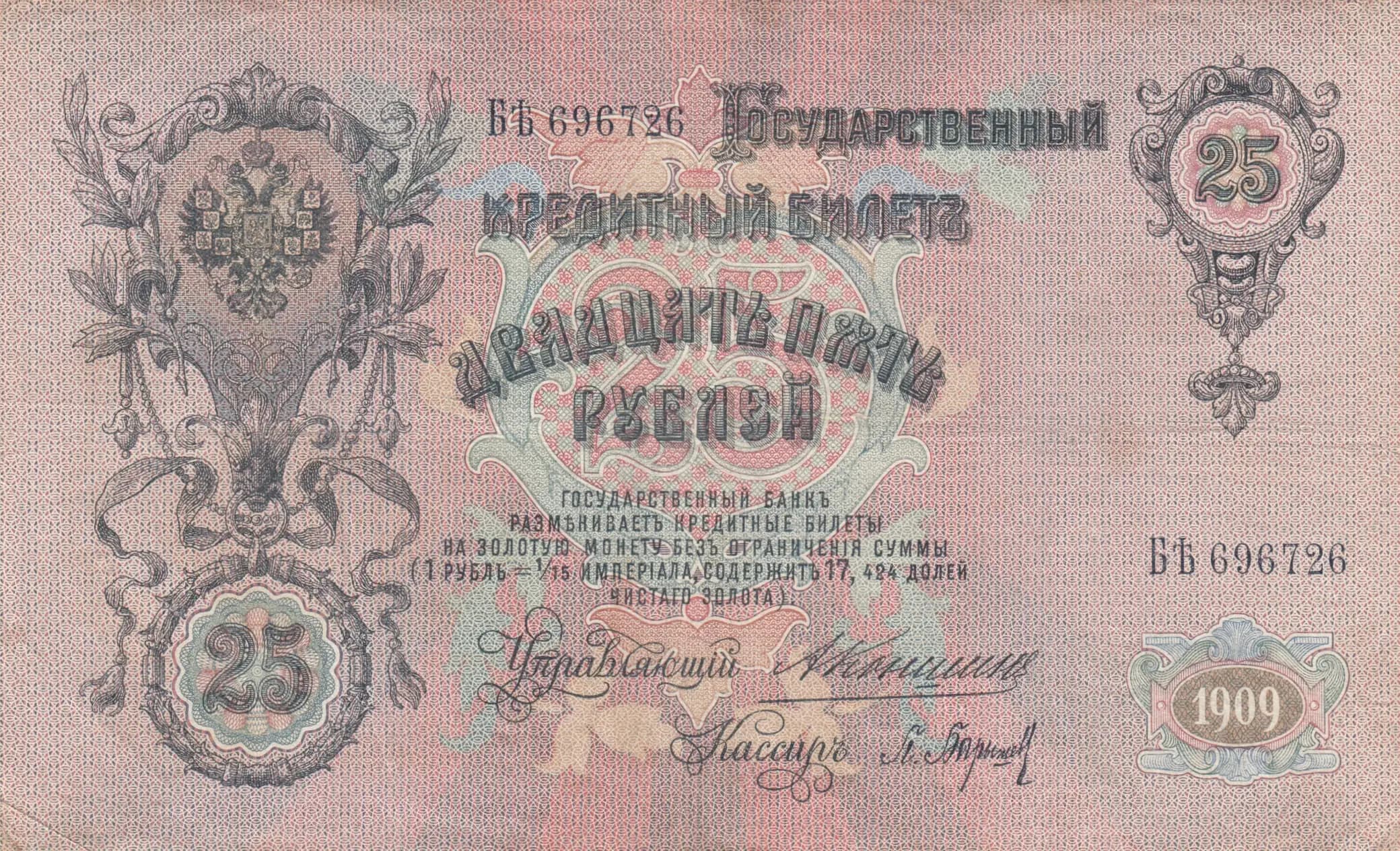
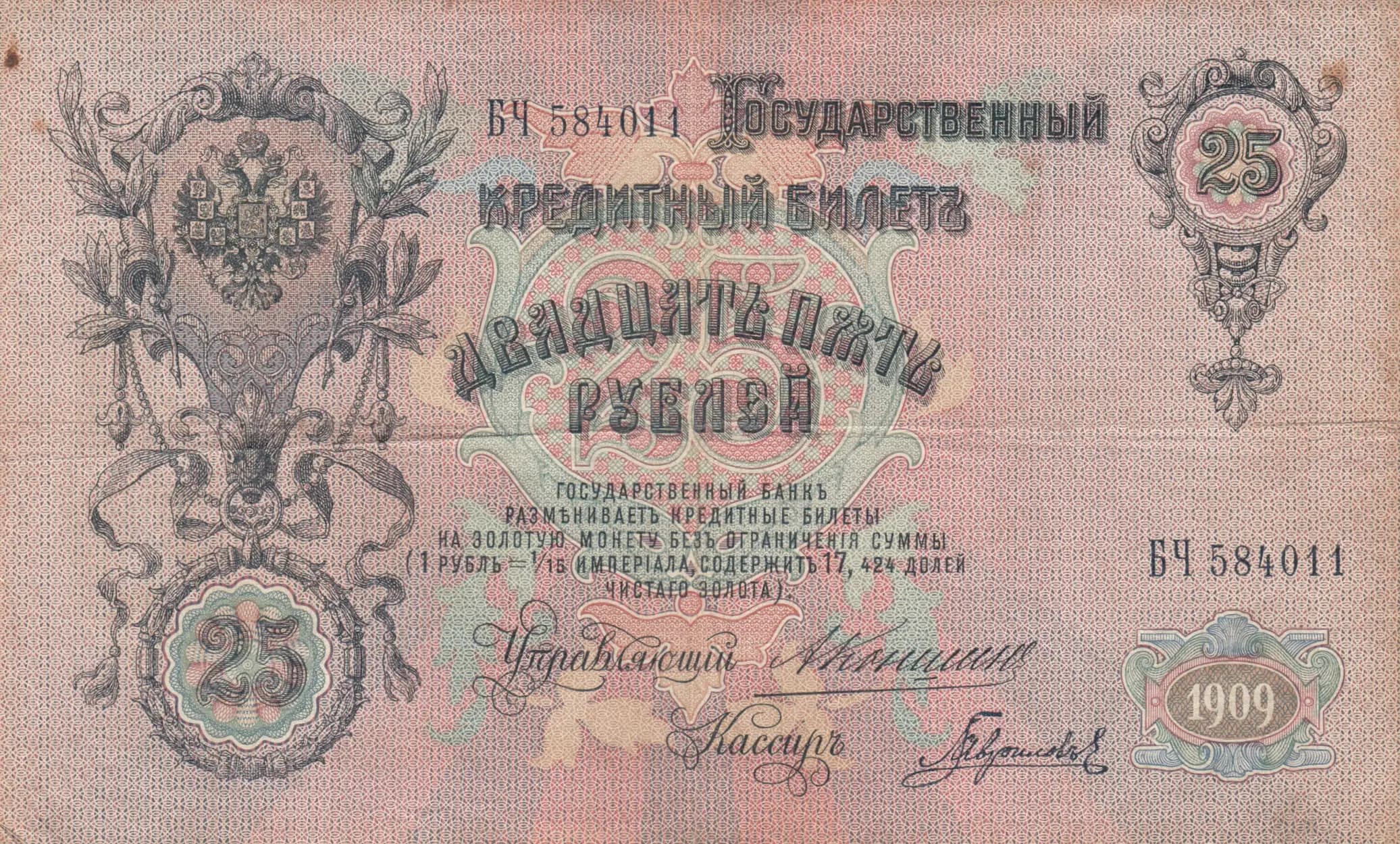
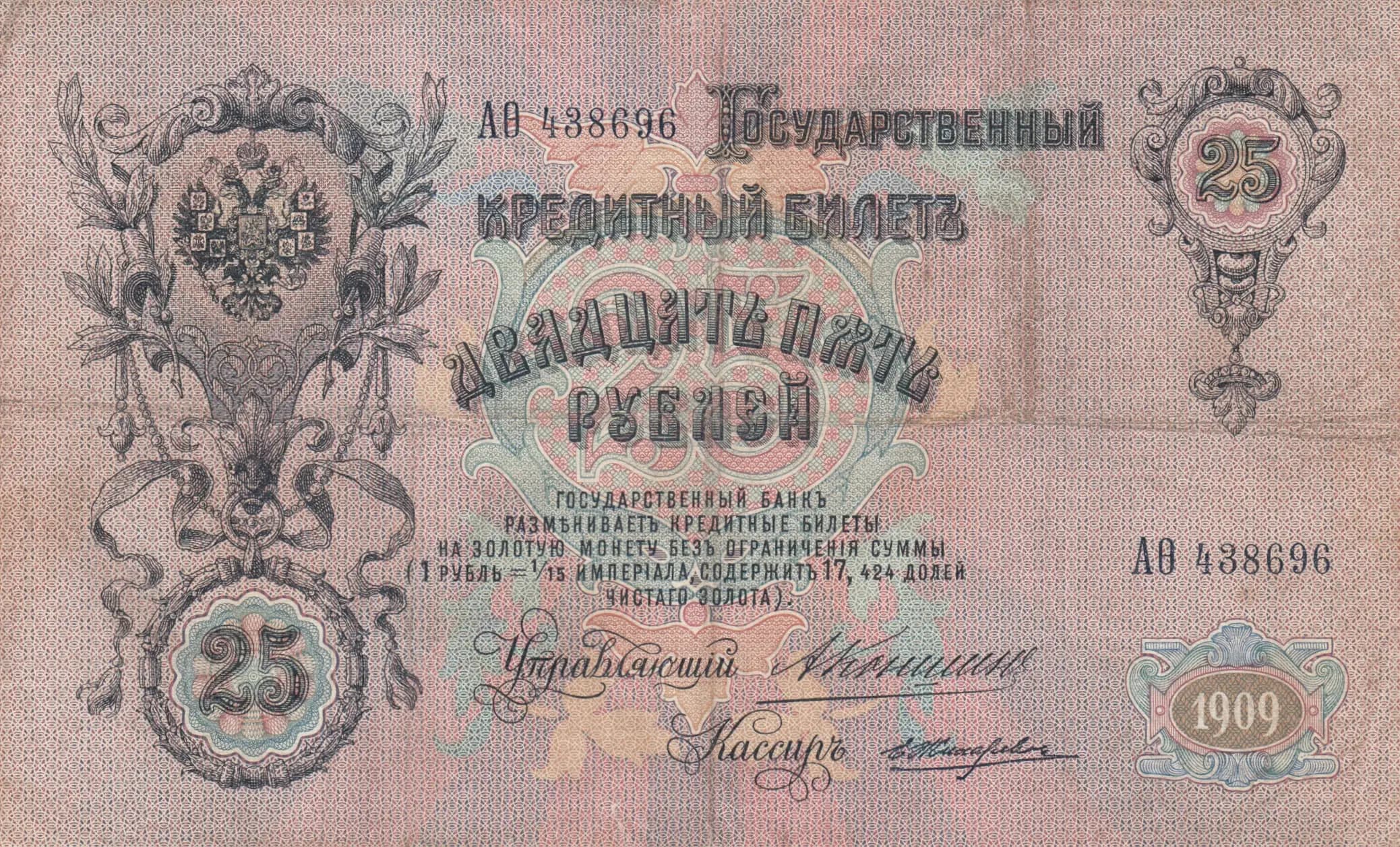
25 rublei 1909
“Sig.Burlakov”
About This Note
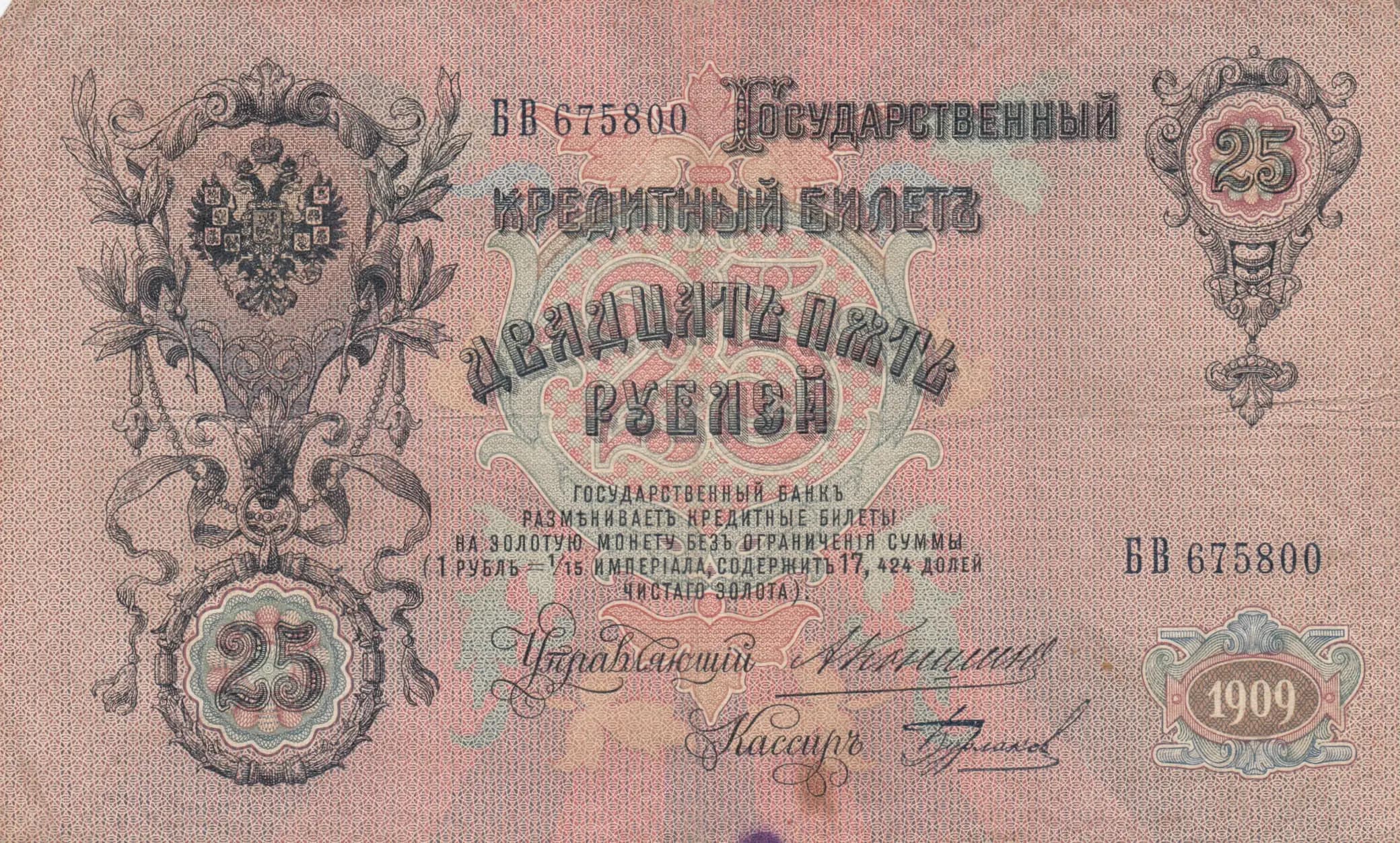
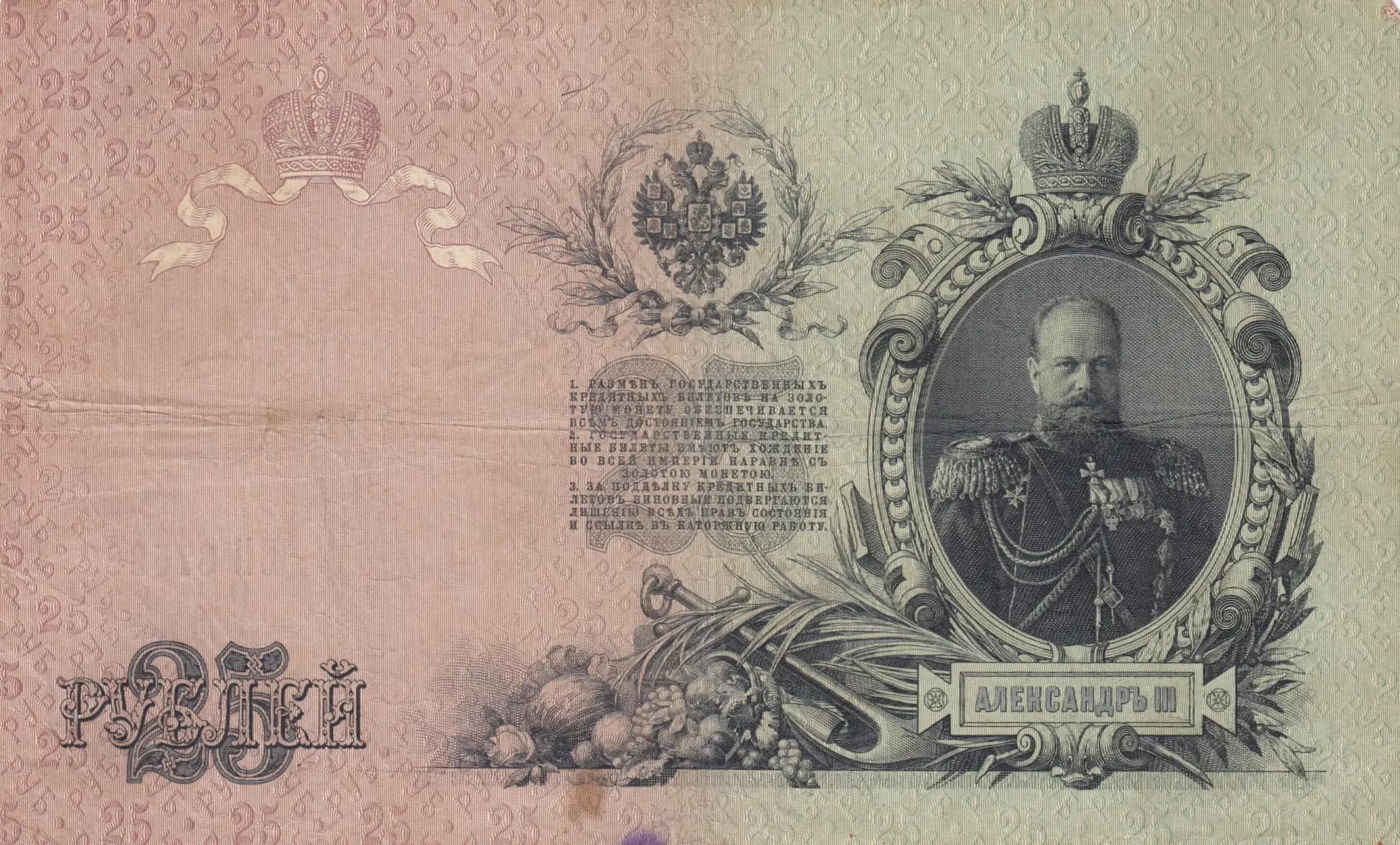
This is a VF-graded 25 ruble Imperial Russian banknote from 1909, featuring the classic design of the late Romanov era with a rose-pink front and greenish-cream reverse. The note displays the characteristic ornate security engraving of the period, including elaborate geometric patterns and the iconic double-headed eagle, along with a dignified portrait of Alexander III on the reverse. The observable foxing, creasing, and age-related patina are consistent with a note that has survived over 114 years, making it a notable example of Imperial Russian currency from the final years before the Revolution.
Common. The 25 ruble note of 1909 (Pick P-12a) was produced in substantial quantities as a standard denomination of Imperial Russian currency during the final stable decade of the Empire. While Russian Imperial notes from this period command collector interest due to their historical significance and artistic merit, the 25 ruble denomination itself was widely circulated and survives in considerable numbers today. The VF condition grade and serial number BB 675800 do not indicate any special rarity—this is a standard circulation-issue note. Examples of this type typically trade in the $15-40 range depending on condition, indicating robust collector availability rather than scarcity.
This 25 ruble note was issued during the reign of Nicholas II (1894-1917), though it features the portrait of his predecessor, Alexander III (1881-1894), reflecting the continuation of imperial imagery in Russian state credit notes. The note's inscriptions reference the gold standard backing of Russian currency, stating that 1 Ruble equals 1/15 Imperial and contains 17.424 parts pure gold—a declaration of the Romanov Empire's financial stability that would become obsolete within a decade due to World War I and the subsequent Russian Revolution. The 1909 date places this note squarely in the final prosperous decade of Imperial Russia before economic and political collapse.
This is a formal, architecturally-inspired design typical of Imperial Russian State Credit Notes. The front features a pale rose-pink background with intricate geometric security patterns and ornamental scrollwork throughout. The denomination '25' appears in two ornate circular frames positioned in the upper corners. The center contains text declaring the note's status as a 'Государственный Кредитный Билет' (State Credit Note) with the Imperial eagle and coat of arms prominently displayed in the upper left within an elaborate decorative surround. The reverse presents a formal three-quarter profile portrait of Alexander III in full military uniform with medals and decorations, positioned on the right side within an ornate circular frame topped by an Imperial crown. The left side features a large '25' denomination numeral and a block of small-print regulatory text. The pale greenish-cream background of the reverse contrasts with the portrait rendered in darker tones, creating clear visual separation and security through multi-color printing. The overall design exemplifies the high-security, artistically sophisticated standards of late Imperial Russian currency.
FRONT SIDE: Serial number 'ББ 675800' (BB 675800); 'ГОСУДАРСТВЕННЫЙ КРЕДИТНЫЙ БИЛЕТ' (State Credit Note); 'ДВАДЦАТЬ ПЯТЬ РУБЛЕЙ' (Twenty-five Rubles); 'ГОСУДАРСТВЕННЫЙ БАНК РАЗММЕНИВАЕТ КРЕДИТНЫЕ БИЛЕТЫ НА ЗОЛОТУЮ МОНЕТУ БЕЗ ОГРАНИЧЕНИЯ СУММЫ. 1 РУБЛЬ = 1/15 ИМПЕРИАЛА, СОДЕРЖИТ 17,424 ДОЛИ ЧИСТОГО ЗОЛОТА.' (The State Bank exchanges credit notes for gold coins without limit on amount. 1 Ruble = 1/15 Imperial, containing 17.424 parts pure gold); Year '1909'. BACK SIDE: 'РУБЛИ' (Rubles); Denomination '25'; 'АЛЕКСАНДР III' (Alexander III); [Block of regulatory/legal text regarding the state credit note - specific content not fully legible in visual analysis].
This note was produced using intaglio (engraved steel plate) printing, the standard security printing technique for Imperial Russian State Credit Notes. The fine detail visible in the portrait of Alexander III, the intricate geometric patterns and scrollwork, the ornamental frames, and the small-print regulatory text all demonstrate the precision achievable through deep-bite intaglio engraving. The Russian State Printing Works (Государственная Типография) and the note printing facilities under the supervision of the State Bank produced these notes. The multi-color printing technique—with distinct rose-pink on the front and greenish-cream on the reverse—required separate color passes in the intaglio process.
This note is cataloged as Pick P-12a(4), with the '(4)' designation indicating a specific variety within the P-12a type. Varieties of Russian Imperial notes of this era are typically distinguished by signature combinations of the Finance Minister and State Bank officials, series letter prefixes in serial numbers, and minor design variations. The serial number ББ (Cyrillic BB) prefix suggests a later issue within the series. The signature notation in the collector notes ('Sig. Burlakov') likely refers to one of the responsible officials whose signature appears on the reverse (in the legal text block). Without access to specialized Russian Imperial banknote catalogs detailing all signature combinations and series variants for 1909 25 ruble notes, the specific distinguishing characteristics of the (4) variety cannot be definitively identified from the visual analysis alone, but this designation indicates it is a cataloged and recognized sub-variety rather than a standard issue.