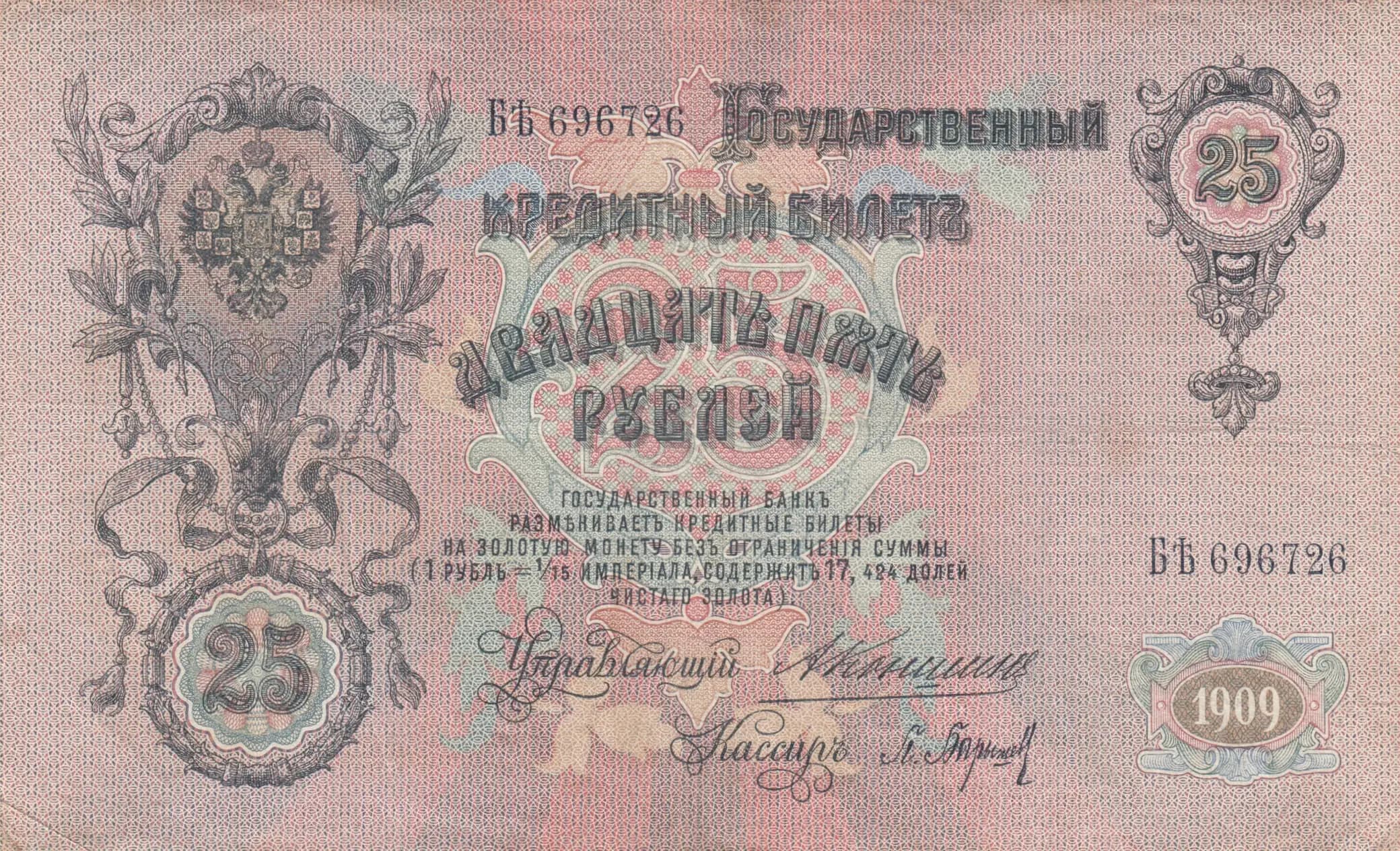
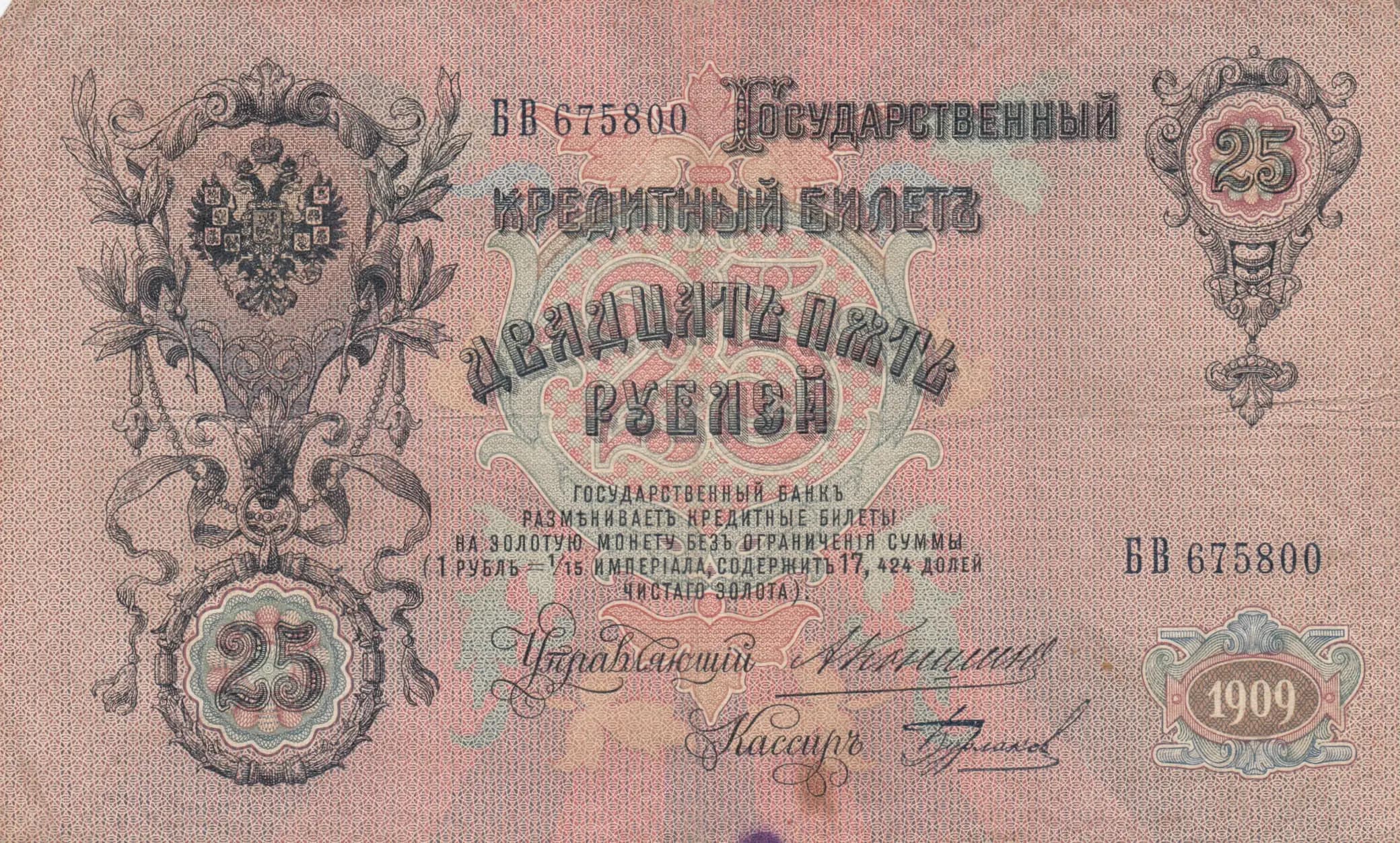
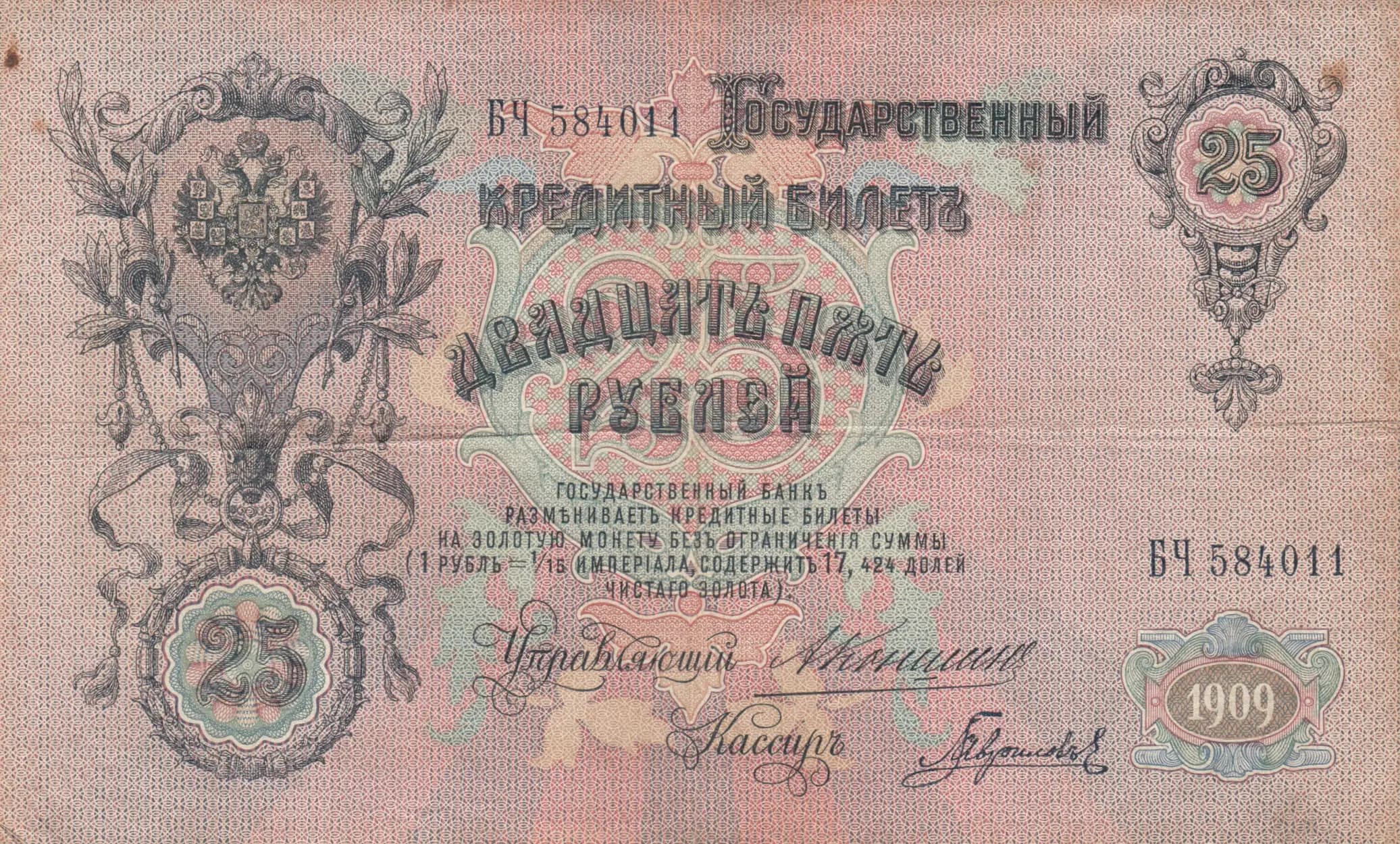
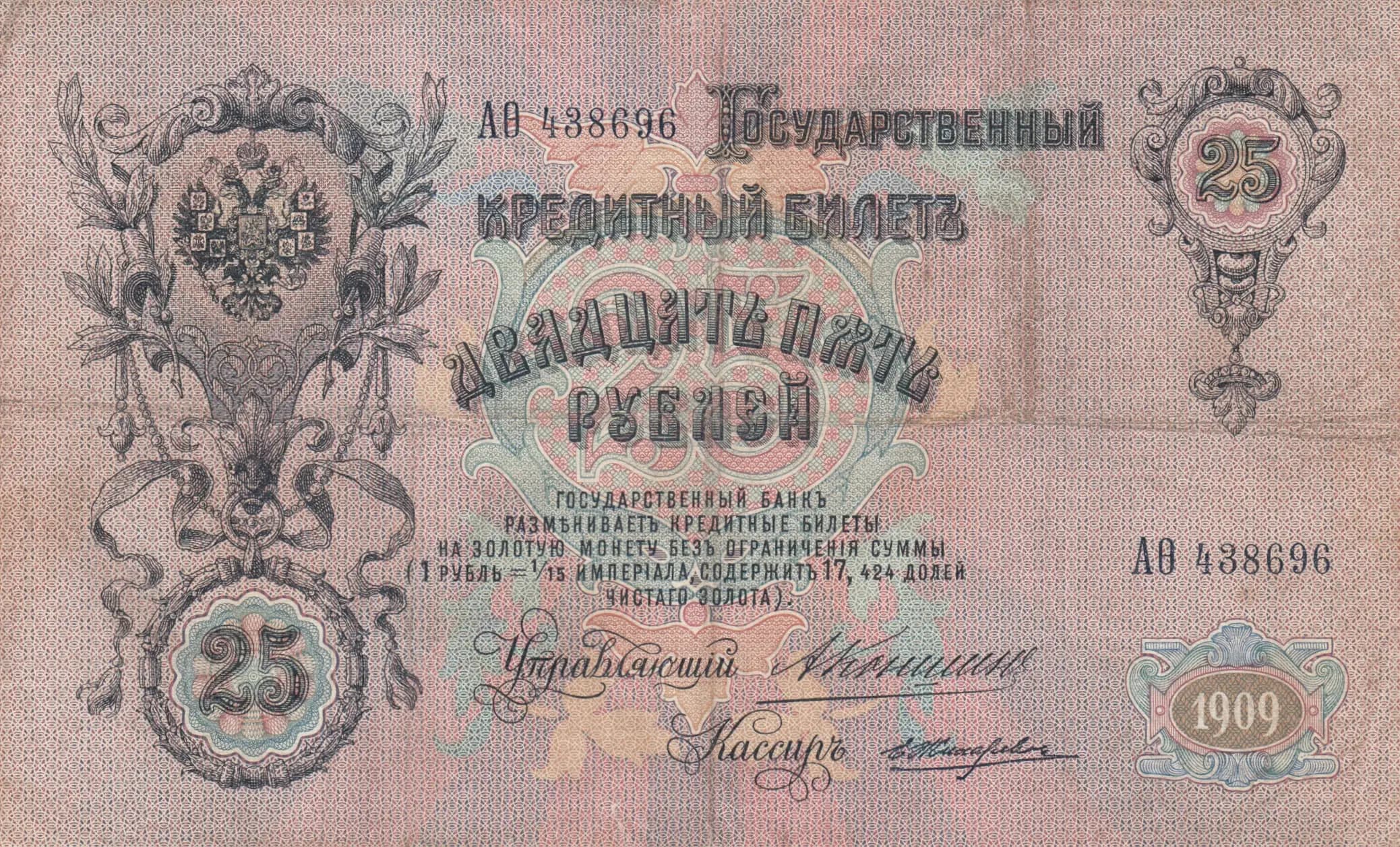
25 rublei 1909
“Sig.Afanasev”
About This Note
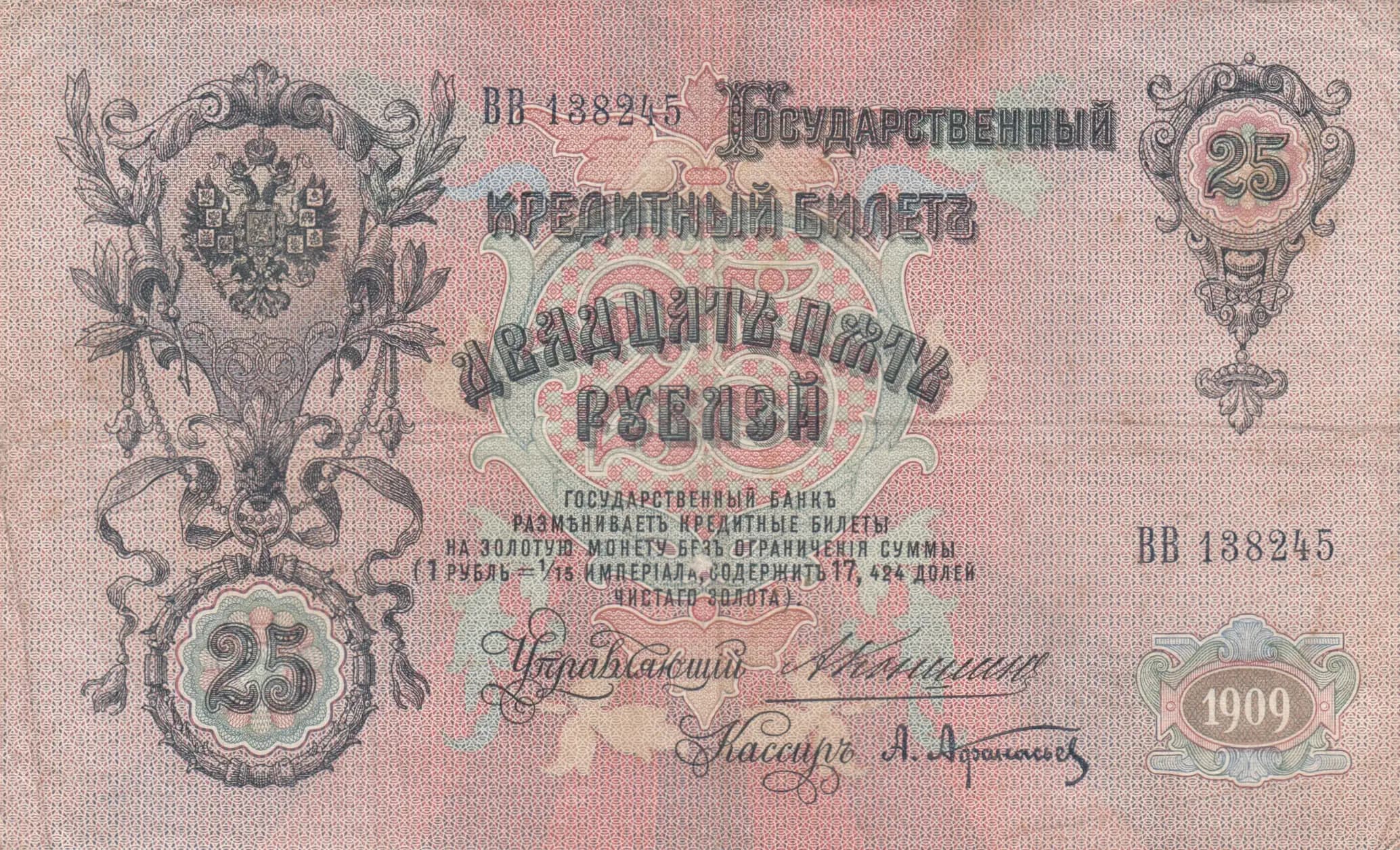
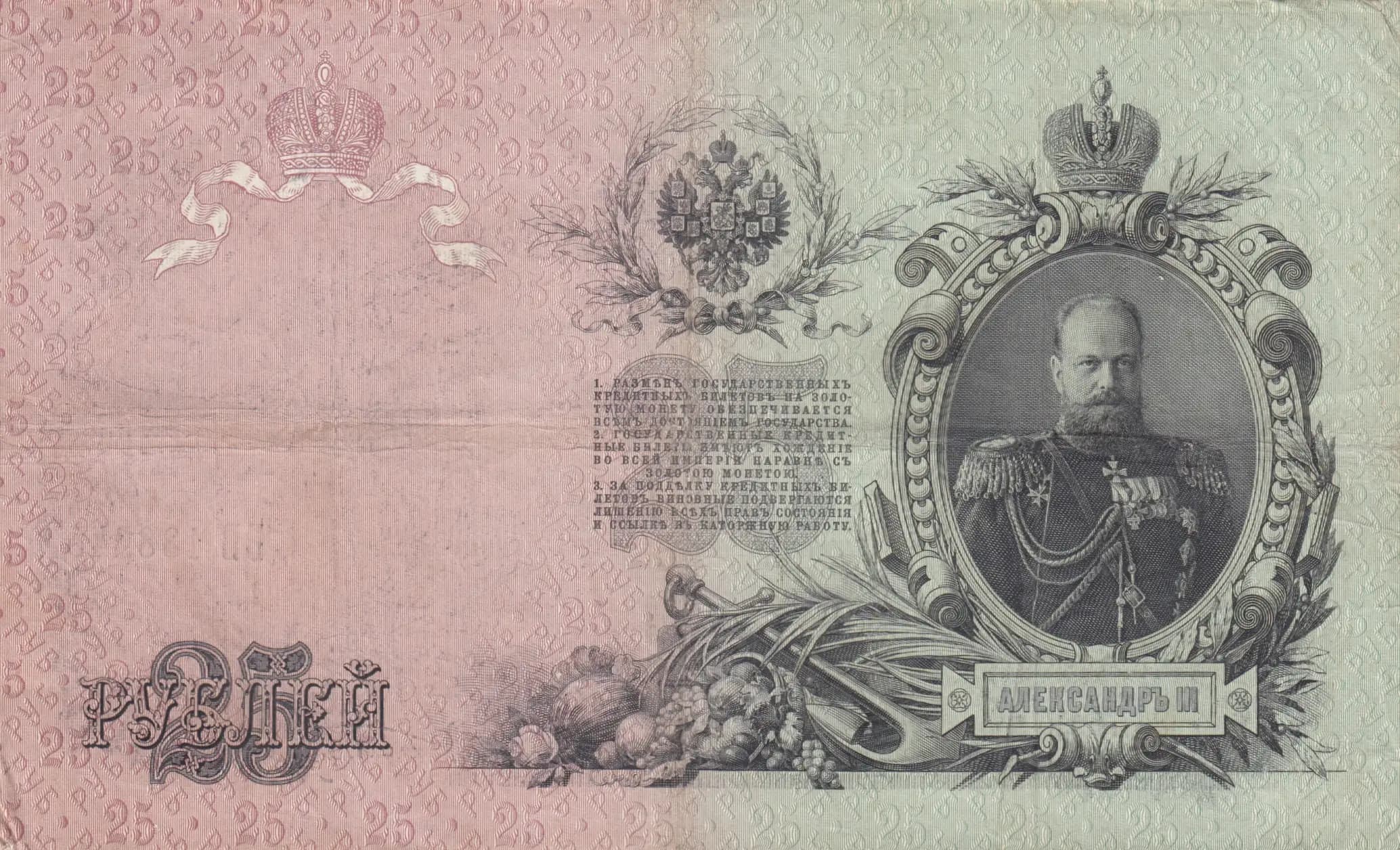
This is an exceptional example of the 1909 Russian Imperial 25 Ruble banknote (Pick P-12a(1)), graded VF, featuring the distinctive pink and green color scheme characteristic of this denomination. The note displays sharp, clear printing throughout with no visible wear, creases, or stains, suggesting either uncirculated or extremely lightly circulated condition. The elaborate baroque ornamental design, double-headed imperial eagle, and portrait of Alexander II make this a desirable example of Imperial Russian currency from the final years before the 1917 Revolution.
Common. The 1909 25 Ruble note is a standard issue from the late Imperial period with substantial surviving examples in circulation. No specific factors suggest a restricted print run or early recall. The Pick catalog designation P-12a(1) indicates this is a cataloged standard variety rather than a scarce sub-variety. While condition examples above VF command modest premiums, the note itself remains commonly available to collectors at reasonable prices, typically in the $20-60 range depending on condition.
This banknote was issued during the reign of Nicholas II (though featuring Alexander II's portrait, likely commemorative or from an earlier series continuation), representing the State Bank's gold-backed currency system of the Russian Empire. The inscriptions referencing the gold standard (1 ruble = 1/15 imperial, containing 17.424 parts pure gold) reflect Russia's commitment to the gold standard in the early 20th century, a policy that would collapse during World War I and the subsequent revolution. The ornate baroque design and imperial eagle symbolism underscore the authority and legitimacy the Russian state sought to project through its currency.
The obverse features an ornate baroque-style design dominated by large circular medallions containing the numeral '25' positioned on the left and right sides, with elaborate decorative scrollwork and floral borders throughout. The double-headed imperial eagle with crown appears prominently, symbolizing the authority of the Russian Empire. A fine crosshatch pattern in pink tones provides the background security feature. The reverse displays a formal portrait of Alexander II (1818-1881, often called the 'Tsar Liberator') depicted in full military dress uniform with decorations, epaulettes, and military insignia, positioned within an ornate oval frame crowned by the imperial crown. The portrait is surrounded by elaborate baroque acanthus leaf motifs and decorative scrollwork. The overall color scheme of pink, green, gray, and beige creates a sophisticated and distinctly Imperial Russian aesthetic. The note is denominated at 25 Rubles and clearly marked as a State Credit Note (Государственный Кредитный Билет) issued by the State Bank.
FRONT SIDE: Serial Number: ББ 188245 (BB 188245) | Государственный Кредитный Билет (State Credit Note/Banknote) | Двадцать Пять Рублей (Twenty-Five Rubles) | Государственный Банк (State Bank) | Размениваемь Кредитные Билеты На Золотую Монету Брак Ограничения Суммы (Exchangeable Credit Notes for Gold Coin with Restrictions on Sum) | 1 Рубль = 1/15 (Империала, Содержать 17, 424 Долей Чистого Золота) (1 Ruble = 1/15 Imperial, Containing 17.424 Parts Pure Gold) | Date: 1909 | BACK SIDE: Александръ (Alexander) | 25 Рублей (25 Rubles) | [Additional regulatory text in ornate frame regarding banknote specifications and legal disclaimers]
Intaglio engraving (copperplate/steel plate engraving), the standard security printing method for Russian Imperial banknotes of this period. The fine crosshatch background pattern, intricate baroque ornamental details, sharp portrait engraving, and complex decorative borders are all characteristic of high-quality intaglio work. The Russian State Bank employed master engravers for this series. Security printers for Imperial Russian notes of this era included the State Printing Works in St. Petersburg (the primary facility for Imperial currency production).
Pick P-12a(1) designation indicates this is the first recognized variety of the 1909 25 Ruble issue. The signature 'Afanasev' noted in the collector notes refers to one of the authorized signatories on the note; variations in signatures and serial number prefixes (ББ in this case) exist across printings of this denomination. Serial number BB 188245 places this note within a specific printing block. The color variety (pink and green dominant tones) is standard for this Pick number; variations in shade saturation may occur depending on paper age and printing conditions, but this represents the canonical design for P-12a(1).