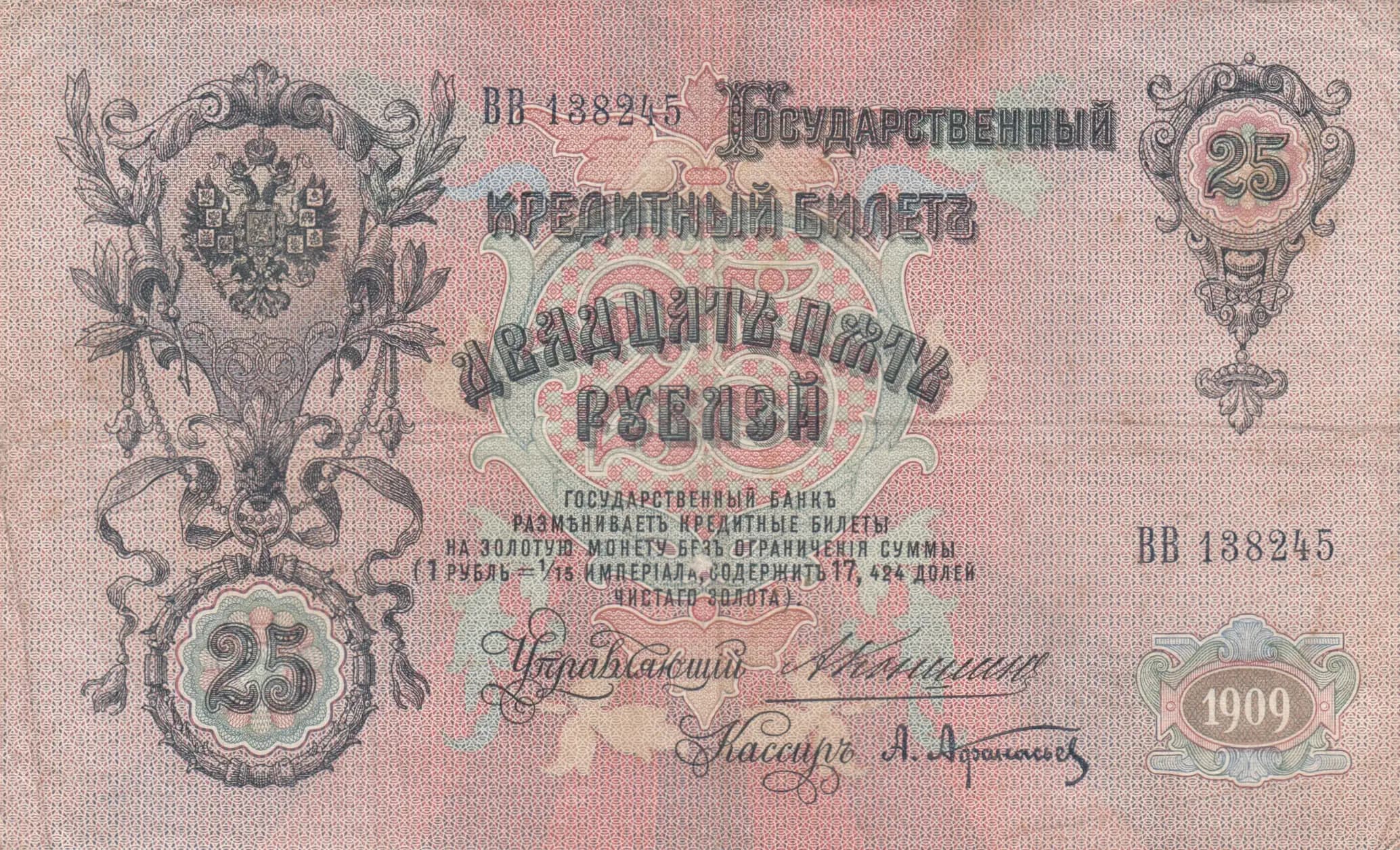
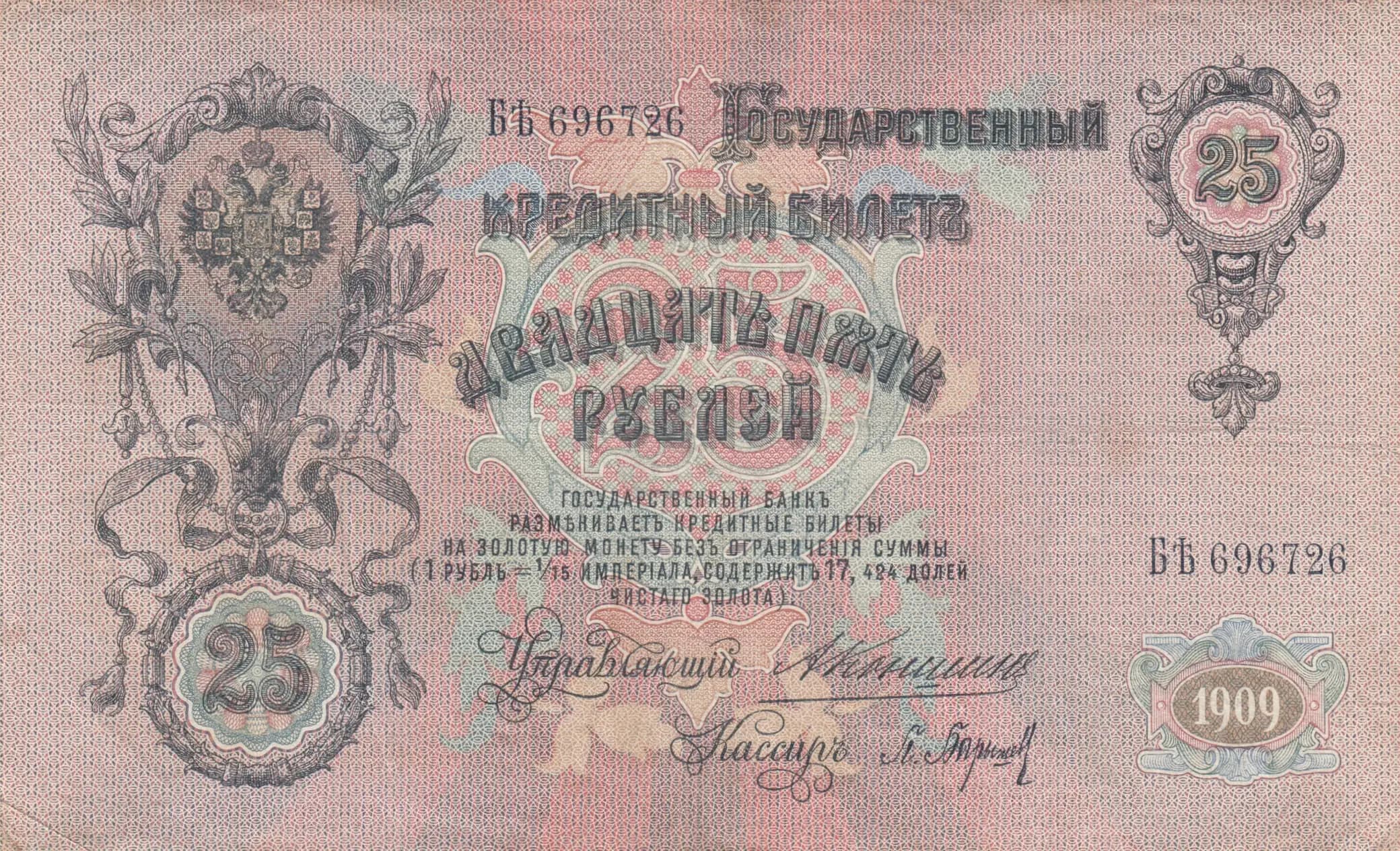
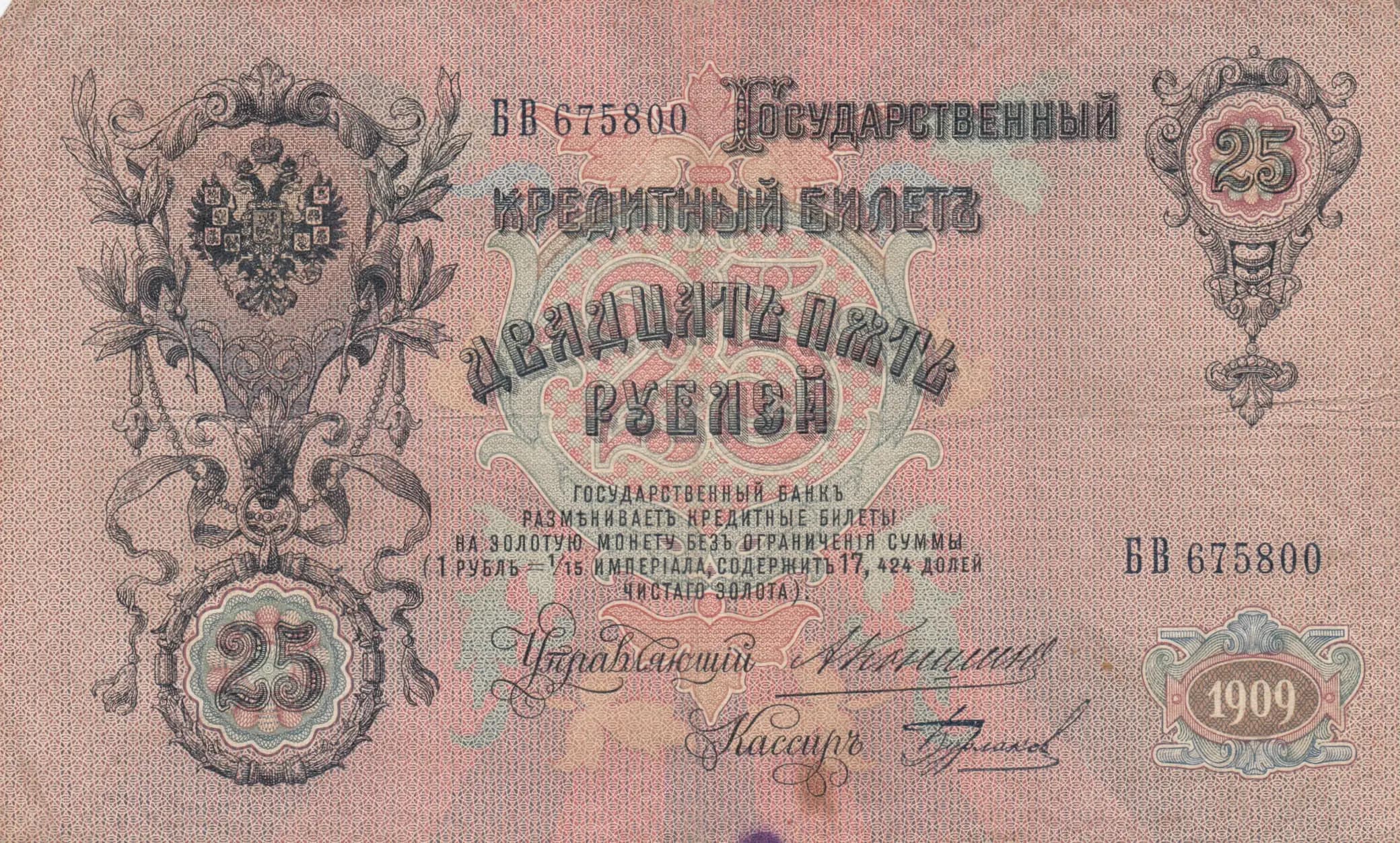
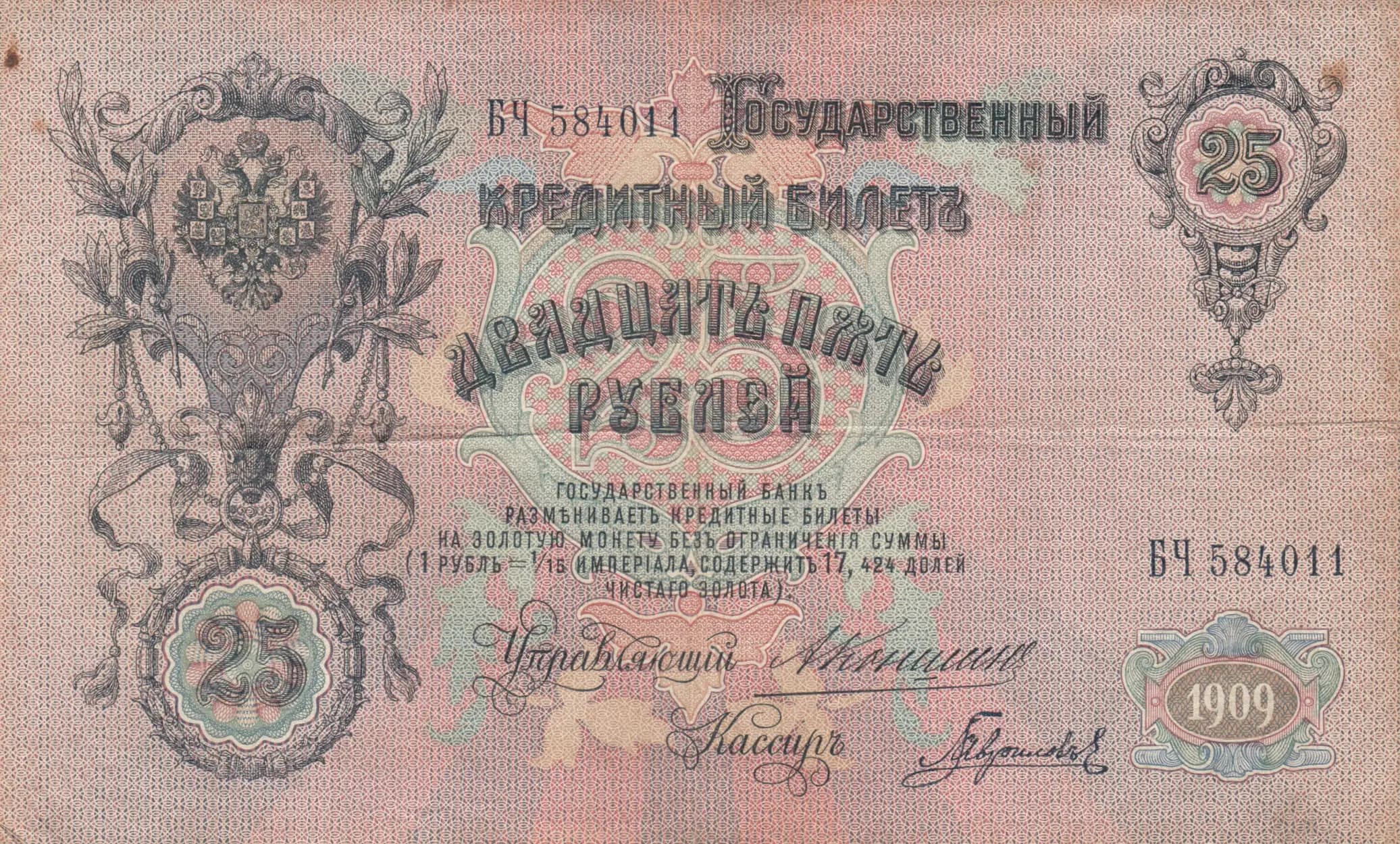
25 rublei 1909
“Sig.Sofronov”
About This Note
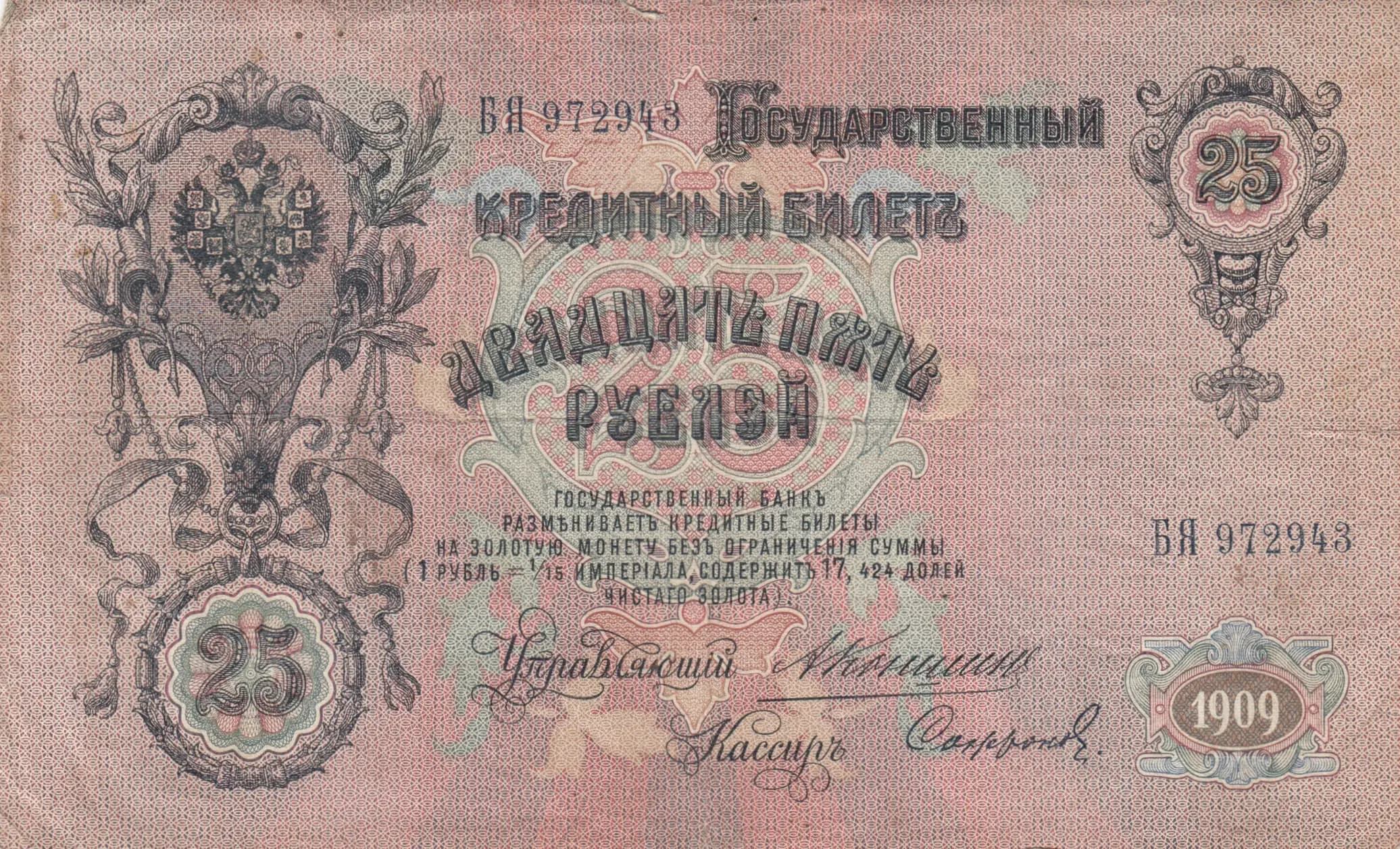
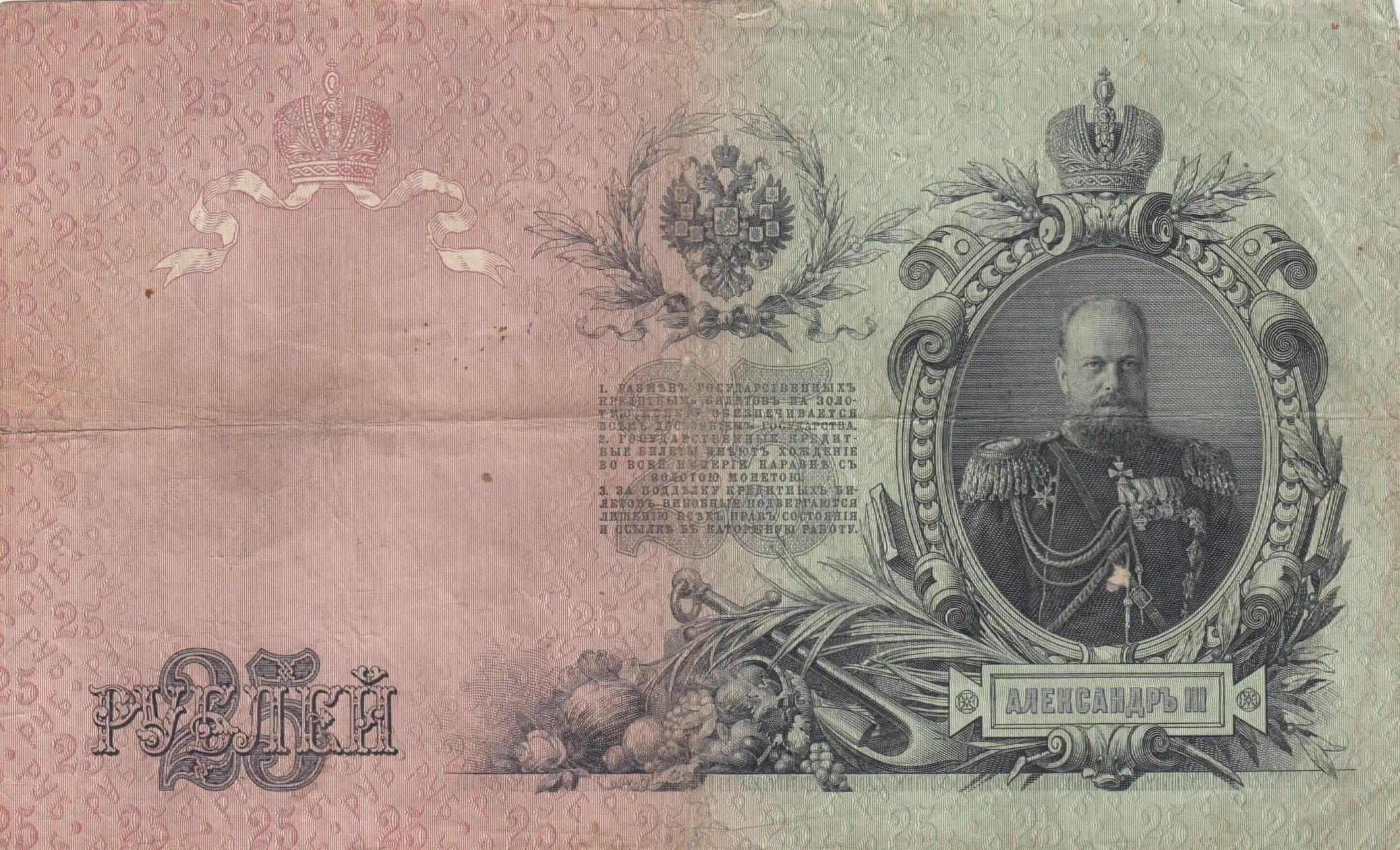
An attractive example of the Russian Imperial 25 Rublei from 1909, issued during the reign of Nicholas II as a State Credit Note backed by gold. The note displays the characteristic ornate design of this period with a prominent double-headed eagle coat of arms on the obverse and a striking portrait of Emperor Alexander III in military dress on the reverse. The piece shows moderate circulation wear consistent with its F (Fine) grade, with visible patina and age-related discoloration, yet retains excellent legibility and the fine detail of its complex engraving.
Common. The 1909 25 Rublei (Pick 12a) was issued in substantial quantities during the final decade of the Russian Empire and represents a standard denomination from the mature gold-standard period. While the Russian Revolution of 1917 eventually rendered these notes obsolete, enough examples survive in various collections and the numismatic market to classify this note as common in most grades. The Fine condition grade observed here is typical for circulated examples that remain available to collectors. No indication of restricted print runs, short-term issue, or unusual scarcity applies to this Pick number.
This note was issued during the final years of the Russian Empire under the gold standard system established by Finance Minister Sergei Witte. The obverse prominently features the Imperial coat of arms and explicitly declares the note's backing: 'The State Bank issues credit notes backed by gold coin without limit of sum (1 ruble = 1/15 of an Imperial contains 17.424 parts pure gold).' The reverse honors the late Emperor Alexander III (r. 1881-1894), whose authoritarian policies shaped the Empire's financial stability, reflecting the regime's emphasis on continuity and imperial authority even after his death.
The obverse features a symmetrical composition centered on the Imperial Russian coat of arms—a double-headed eagle bearing a shield on its chest, topped by an Imperial crown and surrounded by elaborate floral and foliate ornamentation including laurel wreaths and scrollwork. The denomination '25' appears in an ornate circular medallion on the right side, with the full text 'ДВАДЦАТЬ ПЯТЬ РУБЛЕЙ' (Twenty-five Rubles) and official designation 'ГОСУДАРСТВЕННЫЙ КРЕДИТНЫЙ БИЛЕТ' (State Credit Note) prominently displayed in decorative frames. The note's gold-backing declaration is printed in the center. The reverse presents a formal portrait of Emperor Alexander III in full military dress uniform featuring elaborate epaulettes and imperial decorations, enclosed within an ornate rectangular frame with scrollwork and corner flourishes, surmounted by an Imperial crown. His name appears on a banner beneath the portrait. The color scheme of pink/rose with green accents provides visual distinction between sections while maintaining the formal imperial aesthetic typical of late-19th-century European state currency.
OBVERSE: 'ЕА 972943' (Serial number EA 972943); 'ГОСУДАРСТВЕННЫЙ КРЕДИТНЫЙ БИЛЕТ' (State Credit Note); 'ДВАДЦАТЬ ПЯТЬ РУБЛЕЙ' (Twenty-five Rubles); '25' (denomination); 'ГОСУДАРСТВЕННЫЙ БАНК РАЗМЕЩАЕТ КРЕДИТНЫЕ БИЛЕТЫ НА ЗОЛОТУЮ МОНЕТУ БЕЗ ОГРАНИЧЕНИЯ СУММЫ (1 рубль = 1/15 ИМПЕРИАЛА СОДЕРЖИТ 17,424 ДОЛЕЙ ЧИСТОГО ЗОЛОТА)' (The State Bank issues credit notes backed by gold coin without limit of sum [1 ruble = 1/15 of an Imperial contains 17.424 parts pure gold]); 'Правляющий Министр' (Governing Minister); 'Кассир' (Cashier); '1909' (year). REVERSE: 'АЛЕКСАНДР III' (Alexander III - name banner); 'РУБЛЯ' (Ruble); additional legal text regarding the credit note's status and terms (partially visible in fine print).
Intaglio engraving (steel plate engraving), the standard security printing technique for Russian Imperial banknotes of this period. The visual analysis reveals the characteristic fine-line work, complex ornamental detail, and multiple layers of decorative security printing typical of intaglio production. The State Bank of Russia (Государственный Банк России) employed the finest engravers of the era for these notes. The detailed parallel line patterns in backgrounds and the precise execution of the coat of arms and portrait engraving are hallmarks of high-quality intaglio work. This printing method was intentionally complex to deter counterfeiting.
The observed serial number 'ЕА 972943' indicates variety P-12a(17), as cataloged. Signatures of the Governing Minister and Cashier are present but not clearly identified in the visual analysis—these signature combinations are known to vary across the 1909 printing and can indicate specific variety designations within the Pick 12a classification. The note bears signature notation for 'Sofronov' per the collector notes, which may refer to one of the authorized signatories. Further research into the specific signature combination and letter prefix of the serial number would confirm the precise sub-variety within Pick 12a.