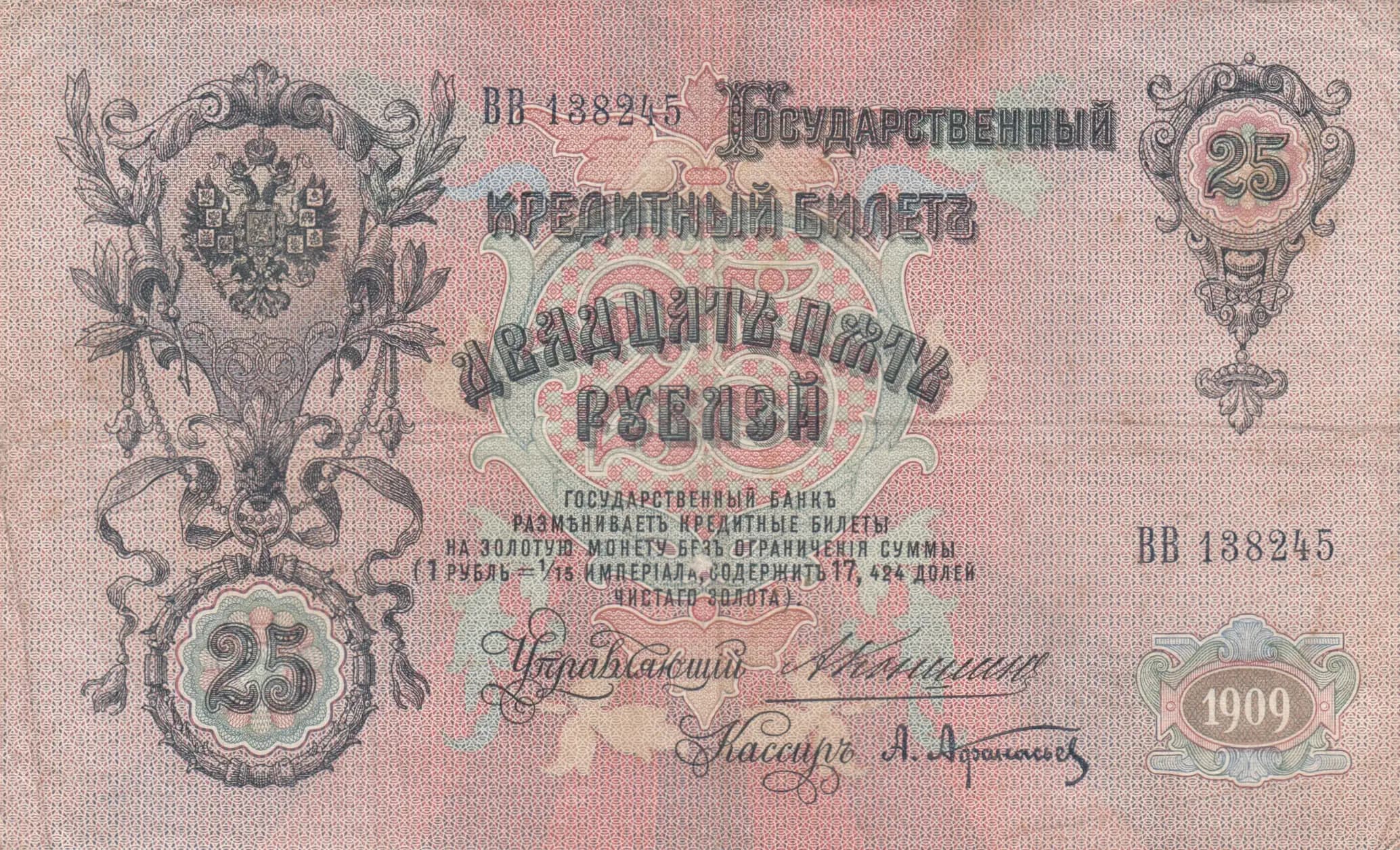
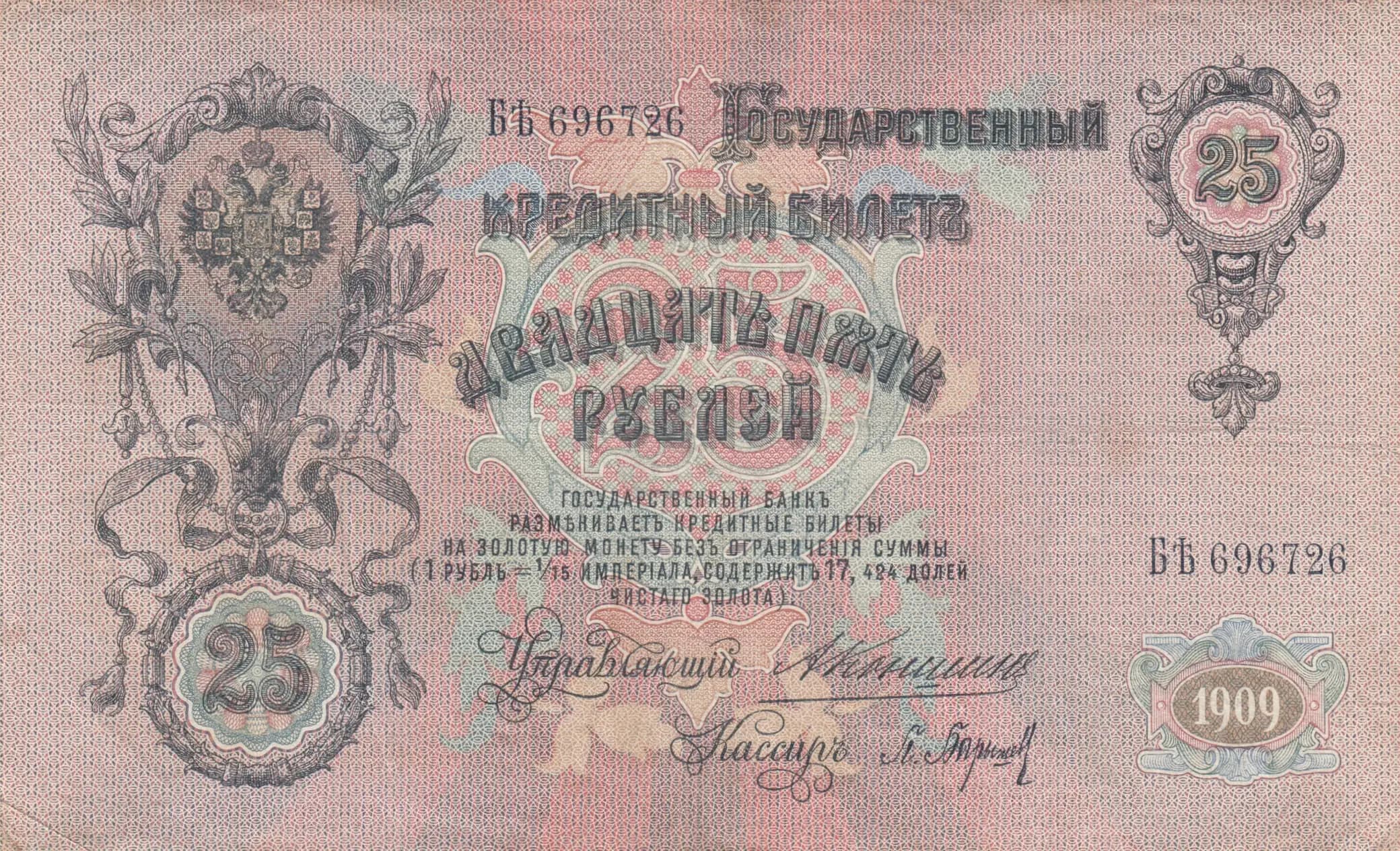
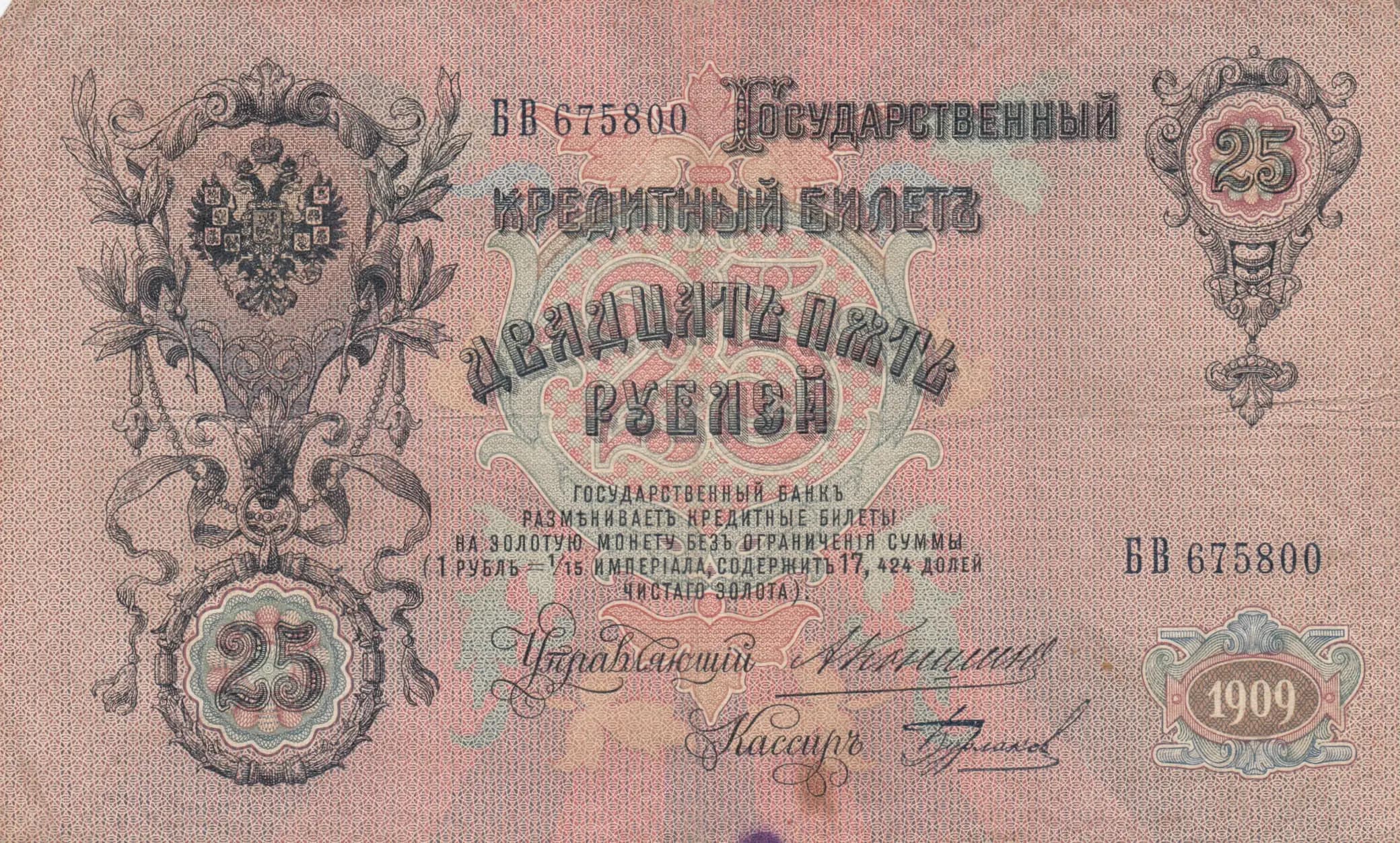
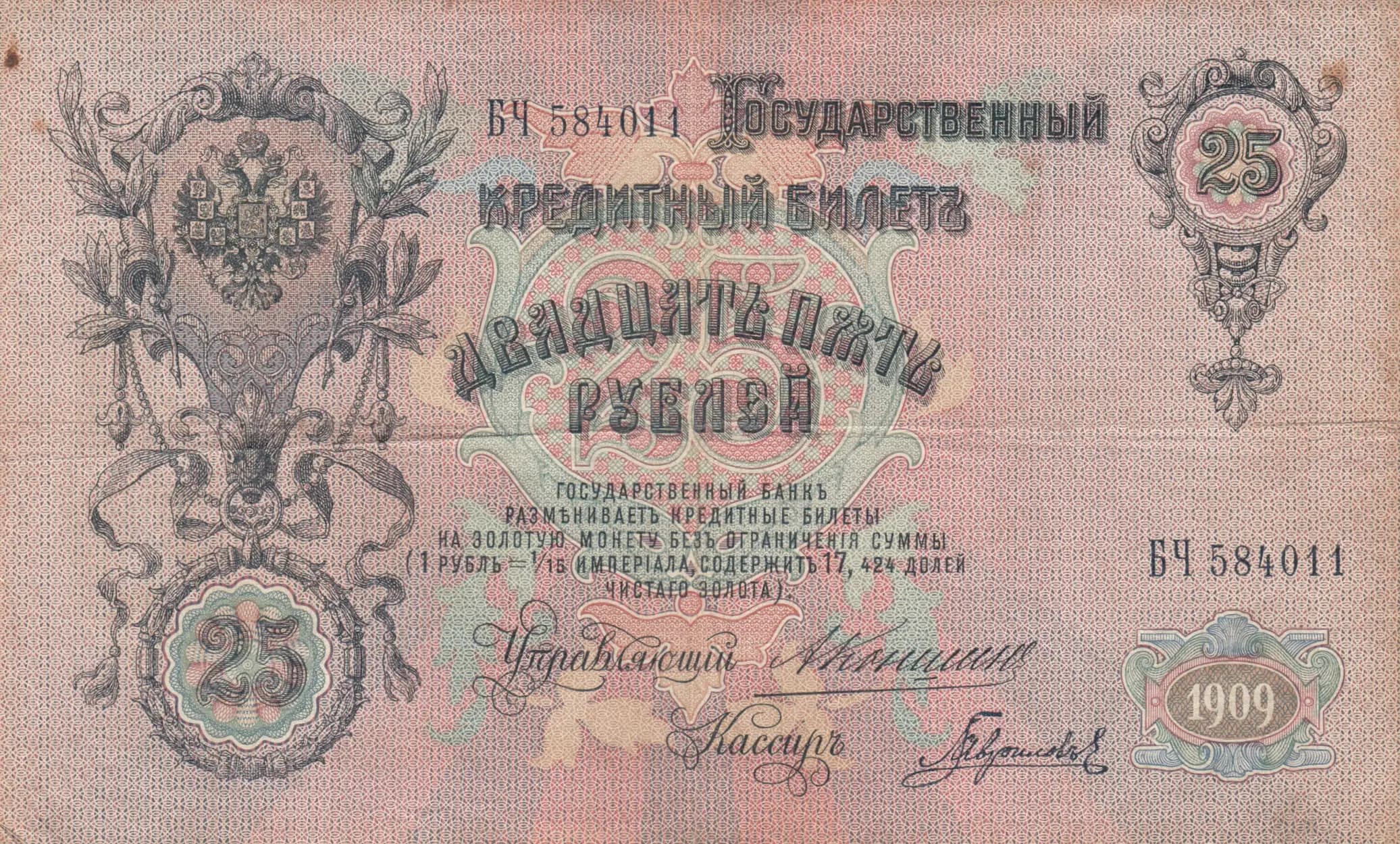
25 rublei 1909
“Sig.Rodionov”
About This Note
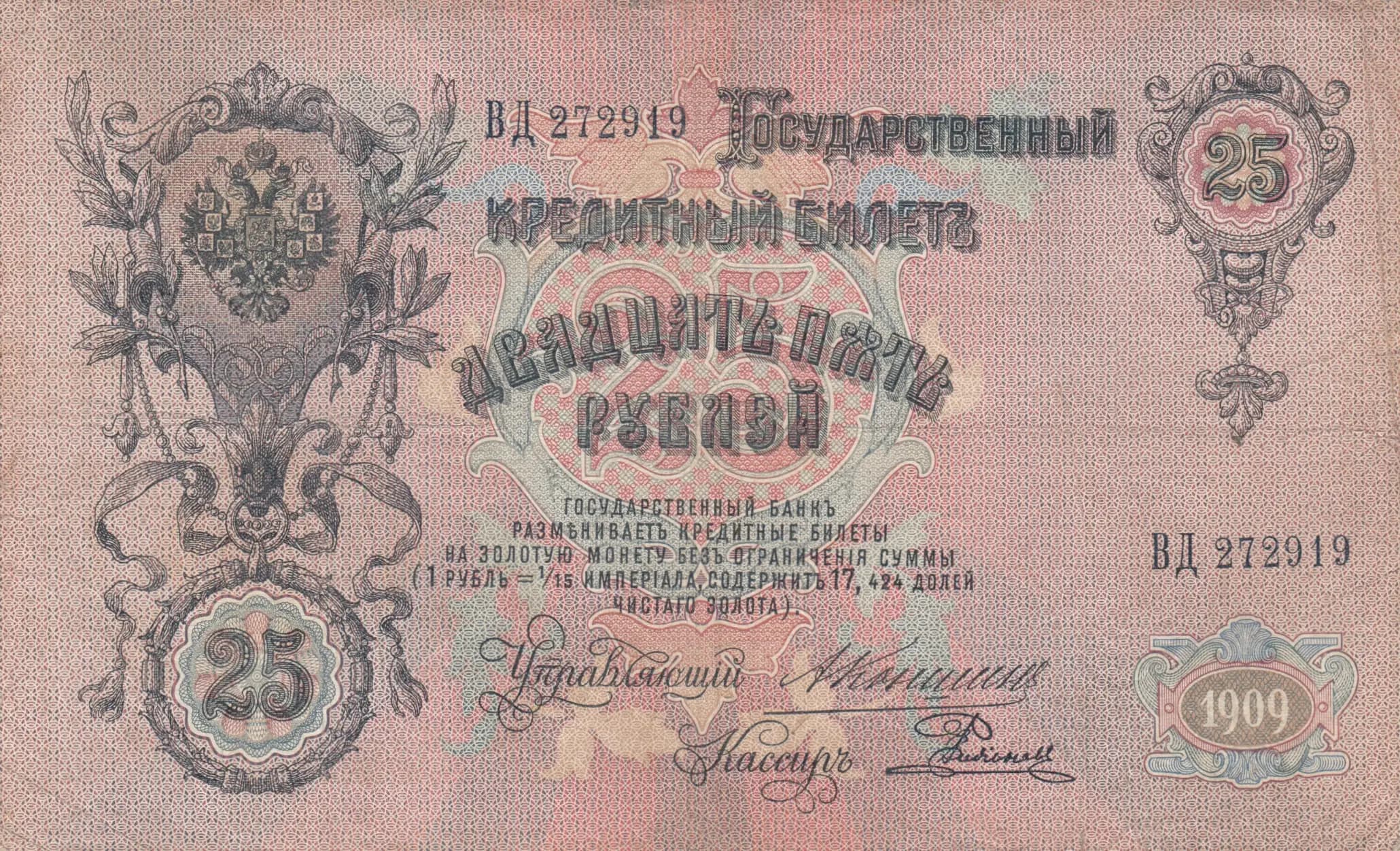
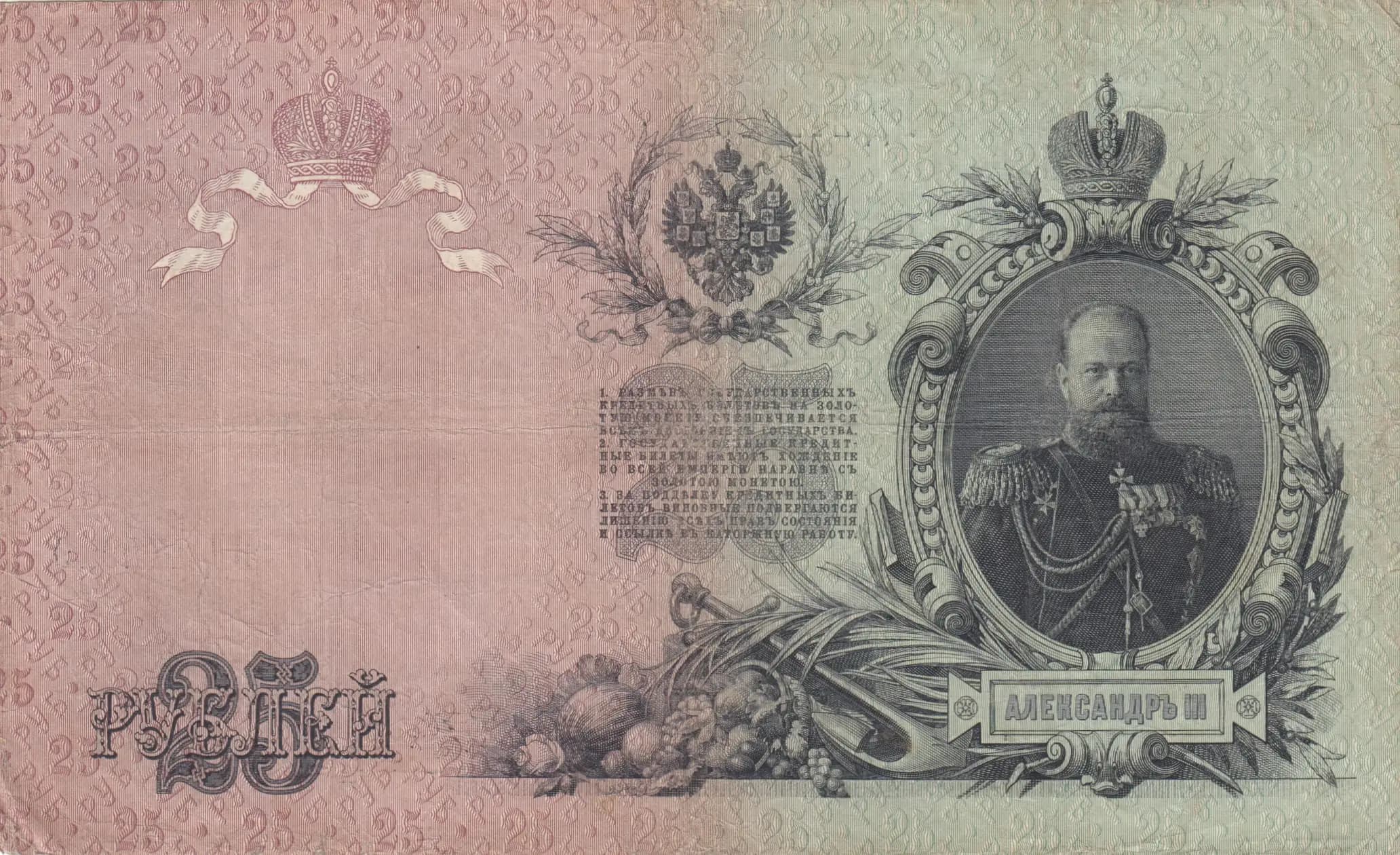
A handsome example of Russia's 1909 State Credit Note for 25 rubles, featuring the imperial double-headed eagle on the obverse and a formal portrait of Alexander III on the reverse. The note displays crisp engraving detail with pink and green color tones typical of this series, appearing in Very Fine condition with no significant wear, creases, or tears visible. This denominated note represents an important transitional period in Russian imperial currency, issued during the final years of Tsar Nicholas II's reign.
Common. The 1909 25-ruble note (Pick 12a) was issued in substantial quantities as a working denomination of the Russian Empire's currency system and remained in circulation until 1917. No evidence of a restricted print run, early withdrawal, or significant rarity premium exists for this Pick number. While condition can affect individual note value, the denomination and type itself is regularly encountered in the numismatic market.
This 1909 25-ruble note was issued by the Russian State Bank (Государственный Банк) during the reign of Nicholas II, though it commemorates his predecessor Alexander III through the portrait on the reverse. The elaborate baroque design with imperial eagles, crowns, laurel wreaths, and military decorations reflects the power and formality of the late Russian Empire. These State Credit Notes (Государственный Кредитный Билет) were a key currency instrument in pre-Revolutionary Russia, and their ornate security features demonstrate the sophisticated engraving capabilities of imperial printing authorities.
The obverse (front) features the Russian imperial coat of arms—a double-headed eagle wearing an imperial crown—positioned prominently on the left side within elaborate baroque flourishes and laurel wreaths. The denomination '25' appears in decorative cartouches in the upper right and lower left corners. The center displays 'ГОСУДАРСТВЕННЫЙ КРЕДИТНЫЙ БИЛЕТ' and '25 РУБЛЕЙ' in ornamental frames with fine legal print below. The reverse (back) presents a formal portrait of Alexander III (1845-1894), the late Tsar, depicted in full military dress uniform with epaulettes and imperial orders/decorations on the chest, framed by ornate scrollwork and a crown above. The double-headed eagle with laurel wreaths appears to the left of the portrait, with a nameplate banner beneath identifying 'АЛЕКСАНДРЪ III'. Both sides employ intricate geometric background patterns as security design elements, with the front using primarily pink and green tones while the back transitions between pink and light green backgrounds.
FRONT SIDE: 'ГОСУДАРСТВЕННЫЙ КРЕДИТНЫЙ БИЛЕТ' (State Credit Note) / '25 РУБЛЕЙ' (25 Rubles) / 'ГОСУДАРСТВЕННЫЙ БАНК' (State Bank) / 'ВД 272919' (Serial number, appearing twice) / '1909' (Year). BACK SIDE: 'АЛЕКСАНДРЪ III' (Alexander III - the deceased emperor commemorated on the note) / 'РУБЛЕЙ' (Rubles) / Fine print legal text (Official issuing authority text, partially legible in image).
Steel-plate engraving (intaglio), the standard security printing method for Russian imperial banknotes. The fine detail visible in the portrait, coat of arms, decorative flourishes, and security patterns indicates this was produced by the Imperial Printing Works in St. Petersburg, which handled high-security state currency production. The multiple serial number placements and geometric background patterns are characteristic of Russian imperial security printing practices of this era.
Serial number ВД 272919 observed on this example. The 1909 25-ruble series (Pick 12a and 12b) includes varieties distinguished by different signature combinations and serial number prefixes. The 'ВД' prefix appears on examples from the later imperial period. Signature identification requires close examination; the collector notation 'Sig. Rodionov' suggests this example may feature Finance Minister or State Bank official Rodionov's signature, which would be a specific variety marker for cataloging purposes.