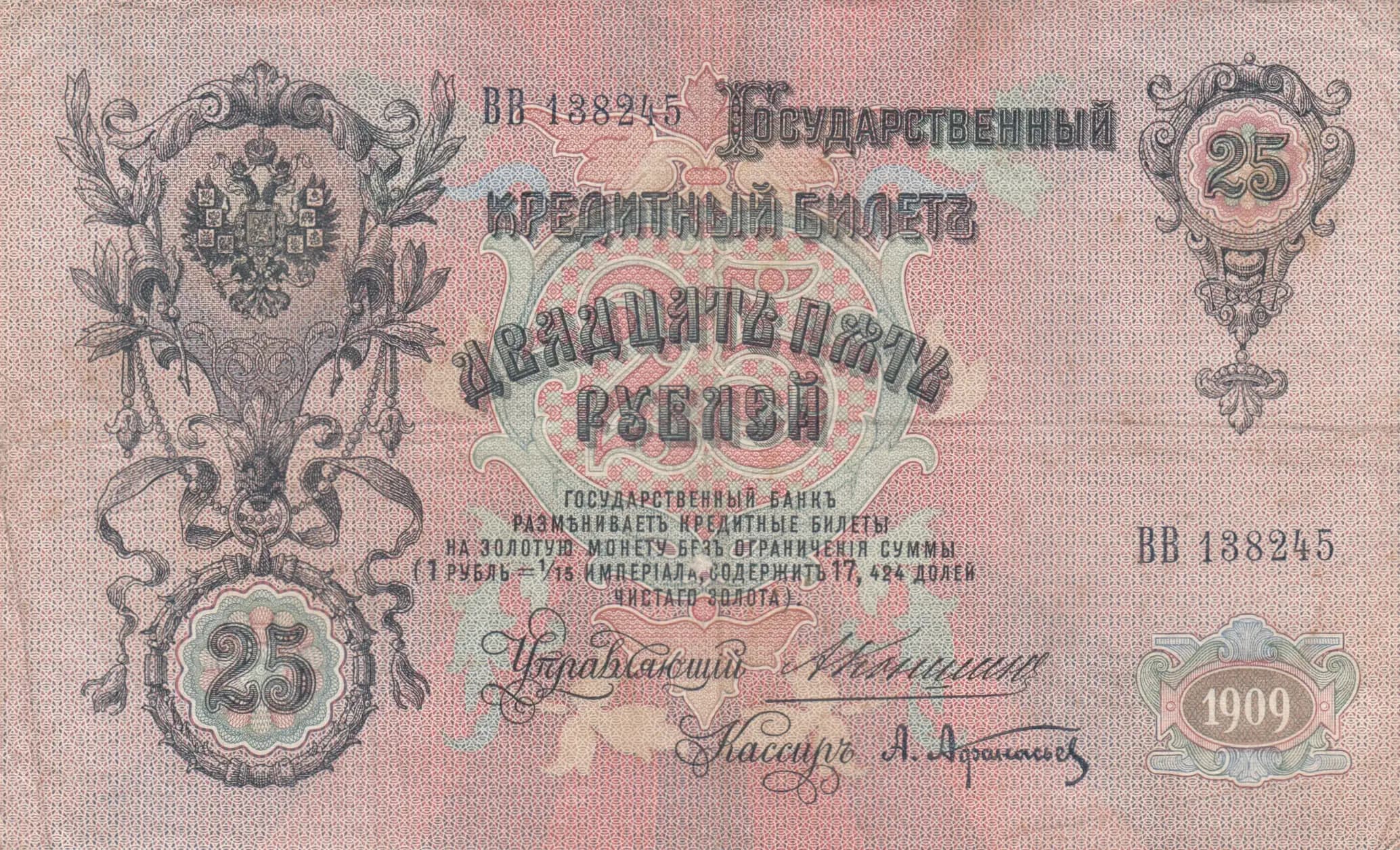
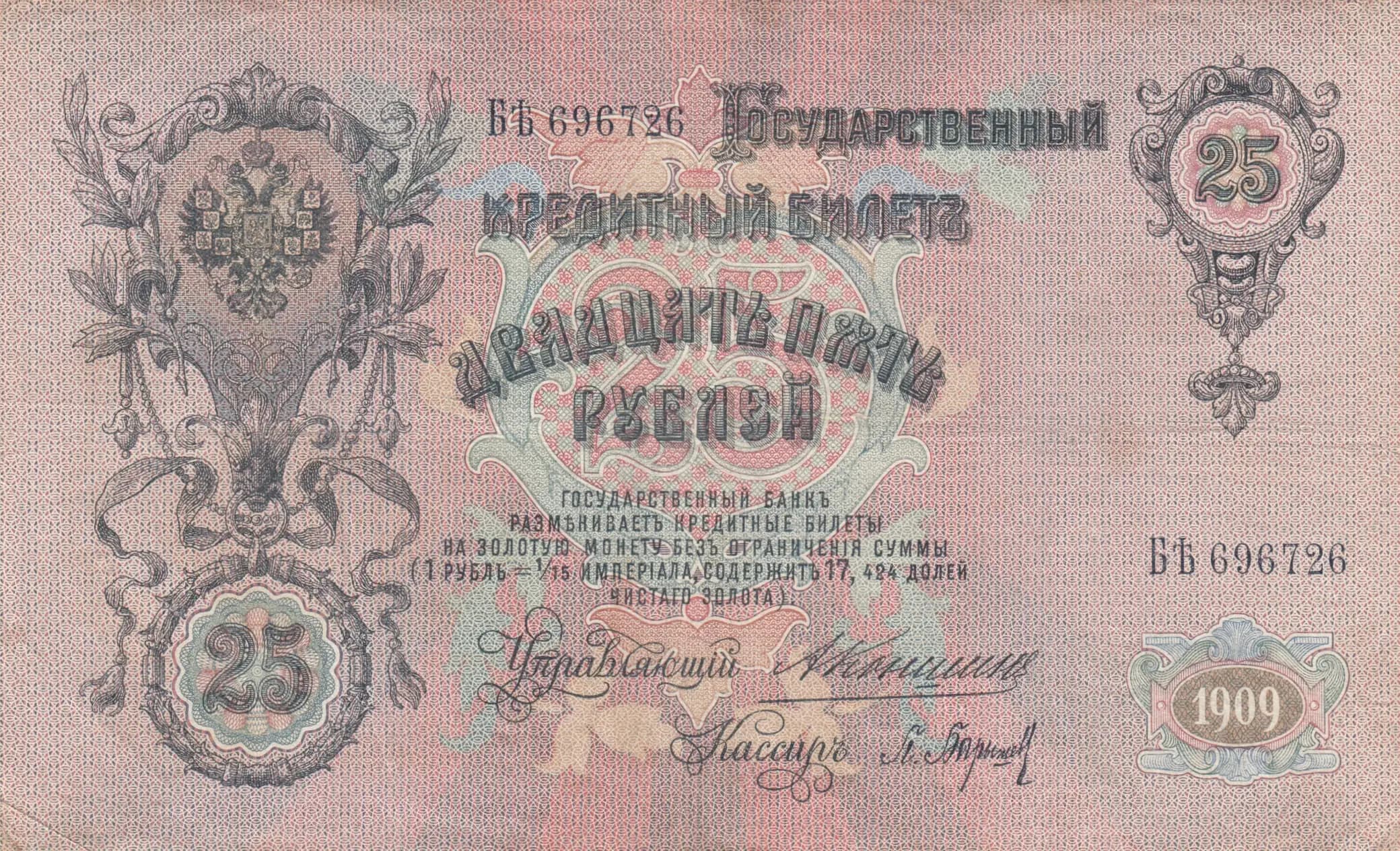
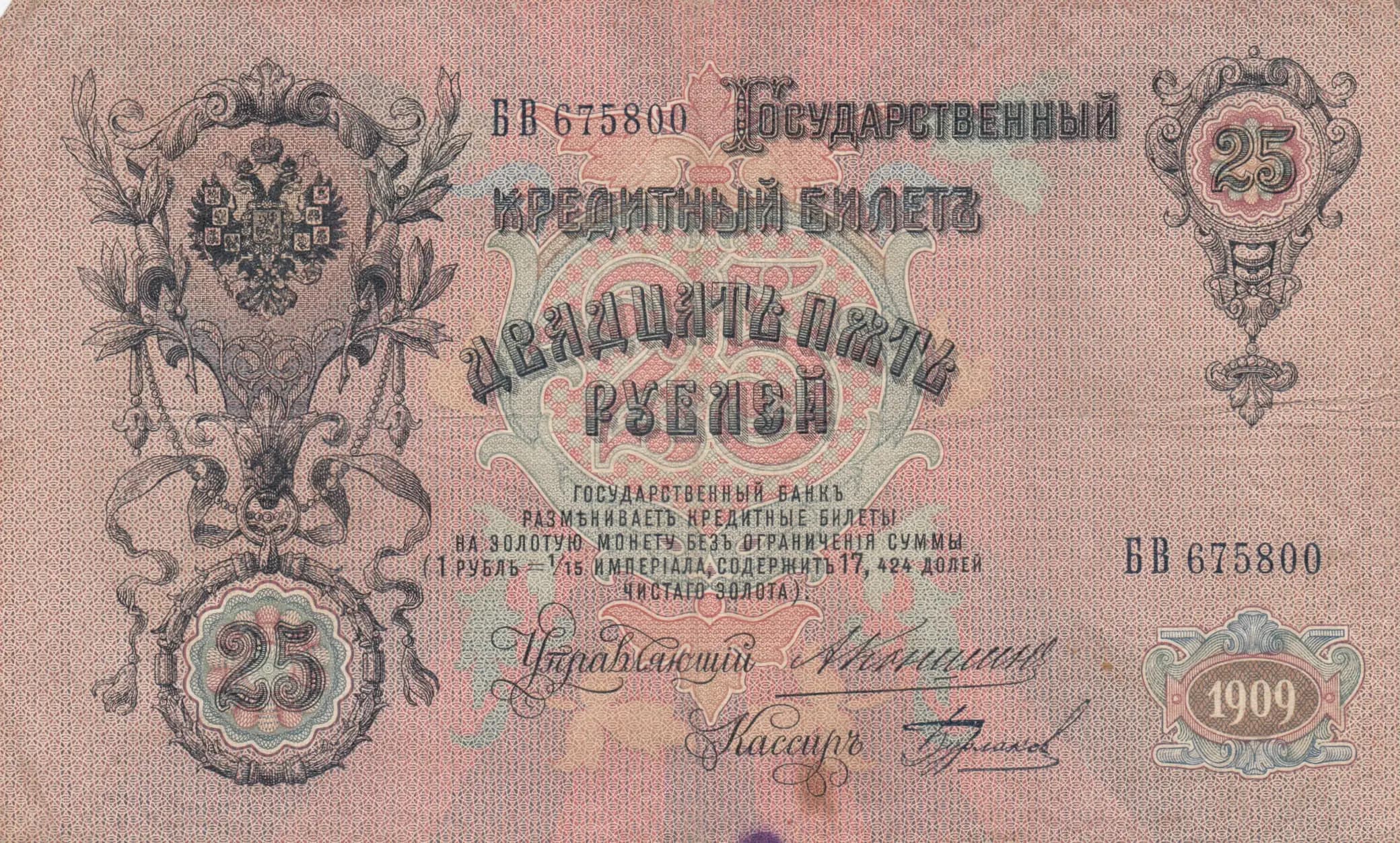
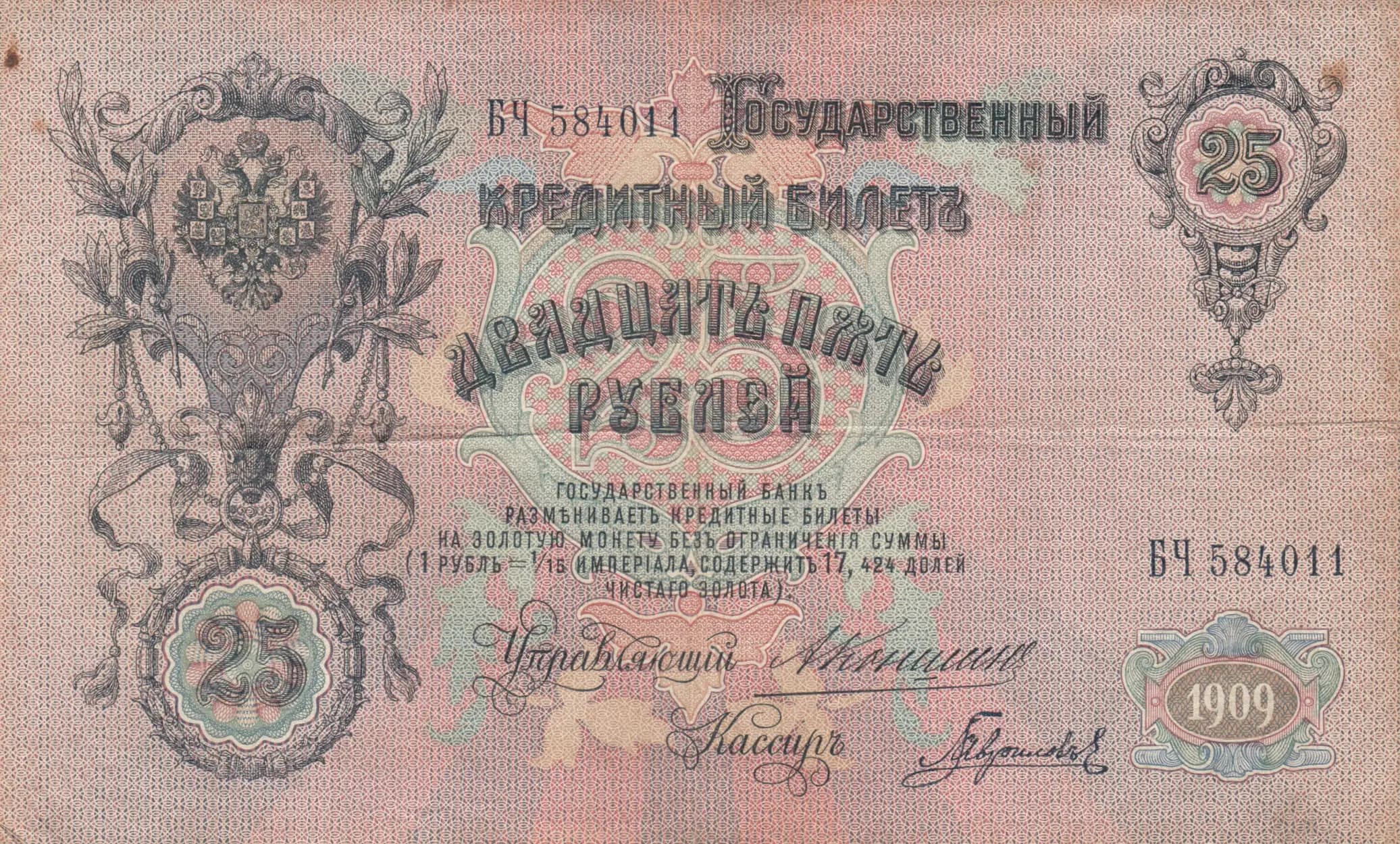
25 rublei 1909
“Sig.Ovchinnikov”
About This Note
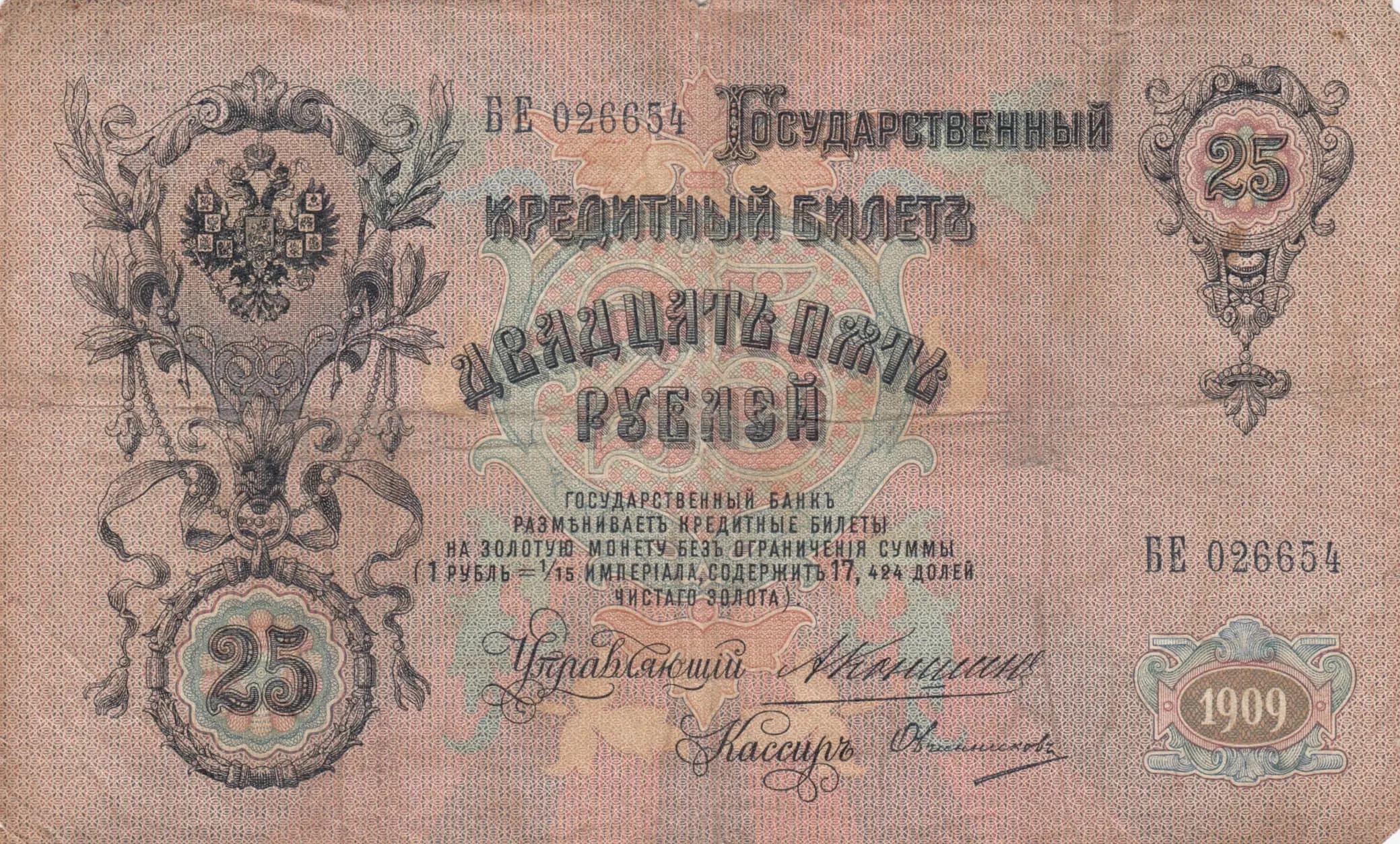
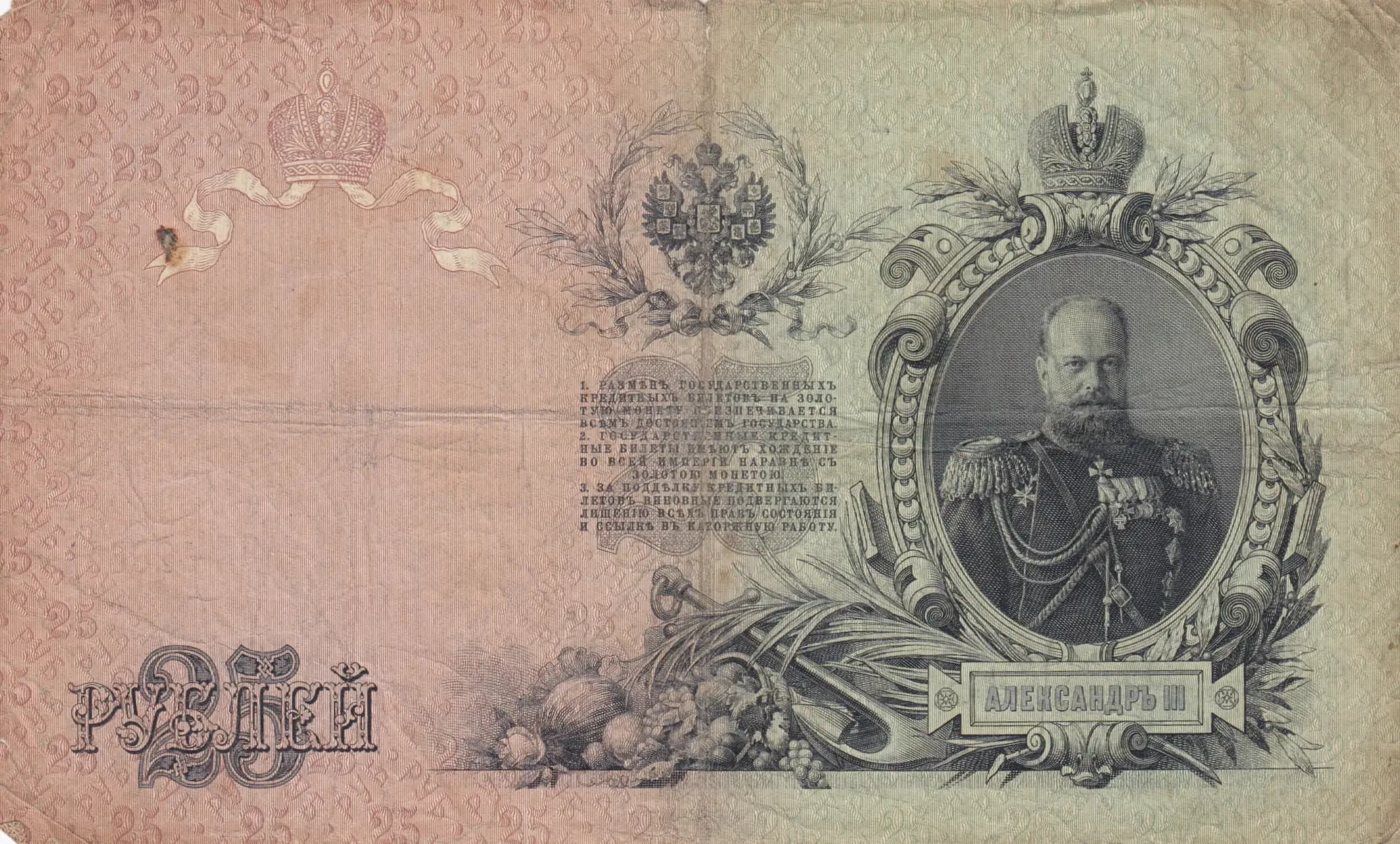
This is a 25 Ruble State Credit Note from the Russian Empire issued in 1909, graded as Fair (F) condition. The note displays the characteristic ornate baroque design of early 20th century Russian currency, featuring the Imperial double-headed eagle on the front and a portrait of Alexander III on the reverse. The piece shows significant age-related wear including creasing, foxing, and discoloration throughout, with visible patina consistent with over a century of circulation, making it a genuine artifact of the late Imperial period.
Common. The 25 Ruble denomination from the 1909 issue was part of a substantial print run during the final years of the Russian Empire. The Pick catalog designation P-12a(15) indicates this is a standard variety with no known scarcity factors. Notes from this series regularly appear in the collector market, and Fair condition examples are typical finds rather than scarce or rare items.
Issued during the reign of Nicholas II in 1909, this State Credit Note reflects the Russian Empire's gold standard monetary system, as indicated by the inscription detailing the gold backing (1 ruble = 1/15 Imperial, containing 17.424 shares of pure gold). The portrait of Alexander III on the reverse commemorates the reformist Emperor who had died in 1894, while the elaborate heraldic design and imperial coat of arms underscore the authority of the autocratic Russian state in its final decade before the 1917 Revolution.
The obverse features a classical ornamental design with pink/salmon and green coloration, centered on elaborate baroque-style decorative frames containing the denomination '25' in the upper right and lower left quadrants. The Imperial double-headed eagle coat of arms appears on the left side, with extensive Cyrillic text describing the gold backing promise in the center. Serial numbers appear in both top corners. The reverse presents a formal portrait of Emperor Alexander III (1845-1894) in full military dress uniform with elaborate epaulettes and decorations, positioned in profile facing left within an ornate decorative frame. The Imperial crown and coat of arms appear above the portrait, surrounded by laurel wreaths and baroque floral ornamental elements. The nameplate 'АЛЕКСАНДРЪ III' appears below the portrait, with additional imperial text in ornate script above.
FRONT SIDE: 'ГОСУДАРСТВЕННЫЙ КРЕДИТНЫЙ БИЛЕТ' (State Credit Note) / 'ДВАДЦАТЬ ПЯТЬ РУБЛЕЙ' (Twenty-Five Rubles) / 'ГОСУДАРСТВЕННЫЙ БАНК РАЗМЕЩАЕТ КРЕДИТНЫЕ БИЛЕТЫ НА ЗОЛОТУЮ МОНЕТУ БЕЗ ОГРАНИЧЕНИЯ СУММЫ (1 РУБЛЬ = 1/15 ИМПЕРИАЛА, СОДЕРЖИТ 17, 424 ДОЛЕЙ ЧИСТАГО ЗОЛОТА)' (The State Bank places credit notes on gold coin without limit of sum [1 ruble = 1/15 Imperial, contains 17.424 shares of pure gold]) / Serial number: 'БЕ026654' / Date: '1909' / BACK SIDE: 'РУБЛЕЙ' (Rubles) / 'АЛЕКСАНДРЪ III' (Alexander III) / [Additional imperial decree text in ornate script, partially legible, relating to imperial authority and government authority].
Line engraving (intaglio printing) with multiple color separation layers, typical of high-security banknote production of the Russian Imperial period. The intricate fine-line detail work, complex ornamental patterns, and multi-layer color printing characteristic of this note indicate production by the Russian State Printing Works (Государственная экспедиция заготовления государственных бумаг), which was the primary security printer for Imperial Russian currency.
The serial number prefix 'БЕ' (BE) indicates this specific printing batch. The Pick number P-12a(15) identifies this as the 25 Ruble note from the standard 1909 issue. The signature of Ovchinnikov noted in the collector notes may indicate a known signature variety on this denomination, though Ovchinnikov served as a state official during this period. No major overprints or special markings are visible on this example.