25 rublei 1909
“Sig.Morozov”
About This Note
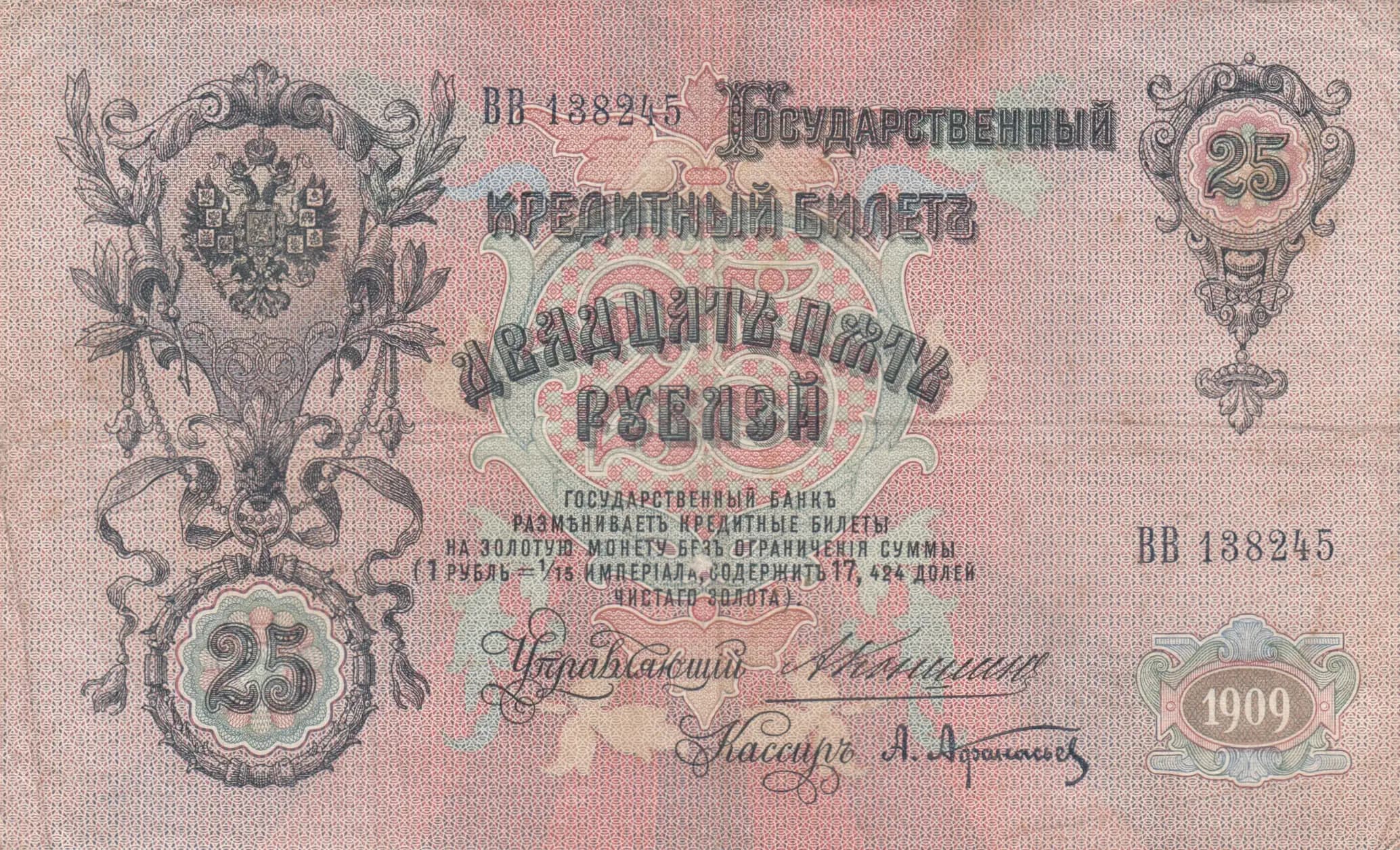
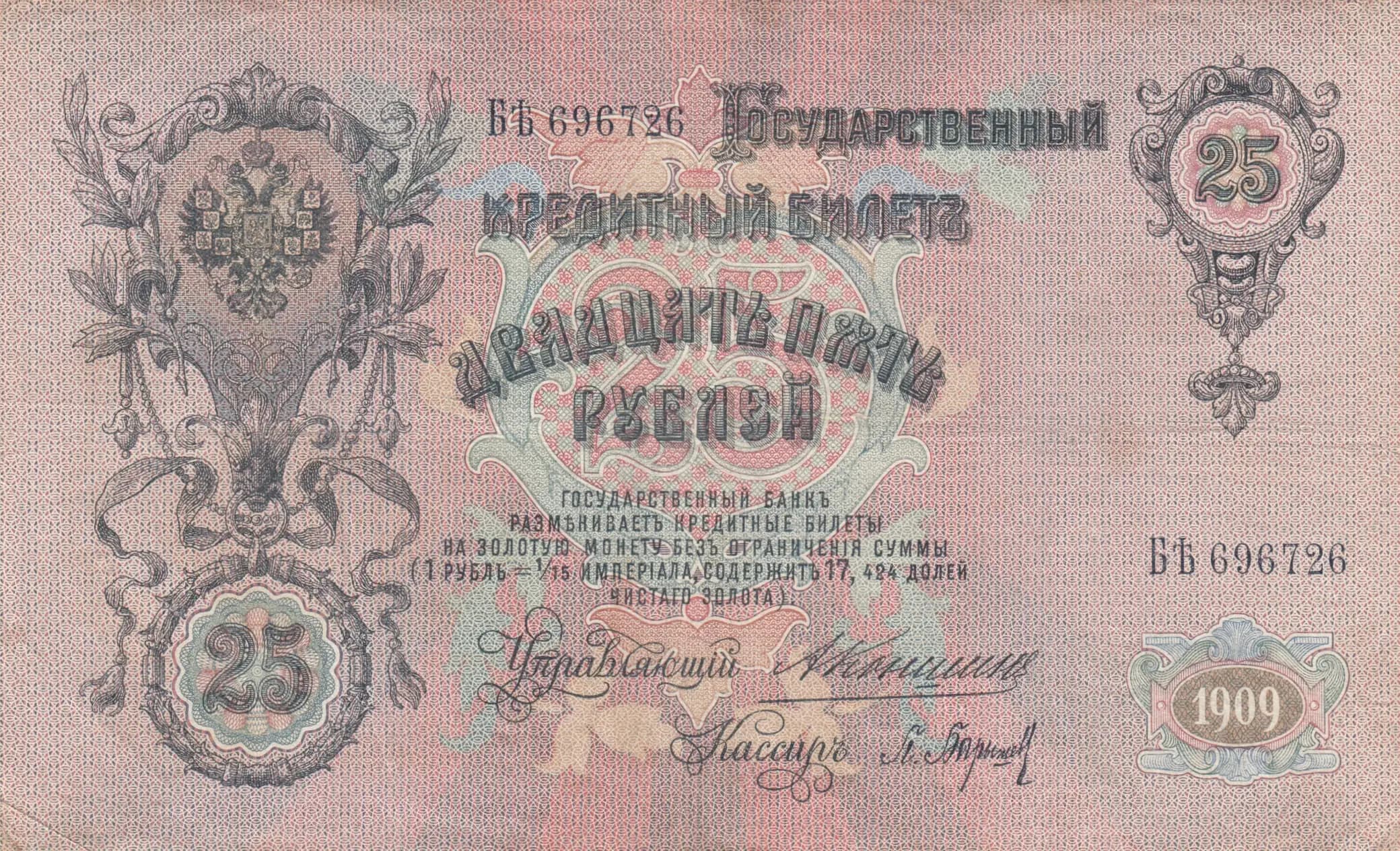
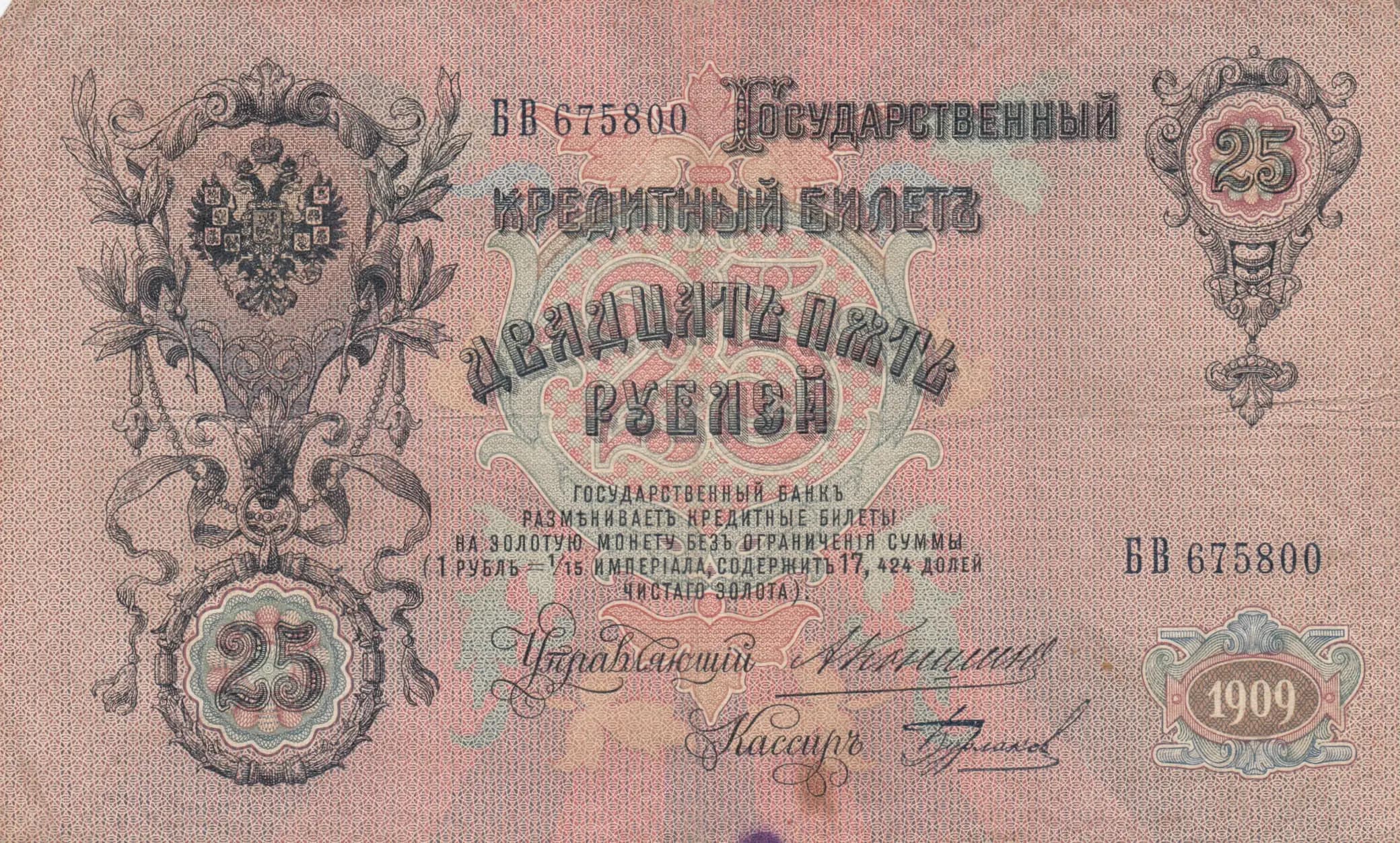
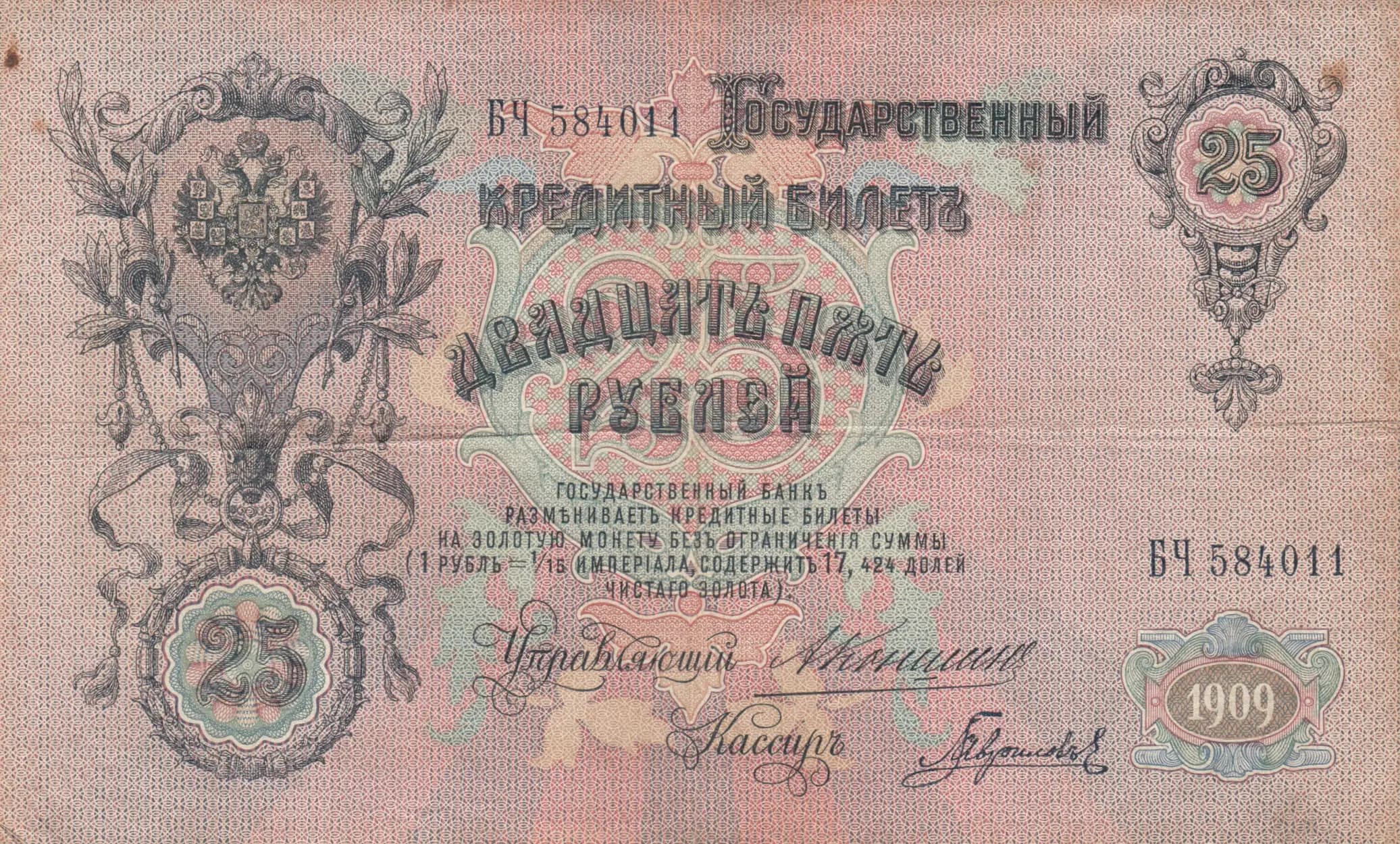
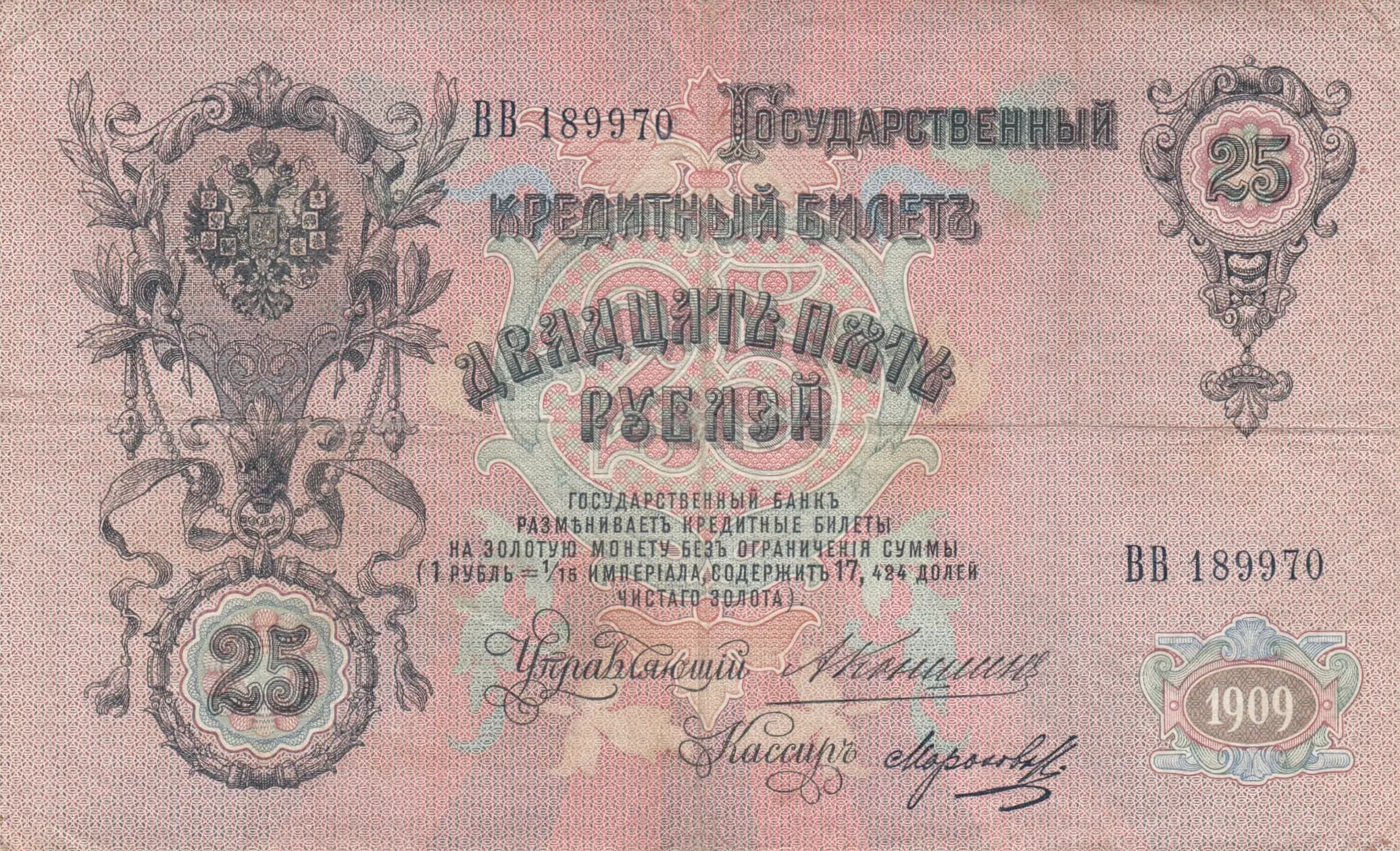
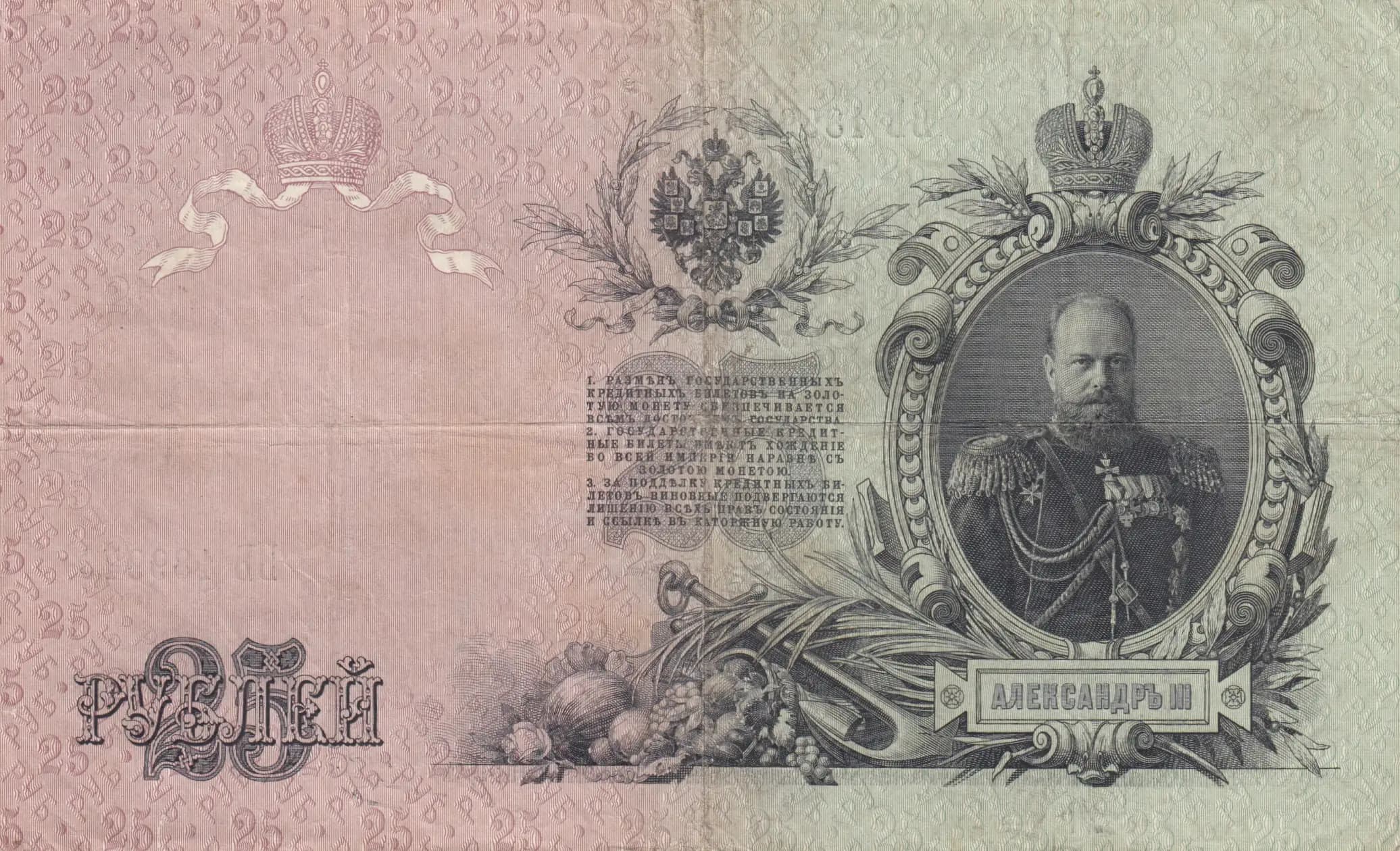
A visually striking 25 ruble State Credit Ticket from 1909, issued during the final years of Tsarist Russia's gold standard currency system. The note displays exceptional condition with vibrant pink and green coloring, sharp engraving throughout, and crisp printing with no visible wear, creases, or damage. The front features the imperial double-headed eagle and denomination cartouches, while the reverse presents a finely detailed portrait of Alexander III in military regalia—a hallmark of Russian Imperial banknote design that emphasizes state authority and prestige.
Common. The 1909 25 ruble note (Pick 12a) was issued in substantial quantities during a period of relative economic stability under the gold standard. Multiple varieties exist with different signatures and serial number prefixes, indicating large and sustained print runs. Notes from this series are frequently encountered in international numismatic markets. No evidence suggests this particular note or its signature variety is scarce or restricted in availability.
This 1909 issue represents the mature phase of Russia's State Credit Ticket system, backed by gold reserves and convertible at the official rate of 1 ruble = 1/15 Imperial. The prominence of Alexander III's portrait on the reverse reflects the reverence for the deceased Tsar (died 1894) and continuity of imperial authority under Nicholas II. The elaborate security features and precise multi-color printing demonstrate the technical sophistication of late Imperial Russian currency production, designed to prevent counterfeiting during a period of economic modernization.
The obverse presents the imperial coat of arms—a double-headed eagle crowned and encircled by ornamental flourishes—positioned on the left, with the denomination '25' enclosed in elaborate circular cartouches at center and right. The note's primary inscription 'ГОСУДАРСТВЕННЫЙ КРЕДИТНЫЙ БИЛЕТ' runs across the center with gold conversion specifications detailed below. The reverse depicts Tsar Alexander III (reigned 1881-1894) in formal military dress uniform complete with epaulettes, high collar, and state decorations, contained within an ornate oval frame topped by the imperial crown and flanked by laurel wreaths. This iconographic arrangement emphasizes imperial prestige and the state guarantee backing the currency. The dual-color printing (pink/rose and green) is characteristic of the 1909 design series.
FRONT SIDE: 'ГОСУДАРСТВЕННЫЙ КРЕДИТНЫЙ БИЛЕТ' (State Credit Ticket); 'ДВАДЦАТЬ ПЯТЬ РУБЛЕЙ' (Twenty-Five Rubles); 'НА ЗОЛОТУЮ МОНЕТУ БЕЗ ОГРАНИЧЕНИЯ СУММЫ (1 РУБЛЬ = 1/15 ИМПЕРИАЛА, СОДЕРЖИТ 17,424 ДОЛИ ЧИСТОГО ЗОЛОТА)' (Payable in gold coin without limitation of sum. 1 ruble = 1/15 Imperial, contains 17.424 parts pure gold); 'Управляющий Министр' (Managing Minister); 'Министр Финансов' (Minister of Finance); Serial number: 'ВВ 189970'; Date: '1909'. BACK SIDE: 'РУБЛИ' (Rubles); 'АЛЕКСАНДР III' (Alexander III); Fine print text describing imperial guarantee and state credit backing.
Steel engraving with multi-color printing using separate color plates for pink, green, black, and white. The fine line work, intricate background patterns, and precision of registration observable in the sharp, vibrant imagery indicate production by a state security printer. Russian Imperial banknotes of this period were printed by the Russian State Security Printing Works (Государственный Красносельский печатный завод). The complexity of the portrait engraving and ornamental elements reflects the high technical standards of Imperial security printing intended to prevent counterfeiting.
Serial number prefix 'ВВ' identifies this as a specimen from the later portion of the 1909 series print run. The signature line indicates signatures of the Managing Minister (Управляющий Министр) and Minister of Finance (Министр Финансов), with the specific signatures visible as 'Sig. Morozov' per collector notes—likely referring to Vladimir Morozov, who held administrative positions in the Imperial Ministry of Finance during this period. The 1909 25 ruble exists in multiple signature varieties corresponding to changes in ministerial personnel between 1909-1917.