1000 rublei 1919
“Armenian SSR”
About This Note
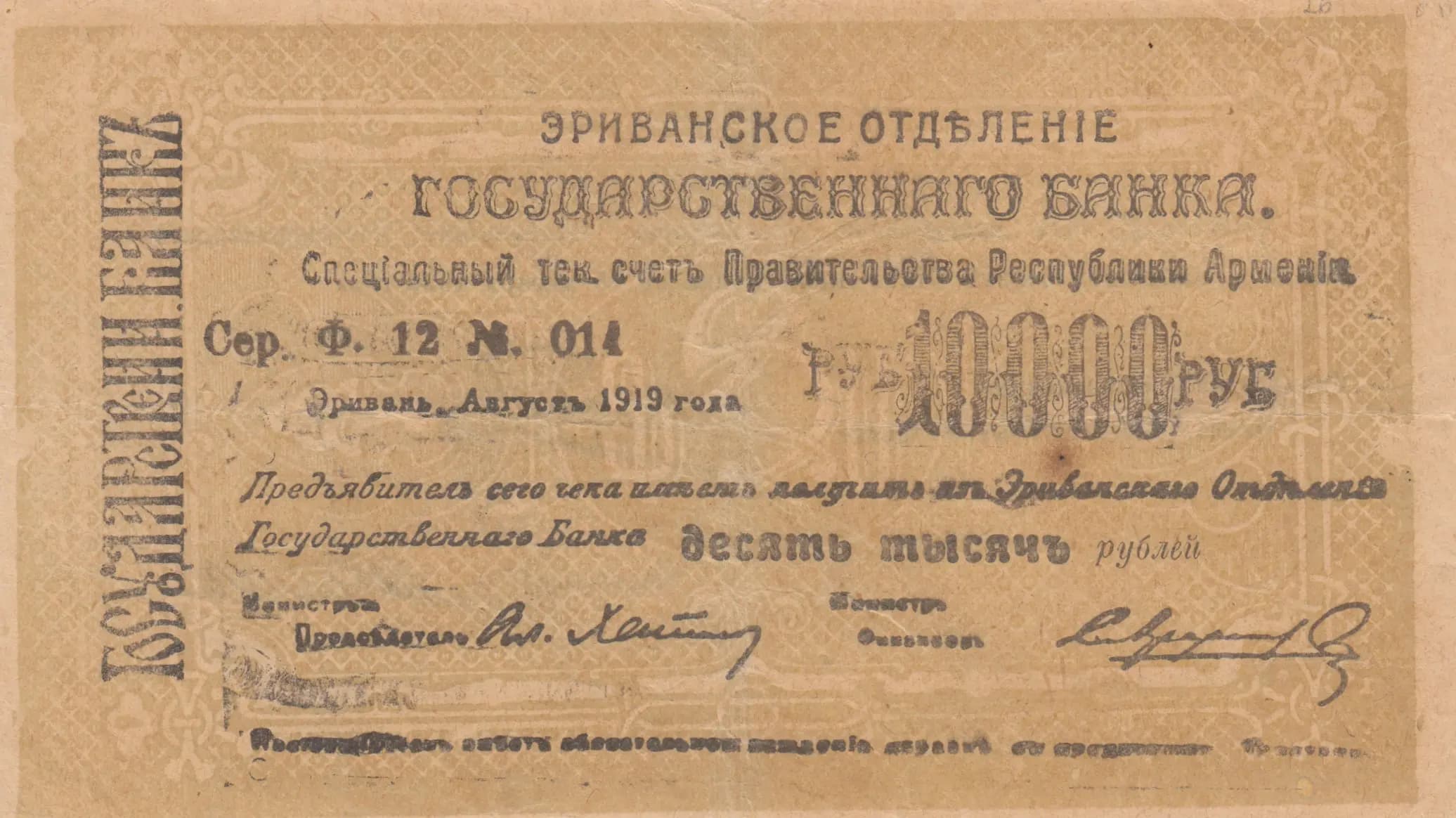
This is a 10,000 ruble check issued by the Erivan (Erevan) Department of the Russian State Bank in August 1919, a crucial document from the Armenian independence period. The note exhibits significant age-related wear with heavy foxing, creasing, and discoloration throughout, consistent with its VF grade and over 100-year history. The presence of handwritten signatures and administrative seals, combined with its explicit reference to the Armenian Republic government account, makes this a historically important piece documenting the brief Armenian Democratic Republic period (1918-1920).
uncommon - This is a specialized check from the Erevan State Bank Branch rather than a standard banknote issue, with a limited geographic scope and short-lived issuing authority (the Armenian Democratic Republic government accounts ceased operation by 1920). The specific Pick catalog listing (P-S678) and Armenian SSR collector focus indicate this is not a mass-circulation item. However, the historical significance of Armenian independence documents and the specific institutional context make these more sought after than typical Russian State Bank checks, placing it in the uncommon rather than common category. The VF condition grade also suggests careful preservation by collectors.
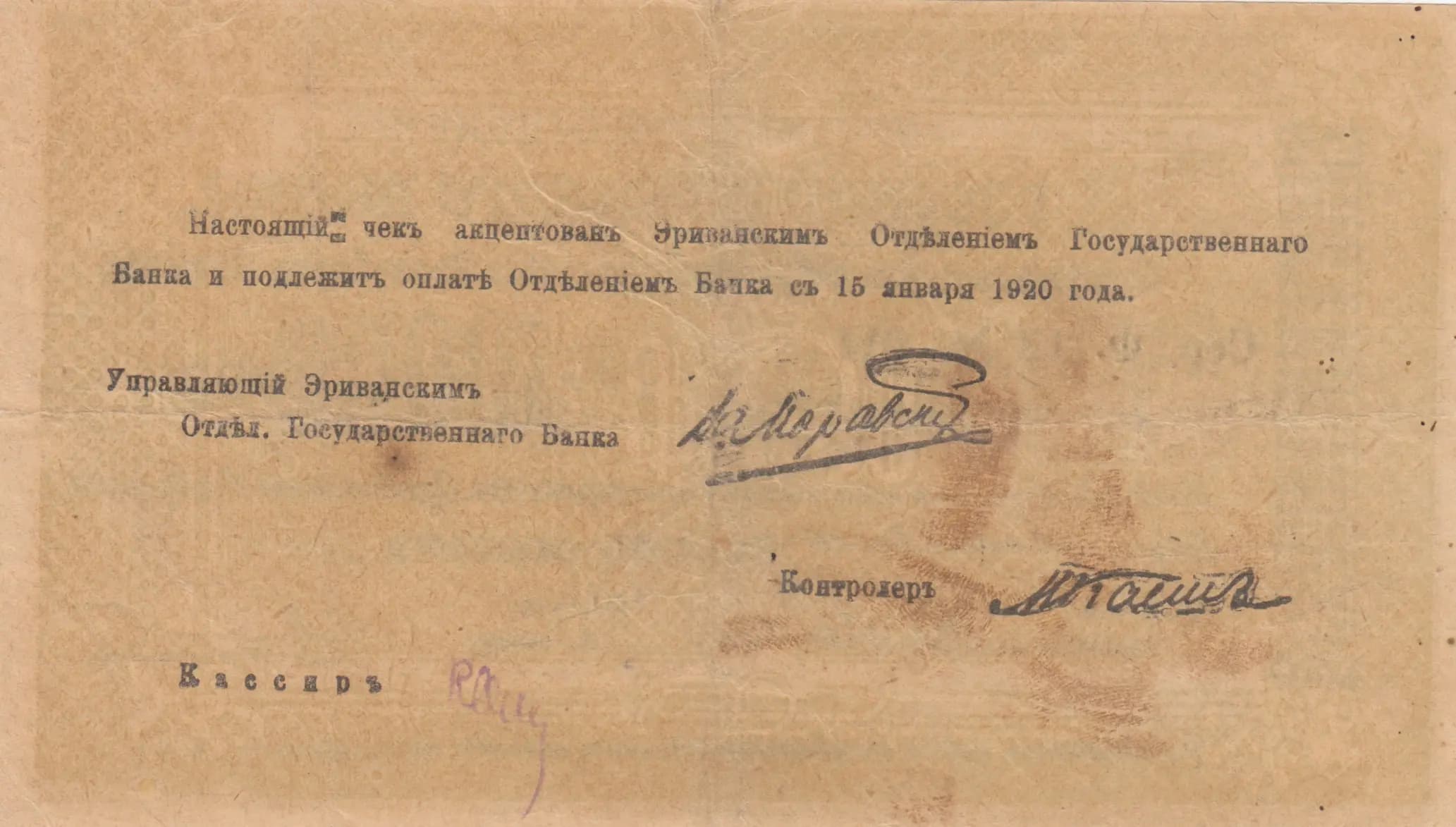
This check was issued during the tumultuous period following the Russian Revolution and the Armenian Democratic Republic's declaration of independence. The notation 'Special current account of the Government of the Republic of Armenia' and the acceptance clause referencing payment from January 15, 1920, document the financial institutions' role in supporting the short-lived Armenian state before Soviet consolidation. The Erivan Department's issuance of this denominated check reflects the complex monetary situation in the South Caucasus during the Russian Civil War and Armenian independence period.
This is a check rather than a traditional banknote, printed on aged tan/beige paper with ornamental guilloche patterns and decorative borders throughout providing security. The Imperial double-headed eagle watermark is visible on the left side, indicating pre-revolutionary paper stock usage during the transition period. The design features formal administrative layout with three signature lines for bank officials (Manager, Controller, and Cashier) and an official circular seal impression. The color palette consists primarily of tan, beige, brown, and gray tones, with black printing for text and administrative marks. The note exhibits no portraits or landmarks, focusing instead on decorative security elements and official stamps.
{"front":{"header":"ЭРИВАНСКОЕ ОТДЕЛЕНИЕ ГОСУДАРСТВЕННОГО БАНКА - Erivan Department of the State Bank","purpose":"Специальный тек счеть Правительства Республики Армень - Special current account of the Government of the Republic of Armenia","identification":"Сер. Ф.12 №. 014 - Series F.12 No. 014","dateLocation":"Эривань, Август 1919 года - Erivan, August 1919","denomination":"10,000 руб - 10,000 rubles","payout":"Предъявитель сего чека имеют законно ему Эриванскому Отделению Государственного Банка десять тысяч рублей - The bearer of this check has the legal right to receive from the Erivan Department of the State Bank ten thousand rubles"},"back":{"acceptance":"Настоящий чек акцептован Эриванским Отделением Государственного Банка и подлежит оплате Отделением Батча с 15 января 1920 года. - This check is accepted by the Erivan Department of the State Bank and is subject to payment by the Batcha Department from January 15, 1920.","signatories":"Управляющий Эриванским Отделением Государственного Банка - Manager of the Erivan Department of the State Bank; Контролер - Controller; Кассир - Cashier"}}
This check was produced using letterpress printing combined with guilloche background patterns, typical of Russian State Bank security documents of the period. The ornamental patterns were likely engraved and intaglio-printed to provide anti-counterfeiting measures. Handwritten signatures and administrative stamps were added post-printing as standard procedure for official checks. The watermark featuring the Imperial double-headed eagle indicates the paper was sourced from pre-revolutionary stocks.
Series F.12, No. 014 - This specific serial number indicates this is from Series F.12 of the Erevan Department's check stock. The August 1919 date and acceptance clause referencing January 15, 1920 payment from the Batcha Department are distinguishing features of this variety. The three handwritten signatures visible on the reverse would be specific to the individual bank officials serving at the Erevan Department during this brief period. No significant documented varieties are typically cataloged for these institutional checks, but serial number series and signature variations would distinguish individual pieces within the issue.