1000 rublei 1919
About This Note
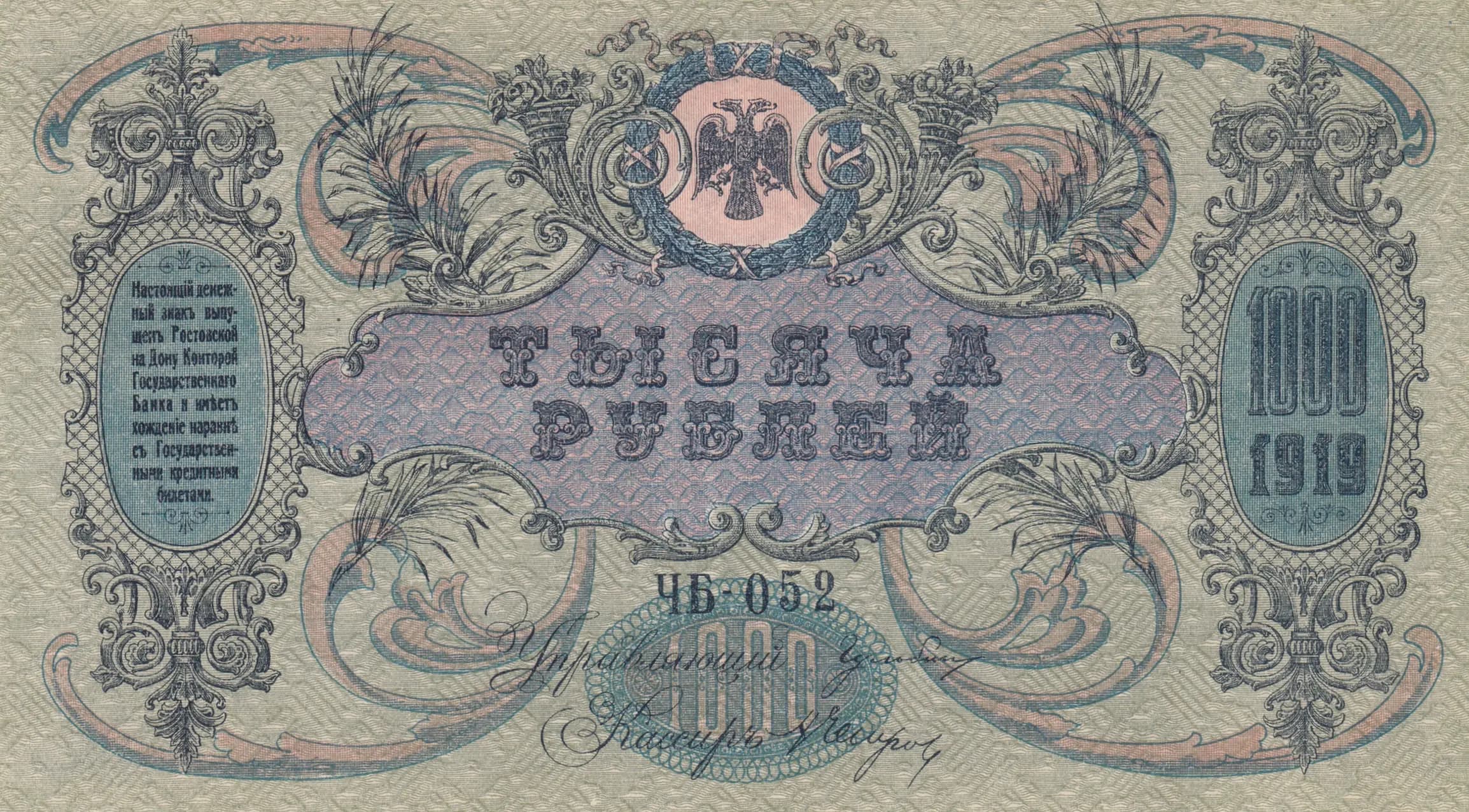
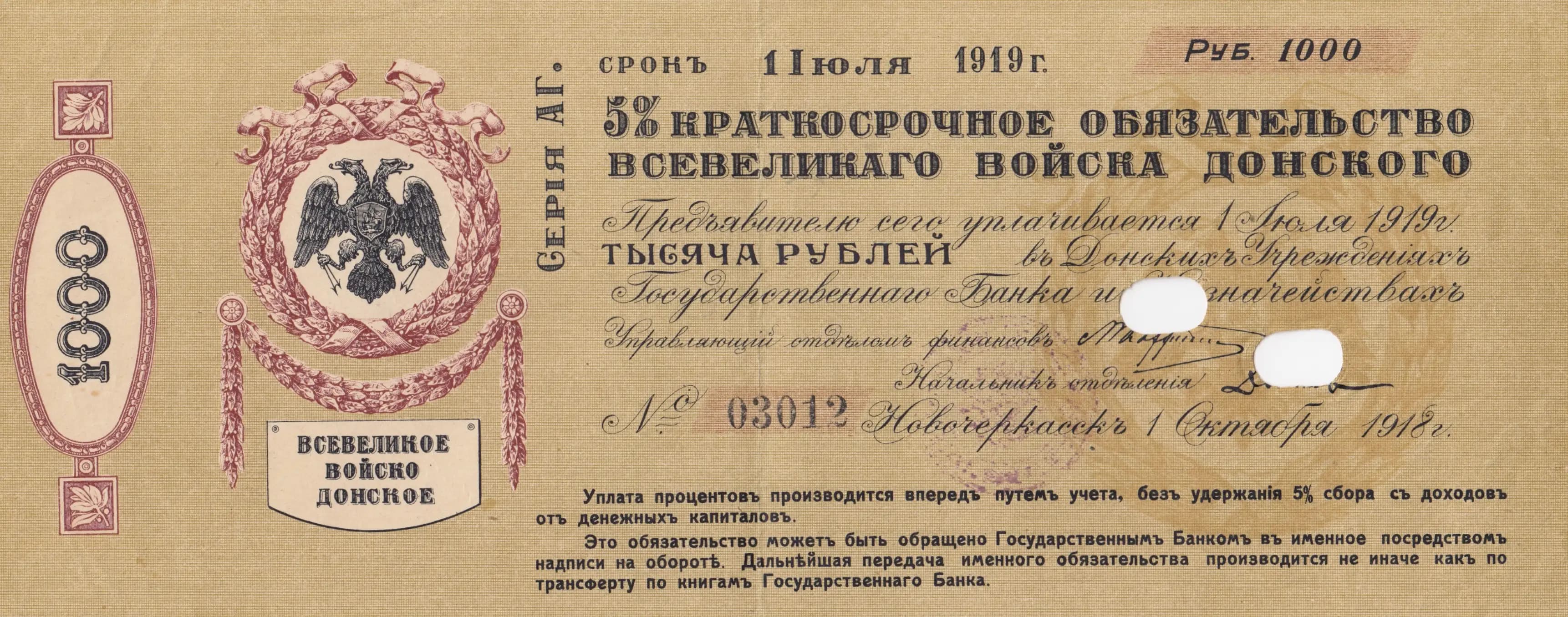
A 1000 Rublei emergency currency issued by the Great Don Cossack Army in 1919, presented in VF condition with significant aging characteristics. The note features an ornate pink/maroon decorative border with an imperial double-headed eagle centered within a laurel wreath, accompanied by extensive Russian Cyrillic text detailing the obligation terms. Observable condition includes foxing, yellowing, creasing from folding, and two white oval stamps/punch marks, typical of a banknote that has circulated for over a century.
common - Civil War era currency from the Don Cossack Army is relatively common in collectors' markets and institutional collections. While the Don Army's government was short-lived and ultimately defeated, their currency was issued in significant quantities across multiple denominations and varieties during 1919. High denominations like 1000 Rublei were produced in substantial numbers and survive in reasonable quantities today. The VF condition grade indicates a well-preserved example, but the note itself is not scarce or rare.
This note represents a critical transitional period during the Russian Civil War when the White Army's Don Cossack forces controlled southern Russia and issued their own emergency currency. The imperial double-headed eagle and formal governmental language ('All-Great Don Army') reflect the Cossacks' claim to legitimate authority and continuity with pre-revolutionary Russian institutions. The April 1919 issuance date places this within the Don Army's period of maximum territorial control, before their defeat by Bolshevik forces later that year.
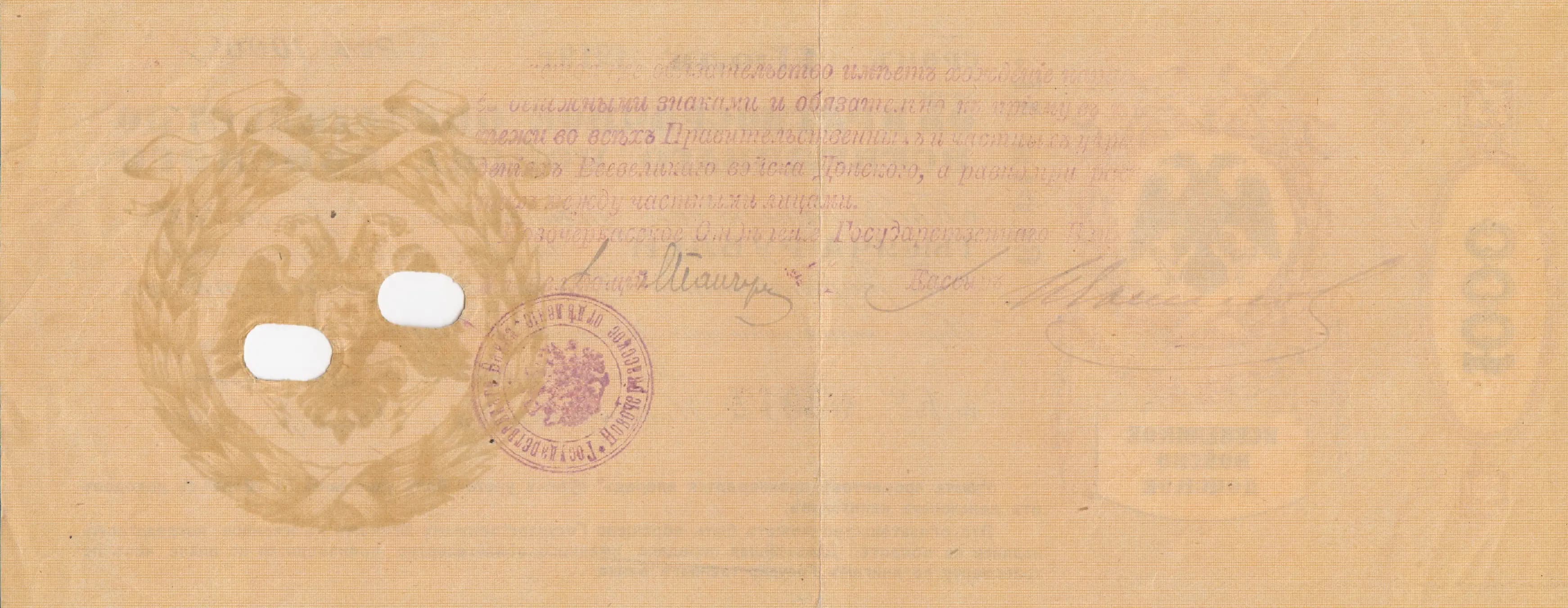
The obverse features a formal debt obligation layout typical of emergency currency issued during the Russian Civil War. The central vignette displays the Imperial Russian double-headed eagle—symbol of sovereignty and state authority—rendered within an ornamental laurel wreath, positioned prominently to assert legitimacy. The denomination '1000' appears in a large oval cartouche on the left side in pink/maroon tones. The reverse contains a prominent watermark-style eagle and decorative ornamental elements forming the background security design. Two white oval stamps/punch marks visible on both sides appear to be validation or inspection marks applied during currency handling. The extensive legal text on the obverse identifies this as a formally structured debt obligation rather than demand notes, reflecting the Don Army's attempt to create sophisticated financial instruments despite their precarious military position.
FRONT SIDE: 'РУБ. 1000' (RUB. 1000); 'СРОНЬЬ 11ИЮЛЯ 1919г.' (Valid until July 11, 1919); 'БОКРАТНОСРОЧНОЕ ОБЯЗАТЕЛЬСТВО ВСЕВЕЛИКАГО ВОЙСКА ДОНСКОГО' (Short-term obligation of the All-Great Don Army); 'ВСЕВЕЛИКОЕ ВОЙСКО ДОНСКОЕ' (All-Great Don Army); 'Представляет сему удостоверяется 1 Апреля 1919г.' (This certifies as of April 1, 1919); 'ТЫСЯЧА РУБЛЕЙ' (One Thousand Rubles); '№ 03012 Новочеркасск 1 Отчета 1918г.' (No. 03012 Novocherkassk Report 1918); 'Уплата процентов производится впередь путем учета, без удержания 5% сбора с доходов от денежных капиталов.' (Interest payment is made forward through accounting, without deducting 5% collection from income from monetary capital); 'Это обязательство может быть обращено Государственным Банком в именное посредством надписи на обороте. Дальнейшая передача именного обязательства производится не иначе как по трансферту по книгам Государственного Банка.' (This obligation can be converted into registered form by the State Bank by inscription on the reverse. Further transfer of a registered obligation is made only by transfer in the books of the State Bank). BACK SIDE: Circular official seal with Cyrillic text (specific inscription illegible due to watermark and aging); handwritten signatures present but largely illegible.
Lithographic printing with multi-color registration, utilizing pink/maroon, cream, and black inks. The ornamental borders, watermark eagle design, and decorative elements are characteristic of high-quality lithographic security printing. The presence of handwritten signatures and manually applied oval stamps indicates post-printing validation procedures. The watermark eagle visible on the reverse suggests either integrated watermark technology or deliberate watermark-style background printing. Production likely occurred at Don Cossack-controlled printing facilities in Novocherkassk (as indicated by the serial number notation), which would have utilized available pre-revolutionary Russian printing equipment and techniques.
Serial number 03012 with Novocherkassk origin and April 1, 1919 date. The validity expiration date of July 11, 1919 is characteristic of this emergency issue. Two distinct white oval stamps/punch marks are visible, possibly indicating inspection or validation marks applied during currency handling or institutional processing. The presence of handwritten signatures on the reverse suggests individual authorization by Don Army financial officials. Pick catalog number P-S394a designation indicates this is a cataloged variety within the specialized Civil War currency classification system.