1000 rublei 1919
“South Russia”
About This Note
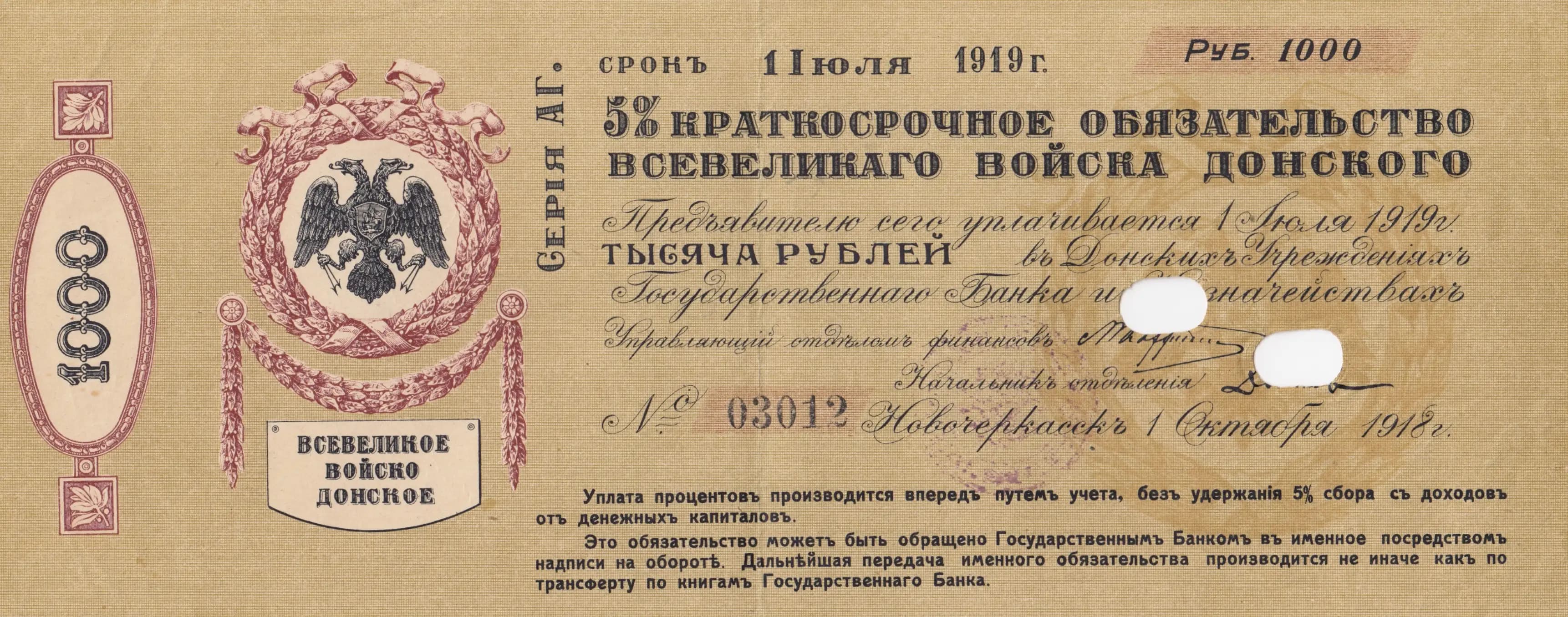
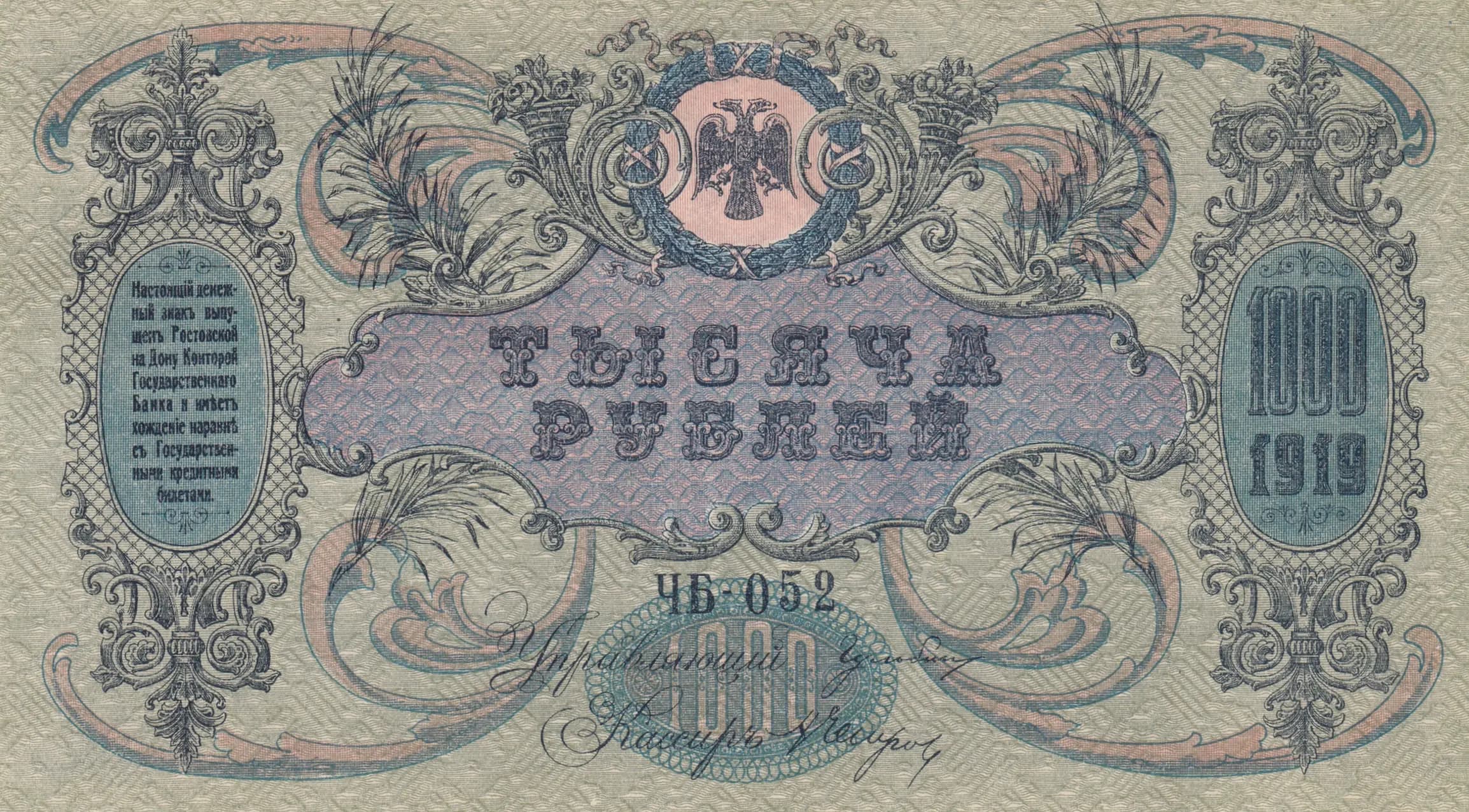
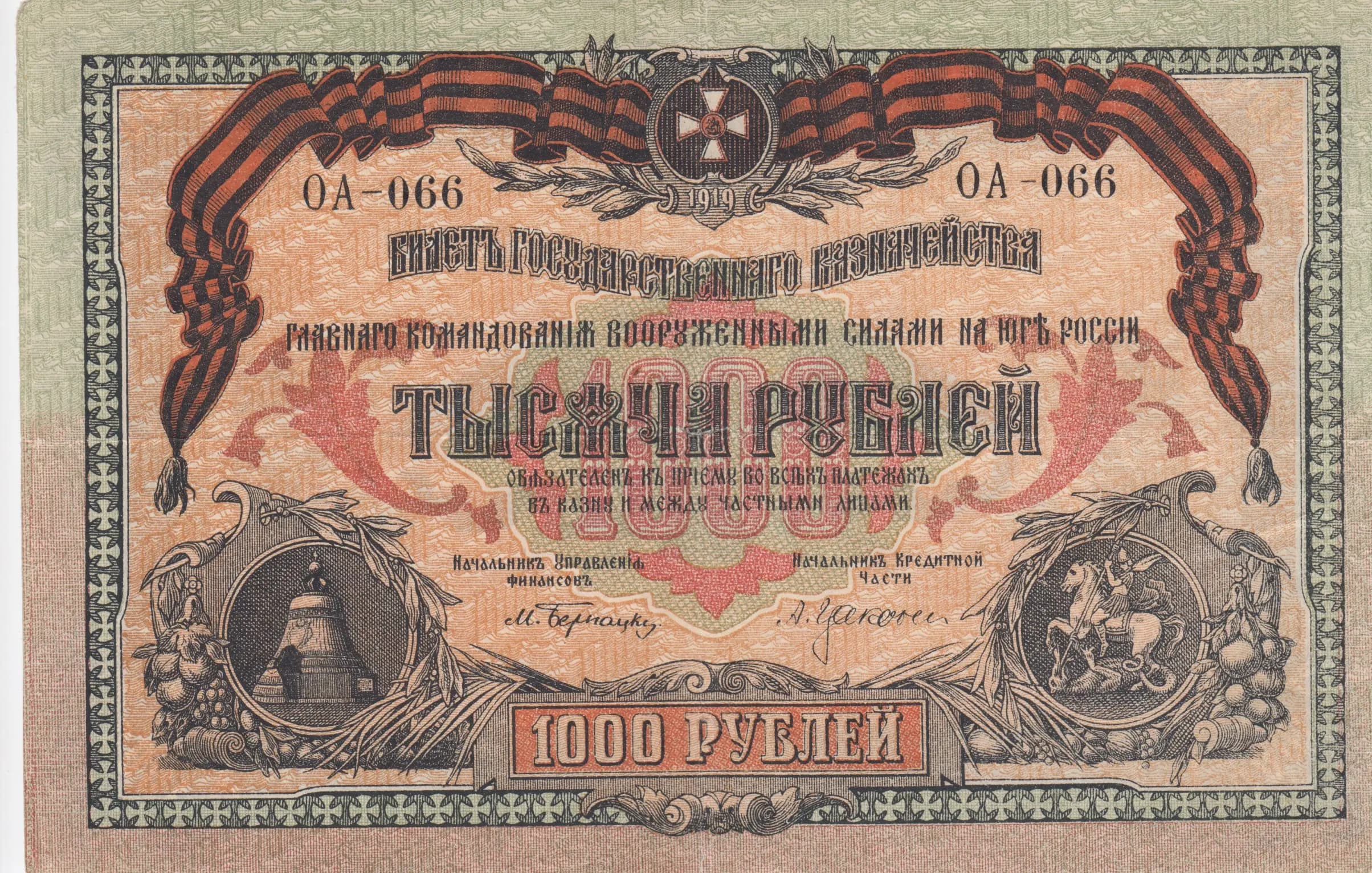
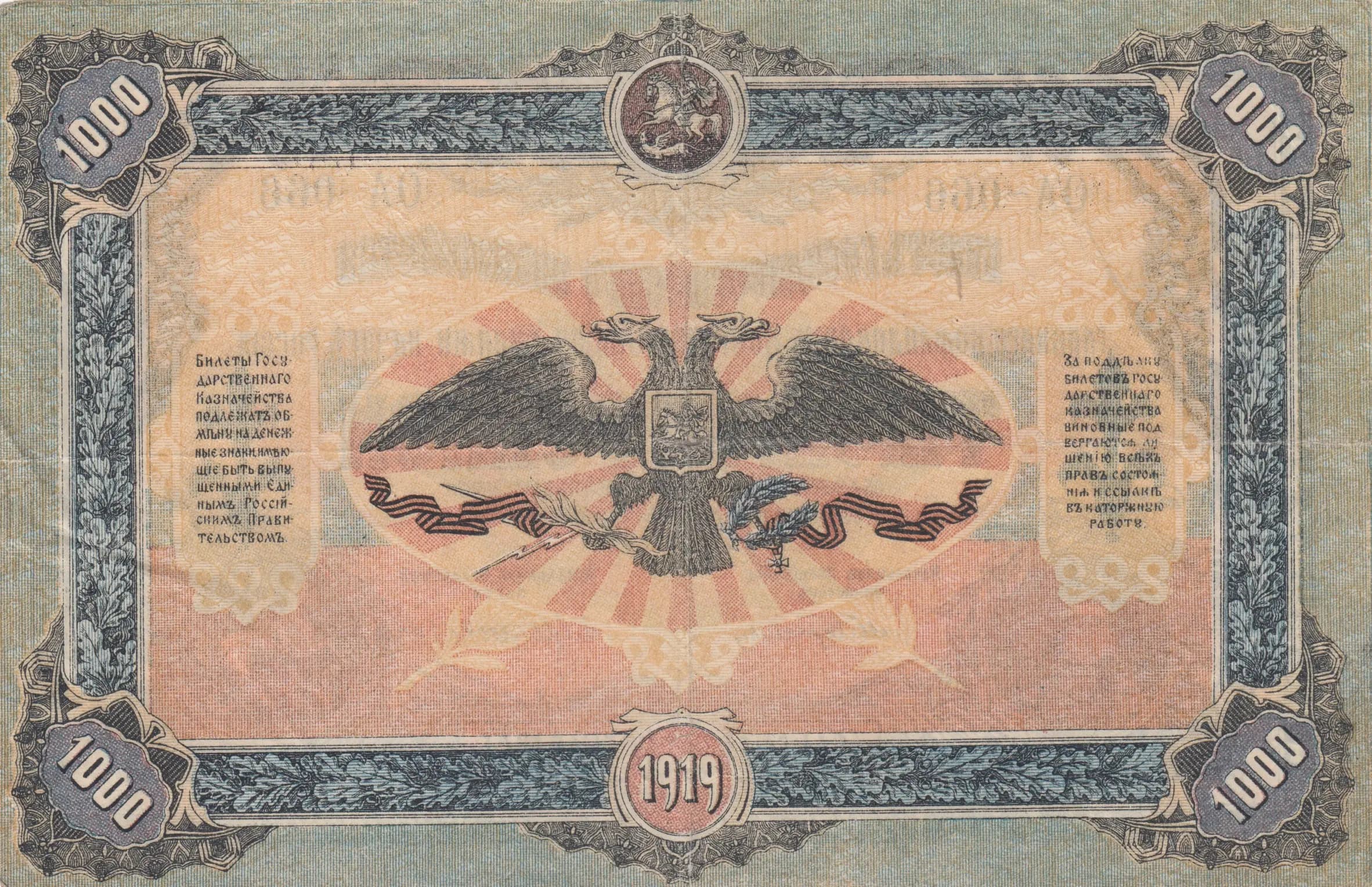
A handsome example of a 1000 ruble note issued by the White Army's South Russian government in 1919, graded VF and displaying the characteristic ornate design and patriotic symbolism of the Russian Civil War period. The note features an impressive peach and red color scheme with intricate engraved borders, dual oval medallions on the obverse, and a striking double-headed eagle sunburst design on the reverse. Despite its age, the note shows even coloring with well-preserved paper structure and minimal wear, making it a visually appealing collector specimen of this historically significant and short-lived issuing authority.
Uncommon. Notes from the South Russian government (1918-1920) are scarcer than mainstream Russian Imperial or early Soviet emissions due to the brief tenure of the White Army's territorial control and the post-civil war demonetization of these notes. However, the 1000 ruble denomination was issued in reasonable quantities during the period of circulation, and examples have survived. The VF condition grade is desirable but not extraordinary for an undestroyed specimen. These notes were not widely hoarded like Imperial-era currency, and surviving examples remain below the rarity threshold of truly scarce notes but are less commonly encountered than Soviet issues of similar vintage.
This note represents the monetary emergency of the Russian Civil War, issued by the High Command of the Armed Forces in South Russia—the White Army faction that controlled southern Russia from 1918-1920 before their defeat by the Bolsheviks. The iconography reflects the anti-Bolshevik ideology of the White movement, prominently featuring the Orthodox cross in a military ribbon motif on the obverse and the imperial double-headed eagle with radiating sunburst on the reverse, symbols asserting continuity with pre-revolutionary Russian legitimacy. These Treasury notes were necessity currency circulated across Don, Kuban, and Black Sea regions during the White Army's brief territorial control.
The obverse displays a formal, symmetrically balanced composition centered on the denomination and issuing authority text in decorative Cyrillic typeface. At the top, an ornamental military ribbon bow in red and black stripes frames an Orthodox cross in a central medallion, symbolizing the White Army's identification with Russian Orthodox legitimacy and imperial continuity. Two oval engraved vignettes flank the lower portion—the left featuring a male profile portrait (likely a historical Russian figure or military leader representative of the White cause) and the right containing an allegorical figure or secondary portrait, both rendered in fine engraving typical of 19th-century banknote security design. The entire composition is enclosed in an intricate geometric and floral border with laurel and grape cluster motifs. The reverse is dominated by a large imperial double-headed eagle with outstretched wings centered against a radiating pink and red sunburst, a potent symbol of pre-revolutionary Russian imperial authority. The eagle appears to hold heraldic symbols or shields in its talons. Ornate botanical borders run vertically along both sides with decorative cartouches in the corners. The denomination '1000' repeats in all four corners, and the date '1919' appears in a circular medallion at the bottom center. The color palette—peach/salmon, red, black, cream, and blue-gray framing elements—creates a visually distinctive appearance that reinforces the note's institutional and patriotic identity.
FRONT SIDE: 'ОА-066' (Serial number: OA-066); 'БИЛЕТ ГОСУДАРСТВЕННОГО КАЗНАЧЕЙСТВА' (State Treasury Bill); 'ИМУЩЕГО КОМАНДОВАНИЯ ВООРУЖЕННЫМИ СИЛАМИ НА ЮГЕ РОССИИ' (of the Command of Armed Forces in Southern Russia); 'ТЫСЯЧА РУБЛЕЙ' (One Thousand Rubles); 'ОБЩАЯ СУММА В ПРЕДЕЛАХ ВСЕЙ ПЛАТЕЖНОГО' (Total sum within entire payment); 'Начальник Управления' (Head of Administration); 'Начальник Кредитной Части' (Head of Credit Department); '1000 РУБЛЕЙ' (1000 Rubles). BACK SIDE: '1000' (denomination, appears in all four corners); '1919' (year of issue); 'Билеты Государственного казначейства выдаются на денежные знаки средства Российской республики' (State Treasury Bills are issued as monetary instruments of the Russian Republic); 'За всеми билетами государственного казначейства ответствуют' (All State Treasury Bills are guaranteed).
Intaglio engraving (steel/copper plate engraving), the standard security printing method for high-value banknotes of the era. The fine-line detail work visible in the borders, portraits, eagle design, and decorative elements, combined with the crisp impression quality evident in the visual analysis, are consistent with traditional intaglio production. The multi-color printing across obverse and reverse was likely achieved through separate engravings and multiple press passes. The printer for White Army South Russian notes was typically contracted through military administration rather than established banknote printers, reflecting the emergency and temporary nature of the issue.
Pick S424a represents the 1919 issue from the State Treasury of the High Command of Armed Forces in South Russia. The serial number observed is OA-066, indicating government/administrative issue stock. Known varieties for this issue include different serial number prefixes (representing different batches) and potential signature variations among the authority holders (Head of Administration and Head of Credit Department). The cataloging as 'S424a' (rather than 'a' alone) suggests Pick has identified this as a specific cataloged variety; the 'a' designation typically indicates the first recorded variety of this type. No overprints or date variations appear on the observed specimen.