10 nouveaux francs 1971 specimen
About This Note
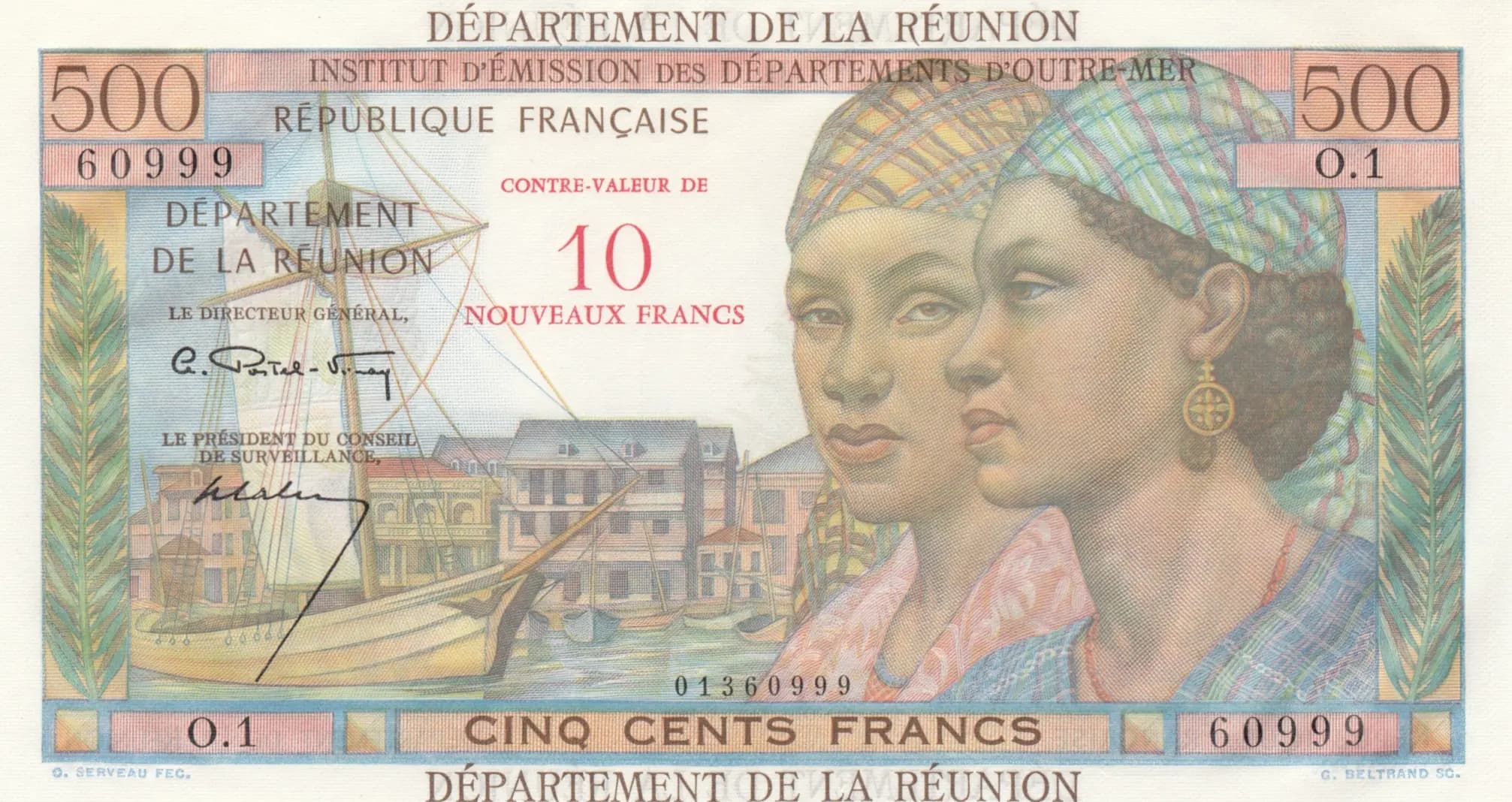
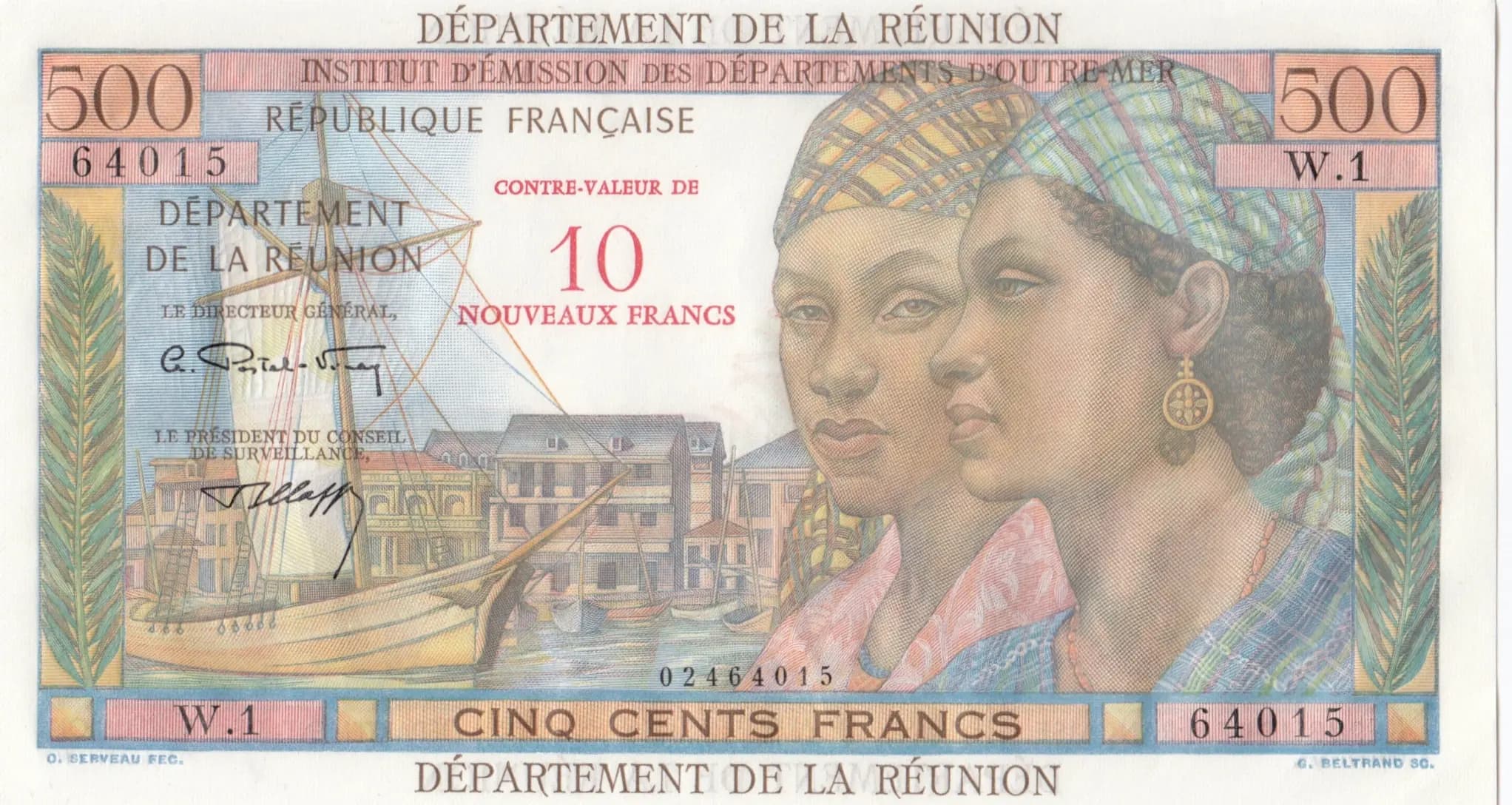
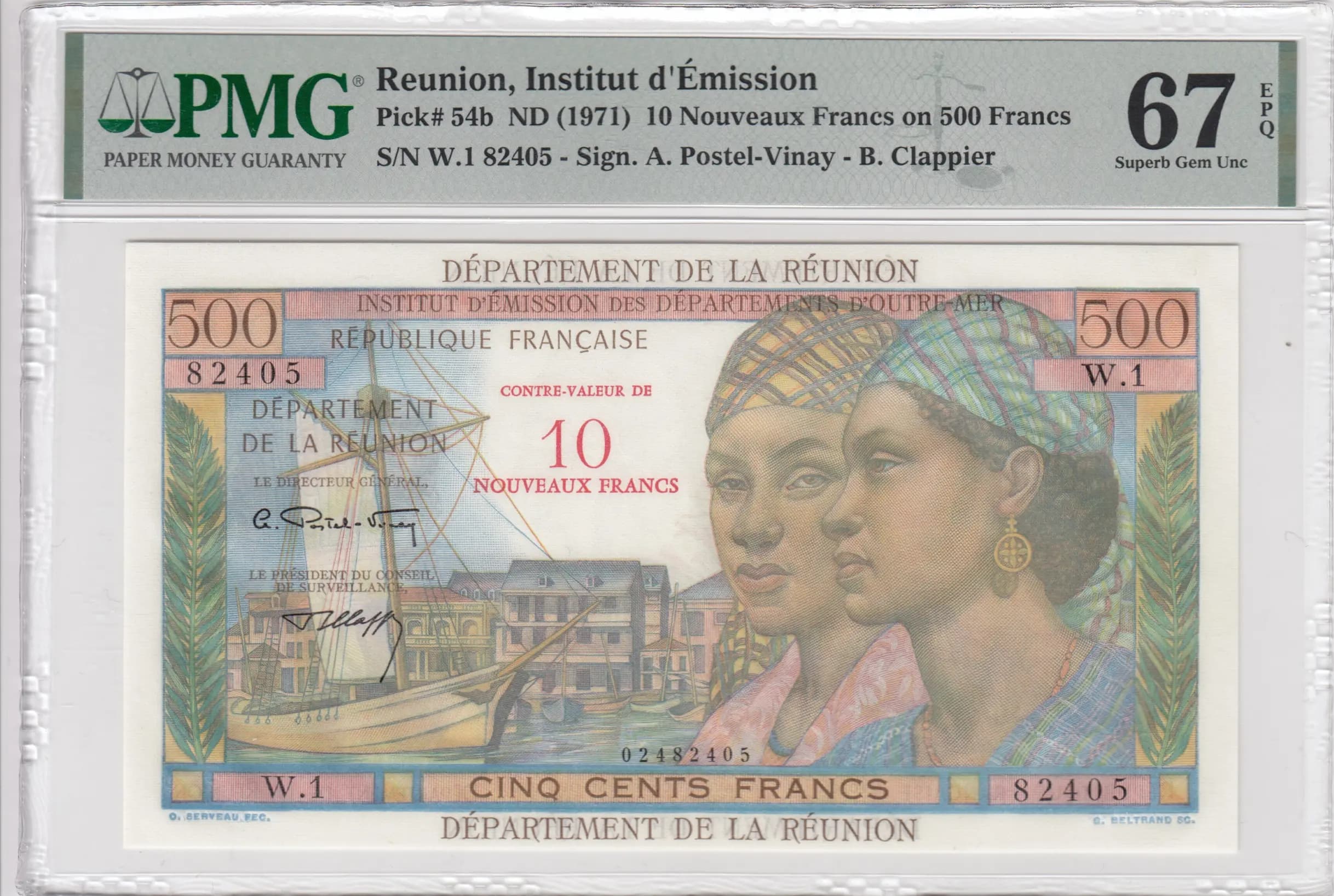
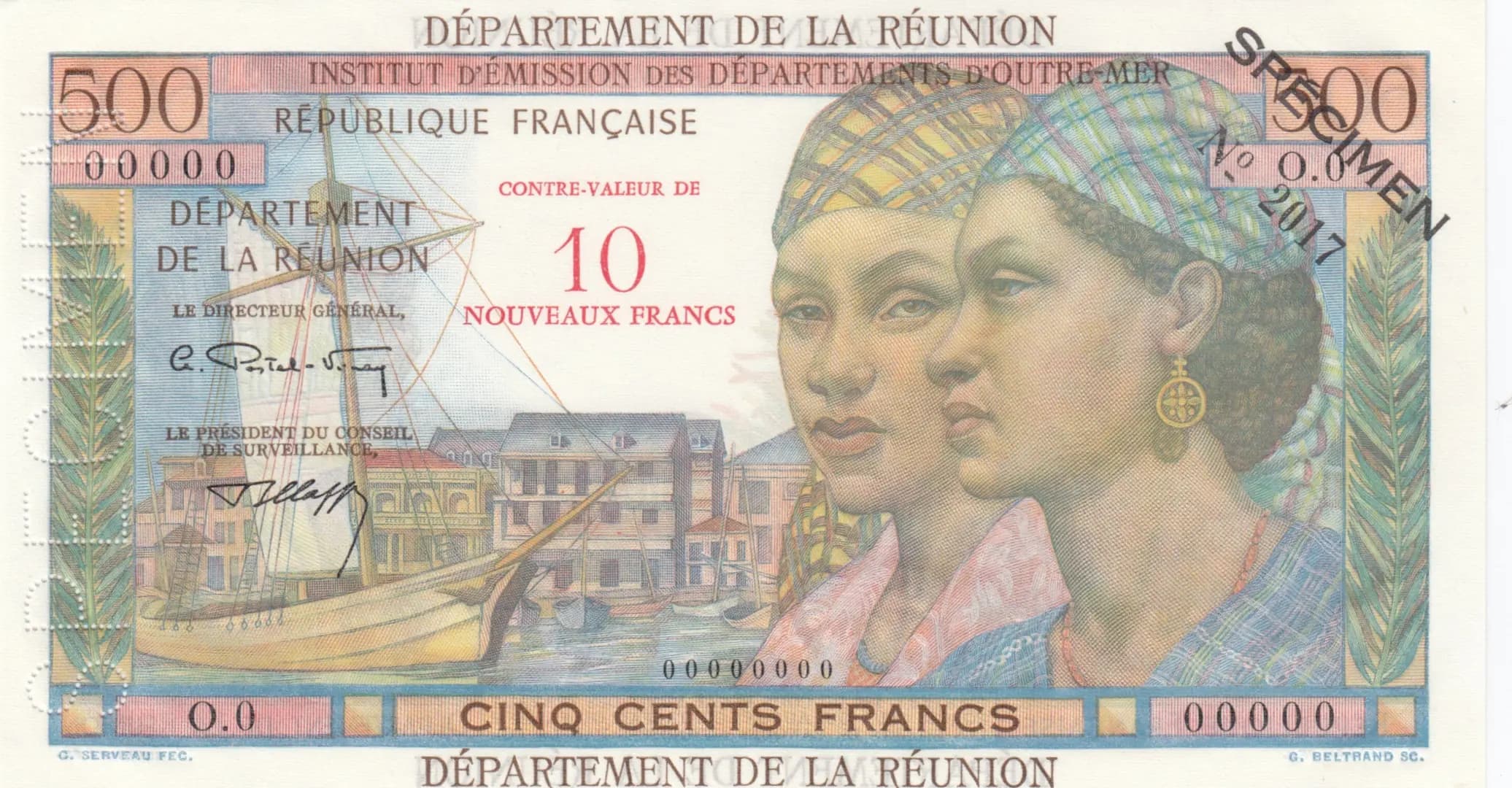
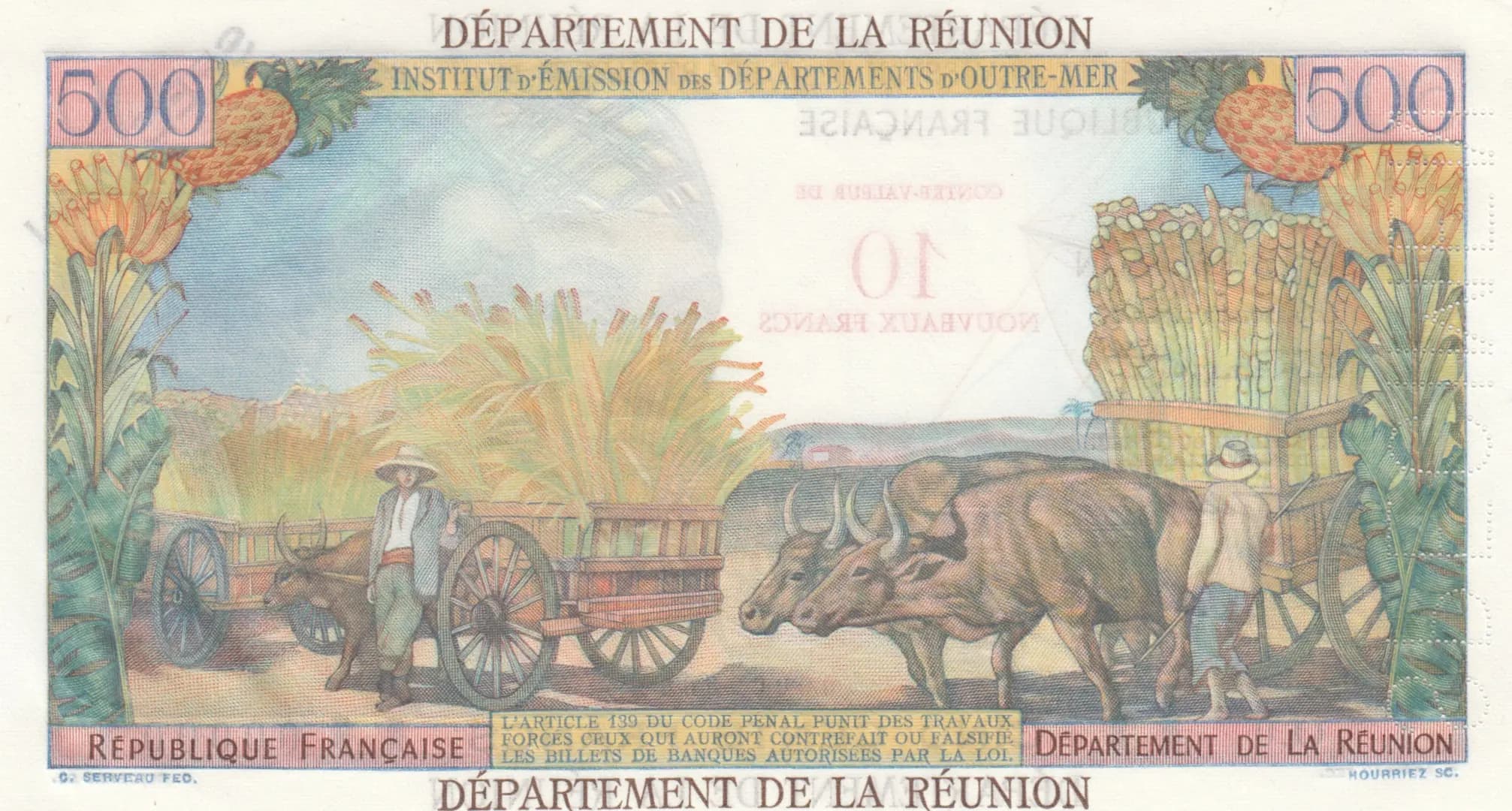
This is an uncirculated 1971 specimen note from Réunion issued by the Institut d'Émission des Départements d'Outre-Mer, featuring elegant classical engravings of two women in traditional dress on the obverse and a colonial-era agricultural scene with oxcart on the reverse. The note displays exceptional engraving detail with vibrant multi-color printing (pink, blue, green, tan, and gold), specimen markings, and placeholder serial numbers indicating this is a presentation or bank sample piece rather than currency released for circulation. Its pristine condition and specimen status make it a notable item for collectors of French colonial currency and overseas department banknotes.
Common. Specimen notes from the 1967-1971 production period of this series exist in quantities sufficient for collector acquisition, and the 10 nouveaux francs denomination was a standard circulating issue for Réunion. While specimen/presentation notes are less common than regular circulation issues, they were produced in reasonable quantities for distribution to banks, government officials, and collectors. The UNC condition grade is appropriate for a specimen note that never entered circulation, and such pieces regularly appear in the numismatic market at modest valuations.
This banknote represents Réunion's monetary system during the transition period of French overseas departments in the early 1970s, issued by the specialized Institut d'Émission des Départements d'Outre-Mer established to manage currency for French territories. The imagery reflects the department's colonial heritage and economic foundation: the obverse features women representative of Réunion's diverse population alongside a colonial sailing ship and period architecture, while the reverse depicts the ox-drawn cart and agricultural wealth (pineapples and sugarcane) that formed the backbone of the island's economy. The dual denomination (10 nouveaux francs = 500 old francs) reflects the 1960 French currency revaluation that created the 'nouveau franc'.
The obverse features two female portraits in left-facing profile, depicted in classical engraving style wearing patterned traditional headwraps and earrings, representing the Créole population of Réunion. The left background shows a colonial-era sailing ship with full rigging detail and multi-story colonial architecture with peaked roofs characteristic of 18th-19th century Indian Ocean colonial settlements. The design is framed by ornamental leaf and palm frond borders on both margins. The reverse depicts a detailed agricultural scene showing a man in colonial white clothing and hat standing beside an ox-drawn wooden cart laden with vegetation, flanked by pineapple plants bearing fruit on the left and tall sugarcane stalks on the right, all within a tropical flora ornamental border. The dual denominations are prominently displayed (10 nouveaux francs and 500 francs).
FRONT SIDE: 'Département de la Réunion' (Department of Réunion), 'Institut d'Émission des Départements d'Outre-Mer' (Institute for the Issuance of Overseas Departments), 'République Française' (French Republic), 'Le Directeur Général' (The Director General), 'Le Président du Conseil de Surveillance' (The President of the Surveillance Council), 'Contre-valeur de 10 Nouveaux Francs' (Face value of 10 New Francs), '500 Cinq Cents Francs' (500 Five Hundred Francs), 'G. Cerveau Fec.' (G. Cerveau engraved), 'G. Beltrand Sc.' (G. Beltrand sculpt). BACK SIDE: 'Département de la Réunion' (Department of Réunion), 'Institut d'Émission des Départements d'Outre-Mer' (Institute for the Issuance of Overseas Departments), 'République Française' (French Republic), 'L'Article 139 du Code Pénal punit des travaux forcés ceux qui auraient contrefait ou falsifié les billets de banques autorisées par la loi.' (Article 139 of the Penal Code punishes with forced labor those who would counterfeit or falsify banknotes authorized by law), 'O. Serriaux Fec.' (O. Serriaux engraved), 'Mourriet Sc.' (Mourriet sculpt).
Intaglio engraving on steel plates, characteristic of high-security banknote production. The fine detail work visible in the portraits, architectural elements, and agricultural scene indicates skilled hand-engraving by the credited artists (G. Cerveau, G. Beltrand, O. Serriaux, and Mourriet). Multi-color printing was achieved through sequential intaglio passes for the pink/coral, blue, green, tan, and yellow/gold color elements. This production method was standard for Banque de France and its overseas department issuing entities during the 1960s-1970s period.
This note is cataloged as Pick P-54bs, identified as a specimen note (indicated by the 's' suffix). The catalog records four variants of the base Pick number P-54: P-54a, P-54as, P-54b, and P-54bs, all bearing the denomination '10 Nouveaux Francs on 500 Francs.' The 'bs' designation indicates this is the specimen variety of the 'b' series. The placeholder serial numbers (00000 and 0000000) and specimen markings visible on the note confirm this classification. The note shows the characteristic features of IEDOM (Institut d'Émission des Départements d'Outre-Mer) specimens from the 1971 period.