6 francs 1930
About This Note
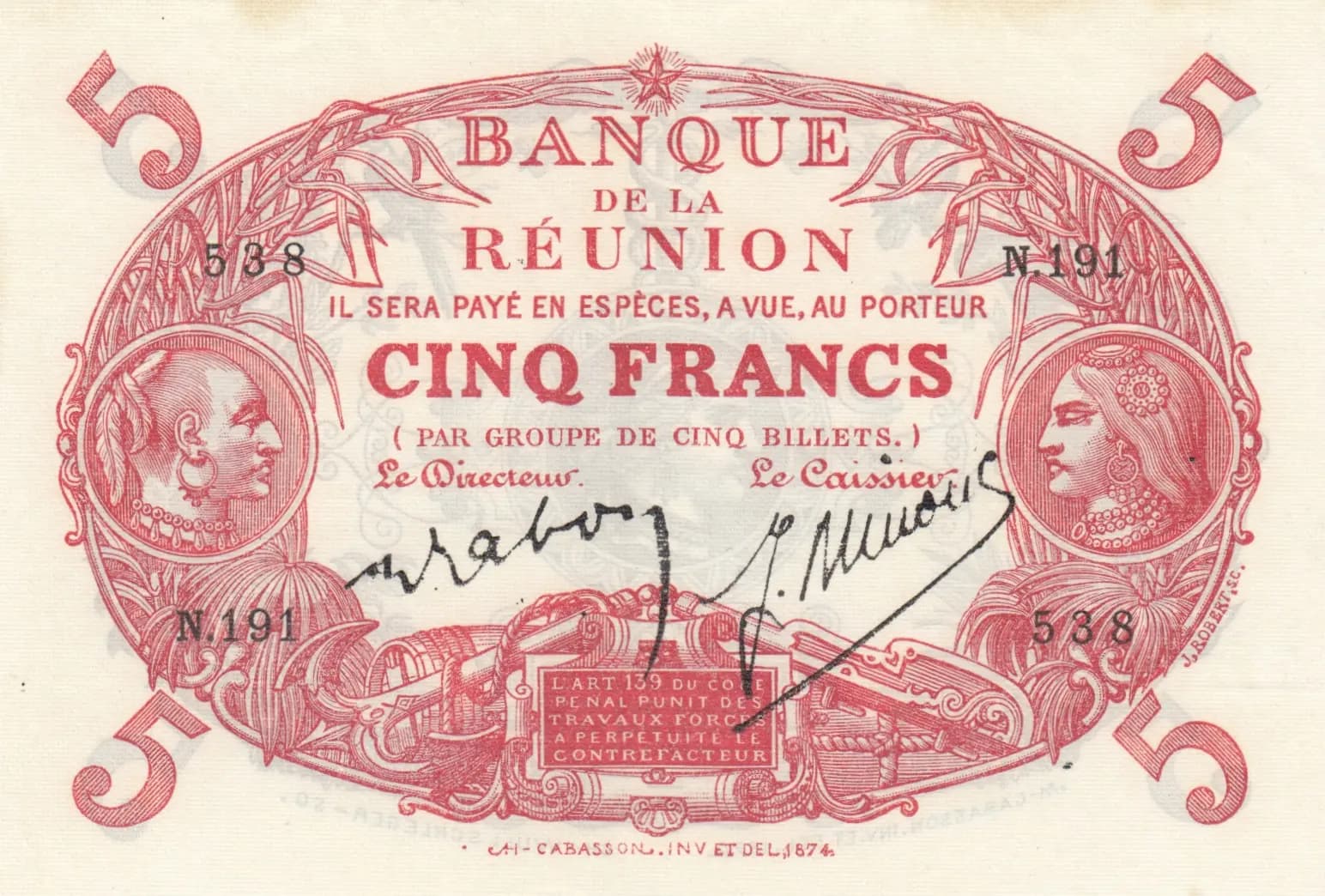
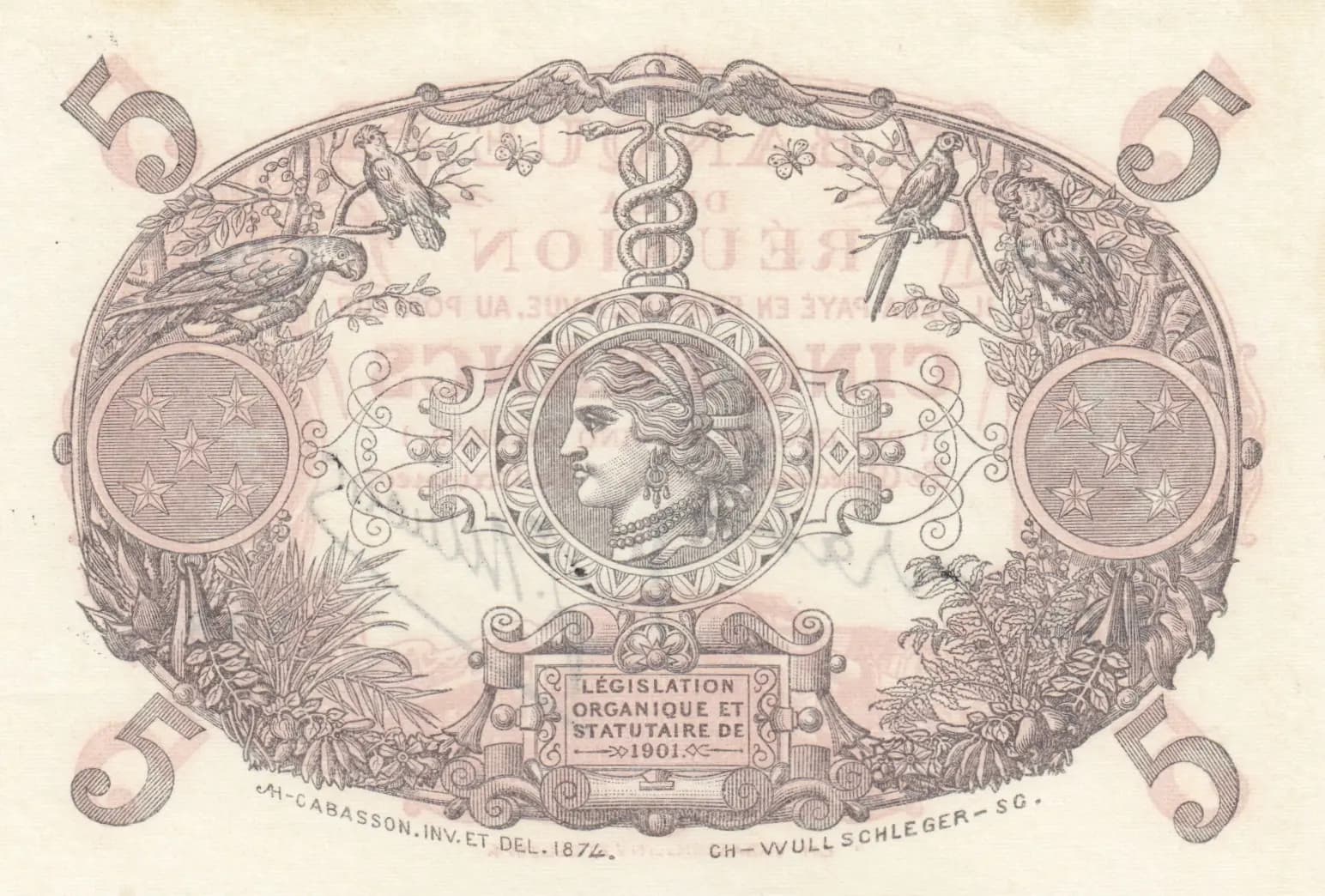
This is a 5 Francs banknote from Banque de la Réunion, cataloged as Pick P-14, issued under the 1901 legislation during the 1930-1944 period. The note displays classical engraving with two female portrait medallions on the obverse and a central female portrait on the reverse, surrounded by ornate botanical and decorative elements in red and gray tones. In AU condition, this note shows visible age patina and historical handling marks including handwritten notations, yet the fine engraving remains crisp and the paper structure is intact, making it an attractive example of French colonial currency from the interwar period.
Common. The 5 Francs denomination of Banque de la Réunion was issued in substantial quantities during the 1930-1944 period under the Pick P-14 designation. No evidence exists of a limited print run, early recall, or significant rarity for this issue. These notes remain relatively affordable in the collector market and are regularly encountered, particularly in mid-grade to fine condition.
The Banque de la Réunion issued this 5 Francs note under the organic and statutory legislation of 1901, reflecting the colonial administrative structure of the French Indian Ocean territory during the Third Republic. The classical allegorical female portraits and the caduceus symbol (Mercury's staff) on the reverse reference French republican iconography and the mercantile prosperity of the island colony. The engraving was designed by Ch. Cabasson in 1874 and engraved by Ch. Wullschleger, representing the high-quality security printing standards maintained for colonial French currency throughout the early 20th century.
The obverse features two classical female allegorical portrait medallions positioned symmetrically on the left and right sides, each within ornate circular frames adorned with jewelry and laurel wreaths, symbolizing prosperity and classical virtue. The reverse presents a central female portrait medallion—likely representing Liberty or Commerce—crowned by a caduceus (Mercury's winged staff entwined with serpents), flanked by eagle or bird motifs in the upper portions and flowering botanical designs at the base. The note is framed by intricate ornamental scrollwork and filigree patterns in red on the obverse and gray/black on the reverse, with the denomination '5' repeated in corners. The overall design reflects the belle époque aesthetic favored in French currency design, combining republican symbolism with colonial French identity.
OBVERSE: 'BANQUE DE LA RÉUNION' (Bank of Reunion); 'CINQ FRANCS' (Five Francs); 'IL SERA PAYÉ EN ESPÈCES, A VUE, AU PORTEUR' (It will be paid in cash, on demand, to the bearer); 'PAR GROUPE DE CINQ BILLETS' (By group of five bills); 'Le Directeur' (The Director); 'Le Caissier' (The Cashier); 'L'ART 139 DU CODE PÉNAL PUNIT DES TRAVAUX FORCÉS A PERPÉTUITÉ LE CONTREFACTEUR' (Article 139 of the Penal Code punishes counterfeiting with forced labor for life); 'CH. CABASSON. INV ET DEL. 1874' (Ch. Cabasson, inventor and designer, 1874). REVERSE: 'LÉGISLATION ORGANIQUE ET STATUTAIRE DE 1901' (Organic and Statutory Legislation of 1901); 'CH. CABASSON. INV. ET DEL. 1874' (Ch. Cabasson, inventor and designer, 1874); 'CH. WULLSCHLEGER - SG.' (Ch. Wullschleger - engraver).
This banknote was produced using intaglio (copperplate) engraving, evident from the fine line work, detailed botanical patterns, and crisp portrait rendering visible throughout both sides. The security features rely on the complexity and difficulty of reproducing the intricate engraving rather than on modern security devices. The work of engraver Ch. Wullschleger demonstrates the high standards of the Banque de la Réunion's security printing, likely executed by a specialized French security printer such as Banque de France's printing division or a licensed private security printer.
The observed serial number notation 'N°191' and the plate/printing mark '5/38' indicate this is from a routine printing run. The handwritten signatures for 'Le Directeur' (Director) and 'Le Caissier' (Cashier) are period-typical authorization marks. No overprints or significant varieties are apparent in this example. This represents a standard circulation issue of the Pick P-14 type with no notable variety characteristics.