10 nouveaux francs 1967
About This Note
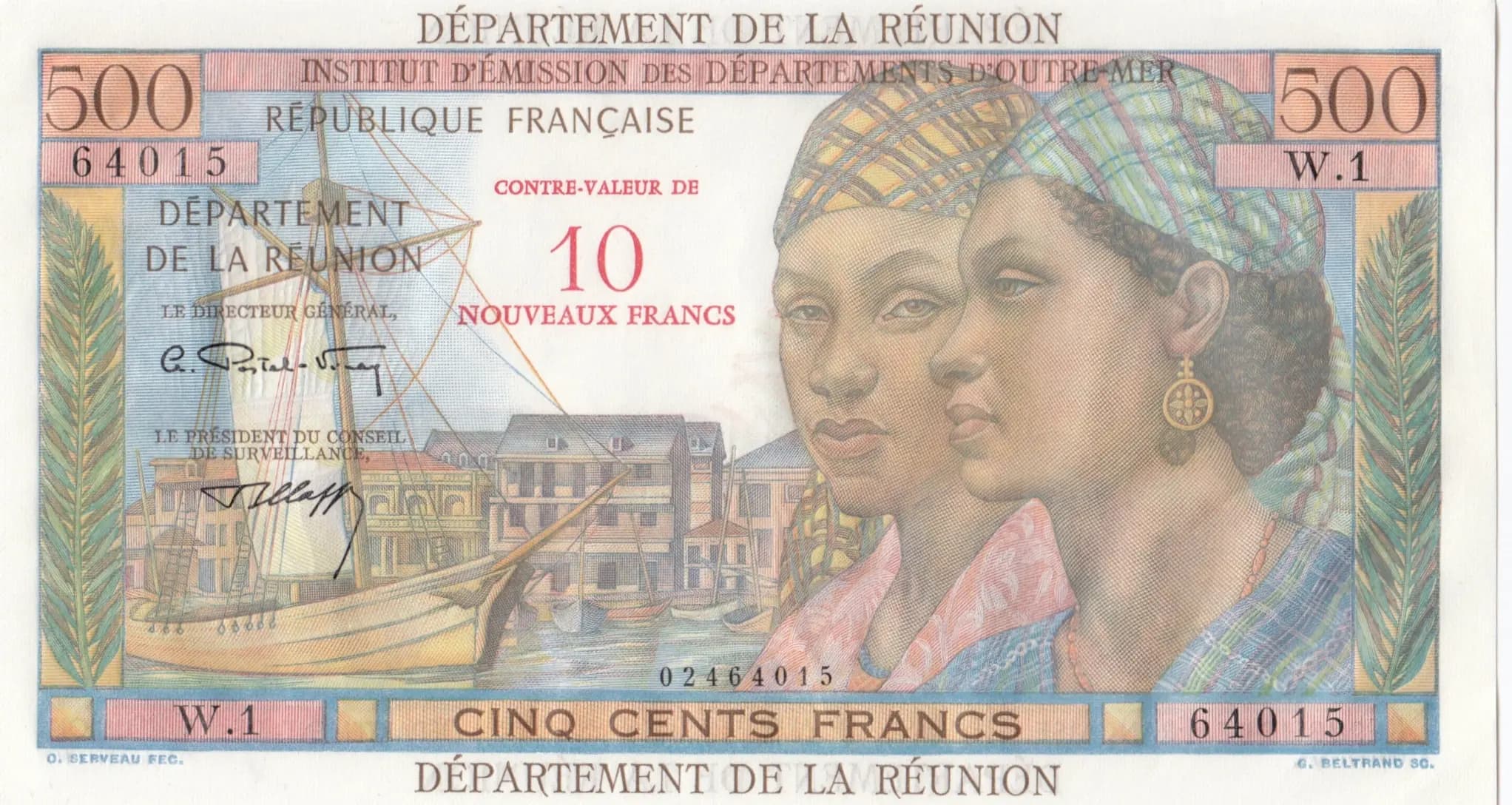
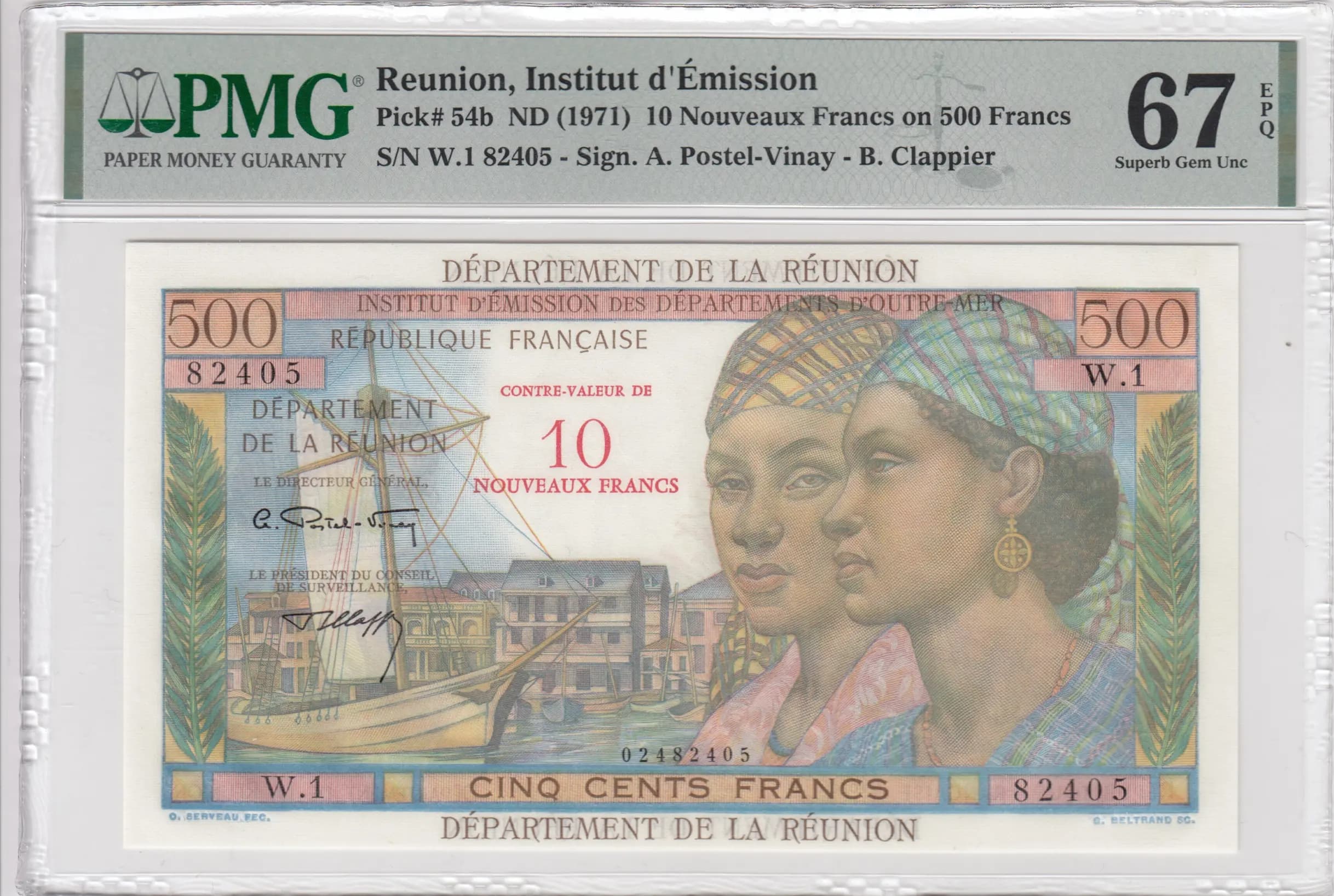
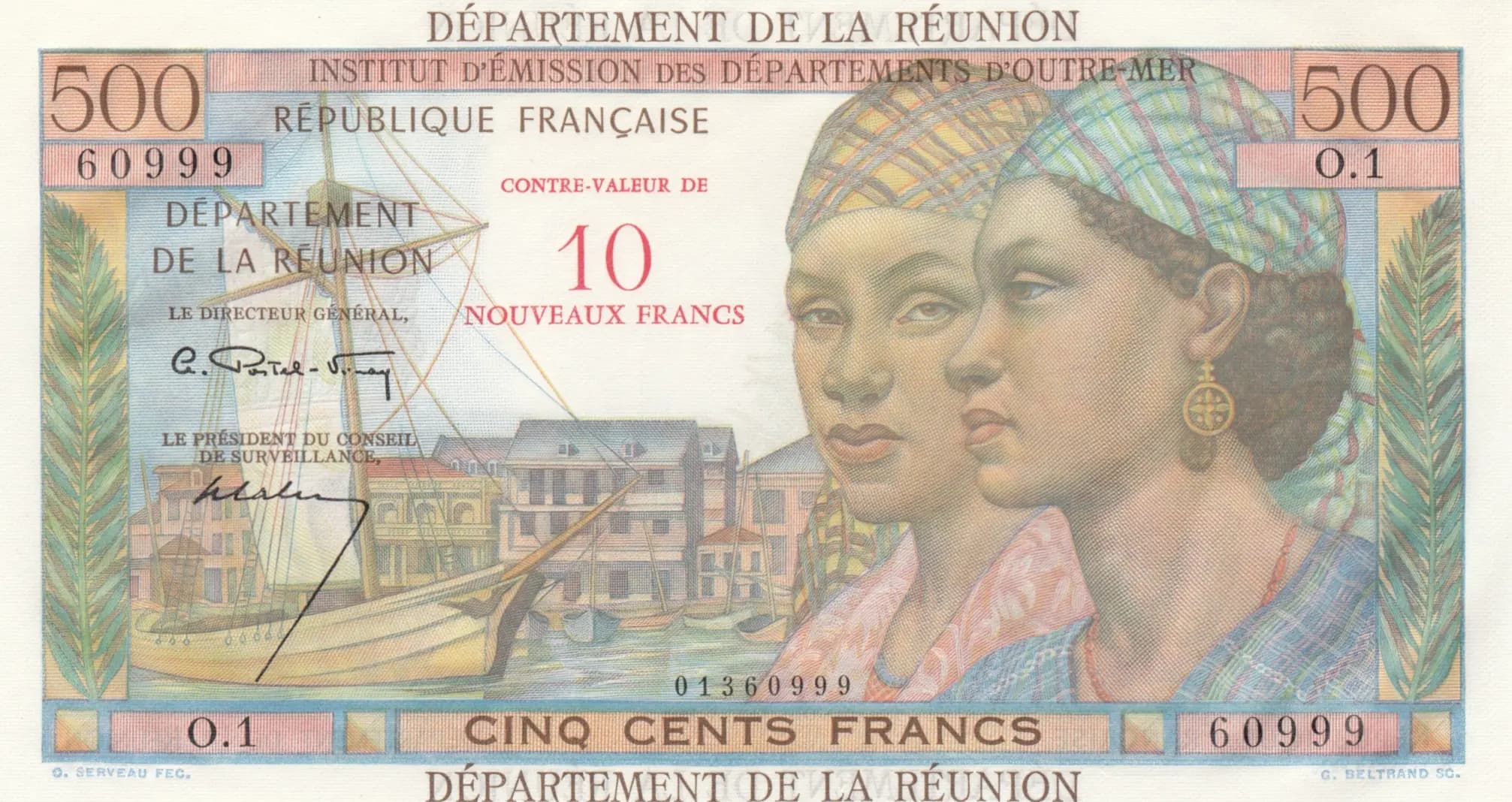
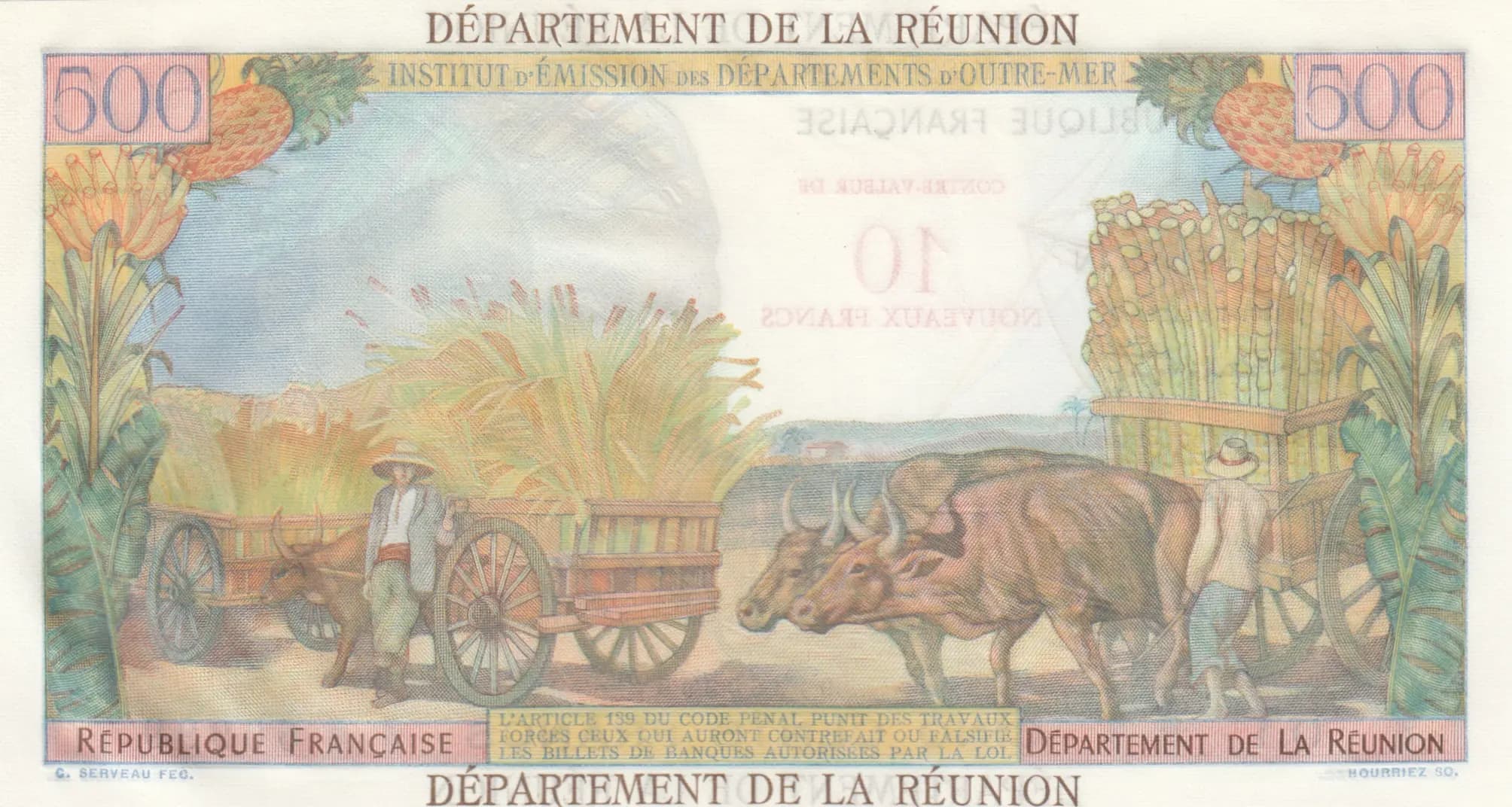
This is a Reunion 10 Nouveaux Francs note from 1967, issued by the Institut d'Emission des Départements d'Outre-Mer and graded UNC. The note features vibrant colonial-era imagery with two women in traditional dress on the obverse and an ox-cart agricultural scene on the reverse, reflecting Reunion's cultural heritage. Despite the catalog grade of UNC, the visible handwritten signatures and slight aging of the paper suggest this note has seen light circulation, making it an authentic example of this French Overseas Department currency.
Common. The 10 Nouveaux Francs on 500 Francs from Reunion (Pick 54a) represents a standard circulation issue from a major French overseas department with substantial print runs during 1967-1971. No evidence of limited mintage, early recall, or collector scarcity exists for this Pick number. Notes of this type remain readily available in the numismatic market at modest valuations typical of mid-20th century French overseas currency.
Issued during the period of French economic reforms in 1967, this note represents the 'nouveaux francs' currency system introduced in 1960 to modernize French monetary circulation. The imagery—colonial port architecture, sailing vessels, and traditional ox-carts—commemorates Reunion's plantation economy and multicultural history as a French overseas department. The dual denomination display (10 Nouveaux Francs/500 Francs) reflects the transitional nature of the currency conversion, maintaining reference to the pre-1960 franc system for continuity.
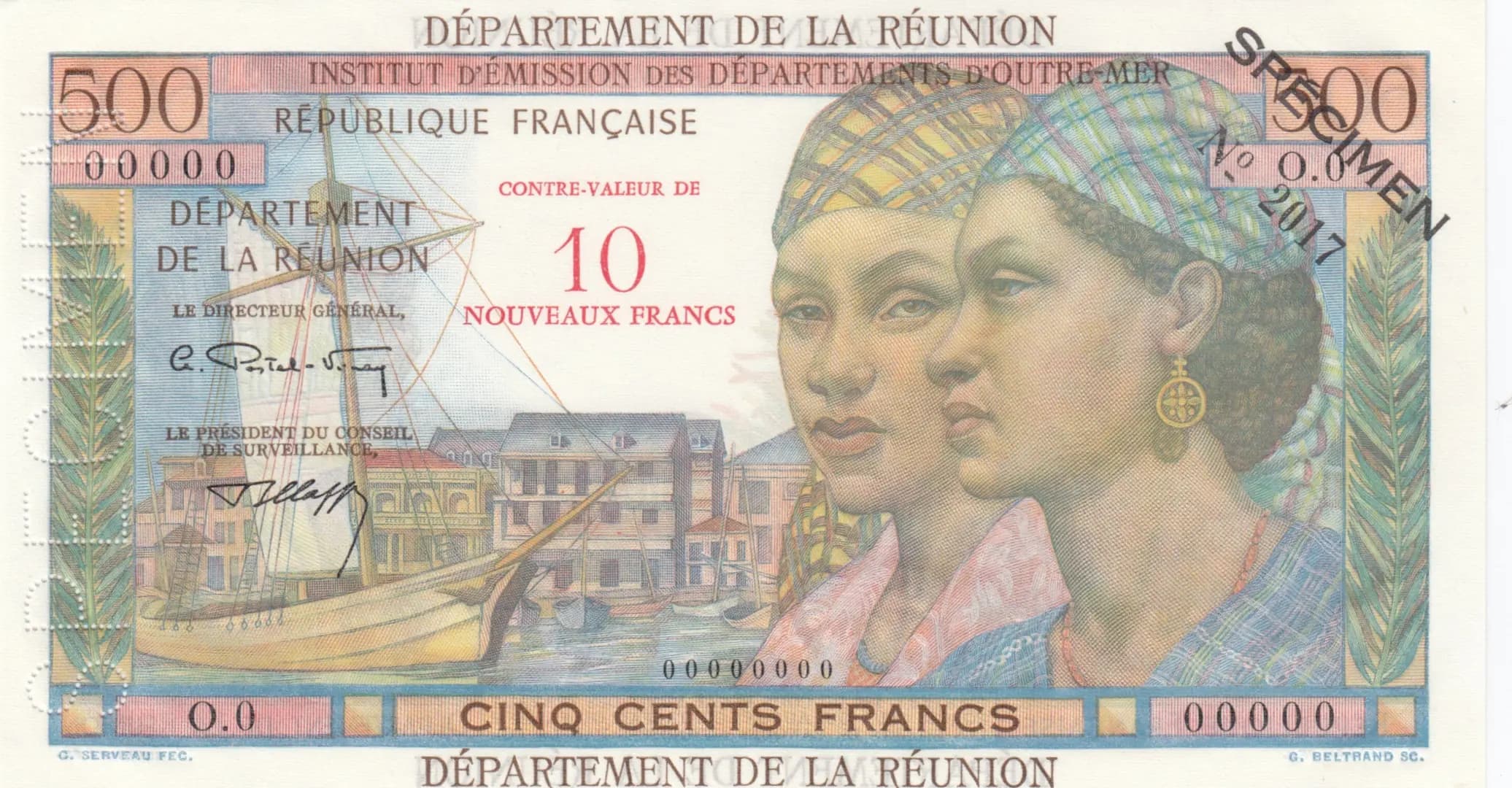
The obverse features two female portrait heads in profile facing right, wearing decorative head wraps with patterned textiles typical of Creole and African-influenced dress of Reunion. Behind the portraits is a colonial-era port scene with a sailing vessel with fully rigged masts and multi-story colonial architecture in the background, evoking Reunion's maritime and commercial heritage during the plantation era. The reverse depicts a man in colonial-period clothing standing with a wooden ox-cart pulled by two oxen, set against a tropical landscape with tall palm trees and distant mountains, symbolizing the agricultural foundation of the island's economy. Both sides feature ornamental borders with geometric patterns in pink/salmon and blue, complemented by botanical motifs including pineapple designs in the upper corners and palm fronds throughout, reinforcing the tropical, agricultural character of the island. The color palette of cream, pink, light blue, green, brown, tan, and gold reflects period chromatic standards for French Overseas Department currency.
FRONT SIDE: 'Département de la Réunion' (Department of Reunion); 'Institut d'Emission des Départements d'Outre-Mer' (Institute of Emission of Overseas Departments); 'République Française' (French Republic); 'Contre-valeur de 10 Nouveaux Francs' (Counter-value of 10 New Francs); 'Département de la Réunion' (Department of Reunion); 'Le Directeur Général' (The Director General); 'Le Président du Conseil de Surveillance' (The President of the Supervisory Board); 'Cinco Cents Francs' (Five Hundred Francs); 'O. Serveau fec.' (O. Serveau engraved); 'C. Beltrand sc.' (C. Beltrand sculpted). BACK SIDE: 'Département de la Réunion' (Department of Reunion); 'Institut d'Emission des Départements d'Outre-Mer' (Institute of Emission of Overseas Departments); 'République Française' (French Republic); 'Département de la Réunion' (Department of Reunion); 'L'article 139 du Code Pénal punit des travaux forcés ceux qui auraient contrefait ou falsifié cette banque ou ses billets' (Article 139 of the Penal Code punishes with forced labor those who would have counterfeited or forged this bank or its notes); 'O. Serveau fec.' (O. Serveau engraved); 'Bourriez sc.' (Bourriez sculpted).
This note was produced using fine-line intaglio engraving, as evidenced by the detailed line work visible throughout the design, the sculptural quality of the portraits, and the intricate decorative borders. The engravers are credited as O. Serveau (fec. = engraved) with C. Beltrand (sc. = sculpted) on the obverse and Bourriez (sc. = sculpted) on the reverse. The production is consistent with Banque de France and Institut d'Emission standards for overseas department currencies of the 1960s, utilizing traditional metal plate engraving with multi-color printing to achieve the layered color effects observed.
This note is cataloged as Pick 54a, one of four variants documented by PMG for the 10 Nouveaux Francs on 500 Francs base number (54a, 54as, 54b, 54bs). The visual analysis shows serial numbers O.1 and 01360999, indicating this is likely an early printing. The 'a' designation (versus 'b') typically distinguishes earlier signature combinations or printing dates within the series. The note does not appear to be a specimen or special issue variant (no 'S' suffix present), representing a standard circulation issue.